2000 vs 2500 PSI Pressure Washer: Which One Should You Buy?
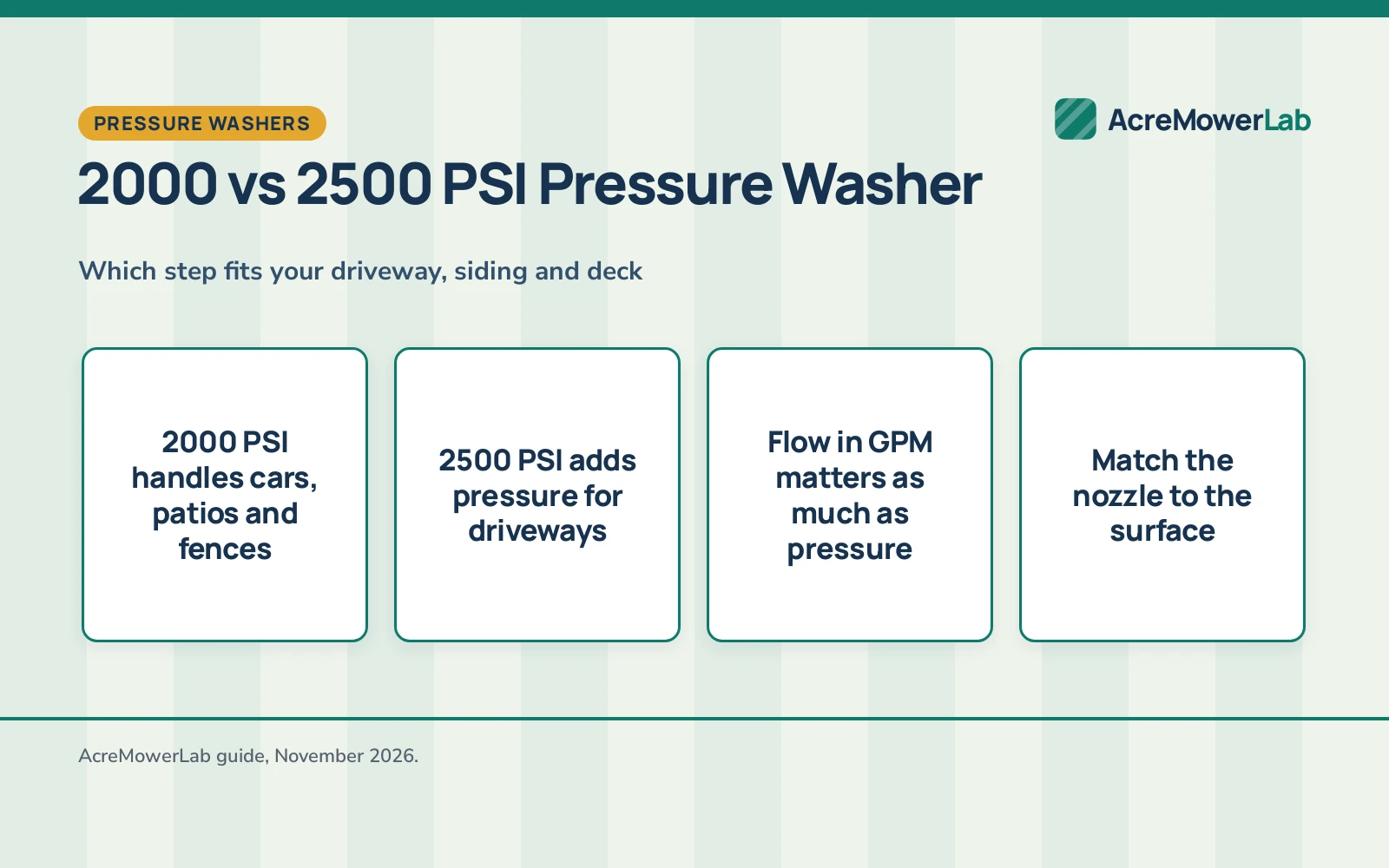
A 2000 PSI washer handles cars, patios and fences, while the 2500 PSI step adds pressure for driveways and siding, and flow matters as much as pressure.

On this page
Top picks at a glance
As an Amazon Associate I earn from qualifying purchases.
- 1
 VEVOR Electric Pressure Washer9.5/10View on Amazon
- 2
 Giraffe Tools G20 Wall Mount Electric Pressure Washer9.5/10View on Amazon
- 3
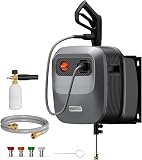 Giraffe Tools G20 Wall Mounted Pressure Washer9.5/10View on Amazon
- 4
 Greenworks 2400 PSIView on Amazon
- 5
 Sun Joe Pressure WasherView on Amazon
- 6
 Greenworks 1600 PSIView on Amazon
- 7
 CRAFTSMAN Electric Pressure WasherView on Amazon
- 8
 Briggs & Stratton 20680 Electric Pressure WasherView on Amazon
- 9
 Greenworks 2000 PSIView on Amazon
For most driveways, patios and siding, a 2000 vs 2500 psi pressure washer is a close call: the 2000 PSI step handles cars, patios, fences and decks, while the 2500 PSI step adds pressure for concrete and driveways, and flow in GPM matters as much as either number. This guide compares the two steps by pressure, flow, nozzles and power, then shows the electric washers that sit on either side of the line.
Other machines to compare
 Greenworks 2400 PSICheck price on Amazon
 Sun Joe Pressure WasherCheck price on Amazon
 Greenworks 1600 PSICheck price on Amazon
 CRAFTSMAN Electric Pressure WasherCheck price on Amazon
 Briggs & Stratton 20680 Electric Pressure WasherCheck price on Amazon
 Greenworks 2000 PSICheck price on Amazon
AcreMowerLab earns a commission when you shop through links here. It never changes your price. Affiliate disclosure.
2000 vs 2500 psi pressure washer: what changes between the steps
Pressure is only half the story. A 2000 PSI washer with 1.65 GPM, like the VEVOR here, can rinse faster than a 2400 PSI washer with 1.2 GPM, like the Greenworks 2400, because flow moves dirt off the surface once pressure has loosened it. The Greenworks 2700 runs up to 2.3 GPM, with flow from 1.2 GPM to 2.3 GPM across its nozzles, and the IvyBess claims 4.0 GPM at a stated 5000 PSI. Read the GPM beside the PSI before choosing a step.
| Washer | Best for | Limit |
|---|---|---|
| VEVOR 2000 PSI, 1.65 GPM | Cars, patios, fences, decks and driveways | Lowest pressure here; 3-hour session limit stated |
| Greenworks 2400 PSI, 1.2 GPM | Driveways, patios, sidewalks, decks, siding and vehicles | Lowest maximum flow here at 1.2 GPM |
| Greenworks 2700 PSI, 2.3 GPM | Heavier cleaning with the highest flow of the Greenworks pair | Heaviest stated weight here |
| IvyBess 5000 PSI claim, 4.0 GPM | Widest stated figures on paper | 2000W motor behind the 5000 PSI claim |
Read the flow, not just the pressure
Flow is measured in GPM, and the washers here span 1.2 GPM to a claimed 4.0 GPM. The Greenworks 2700 lists GPM from 1.2 GPM to 2.3 GPM with its included nozzles, and the maker claims its JETTFLOW technology delivers up to 50% more flow for higher areas and quick power rinsing. The VEVOR lists 1.65 GPM from a 1500W motor, and the Greenworks 2400 lists 1.2 GPM. The IvyBess claims 4.0 GPM from a 2000W motor at a stated 5000 PSI, a figure that sits well above the rest of the group. A higher GPM rinses a wide driveway faster. For cars and siding, the nozzle sets the spray pattern, not the flow figure, since flow volume on its own does not make the spray gentler.
Match the nozzle to the surface
Nozzles set the fan angle, and the listings that name a use for each tip agree on the pattern. The 0 degree tip is for tough stains and hard-to-reach areas, the 15 degree tip is for concrete and driveway cleaning, the 25 degree tip is for general cleaning on patios and decks and for coated surfaces, wood siding and fences, and the 40 degree tip is for windows and screens, with a soap nozzle for detergent. The Greenworks 2400 promises 5 interchangeable nozzles, but the listing names them two ways: one passage lists 0, 15 and 25 degree tips plus turbo and soap nozzles, while another lists 15, 25 and 40 degree tips plus soap and turbo, so the 0 and 40 degree tips do not both fit the five-nozzle count. The VEVOR includes 4 quick-connect metal nozzles at 0, 15, 25 and 40 degrees with a 500 ml detergent bottle. The IvyBess heading promises 4 nozzles while the list names 0, 15, 25, 40 degree and soap tips, so that list names one more tip than the heading claims. See the rotary vs turbo nozzle pressure washer guide for the turbo choice.
The gear: electric washers on either side of the line
The Greenworks 2400 sits closest to the 2500 PSI step, at 2400 PSI and 1.2 GPM, and it is the washer with the lowest weight here at 19.0 lb. It carries a built-in detergent tank, on-board nozzle storage, a 35 ft GFCI-protected power cord and a 25-ft steel braided hose, plus a self-primed siphon hose that draws water from a standing water source or tank. One wrinkle: the bullets claim complete portable power with no electrical cords while also listing the 35 ft GFCI power cord, so read it as a corded washer with a long cord.
The Greenworks 2700 is the strongest Greenworks here, at 2700 PSI with flow from 1.2 GPM to 2.3 GPM, a TruBrushless motor and a heavy duty cast aluminum axial cam pump. Push-button start powers it up, and the maker claims its TruBrushless motor delivers up to 2x the cleaning power compared to leading competitors, while JETTFLOW delivers up to 50% more flow. It carries the heaviest stated weight here, and its dimensions run 18.98 by 35.43 by 22.95 in.
The VEVOR is the 2000 PSI step itself, at 2000 PSI and 1.65 GPM from a 1500W motor, with ETL certification, a foam cannon and 4 nozzles. Its total stop system shuts off the pump when the trigger is not engaged, and a press-type lock keeps the spray gun from engaging by accident. One wrinkle: the title lists a 20 ft hose while the bullets list a 30 ft hose, so confirm the hose length before buying. The listing also recommends not using it for over 3 hrs at a time, and the pump stops automatically when temperatures reach over 105 degrees Celsius.
The IvyBess claims the widest figures here, at a stated 5000 PSI and 4.0 GPM from a 2000W motor, with a 33 ft hose, a safety automatic total stop system, a spray gun safety lock, an IPX5 code and a GFCI plug. It has 2 sturdy wheels and an ergonomic telescopic rod, and a 2 year warranty is stated. Worth noting: the 5000 PSI and 4.0 GPM figures sit far above the 2000W motor behind them, and the heading promises 4 nozzles while the list names 0, 15, 25, 40 degree and soap tips. Water inlet temperature is stated at a max of 104 degrees Fahrenheit.
Power and safety on the property
Every washer here is electric, so there is no fuel to store and no exhaust to manage. The Greenworks 2400 has a 35 ft GFCI-protected power cord, the IvyBess has a GFCI plug, and the VEVOR is ETL certified. The IvyBess and VEVOR each have a total stop system that shuts off the pump when the trigger is not engaged, and each has a safety lock on the spray gun. Keep cords dry and clear of the spray, and plug into a GFCI outlet where the listing calls for one.
Safety
Never point a pressure washer at people or animals, and keep children and pets out of the work area. Wear eye protection and sturdy shoes, and clear sticks and stones before you spray. The IvyBess and VEVOR spray guns have a safety lock; use it whenever the gun is set down. Gas units run outdoors only; every washer here is electric. See the Safety Disclaimer.
FAQ: mowing large lots
Is 2000 PSI enough for a driveway?
The VEVOR at 2000 PSI lists driveways among its ideal uses, and the 15 degree tip is for concrete and driveway cleaning. A 2400 or 2700 PSI step gives more pressure for concrete, and flow in GPM matters too.
What does GPM change?
GPM is flow: the washers here span 1.2 GPM to a claimed 4.0 GPM. Higher flow rinses a wide area faster; for cars and siding, the nozzle sets the spray pattern, and a low flow figure on its own does not make the spray gentler.
Which nozzles fit each surface?
The 0 degree tip is for tough stains, 15 degrees for concrete, 25 degrees for patios, decks and siding, 40 degrees for windows and screens, and a soap nozzle for detergent.
Can a pressure washer run from a tank?
The Greenworks 2400 includes a self-primed siphon hose that draws water from a standing water source or a tank, or connects to a garden hose.
How long can the VEVOR run at a time?
The listing recommends not using it for over 3 hrs at a time.
More mowing guides
- Best Small Pressure Washer (2026): 5 Picks Compared
- Brushless vs Brushed Pressure Washer: Which One Should You Buy?
- Portable vs Trailer Pressure Washer: Which One Should You Buy?
- Ceramic vs Triplex Pump Pressure Washer: Which One Should You Buy?
Use the Mower Matcher to narrow down choices by acreage, terrain, budget, and power type.