Two Wheel vs Four Wheel Garden Cart: Which One Should You Buy?
A direct comparison of wheel count for garden carts, covering steering, stability, beds, tires and dumping, with four listed carts ranked by stated capacity and features.

On this page
Top picks at a glance
As an Amazon Associate I earn from qualifying purchases.
- 1
 DWAEEGG Pre-Installed Two-Layer Spike Aerator Shoes with9.6/10View on Amazon
- 2
 VEVOR 900 lbs Steel Garden Cart on Wheels9.7/10View on Amazon
- 3
 Maxsa Dual-Wheel Garden Cart with Built-in Stand9.7/10View on Amazon
- 4
 Gorilla Carts 1000 lb Heavy Duty Steel Garden Utility WagonView on Amazon
- 5
 Backyard Expressions Garden Cart and Utility WagonView on Amazon
- 6
 400 Lbs Steel Garden CartView on Amazon
- 7
 Gorilla Carts Steel Garden CartView on Amazon
- 8
 Strongway Garden CartView on Amazon
- 9
 Sekey Garden Dump CartView on Amazon
Hauling soil, mulch, firewood and tools across a yard turns into slow work when the cart fights the ground. The answer in two wheel vs four wheel garden cart terms is straightforward: a two-wheel cart turns tighter through gates and beds, while a four-wheel cart stays level under a full load. Wheel count sets steering and stability, and the dumping system sets how the load comes out, so the right choice follows the load and the ground, not the cart that looks largest.
Other machines to compare
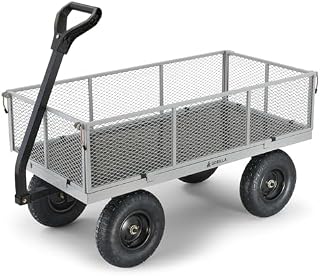 Gorilla Carts 1000 lb Heavy Duty Steel Garden Utility WagonCheck price on Amazon
 Backyard Expressions Garden Cart and Utility WagonCheck price on Amazon
 400 Lbs Steel Garden CartCheck price on Amazon
 Gorilla Carts Steel Garden CartCheck price on Amazon
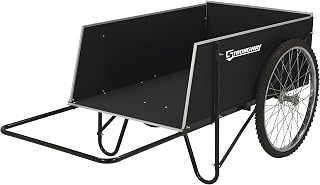 Strongway Garden CartCheck price on Amazon
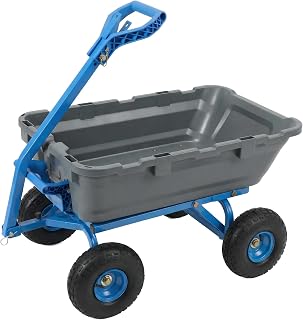 Sekey Garden Dump CartCheck price on Amazon
AcreMowerLab earns a commission when you shop through links here. It never changes your price. Affiliate disclosure.
two wheel vs four wheel garden cart: how wheel count changes hauling
A two-wheel cart pivots on its axle, which helps in beds, along fences and through gates where a longer cart cannot swing around. A four-wheel cart spreads the load across a wider base, which helps when the bed is full and the ground is uneven. The trade is simple: tighter steering on one side, steadier carrying on the other. Neither setup fixes a cart that is loaded past its stated capacity, so capacity stays the first check after wheel count.
| Wheel setup | Steering | Stability | Limit |
|---|---|---|---|
| Two wheels | Tighter turns in beds and through gates | Load needs balance when lifted | Balance matters on uneven ground |
| Four wheels | Wider turns, steadier tracking | Load stays level at rest and in motion | Needs more room to turn |
The gear in this guide, ranked by stated capacity
The four carts below are ranked by stated hauling capacity, highest first, with stated bed, tire, dumping and handle features deciding the order where capacities match. The ranking uses only figures the listings state.
| Cart | Stated capacity | Bed | Tires |
|---|---|---|---|
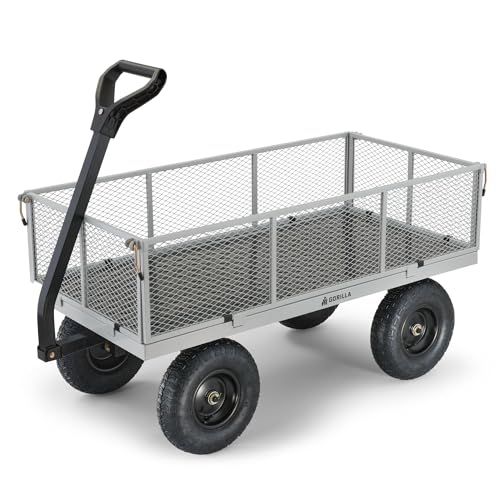
| Gorilla Carts steel utility wagon | 1,000 pounds | 49 by 24.5 inches, powder-coated mesh bed | Four 13-inch pneumatic tires |
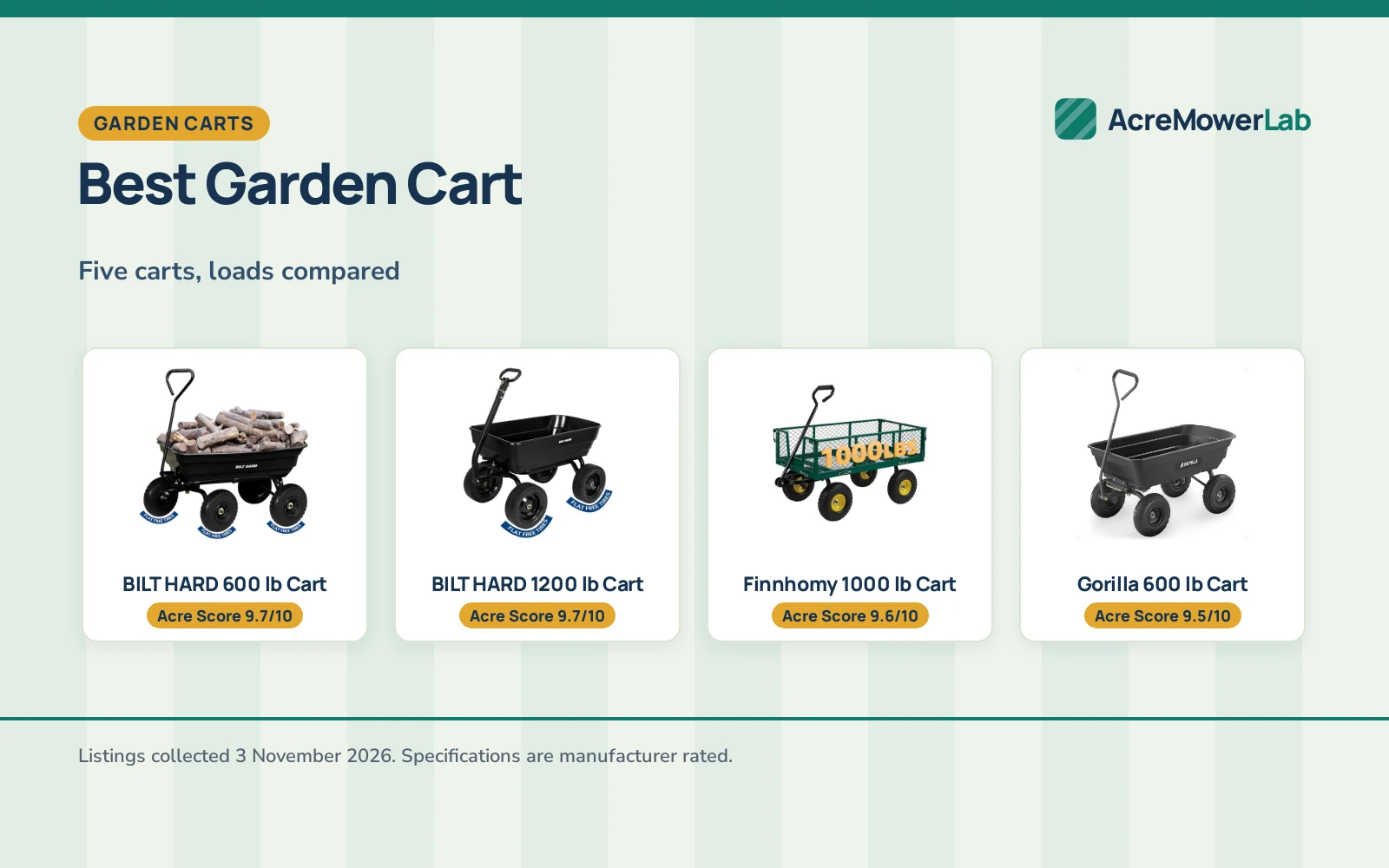
| BILT HARD poly yard dump cart, rotating handle | 600 lb | 36.5-inch x 20-inch poly bed | 10-inch no-flat tires |
| BILT HARD poly garden dump cart, quick release | 600 lb | 36.5-inch x 20-inch poly bed | 10-inch no-flat tires |
| Best Choice Products dual-wheel wheelbarrow cart | 500 lb | Poly tray | Air-filled dual wheels |
Gorilla Carts steel utility wagon. The listing states a capacity of 1,000 pounds and a powder-coated mesh bed measuring 49 by 24.5 inches, for hauling firewood, bricks and construction debris. Four 13-inch pneumatic tires roll over dirt, gravel, grass and pavement, and the listing states tight-turning steering with balanced 4-wheel stability across uneven terrain and rough ground. Removable side panels create a flatbed for bulky items, and the handle works by hand or hitched to a lawn tractor or ATV. One contradiction needs noting: the spec table lists dimensions far smaller than the bed size stated in the bullets, so the bullets are the trusted source here. No warranty term is stated in the listing data.
BILT HARD poly yard dump cart, rotating handle. The listing states a 4-cu ft poly bed measuring 36.5-inch x 20-inch, 10-inch no-flat tires, a capacity of 600 lb and a maximum dumping capacity of 300 lb. The title states a rotating handle, and the bullets state a quick-release dump system worked by lifting the handle. The maker lists a 1 year warranty term. The no-flat tires are stated to pass across uneven garden terrain and grassy slopes, with no pumping trouble and no puncture or deflation worry stated as the benefit.
BILT HARD poly garden dump cart, quick release. This cart states the same core figures as the rotating-handle cart: a 4-cu ft poly bed measuring 36.5-inch x 20-inch, 10-inch no-flat tires, a capacity of 600 lb and a maximum dumping capacity of 300 lb, plus a 1 year warranty term. The difference in the listing is the emphasis on the quick-release dump system and the rust-proof poly bed with a heavy steel frame. Where the two BILT HARD carts match on capacity, bed and tires, the choice comes down to handle style and dumping preference, not to load size.
Best Choice Products dual-wheel wheelbarrow cart. The listing states a capacity of 500 lb for soil, gravel, mulch or tools, with air-filled dual wheels that improve maneuverability and traction on dirt, grass and gravel. Split handles are stated to reduce wrist strain and improve leverage when lifting, steering and dumping, while the balanced dual-wheel design keeps loads steady. The tray is poly and the frame is steel. One contradiction needs noting: the bullets state overall dimensions of 57.5 inches x 28.5 inches x 28 inches, while the spec table lists a width of 22.0 inches, so the bullets are the trusted source here. A 60 day warranty term is stated in the spec table.
Match the cart to the load and the ground
Heavy, dense loads point toward four wheels and a steel bed. The Gorilla Carts wagon states firewood, bricks and construction debris as its hauling work, and its stated capacity of 1,000 pounds is the highest in this guide. Loose garden loads such as soil and mulch suit a dump cart, where the bed tips the load out instead of asking the operator to lift it over the side. The two BILT HARD dump carts state a dumping capacity of 300 lb, which is the figure to respect at the dumping point even though the hauling capacity states 600 lb.
Tight ground points toward two wheels. A dual-wheel wheelbarrow cart turns in beds and passes through gates where a four-wheel wagon needs a wider swing. Rough, rutted ground points toward tire choice as much as wheel count: no-flat tires remove puncture and pumping worry, while pneumatic tires are stated to roll easily over dirt, gravel, grass and pavement. On grassy slopes and uneven garden terrain, the BILT HARD listing states smooth transport, and the Gorilla Carts listing states balanced stability across uneven terrain and rough ground.
Beds, tires and dumping
Bed material sets what the cart tolerates. A rust-proof poly bed suits wet soil, mulch and garden debris, and both BILT HARD carts state that material. A powder-coated steel mesh bed suits bricks, firewood and construction debris, and the Gorilla Carts wagon states rust resistance for that frame and bed. Bed size also sets the load shape: a bed measuring 49 by 24.5 inches takes long, bulky items, while a 4-cu ft poly bed suits loose material that dumps cleanly.
Dumping style matters as much as capacity. A quick-release dump system lifts the handle to drop the load where it belongs, and one cart states a 180° rotating handle as well. Removable side panels turn a wagon into a flatbed for items that do not fit inside a bed at all. Before choosing, picture the unloading spot: a narrow bed, a compost pile, a woodpile or a driveway each favor a different dumping motion.
Safety
Keep every load within the stated capacity, and keep the load balanced so it does not shift on a slope or a turn. Clear sticks, stones and other debris from the path before hauling, wear sturdy shoes, and keep children and pets away from the work area while a loaded cart is moving. Never stand under a tipped bed, and lower the bed fully before moving the cart again. On slopes, follow the maker guidance in the listing and keep speed slow and steady.
FAQ: mowing large lots
Which wheel count suits a small yard with gates?
A two-wheel cart suits tight ground, since it pivots on its axle and turns in beds and through gates. The dual-wheel wheelbarrow cart in this guide states split handles and balanced dual-wheel handling for that kind of steering work.
Which wheel count suits heavy loads?
A four-wheel cart suits heavy loads, since the load stays level across a wider base. The Gorilla Carts wagon states a capacity of 1,000 pounds and balanced 4-wheel stability under heavy loads across uneven terrain.
Do no-flat tires matter on rough ground?
They matter where thorns, sharp debris or uneven ground threaten a pneumatic tire. The BILT HARD carts state 10-inch no-flat tires with no pumping trouble and no puncture or deflation worry, while the Gorilla Carts wagon states 13-inch pneumatic tires for rolling over dirt, gravel, grass and pavement.
Can a dump cart unload without lifting the whole load?
Yes, where the listing states a dumping system. The BILT HARD carts state a quick-release dump system worked by lifting the handle, with a maximum dumping capacity of 300 lb, and one states a rotating handle as well.
What if a listing states no warranty term?
Then the term is not stated, and the cart should be judged on its stated capacity, bed and tires alone. The Gorilla Carts listing in this guide states no warranty term, while the BILT HARD carts state a 1 year term and the Best Choice Products cart states a 60 day term.