Jerry Can vs Gas Can: Which One Should You Buy?
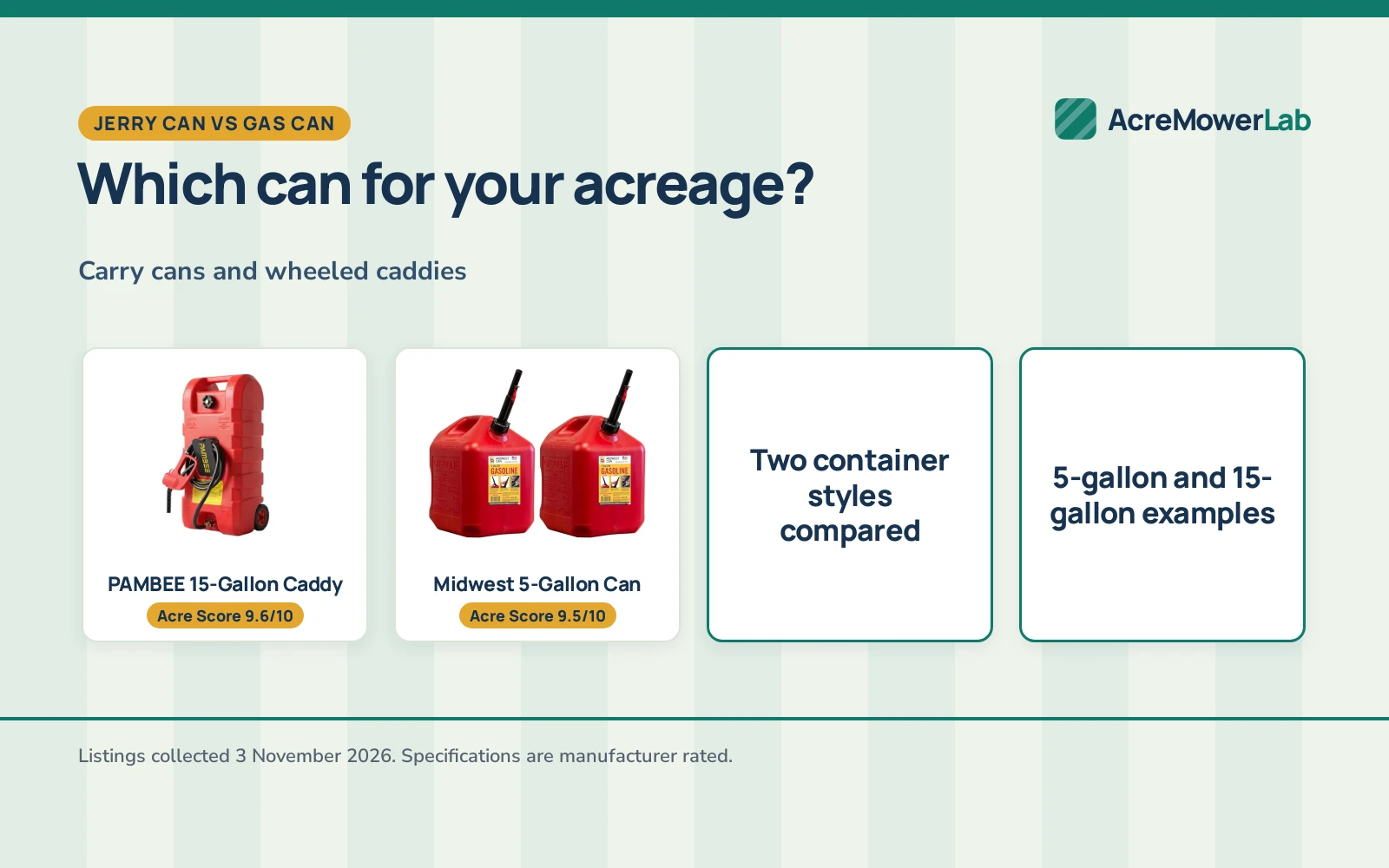
A jerry can and a gas can compared on shape, capacity, pouring, moving and safety, with a 5-gallon carry can and a 15-gallon wheeled caddy as examples.

On this page
This guide covers jerry can vs gas can. Verdict: Choose a gas can in the classic carry form if you fuel mowers, trimmers and outdoor equipment by hand. Choose a wheeled fuel caddy if you move larger volumes to several machines. A jerry can, the metal can most owners picture, earns its place when you want one tough container for the shed shelf, but both examples here are gas cans, so the choice below rests on the two listings we reviewed.
On a few acres, fuel is part of the weekly round: the mower, the trimmer and the generator all drink from the same shelf in the shed. The jerry can vs gas can question comes down to what you carry, how far you carry it and how you pour. This comparison covers the differences, then two examples from the listings we reviewed.
As an Amazon Associate I earn from qualifying purchases. AcreMowerLab earns a commission when you shop through links here. It never changes your price. Affiliate disclosure.
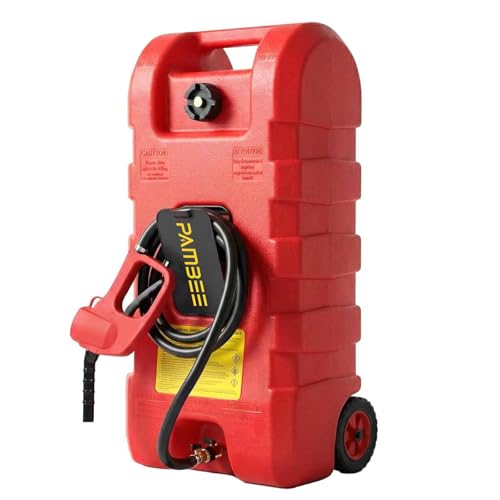
PAMBEE 15 Gallon Fuel Caddy with Manual Siphon Pump and 10FT Hose
A 15-gallon wheeled fuel caddy with a manual siphon pump and a 10-foot hose for refueling cars, boats, mowers and generators.
Who it's for: owners who fuel several machines and want to roll fuel instead of carrying it.
Who should skip it: owners who only fuel one mower and want the smallest container on the shelf.
Read the full review
The listing states a 15-gallon maximum capacity, high-density polyethylene that is rust-proof, a 10-foot automotive-grade rubber hose with a holder, siphon and gravity modes, 3 gallons per minute in siphon mode, a top handle, 6-inch wheels and 2 brass shut-off valves. It lists gasoline, diesel, paraffin and light oil, and names cars, motorbikes, boats, lawnmowers, snow blowers and generators as uses.
Pros
- 15-gallon capacity stores fuel for multiple vehicles
- Siphon and gravity modes, with 3 gallons per minute in siphon mode
- Top handle and 6-inch wheels for moving across terrains
- 2 brass shut-off valves, one at the tank and one at the hose, against leaks
Cons
- No warranty term is stated
- 23.06 pounds before fuel, so it is the heavier container here
- Siphon speed depends on how fast you press
- 34.0 inches tall, so it needs floor room in the shed or truck bed

Midwest Can Company 5610 5 Gallon Gas Can Fuel Container Jugs w/Spout (2 Pack)
A 5-gallon gas can in a 2-pack with a spout and a FlameShield system for mowers, trimmers and outdoor power equipment.
Who it's for: owners who carry fuel by hand to mowers and trimmers.
Who should skip it: owners who move larger volumes or want wheels and a hose.
Read the full review
The listing states a 5-gallon gas can of durable HDPE with a vapor barrier, a FlameShield system with 2 layers of protection from sparking accidental fires, and a spout for faster fueling. Note the contradictions: the title says 2 Pack while the spec table lists 1 item, and the spec table dimensions read 0.0 inches; trust the title and bullets, and check the listing before ordering.
Pros
- 5-gallon size suits lawnmowers, trimmers and outdoor power equipment
- Durable HDPE with a vapor barrier
- FlameShield system with 2 layers of protection from sparking accidental fires
- Spout makes fueling faster, per the listing
Cons
- No warranty term is stated
- Spec table dimensions read 0.0 inches, so they give no usable size
- 5 gallons per can, well below the 15-gallon caddy
- No wheels, pump or hose, so every pour is by hand
Jerry can vs gas can side by side
| Factor | PAMBEE 15-Gallon Caddy | Midwest 5-Gallon Can | Takeaway |
|---|---|---|---|
| Container style | 15-gallon wheeled caddy | 5-gallon carry can, 2-pack | Rolling tank vs carry can |
| Capacity (stated) | 15 gallons | 5 gallons | Caddy holds more per trip |
| Pouring | Manual siphon pump, 10-foot hose, 3 gallons per minute in siphon mode | Spout for faster fueling | Siphon and hose vs spout |
| Moving it | Top handle and 6-inch wheels, 23.06 pounds stated | Carry by hand, 1.0 pounds in the spec table | Wheels matter at 15 gallons |
| Safety features | 2 brass shut-off valves, leak-proof design | FlameShield, 2 layers of protection from sparking | Fire protection on one, leak protection on the other |
| Best at | Refueling cars, boats, mowers, generators and more | Fueling mowers, trimmers and outdoor equipment | Small jobs vs many vehicles |
| Warranty | Not stated | Not stated | Neither listing states a term |
Figures are manufacturer stated for the two example models, collected 3 November 2026.
The can shapes: jerry can or gas can
A jerry can is the classic metal can shape: rectangular, with a handle on top and a spout for pouring. A gas can is the wider family, and it covers the plastic jugs and wheeled caddies sold for fuel today. Both examples here sit on the gas can side: the Midwest can is a 5-gallon plastic jug, and the PAMBEE is a 15-gallon wheeled tank. The shape you pick sets everything else, because it decides how much you carry, how you pour and where the container lives between uses.
Capacity and moving fuel
Capacity is the widest gap between the two examples. The Midwest can holds 5 gallons per can, and its title lists a 2-pack, so it suits topping up one machine at a time. The PAMBEE caddy holds 15 gallons, enough for multiple vehicles per the listing, and it moves on a top handle and 6-inch wheels. The trade is weight and bulk: the Midwest spec table lists 1.0 pounds, while the PAMBEE lists 23.06 pounds before any fuel goes in. A carry can suits short walks to the mower; a wheeled caddy suits longer hauls across the property.
Pouring and control
Pouring is where the two designs split. The Midwest can pours through a spout, which the listing says makes fueling faster so you can get back to work. The PAMBEE caddy pours through a manual siphon pump and a 10-foot hose, with siphon and gravity modes, and the listing states a flow rate of 3 gallons per minute in siphon mode. The caddy also carries 2 brass shut-off valves, one at the tank and one at the hose, so the hose can be disconnected in a way the listing says can prevent fuel leaks. A spout is simple and direct; a siphon and hose reach further and stop cleaner.
Safety and storage
Both listings state safety features, and both deserve a read before buying. The Midwest can lists a FlameShield system with 2 layers of protection from sparking accidental fires, and its HDPE body carries a vapor barrier. The PAMBEE caddy lists a leak-proof design with 2 brass shut-off valves, which the listing says reduces fire hazards and environmental risks. Refuel with the engine off and cool, and keep fuel away from ignition sources. The PAMBEE listing names the garage, shop and shed among the places the tank can be placed. Neither listing states a warranty term, so both score zero on that line.
The two examples
Acreage and terrain fit
PAMBEE 15-Gallon Caddy
Midwest 5-Gallon Can
Matching It to Your Property
- Flat ground near the shed suits the 5-gallon carry can for mowers and trimmers.
- Rough ground and longer hauls suit the wheeled caddy with 6-inch wheels.
- A shed shelf suits the 5-gallon can, while the 15-gallon caddy at 34.0 inches tall needs floor room.
- Obstacles suit carrying the small can by hand where wheels cannot roll.
The Acre Score explained
The Acre Score weighs five factors: performance (capacity, pouring and moving fuel), build quality (materials, wheels and valves), value (what comes in the box), safety (fire and leak protection the listing states) and warranty (years and coverage). A factor the listing does not state scores zero, which is why both examples score zero for warranty.
| Product | Acre Score | Perf. /35 | Build /25 | Value /25 | Safety /10 | Warranty /5 |
|---|---|---|---|---|---|---|
| PAMBEE 15-Gallon Caddy | 9.6 | 30 | 21 | 21 | 8 | 0 |
| Midwest 5-Gallon Can | 9.5 | 28 | 20 | 20 | 7 | 0 |
Scores run from 9.2 to 9.8: each product’s point total is placed on that range, so more points always means a higher score.
Many owners on acreage keep both forms: a carry can for the weekly mower fill and a wheeled caddy for the generator and the truck. If you maintain mowers yourself, see our mower maintenance guides for the rest of the upkeep shelf.
Read the manual, keep children and pets out of the yard while you work, wear eye and hearing protection and sturdy footwear, and never exceed the slope rating of your machine. Refuel only with the engine off and cool. See CPSC lawn mower safety. Read our Safety Disclaimer.
FAQ: mowing large lots
What is the difference between a jerry can and a gas can?
A jerry can is the classic metal can shape with a handle and a spout. A gas can is the wider family, covering plastic jugs and wheeled caddies like the two examples here. The name matters less than capacity, pouring and the safety features the listing states.
How much fuel should I carry for mowing?
The Midwest can holds 5 gallons, which its listing pitches at mowers, trimmers and outdoor equipment. The PAMBEE caddy holds 15 gallons for multiple vehicles. Match the container to how many machines you fuel between fill-ups.
Can I use the caddy for diesel as well as gasoline?
The PAMBEE listing says it delivers gasoline, diesel, paraffin and light oil, and names cars, motorbikes, boats, lawnmowers, snow blowers and generators as uses.
Is the 5-gallon can sold singly or as a pair?
The title says 2 Pack, while the spec table lists 1 item. Trust the title and check the listing before ordering, since the spec table dimensions also read 0.0 inches.
Do I need a pump to use the caddy?
No separate pump is needed: the caddy includes a manual siphon pump for siphon mode and also supports gravity mode, with a 10-foot hose plus a hose holder for storage.