Zero Turn Mower Sizes: Deck Width and Footprint Guide
A practical guide to zero turn mower sizes, deck widths, frame dimensions, gate clearance, and matching mower size to your acreage.

On this page
Top picks at a glance
As an Amazon Associate I earn from qualifying purchases.
- 1
 Husqvarna MZ619.7/10View on Amazon
- 2
 EGO Power+ Z6 Zero Turn Electric Riding Lawn Mower9.6/10View on Amazon
- 3
 EGO Power+ Z6 Zero Turn Electric Riding Lawn Mower9.6/10View on Amazon
Zero turn mower sizes range from compact residential frames built for tight suburban yards to wide commercial machines engineered for expansive acreage. A mower’s size is defined by key measurements: the cutting deck width, which dictates cutting swath and mowing speed, and the overall frame dimensions, which determine gate clearance, trailer fit, and storage footprint. Choosing the right size requires balancing lawn acreage against gates, trees, and shed doors. This guide breaks down deck widths, frame dimensions, and clearance requirements step by step.
AcreMowerLab earns a commission when you shop through links here. It never changes your price. Affiliate disclosure.
Zero turn mower sizes: deck width and machine dimensions
| Deck category | Best for | Key limit |
|---|---|---|
| Compact deck | Small residential lawns with narrow gates and tight obstacles | More passes needed across open lawn areas |
| Mid-size deck (54 inch) | Mowing open acreage while balancing storage space and transport | Requires measuring trailer width and shed doors |
| Wide commercial deck | Large open acreage and commercial properties needing maximum speed | Heavy machine weight and difficult navigation through gates |
| Compact electric zero-turn | Residential yards wanting quiet operation without fuel storage | Runtime dependent on battery capacity and lawn scale |
Selecting the right size prevents buying a machine that cuts quickly in open turf but cannot pass through your gates. For operating controls and maneuverability, see our guide on how to use zero turn mower steering levers.
Step 2: choose your deck width
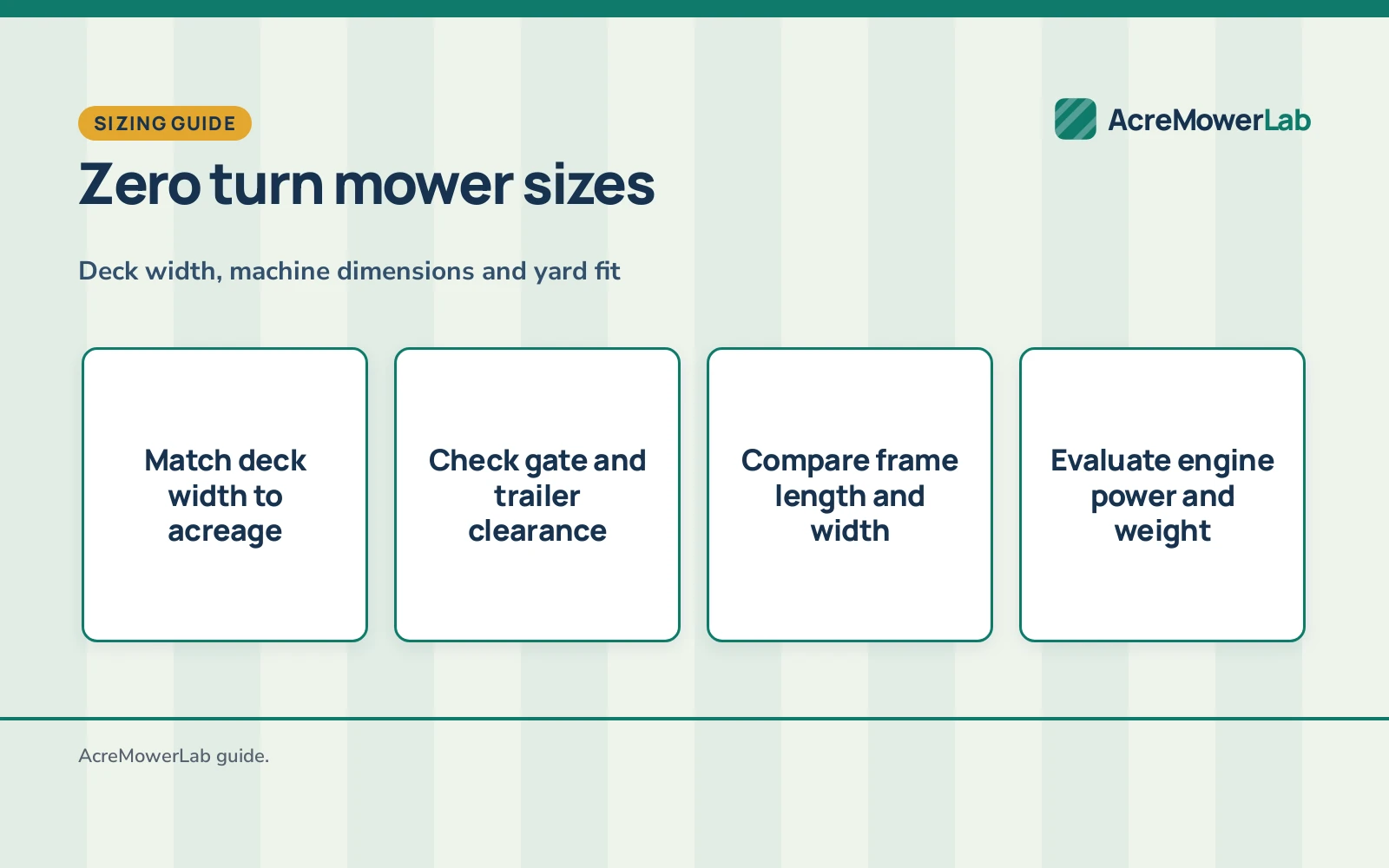
Deck width determines how much grass the mower cuts in a single pass. A wider cutting deck reduces total mowing passes and shortens time spent mowing broad acreage. However, deck width also defines machine maneuverability around landscape beds, fence corners, and trees.
For example, Husqvarna lists a 54 inch cutting width on its fabricated steel deck models. A 54 inch cutting width uses 3 blades to cut a wide swath across open turf, reducing the passes needed on acreage. Fabricated decks, built by welding plate steel, withstand impacts from unseen tree roots or uneven turf better than lighter stamped shells. However, wider decks require flatter ground, as wide cutting widths can scalp high spots on rolling terrain.
Step 3: check storage and trailer dimensions
A zero-turn mower’s total width is always wider than its cutting deck width because of the discharge chute. Evaluating zero turn lawn mower sizes requires measuring total operating width and transport width rather than deck width alone. Measuring storage sheds and transport trailers based solely on deck width leads to costly surprises when parking or loading equipment.
Husqvarna lists an overall width of 67 inches on its 54 inch deck model when measured with the discharge chute in operating position. When the deflector chute is raised for transport or storage, Husqvarna lists the machine width at 56 inches. That 11 inch difference determines whether the mower passes through a standard utility gate or drives onto an enclosed trailer. Husqvarna lists machine dimensions of 75 inches in length and 40 inches in height. Measuring shed door openings, garage wall clearance, and trailer bed length before buying ensures the machine fits into your storage space without crowding other equipment.
Step 4: evaluate engine power and weight
As mower deck size and frame dimensions increase, engine displacement and machine weight increase to drive heavier blades and dual hydrostatic transmissions. Adequate displacement ensures blades maintain cutting tip speed when entering tall or damp grass.
Husqvarna lists a 726 cc engine with 24 hp on the Z254F model and a 726 cc engine with 22 hp on the Z254FX configuration. Machine weight also scales with frame size and deck fabrication. Husqvarna lists an item weight of 595 pounds on the Z254F model and 780 pounds on the Z254FX build. Heavier mowers provide solid tire traction on dry, level turf, but they require sturdy trailer ramps and can leave ruts on soft or saturated soil.
Husqvarna lists 6 cutting height positions, with a stated minimum cutting height of 1 inch. When reviewing listing specifications, note that published spec tables sometimes contain clerical errors. For example, a Husqvarna listing spec table reports a maximum cutting height of 44.13 inches, which is an obvious clerical entry error, while another reports 10.2 centimeters. Relying on verified manufacturer manual figures prevents confusion.
Maintaining sharp cutting edges ensures clean cuts regardless of deck size. Read our mower blade sharpener recommendations to keep blades in top condition.
Step 5: match mower size to property terrain
Zero-turn mowers steer through independent rear-wheel hydrostatic drive systems. On flat, open acreage, wide zero-turn decks deliver exceptional mowing productivity and smooth zero-radius turning at the end of each pass. However, properties with varied topography require careful size selection.
On properties with rolling hills or steep slopes, larger zero-turn mowers require deliberate handling. Front caster wheels float freely and provide no steering traction. If a heavy machine begins sliding on a slope, steering control diminishes quickly. For properties with steep grades, choosing a compact frame with a lower center of gravity improves stability.
Measure gate and shed clearance
Before selecting a mower size, physically measure every gate, doorway, and opening the machine must navigate. Gate openings represent the most common constraint for residential and acreage zero-turn owners.
Measure gates at their narrowest point, accounting for hinge hardware, gate stops, and latch posts. Compare that measurement against the mower’s total width with the discharge chute down and raised. If your narrowest gate cannot accommodate a mid-size deck, either plan on installing a wider gate or select a compact mower that passes through without rubbing fence posts. Measure shed doors, garage bays, and trailer ramps with equal precision.
Match deck size to lawn obstacles
Lawn layout impacts mower sizing as much as total property acreage. A property with numerous mature trees, garden borders, retaining walls, and fence lines requires a machine that maneuvers cleanly through tight gaps.
Deck overhang represents a critical measurement when evaluating obstacles. The amount of deck that extends beyond the outer edge of the mower tires determines how closely you can trim along borders without scuffing tires against obstacles. A deck with sufficient side overhang allows clean trimming around mulch beds, reducing time spent with a string trimmer.
For heavy-duty properties with vast open fields, review our commercial zero-turn mowers guide for high-capacity options.
Plan mowing efficiency in zones
Dividing a large property into distinct mowing zones helps you determine the optimal mower size. Most acreage properties feature a mix of manicured house lawn, open pasture or field borders, and utility corridors.
Open acreage zones benefit from wide cutting decks that maximize acreage cleared per hour. Manicured zones around buildings, septic cleanouts, and flowerbeds require careful navigation and slower ground speeds. Matching your mower size to the dominant zone ensures you achieve efficient mowing without compromising trimming capability in tight spaces.
Regular maintenance keeps steering levers responsive and spindles running smoothly. See our breakdown of zero turn mower parts to plan replacement schedules.
Mind slope limits and ground conditions
Ground conditions and slope angles dictate where zero-turn mowers can operate safely. Damp morning grass, loose dirt, and wet clay dramatically reduce tire traction.
Never operate a zero-turn mower on slopes steeper than the manufacturer’s specified maximum slope angle. Because front caster wheels do not brake or steer, losing rear-wheel traction on a hillside can cause the mower to slide uncontrollably. Avoid operating along steep drainage ditches, retaining walls, or pond banks where wet soil or sudden drop-offs create rollover hazards.
Safety
Operating a zero-turn mower safely requires strict adherence to operating rules and manufacturer guidelines. Never exceed the manufacturer’s maximum slope rating, as zero-turn mowers lose traction on slopes and near ponds or ditches. Keep the rollover protective structure deployed and fasten the seat belt where equipped. Never carry passengers, and keep children, pets, and bystanders completely out of the yard during mowing operations.
Disengage mower blades before reversing, crossing gravel paths, or driving across non-turf surfaces. Turn off the engine and allow it to cool completely before refueling. Always wear eye protection, hearing protection, and sturdy closed-toe footwear. Clear sticks, stones, and foreign debris from the lawn before mowing to prevent thrown object hazards.
FAQ: mowing large lots
How wide is a 54 inch zero turn mower?
A 54 inch zero-turn mower has a cutting deck that spans 54 inches, but overall machine width is wider. On Husqvarna 54 inch deck models, width measures 67 inches with the discharge chute down in operating position, and 56 inches with the chute raised for transport.
Will a 54 inch zero turn mower fit on a utility trailer?
A 54 inch Husqvarna zero-turn mower measures 56 inches wide with the chute raised, 67 inches with the chute down, and 75 inches in length. It fits on a trailer whose deck width between side rails exceeds 56 inches and whose bed length exceeds 75 inches, leaving adequate room for tie-down straps.
What size zero turn mower fits through a standard yard gate?
Standard single yard gates often provide narrow clearance. A 54 inch Husqvarna mower requires wider clearance because the machine measures 56 inches wide even with the chute raised. Yards with narrow single gates require compact mowers or widened double gates.
Does a larger deck size cut grass faster on acreage?
A wider cutting deck covers more surface area on each pass, reducing the number of passes required to mow open acreage. However, on yards with numerous obstacles, tight turns, and narrow passages, a wider deck can slow progress compared to a nimble mid-size machine.
How do I choose between stamped and fabricated cutting decks?
Stamped decks are pressed from a single sheet of metal, offering rounded airflow channels suitable for residential lawns. Husqvarna lists a fabricated steel deck on its 54 inch models, welded from heavy plate steel to withstand impacts from rough acreage terrain.
More mowing guides
- How to Use Zero Turn Mower: Beginner Operation and Safety Guide
- Best Commercial Zero-Turn Mower: 4 Picks for 5 to 10 Acres
- Zero Turn Mower Parts: Maintenance and Replacement Guide
- How Long Does It Take to Mow an Acre? Times by Mower Type
Visit our zero turn mowers section to compare deck sizes, power options, and machine configurations for your property.