What CFM Leaf Blower Do I Need?
A guide to choosing the right CFM leaf blower for your yard, explaining airflow ratings, airspeed, and property size needs.

On this page
Top picks at a glance
As an Amazon Associate I earn from qualifying purchases.
- 1
 Husqvarna 350BT Gas Leaf Blower9.6/10View on Amazon
- 2
 PROYAMA 72CC Gas Backpack Leaf Blower9.6/10View on Amazon
- 3
 EGO Power+ LB7654 56V 765 CFM Cordless Leaf Blower9.6/10View on Amazon
- 4
 BLACK+DECKER Electric Leaf BlowerView on Amazon
- 5
 WORX 12 Amp Turbine Electric Leaf Blower for Daily LeafView on Amazon
- 6
 WORX Trivac 3-in-1 Electric Leaf Blower/Leaf Vacuum/LeafView on Amazon
- 7
 BLACK+DECKER Leaf Blower Leaf Vacuum and Leaf Mulcher 3-in-1View on Amazon
- 8
 Husqvarna 125B Gas Leaf BlowerView on Amazon
- 9
 BLACK + DECKER Electric Leaf BlowerView on Amazon
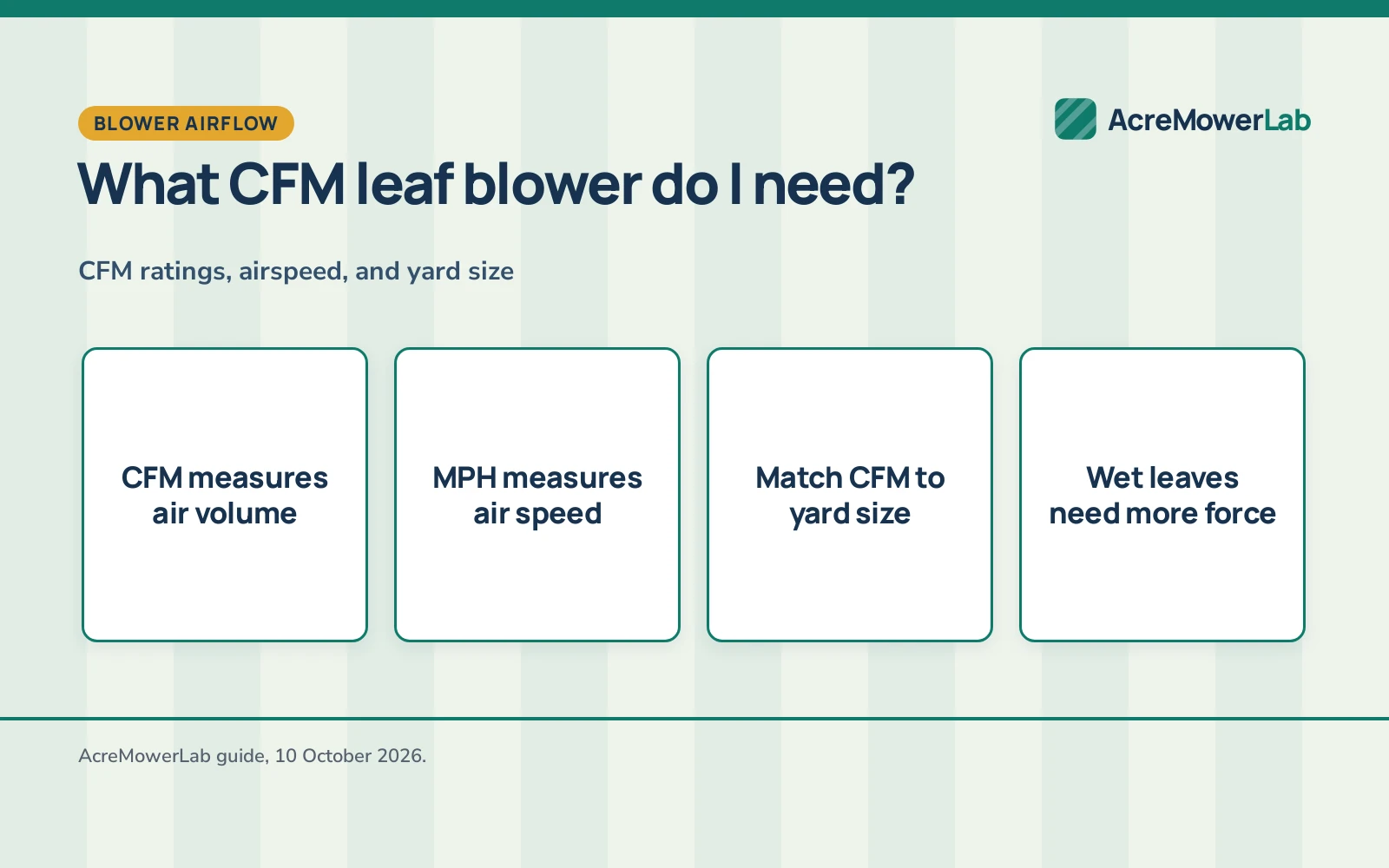
To decide what CFM leaf blower do I need, match the airflow volume to your property size and cleanup chores: small hardscapes like patios and porches clear well with 100 CFM, general residential yards need 620 to 650 CFM, and large properties with wet leaves call for 700 to 800 CFM or up to 930 CFM. CFM measures the total volume of air pushed through the tube, while air speed (measured in MPH) determines how forcefully that air dislodges stubborn debris. This guide explains how to balance CFM and MPH so you choose the right blower for your yard.
Other machines to compare
 BLACK+DECKER Electric Leaf BlowerCheck price on Amazon
 WORX 12 Amp Turbine Electric Leaf Blower for Daily LeafCheck price on Amazon
 WORX Trivac 3-in-1 Electric Leaf Blower/Leaf Vacuum/LeafCheck price on Amazon
 BLACK+DECKER Leaf Blower Leaf Vacuum and Leaf Mulcher 3-in-1Check price on Amazon
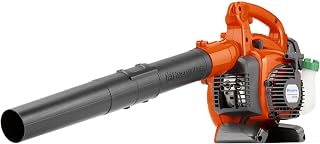 Husqvarna 125B Gas Leaf BlowerCheck price on Amazon
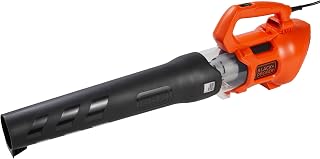 BLACK + DECKER Electric Leaf BlowerCheck price on Amazon
AcreMowerLab earns a commission when you shop through links here. It never changes your price. Affiliate disclosure.
What CFM leaf blower do I need: pick the right airflow
| Airflow rating | Best for | Common blower style |
|---|---|---|
| 100 CFM | Patios, porches, workshops, and light dry debris | Compact jobsite or sweep blower |
| 620 to 650 CFM | Walkways, driveways, dry lawn leaves, and yard cleanups | Cordless handheld blower |
| 700 to 800 CFM | Large lawns, deep leaf layers, and damp foliage | High-output handheld or light backpack |
| 930 CFM | Heavy piles, wet matted leaves, and acreage cleanup | High-capacity handheld or commercial backpack |
CFM stands for cubic feet per minute. It measures how much air moves through the blower tube each minute. A blower with higher CFM pushes a wider column of air, allowing you to sweep larger swaths of lawn in fewer passes. For example, DEWALT lists 100 CFM on its compact model, which suits sweeping sawdust or porch dirt. Mid-range tools like the WOLFBOX MegaThrust 600 deliver 620 CFM, while Greenworks rates its 80V model at 700 CFM and WORX rates its cordless unit at 780 CFM. On large properties with extensive tree cover, a backpack blower moves heavy piles across open turf. See our best backpack leaf blower guide for acreage cleanup options.
Step 2: understand blower CFM vs MPH
When comparing leaf blowers, CFM and MPH work together. CFM indicates the volume of air, while MPH (miles per hour) measures the velocity of that air stream. High airspeed lifts leaves that are stuck to wet soil or pavement, while high air volume keeps the entire pile rolling forward.
If a blower has high MPH but low CFM, the narrow air stream will carve a thin groove through a pile of leaves without moving the mass. Conversely, high CFM with adequate speed moves wide rows quickly. In reference listings, the DEWALT 100 CFM unit pairs with 135 MPH, suitable for light sweeping. In contrast, the Greenworks 700 CFM blower pairs with 170 MPH, the WORX 780 CFM model provides 190 MPH, and Houselife lists 800 CFM with 300 MPH. For balanced clearing, look for a blower that pairs strong volume with enough speed to break foliage loose.
Step 3: account for wet leaves and heavy debris
Dry leaves are light and roll easily across grass and pavement. Wet leaves mat down, stick to turf, and weigh significantly more. If your yard has dense shade or frequent autumn rain, you need higher CFM and greater air velocity to dislodge the damp layer.
A blower rated at 620 to 650 CFM, such as the WOLFBOX MegaThrust or RAXONE handheld units, handles damp driveway debris and routine lawn buildup. When dealing with thick blankets of soaked oak or maple leaves across large lawns, ratings of 700 to 800 CFM prevent the nozzle from bogging down. High-volume units, such as the 930 CFM RAXONE blower rated at 197 MPH, provide the extra thrust required to shift soaked leaf piles into manageable collection rows.
Step 4: choose handheld or backpack
Handheld blowers offer agility and compact storage. They work well for clearing patios, walkways, gutters, and yards under an acre. However, holding a blower for extended sessions can tire your arm and wrist. In data listings, bare handheld units weigh from 2.5 pounds for the DEWALT compact blower to 5.8 pounds for Greenworks and 8.9 pounds for the WORX unit with dual batteries.
For properties spanning several acres or containing many mature deciduous trees, backpack blowers shift the machine weight to your shoulders and hips. Backpack models also feature larger fans that generate higher CFM continuously without straining your hands. If you maintain a larger property, review our guide to best leaf blower for large yards for heavy-duty options.
Step 5: check battery voltage and runtime
Cordless electric blowers eliminate fuel mixing and pull cords, but running at maximum CFM consumes battery power rapidly. Battery platforms in reference listings range from 20V systems up to 80V commercial-grade setups.
Higher-voltage tools draw less current for the same power output, maintaining stronger airflow under load. For instance, the Greenworks 80V blower runs on a 2.5 Ah pack, while the WORX 40V unit utilizes two 20V 4.0Ah batteries. RAXONE lists two 6.0 Ah packs for its 650 CFM model, claiming up to 130 minutes at low speed and 30 minutes in turbo mode. The WOLFBOX 40V setup lists 120 minutes of low-speed runtime from two 4.0Ah batteries. If you have extensive acreage, keep a secondary battery pack on a dual charger so you can swap packs without stopping work. For lighter yard tasks, see our cordless handheld leaf blower recommendations.
Consider noise levels and motor type
Brushless motors run cooler, last longer, and produce less mechanical noise than traditional brushed motors. Listings highlight significant differences in sound ratings across leaf blowers. The WORX WG582 brushless model operates at 57 dB, making it quiet for residential neighborhoods. Houselife lists 65 dB on its 800 CFM unit, Greenworks lists 74 dB on its 800-series model, and RAXONE lists 100 dB on its 930 CFM unit.
If you live in a noise-sensitive suburban development, a blower rated under 65 dB allows early morning or weekend yard work without disturbing neighbors. On rural acreage where distance separates homes, higher decibel output is less critical than moving leaves off the grass quickly.
Match blower airflow to leaf type
The type of trees on your land influences how much CFM you need. Broad leaves from oak and sycamore trees catch wind well when dry, but once wet, they stick together like cardboard. Moving these mats off turf demands blowers delivering 700 CFM or more.
Pine needles create a different challenge. Their slender profile allows air to slip past, and they weave tightly into grass blades. Dislodging pine needles requires higher airspeed (MPH) rather than raw air volume. Lightweight leaves from birch, maple, and ornamental trees slide easily across turf, meaning a blower delivering 620 to 650 CFM clears them efficiently. If your property features heavy tree cover, check our walkthrough on clearing leaves on a large property for structured clearing strategies.
Plan your property cleanup passes
Blowing leaves across open lawn requires working with the prevailing wind rather than fighting it. Walk the boundary before starting to identify natural collection points along fence lines or open pastures. Always push leaves downwind in wide, overlapping arcs toward your central collection area.
Clear hard surfaces first. Driveways, walkways, and patios should be swept clean before tackling open lawn areas so you do not blow lawn debris back across clean asphalt or concrete. When working open turf, divide large lawns into smaller zones. Completing one zone before moving to the next keeps the wind from scattering piles across previously cleared turf.
Mind the ground and working weight
Soggy autumn ground creates slip hazards, especially when carrying equipment. Handheld blowers ranging from 3.9 pounds to 8.9 pounds place strain on your forearm and shoulder during extended sessions. If using a heavier handheld unit, look for models that include a shoulder strap to distribute machine weight across your upper body.
Never operate a blower on steep slopes when grass is wet. If clearing leaves around ponds, ditches, or roads, direct the nozzle away from water and traffic to prevent road hazards and blocked drainage culverts. On uneven acreage, watch your footing around hidden tree roots, rocks, and animal burrows concealed beneath fallen leaves.
Safety
Always wear eye and hearing protection when operating a leaf blower, as high-velocity air streams can kick up gravel, twigs, and hidden debris. Wear sturdy work shoes with slip-resistant soles to maintain footing on slick grass and uneven terrain. Before blowing, walk the area to clear sticks, stones, wire, and foreign objects that could become airborne projectiles.
Keep children, pets, and bystanders away from the work zone. Never point an active blower tube toward people, animals, open windows, or vehicles. For gas-powered blowers, always refuel outdoors with the engine turned off and completely cool to prevent fuel vapor ignition. On electric models, inspect battery casings for damage before charging and avoid running overheated batteries.
FAQ: mowing large lots
Is CFM or MPH more important for a leaf blower?
Both matter, but they perform different roles. CFM measures air volume, which dictates how wide of a leaf swath you can push across your yard. MPH measures air speed, which provides the force needed to lift wet leaves and heavy debris. For lawn cleanup, CFM is generally more important once minimum airspeed is met.
Is 650 CFM enough for clearing lawn leaves?
Yes, 650 CFM is ample for clearing dry autumn leaves, grass clippings, and driveway debris across average residential properties. Blowers in the 620 to 650 CFM range provide enough air volume to move wide rows across turf without requiring commercial equipment.
What CFM do I need for wet leaves?
Wet leaves require higher airflow volume and speed because moisture binds them into heavy mats. Aim for a blower rated between 700 and 800 CFM, or up to 930 CFM for deep piles. Higher volume keeps soaked foliage rolling forward instead of stalling in the turf.
Can a high CFM blower damage lawn turf?
When held at the proper working angle, a high-volume leaf blower will not damage healthy turf. Sweep the nozzle in broad strokes rather than pinning the air stream directly into the root zone. Lower speed settings should be used when working near mulch beds and garden borders to avoid blowing topsoil.
Should I mulch or blow leaves on a large lawn?
Light leaf layers can be shredded directly into the grass with a mulching mower to return nutrients to the soil. However, heavy leaf falls should be blown into collection piles to prevent smothering the lawn. See our guide on whether it is better to mulch or bag leaves for lawn health recommendations.
More mowing guides
- Best Backpack Leaf Blower: 3 Gas Picks for Acreage Leaf Cleanup
- Best Leaf Blower for Large Yards (2026): 5 Picks Compared
- Best Handheld Leaf Blower Cordless: 5 Picks Compared (2026)
- How to Clear Leaves on a Large Property
Explore our trimmer and blower reviews to compare equipment by power type, yard size, and clearing performance.