How to Store a Battery Mower for Winter
A step-by-step guide to storing a battery mower for winter: cleaning the deck, removing the battery, maintaining charge, and dry indoor storage.

On this page
Top picks at a glance
As an Amazon Associate I earn from qualifying purchases.
- 1
 WEIZE 12.8V 12Ah Lithium Battery for Lawn Mower and Tractor9.6/10View on Amazon
- 2
 TYKOOL U1-S-400 Group U1 Lithium Lawn Mower Battery 400A 8Ah9.6/10View on Amazon
- 3
 UPLUS U1 360CCA 12V 26Ah AGM Lawn Mower Battery9.6/10View on Amazon
- 4
 Litheli 16.5" Electric Lawn Mower CordlessView on Amazon
- 5
 Runleader RL-HM011F Digital Hour MeterView on Amazon
- 6
 UPLUS LP12-35 12V 35Ah Deep Cycle BatteryView on Amazon
- 7WEIZE 12.8V 12Ah Lithium Battery for Lawn Mower and TractorView on Amazon
- 8
 WEIZE Lawn Garden AGM BatteryView on Amazon
- 9
 Litheli Electric Lawn Mower CordlessView on Amazon
To store a battery mower for winter, remove detachable battery packs to store them in a dry, climate-controlled room, clean grass buildup from the deck, inspect the cutting blade, and park the mower under a breathable cover in a sheltered space. Storing lithium-ion batteries indoors away from freezing cold preserves cell capacity and runtime, while cleaning the deck prevents off-season corrosion. For mowers with integrated batteries, park the machine in a dry space and follow maker charging guidelines. This guide explains each phase of winter preparation step by step.
Other machines to compare
 Litheli 16.5" Electric Lawn Mower CordlessCheck price on Amazon
 Runleader RL-HM011F Digital Hour MeterCheck price on Amazon
 UPLUS LP12-35 12V 35Ah Deep Cycle BatteryCheck price on Amazon
 WEIZE 12.8V 12Ah Lithium Battery for Lawn Mower and TractorCheck price on Amazon
 WEIZE Lawn Garden AGM BatteryCheck price on Amazon
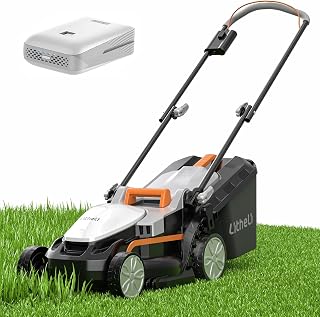 Litheli Electric Lawn Mower CordlessCheck price on Amazon
AcreMowerLab earns a commission when you shop through links here. It never changes your price. Affiliate disclosure.
How to store a battery mower for winter: key steps
| Storage step | Primary action | Key consideration |
|---|---|---|
| Battery pack storage | Disconnect removable packs and store indoors | Freezing cold degrades cell chemistry and runtime |
| Deck cleaning | Scrape grass buildup with a plastic putty knife | Never spray water into electric motor compartments |
| Blade inspection | Check for dull edges and coat metal with light oil | Wear heavy leather gloves during blade handling |
| Protective cover | Drape a vented, weather-resistant cover over the chassis | Keeps dust off while allowing trapped moisture to escape |
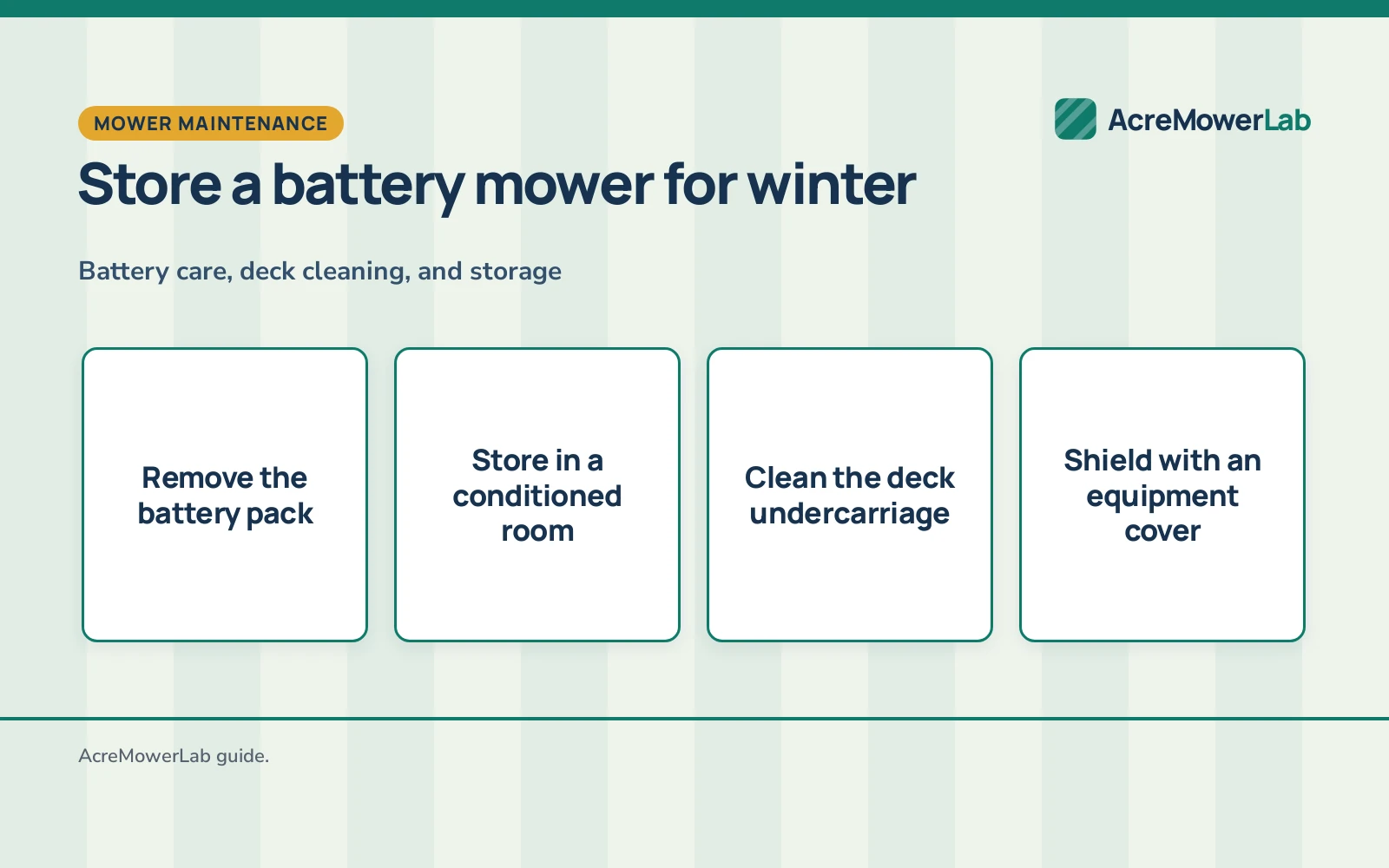
Winter preparation requires protecting both electrical parts and mechanical assemblies. Cordless mowers avoid fuel stabilizers and spark plug checks, but lithium-ion packs and wiring connections require care to avoid cold damage. See our best battery electric lawn mower guide to compare cordless systems.
Step 2: remove and store the battery pack
When preparing a cordless mower with a removable pack for winter, removing the battery is standard practice. Leaving a removable battery connected in an unheated shed invites capacity loss. Parasitic electrical draw from control boards and safety switches can slowly drain cells over winter. If a battery pack drains completely into deep sleep, its internal management system may block subsequent charging. For machines with non-removable integrated batteries, consult the manual for maker guidance, which often directs owners to disconnect the main safety key and park the entire unit in a dry, sheltered location.
For removable packs, wipe the battery casing with a dry cloth and check the metal terminals for dust or grass clippings. Store the pack on an interior shelf in a heated room away from moisture and direct heat. For walk-behind models, see our best small battery lawn mower picks.
Step 3: clean the deck and undercarriage
Accumulated grass clippings hold moisture against the deck, promoting rust on steel decks and oxidation on aluminum housings. On battery mowers, dried grass can also trap humidity around motor shaft seals.
Verify that the battery pack and safety key are removed before cleaning. Tilt the mower according to maker guidelines (typically tilting the handle backward toward the ground) and scrape encrusted clippings away with a plastic scraper or wooden putty knife. Plastic scrapers remove debris without scratching the protective powder coat. Never spray high-pressure water or garden hoses at an electric mower deck, as moisture forced past seals can short motor windings.
Step 4: inspect and service the cutting blade
Winter downtime is the right time to examine mower blades. Remove the blade retaining bolt while wearing thick leather gloves, blocking the blade with wood to prevent rotation. Check the cutting edge for nicks, cracks, or bends. Dull blades tear grass and increase motor workload, reducing battery run time.
Sharpen the cutting edge with a file, balance the blade, and apply a light coat of mineral oil or silicone spray to prevent surface rust during storage. Our mower blade sharpener guide reviews sharpeners for large lawns.
Step 5: cover and park the mower
Store the clean mower in a dry garage, workshop, or shed protected from freezing rain and windblown snow. Park the machine away from fertilizer bags and pool chemicals, because airborne chemicals accelerate corrosion on exposed electrical terminals.
Cover the mower with a fitted equipment cover to keep out dust and debris. Choose a cover made from Oxford fabric designed with ventilation, which prevents condensation from sweating against metal components. Avoid plain, non-breathable plastic sheets, which trap ambient humidity underneath.
Select a climate-controlled battery spot
Lithium-ion batteries perform best when stored in stable indoor temperatures. Sub-freezing cold increases internal resistance and accelerates cell aging, while hot utility spaces degrade battery chemistry. A closet shelf, laundry room, or heated basement provides a suitable location.
Most manufacturers recommend storing lithium-ion packs at a partial charge rather than completely depleted or at maximum voltage. Storing cells with a moderate charge stabilizes internal chemistry and prevents the pack from dropping into a damaging deep discharge state over months of storage. Check the battery status lights midway through winter. If the level drops, connect it to an approved charger to restore partial charge. See our best lawn mower battery charger guide for charger options.
Match the cover to your mower dimensions
Choosing an equipment cover with the right fabric density and dimensions protects your mower during off-season hibernation. Fabric density is measured in denier. In published product listings, KISEER lists a 210D polyester oxford push mower cover with PVC coating weighing 0.35 kg. HCFGS lists a 420D oxford cloth cover with a bottom drawstring weighing 0.3 kg. For heavier fabric, Himal Outdoors and TITANCOVERS list 600D oxford cloth covers. TITANCOVERS lists its 600D cover with a PA coating and a weight of 0.37 kg. NEVERLAND lists an 800D oxford fabric cover weighing 0.6 kg, with 420D polyester Oxford stated in its spec table.
Cover dimensions must fit your mower footprint to prevent wind flapping or exposed wheels. Himal Outdoors lists push cover dimensions of 74″L x 25″W x 39″H, stating a fit for walk-behind units with a maximum size of 25 * 74 inches. KISEER lists dimensions of 75″L x 25″W x 40″H. NEVERLAND lists dimensions of 76″L x 26″W x 42″H, stating compatibility with walk-behind mowers up to 22″. HCFGS lists push mower dimensions of 76*25inch in bullets and 84.7″ L x 49.3″ W x 67″ H in its spec table. Rimwig lists dimensions of 188 x 102 x 66 cm and 74″L x 26″W x 40″H with an air vent to help manage moisture, noting customer support responses within 24 hours. For riding mowers, Himal Outdoors lists a cover sized at 72″L x 54″W x 46″H, labeled for tractors up to 54″. See our push lawn mower sizes guide for walk-behind dimensions.
Manage auxiliary lead-acid starter batteries
While modern cordless push mowers rely exclusively on lithium-ion power packs, some lawn equipment and riding machinery utilize auxiliary sealed lead-acid (SLA) batteries for starting circuits or accessories. For example, gas lawn tractors and select electric-start walk-behind mowers use 12-volt SLA batteries that require special care in winter. Unlike lithium drive packs, lead-acid batteries discharge in cold storage and suffer plate sulfation if left uncharged.
In data listings, Mighty Max Battery publishes specifications for several 12-volt SLA replacement units. For walk-behind mowers, Mighty Max Battery lists model YTX4L-BS as a replacement battery for Snapper walk-behind units, rated as a 12V 3AH battery with 50 Cold Cranking Amps, dimensions of 4.40 inches x 2.90 inches x 3.42 inches, and a battery weight of 3.1 pounds (with 2.9 pounds item weight in its spec table). Mighty Max Battery also lists model YTZ12S, a 12V 11AH SLA AGM battery with 210 Cold Cranking Amps, weighing 7.6 pounds with dimensions of 6.00 inches x 3.44 inches x 4.38 inches. Additionally, Mighty Max Battery lists model ML15-12NB, a 12V 15AH SLA AGM unit weighing 9 pounds (8.7 pounds item weight in its spec table) with dimensions of 3.86 x 5.94 x 4.25 inches. Each of these Mighty Max Battery models carries a 1 Year warranty. If your lawn equipment includes an auxiliary or starter SLA battery, connect an approved maintainer to preserve charge. See our best battery maintainer for winter storage guide for maintainers, or read our how to store a riding mower for winter article.
Mind cold temperatures and moisture
Cold temperatures and damp air can affect stored machinery over long winter months. While mower chassis and decks are built to withstand unheated garage or shed storage, temperature fluctuations cause humidity to condense on cool metal surfaces and electrical terminals, encouraging surface rust or contact oxidation.
Elevate mower tires off bare concrete garage floors using rubber stall mats or wooden boards, as cold concrete pulls dampness from the ground. Keep the machine clean and dry, and avoid storing equipment adjacent to open fertilizer bags or pool chemicals, where airborne corrosive vapors can attack wiring pins.
Safety
Prioritize safety before cleaning, inspecting, or storing any electric mower. Remove the battery pack and safety key before inspecting the deck, handling cutting blades, or wiping down motor housings to prevent accidental startup. Wear heavy leather gloves and eye protection when cleaning under the deck or servicing blades. Charge batteries only on clean, non-flammable surfaces away from combustible items, and never attempt to charge a frozen battery. Keep children, pets, and bystanders away from the work area during seasonal maintenance.
FAQ: mowing large lots
Can I leave a battery mower in an unheated shed for winter?
The mower chassis and deck can stay in a dry, unheated shed, but detachable lithium battery packs should be stored indoors in a conditioned space. Freezing temperatures degrade lithium cell chemistry and reduce usable runtime.
Should I remove the battery pack from the mower for winter storage?
Yes, if the mower has a detachable pack. Removing the battery prevents parasitic electrical drain from onboard control modules and allows you to store the cells in a climate-controlled room. For mowers with integrated batteries, follow maker instructions regarding indoor parking or storage switches.
What charge level is recommended for winter battery storage?
Most manufacturers recommend storing lithium-ion batteries at a partial charge rather than completely full or depleted. A partial charge minimizes stress on internal components while preventing the pack from dropping into a damaging deep discharge state.
Can I wash the mower deck with water before storing it?
Avoid spraying water with hoses or pressure washers on electric mower decks. Water can penetrate motor shaft seals and electrical connectors. Instead, scrape dried grass away using a plastic putty knife and wipe surfaces with a dry cloth.
Do auxiliary starter batteries require a trickle charger during winter?
Yes. If your equipment uses a 12-volt sealed lead-acid auxiliary or starter battery, connecting an approved maintainer prevents self-discharge and plate sulfation during cold storage.
More mowing guides
- How to Store a Riding Mower for Winter
- Best Battery Maintainer for Winter Storage (2026): 5 Picks Compared
- Best Battery Electric Lawn Mower: 5 Picks Compared (2026)
- Best Lawn Mower Battery Charger (2026): 5 Picks Compared
Explore our mower maintenance guides for more advice on seasonal lawn equipment care and blade upkeep.