Are Zero Turn Mowers Safe on Hills?
Zero-turn mowers risk traction loss and rollover on steep slopes; learn how drive systems behave on hills and how to stay safe.

On this page
Top picks at a glance
As an Amazon Associate I earn from qualifying purchases.
- 1
 SEATIN Comfortable Zero Turn Mower Seat9.7/10View on Amazon
- 2
 EGO Power+ Z6 Zero Turn Electric Riding Lawn Mower9.6/10View on Amazon
- 3
 Greenworks 60V 54" MaximusZ Zero Turn Mower9.6/10View on Amazon
- 4
 Segway Navimow i210 AWD Robot Lawn Mower Wire Free withView on Amazon
- 5
 Segway Navimow i206 AWD Robot Lawn Mower Wire Free withView on Amazon
- 6
 Robot Mower GarageView on Amazon
- 7
 ECOVACS Goat O1000 RTK Robot Lawn MowerView on Amazon
- 8
 DREAME LiDAR 3500 Robot Lawn Mower A3 AWD Pro Wire Free No RTKView on Amazon
- 9
 MOVA LiDAX Ultra 1000 Robot Lawn Mower Wire Free for 1/4 AcreView on Amazon
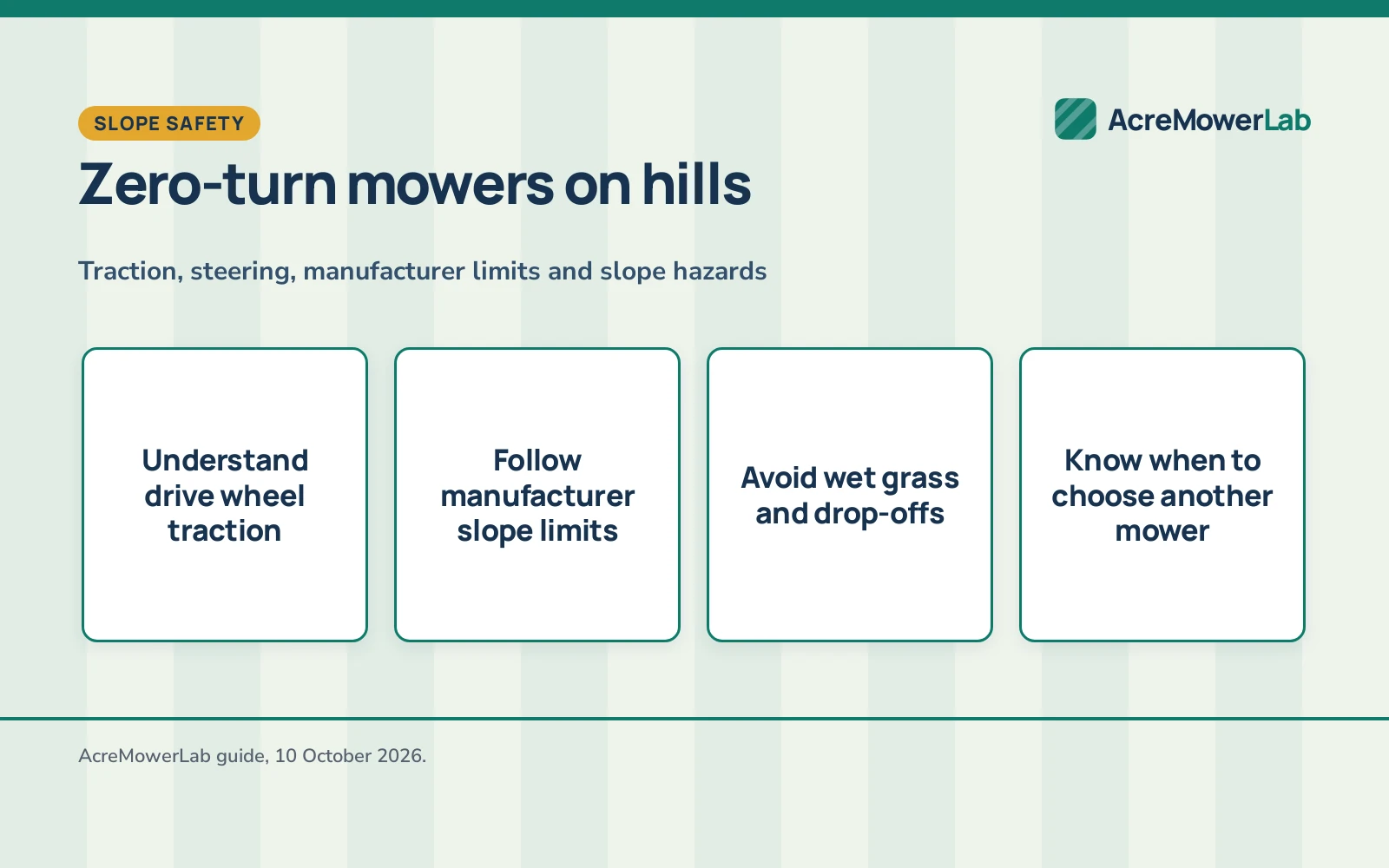
Are zero turn mowers safe on hills? In most situations, zero turn mowers are not safe on steep slopes. While zero turn machines offer speed on flat turf, their steering and braking depend entirely on rear drive wheel traction. The front caster wheels swivel freely without steering links or brakes. On steep slopes or damp grass, gravity pulls the machine downward, causing the rear tires to lose traction. Loss of traction eliminates both steering control and braking, creating severe slide and rollover risks. For sloping ground, property owners must check the manufacturer slope rating, follow safe mowing practices, or select equipment designed for hills.
Other machines to compare
 Segway Navimow i210 AWD Robot Lawn Mower Wire Free withCheck price on Amazon
 Segway Navimow i206 AWD Robot Lawn Mower Wire Free withCheck price on Amazon
 Robot Mower GarageCheck price on Amazon
 ECOVACS Goat O1000 RTK Robot Lawn MowerCheck price on Amazon
 DREAME LiDAR 3500 Robot Lawn Mower A3 AWD Pro Wire Free No RTKCheck price on Amazon
 MOVA LiDAX Ultra 1000 Robot Lawn Mower Wire Free for 1/4 AcreCheck price on Amazon
AcreMowerLab earns a commission when you shop through links here. It never changes your price. Affiliate disclosure.
Are zero turn mowers safe on hills: understand traction and steering
| Machine type | Drive setup | Slope capability |
|---|---|---|
| Residential zero turn mower | Dual rear hydrostatic drive with front casters | Safe only on gentle slopes per maker manual; loses traction and steering on steep inclines |
| Lawn tractor or garden tractor | Front wheel steering with rear transaxle drive | Maintains mechanical front steering on moderate grades; limited by high center of gravity |
| Commercial all-wheel-drive robot | Four independent drive motors | Mammotion lists its LUBA 3 AWD for slopes up to 80% (38.6°) |
| Remote control crawler mower | Dual rubber track drive system | Tyzar lists climbing capability up to 45° with crawler tracks |
Traditional riding mowers feature front wheels tied directly to a steering wheel, providing directional guidance even if the drive wheels slip. By contrast, a zero turn mower uses independent wheel motors powering the rear wheels, paired with front caster wheels that swivel in any direction. Pushing both levers forward moves the machine ahead, while pulling a lever back slows or reverses that drive wheel to turn. Because the front casters have no mechanical steering connection and no brakes, they cannot hold against gravity. If the rear tires lose grip on a slope, the front end swings downhill uncontrollably. See our riding mower for hills guide for machines designed for slopes.
Step 2: check the manufacturer slope rating
Before taking any mower onto an incline, consult the operator manual for the published maximum slope limit. Manufacturers specify a strict slope limit based on machine geometry, tire contact area, and braking ability. The Consumer Product Safety Commission (CPSC) warns that exceeding manufacturer slope limits is a leading cause of riding mower rollover accidents.
Slope limits are also displayed on warning decals on the mower frame. When reviewing zero turn mower specifications, note that many listings do not publish slope limits in marketing summaries. If a listing states ‘Not stated’ for slope angle, locate the operator manual before mowing slopes. Never infer a slope rating based on deck width or engine power. In addition, check for active safety notices by learning how to check if your mower is recalled through the CPSC database.
Step 3: inspect the slope and surface conditions
A slope that looks manageable from a distance often contains hazards that compromise stability. Walk the area on foot to inspect ground firmness, moisture, and surface irregularities. Holes, ruts, and exposed tree roots can drop an uphill wheel or bounce a downhill wheel, causing the machine to tip.
Surface moisture represents the single most dangerous factor on a hillside. Morning dew, rain, or damp clay soil reduces tire traction drastically. A slope that a zero turn climbs easily when dry can turn into a slide on wet turf. Keep a wide buffer zone between your mowing path and any retaining wall, drainage ditch, or pond edge.
Step 4: use safe operating techniques on slopes
Mowing on an approved slope requires disciplined technique. Always drive up and down the slope face, never across the slope. Operating across an incline places excessive weight on downhill tires, increases rollover risk, and causes front casters to drift downhill. Travel slowly and keep all control lever movements smooth and gradual.
Avoid stopping or starting on a hillside. If you must stop while traveling uphill, back down slowly in a straight line with the mower deck lowered. Never attempt a zero-radius turn on a slope: reversing one wheel while driving the other breaks turf grip and starts a slide. Keep cutting blades disengaged when crossing slopes between cutting zones. Review our guide on how to use a zero turn mower for essential operational techniques.
Step 5: select alternative equipment for steep ground
When property slopes exceed manufacturer ratings, attempting to mow with a zero turn mower is unsafe. Property owners should choose alternative equipment built for steep ground.
- Walk-behind commercial mowers: Walk-behind units offer a lower center of gravity and eliminate operator rollover risks on steep banks.
- All-wheel-drive robotic mowers: Robotic mowers such as the Mammotion LUBA 3 AWD use four independent motors and all-wheel drive, climbing slopes up to 80% (38.6°) without an onboard rider.
- Remote-control crawler mowers: For steep banks and rough growth, tracked mowers such as the Tyzar model use a 224 cc gas engine and rubber tracks to climb slopes up to 45° while the operator stands on level ground.
- Commercial string trimmers: For steep culverts, ditches, and rocky hillsides, heavy-duty trimmers provide the safest manual clearing method.
Identify rollover and slide hazards
Rollovers and slides are the primary mechanisms of slope accidents on zero turn mowers. A slide starts when gravity overcomes friction between the rear tires and turf. Because front casters swivel freely, the machine pivots so the heavy rear end slides downhill first. Pulling back abruptly on steering levers locks the drive tires, turning them into sled runners that accelerate the slide.
A rollover can occur sideways or rearward. A sideways rollover happens when a sliding mower trips on a rut, rock, or ditch edge, flipping the machine over. A rearward rollover happens when climbing a steep slope: if the rear tires suddenly grip while driving uphill, the front casters lift and the chassis rotates backward over the rear axle. Knowing these hazards helps operators avoid unsafe situations.
Match the machine to the slope severity
Machine weight, deck size, and tires directly affect stability on hillsides. A residential mower such as the Husqvarna Z254FX features a 54-inch fabricated steel deck, a 726 cc engine producing 22 hp, and a total weight of 780 pounds. That substantial weight increases downhill slide force, requiring reliable tire grip.
Tire design also influences hillside handling. Front tire assemblies such as Roueoo solid polyurethane wheels support up to 350 lbs with 7-inch rims, while LTNICER front tires carry up to 220 lbs on 9-inch wheels. Solid tires resist punctures from thorns, but smooth treads offer less traction on damp grass than turf treads. To compare frame footprints and deck options across categories, review our guide to zero turn mower sizes.
Plan your mowing path across the property
Mowing large acreage with varied terrain requires planning before starting the mower. Divide your property into zones based on slope angle. Keep flat areas in a dedicated zone and treat sloping sections separately.
Plan clear runoff routes at the base of every slope. Ensure the bottom area is dry, level, and free of obstacles, ditches, or water. Never mow toward a pond or retaining wall where a slide could carry the mower over the edge. Setting planned mowing lanes keeps you in control.
Mind ground moisture and turf conditions
Moisture levels change during the day and alter tire grip on slopes. Morning dew creates slick grass blades even on sunny days. Soil beneath the grass may remain soft and damp after rain, reducing tire bite.
Mow slopes during late morning or early afternoon after dew dries. Avoid mowing slopes after rain showers. In addition, watch for thatch and wet leaves on hillsides, as loose debris creates a slippery layer between tires and soil. If tires slip on a gentle rise, stop mowing that slope until ground conditions dry.
Safety
Operating on sloping ground requires following strict safety procedures. Never exceed the manufacturer maximum slope rating stated in the operator manual. Zero-turn mowers lose traction on slopes and near ponds or ditches. When mowing on slopes, keep the Rollover Protective Structure (ROPS) upright and locked, and fasten your seat belt. If the mower lacks a ROPS, do not operate on slopes.
Never carry passengers, and keep children and pets out of the yard during mowing. Keep mower blades off when reversing, and check behind before backing up. Wear eye and hearing protection, and clear sticks and debris before cutting. Refuel only with the engine off and cool. For deck maintenance, support the mower with a dedicated lift jack such as the Maxority lift jack, which supports up to 750 pounds and lifts up to 24 inches with a safety lock. Never work under equipment supported only by hydraulics. See our Safety Disclaimer.
FAQ: mowing large lots
Are zero turn mowers safe on hills?
Zero turn mowers are safe only on gentle slopes that remain within the manufacturer slope rating. Because steering and braking depend solely on rear drive tire traction, steep or damp slopes create severe slide and rollover risks.
Why do zero turn mowers lose traction on slopes?
Zero turn mowers lack front wheel steering. When gravity pulls the machine downhill, the rear tires can break traction. Without rear tire grip, the front casters swivel downhill and the operator loses both steering and braking control.
Should you mow up and down or across a hill with a zero turn?
Always mow up and down a slope, never across. Driving across a slope increases rollover risk and causes the front casters to slide downhill. If the mower cannot climb an incline, back down slowly in a straight line.
What should you do if a zero turn mower starts to slide downhill?
Do not yank the control levers backward abruptly, as locking the drive wheels accelerates the slide. Keep the levers aligned with the direction of travel, lower the cutting deck to create ground drag, and guide the machine toward level ground.
What is the safest alternative for mowing steep banks?
Safe alternatives for steep banks include commercial walk-behind mowers, all-wheel-drive robotic mowers, remote-control crawler track mowers, and commercial string trimmers. These options remove the rider from rollover danger.
More mowing guides
- Best Riding Mower for Hills: 4 Picks and How to Read Slope Ratings
- How to Use Zero Turn Mower: Beginner Operation and Safety Guide
- Zero Turn Mower Sizes: Deck Width and Footprint Guide
- How to Check if Your Mower Is Recalled
Use the Mower Matcher to narrow down choices by acreage, terrain, budget, and power type.