How to Measure the Slope of Your Yard
A step-by-step guide to measuring yard slope using a string line, level, or angle gauge to find your rise, run, and grade percentage.

On this page
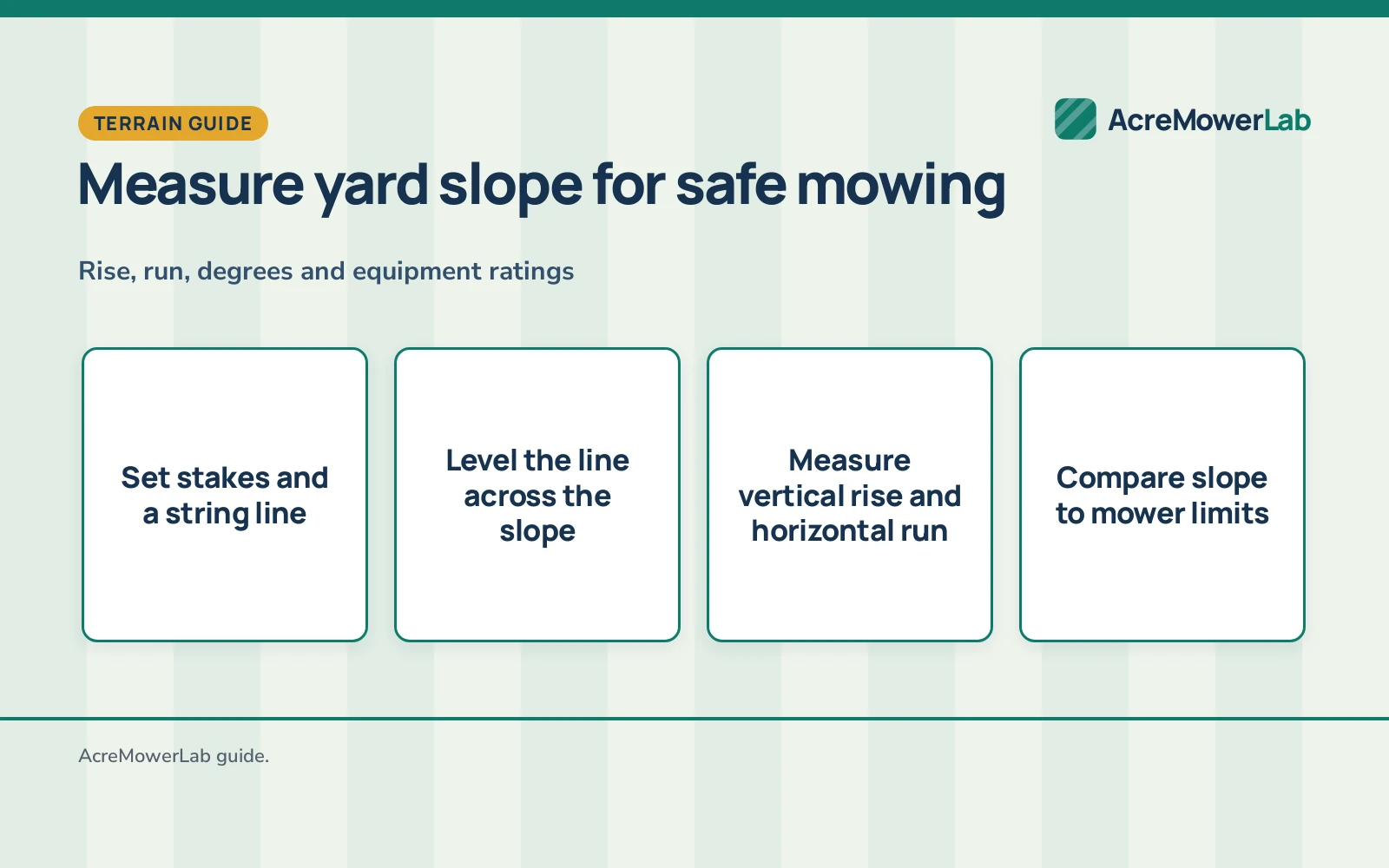
Here is how to measure the slope of your yard: set stakes at the uphill and downhill points of the incline, stretch a string taut between them, level the line with a string level, and measure the vertical rise and horizontal run. Dividing the vertical rise by the horizontal run gives the slope ratio and percent grade, while placing a digital angle gauge or pitch locator on a straight board directly displays the angle in degrees. Measuring yard slope identifies steep grades before you mow and helps you match your terrain to safe equipment limits. This guide explains each step in order.
As an Amazon Associate I earn from qualifying purchases. AcreMowerLab earns a commission when you shop through links here. It never changes your price. Affiliate disclosure.
How to measure the slope of your yard: pick the right tool
| Tool | Best for | Limit |
|---|---|---|
| String line and line level | Measuring defined slope intervals between stakes | Requires manual measurement of rise and run |
| Digital level (12-inch) | Instant angle and percent grade readouts on a board | Needs a straight edge across rough turf |
| Pitch and slope locator | Direct analog reading of degrees and pitch | Must sit flush on a rigid board across the incline |
| Digital angle gauge | Compact angle measurements on a straight edge | Measures board angle rather than ground contours beneath |
Most property owners combine a string line with a handheld level or gauge. Check our best riding mower for hills guide to see how slope measurements apply to equipment ratings.
Step 2: set stakes and string across the slope
Start by identifying the slope line you need to evaluate. Drive a wooden or metal stake into the ground at the top of the incline. Walk directly down the fall line to the bottom of the slope section and drive another stake into the ground. Driving the stakes firmly ensures they remain plumb under string tension.
Tie mason line to the uphill stake right at ground level. Stretch the string line down to the lower stake, pulling it tight so there is no belly or sag in the line. Hang a lightweight line level on the center of the string. Move the string up or down along the downhill stake until the level vial bubble rests centered between the indicator lines. Once level, secure the string tightly to the downhill stake.
Step 3: level the line and record rise and run
With the string line secured and verified level, record your physical dimensions with a measuring tape. The horizontal distance along the string between the uphill ground point and the downhill stake represents the horizontal run. The vertical distance on the downhill stake from the ground up to the level string represents the vertical rise.
Published specifications for individual leveling tools illustrate the measurement units available. The Johnson 750 pitch and slope locator listing features a printed scale reading pitch in inch rise per 12 in. run without conversion tables, showing 0-90° across two quadrants. The Swanson AF006M angle finder lists accuracy to 0.5 degrees across 4 quadrants. The Prexiso 12-inch digital level specifies 3 measuring units: degrees, % grade, and IN/FT, with a stated accuracy of ±0.1° at 0° and 90°. The Klein Tools 935DAG digital angle gauge listing specifies 0 – 90 and 0 – 180 degree ranges. In contrast, grading levels such as the Kapro 105 Topgrade 48 inch gradient box level feature pre-set vials for 0%, 1% and 2% slope, which are designed for slight drainage pitch rather than steep yard hills.
Step 4: calculate slope percentage and angle
Once you have recorded the vertical rise and horizontal run, divide the rise by the run. This division produces the slope ratio. Multiplying the ratio into a percentage yields the percent grade of your lawn. For example, dividing vertical drop by horizontal distance gives the gradient across that slope span.
Percent grade and slope degrees describe the same physical hill using different scales. Percent grade expresses the vertical change per unit of horizontal span, while degrees measure the radial angle upward from a horizontal baseline. For typical yard slopes, percent grade produces a higher numerical figure than the angle in degrees. Handheld digital levels and angle gauges display these units directly without manual calculations. While equipment-mounted instruments like the Slope Meter No. 2 provide a 0-12% grade range with 1 degree accuracy and a 1 second response for motor graders, residential yard hills frequently require tools with wider degree ranges to match mower ratings.
Step 5: compare results to mower slope ratings
After determining your yard’s slope in degrees and percent grade, compare the figures against the manufacturer specifications in your equipment operator manual. Equipment manuals state maximum operating slope angles designed to prevent loss of control, engine oil starvation, and rollover hazards.
Never exceed the equipment maker stated slope limit. Consult our guide on what is the max slope for a riding mower for details on standard tractor ratings. Operators using zero-turn equipment should review are zero turn mowers safe on hills, as dual-lever drive systems handle inclines differently than front-steer machines. Slopes exceeding your equipment rating should be maintained with walk-behind mowers, string trimmers, or planted with ground cover.
Locate the sharpest slope sections
Acreage properties rarely feature uniform grade throughout. Swales, drainage ditches, septic mounds, and roadside banks create sharp transitions across an otherwise gentle lawn. Walking the mowing route before measuring helps locate the sharpest individual sections.
Take measurements at multiple spots along your mowing route, concentrating on transition zones and drop-offs. Measuring only the broad, gentle center of a hill gives a false impression of safety if your mower must enter or exit across a sharper bank. Machine stability and tire grip are governed by the sharpest pitch the wheels encounter.
Match the measuring method to your yard
Choose your measuring method based on the slope length and terrain profile. On long, rolling hillsides across acreage, measure distinct slope intervals of manageable length with stakes, string, a line level, and a tape measure. Measuring separate sections prevents long string lines from sagging and ensures that localized steep pitches are not obscured by an overall average grade.
For short banks, roadside ditches, and abrupt terraces, a rigid straight edge paired with a digital level or angle gauge provides immediate numbers. Placing a long, straight wooden board across the turf bridges small holes and thick grass clumps, allowing the digital gauge or slope locator to sit flush without rocking on uneven turf. For matching equipment to property profiles, browse our riding mower reviews.
Map your property in slope zones
Divide your property into distinct management zones according to measured slope severity. Classify flat areas around the home as primary mowing zones, moderate hills as controlled operating areas, and steep perimeter banks as restricted zones.
Establish clear travel patterns for each zone. On riding lawn tractors, mowing straight up and down slopes minimizes sideways tip risk. On zero-turn mowers, follow your manual specific slope direction rules, avoid sharp turns on inclines, and never mow across steep slopes where drive wheels can lose traction and pivot downhill. Clearly delineate any terrain sections that exceed your machine manual rating so every operator knows where riding equipment must not travel.
Mind ground conditions and turf grip
Slope measurements represent dry, ideal ground conditions, but real-world traction changes dramatically with weather and moisture. Morning dew, recent rainfall, or damp shade reduce tire traction across grass. Even a modest hill that is safe when dry can cause equipment tires to break loose and slide when the grass is wet.
Soil type also affects wheel grip. Saturated clay soil shears under tire tread, while dry, loose sandy soil can slide under braking pressure. Always wait until the turf is thoroughly dry before operating riding machinery on slopes. Never mow near retaining walls, drainage ditches, or ponds where a slide could carry equipment over an edge or into water.
Safety
Operating machinery on slopes demands strict adherence to safety rules. Always consult the operator manual and never exceed the manufacturer maximum slope rating for your machine. Zero-turn mowers steer through wheel traction and can lose steering authority on steep slopes, sliding unexpectedly toward ponds, ditches, or embankments. Keep the rollover protective structure upright and fasten the seat belt securely on equipped machines. Never carry passengers, and keep children and pets completely away from the work area while mowing. Always disengage the mower cutting blades before shifting into reverse. Wear sturdy work shoes with non-slip soles, eye protection, and hearing protection. Refuel gas machinery outdoors only with the engine shut down and cool. See our Safety Disclaimer.
FAQ: mowing large lots
How do you calculate yard slope from rise and run?
Measure the vertical drop and horizontal distance along the slope. Divide the vertical rise by the horizontal run to find the slope ratio, then express the result as percent grade. For direct degree readouts, place an electronic angle gauge or slope locator on a straight board along the incline.
What tools work best for measuring yard slope?
A string line with a line level and ground stakes works well for long yard sections. For quicker measurements across short spans, a straight board paired with a digital level or pitch locator provides instant slope readings.
What is the difference between percent grade and degrees of slope?
Percent grade measures vertical rise divided by horizontal run, while degrees measure the physical angle of inclination from horizontal. For typical yard slopes, percent grade produces a higher numerical figure than the angle in degrees.
Where should I measure slope on my property?
Measure along the sharpest path where your mower travels, rather than the gentlest approach. Identify drainage banks, roadside ditches, and sharp transitions, as these represent the greatest risk for loss of traction.
Why is yard slope measurement critical before mowing?
Mower stability depends directly on ground angle. Exceeding the manufacturer maximum slope limit can cause drive wheels to lose traction, leading to sliding, loss of steering control, or rollovers.
More mowing guides
- Best Riding Mower for Hills: 4 Picks and How to Read Slope Ratings
- What Is the MAX Slope for a Riding Mower?
- Are Zero Turn Mowers Safe on Hills?
- How to Use Zero Turn Mower: Beginner Operation and Safety Guide
Use the Mower Matcher to narrow down choices by acreage, terrain, budget, and power type.