Hedge Trimmer Sizes: Blade Length and Reach Guide
A practical guide to hedge trimmer sizes: blade length, branch cut capacity, pole reach, tool weight and matching the tool to your property.

On this page
Top picks at a glance
As an Amazon Associate I earn from qualifying purchases.
- 1
 EGO Power+ HT2600 56V 26 in Cordless Hedge Trimmer9.6/10View on Amazon
- 2
 Greenworks 40V Pole Saw and Hedge Trimmer Combo Kit9.6/10View on Amazon
- 3
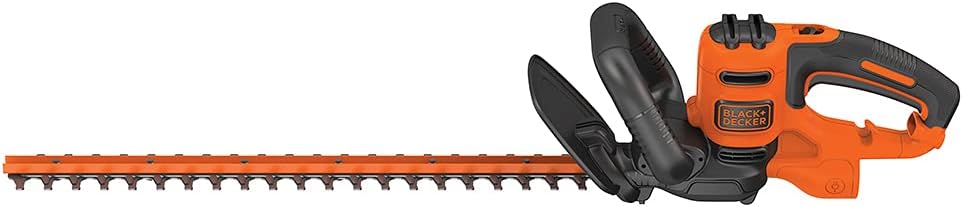 BLACK+DECKER BEHT350FF 22 in Corded Electric Hedge Trimmer9.6/10View on Amazon
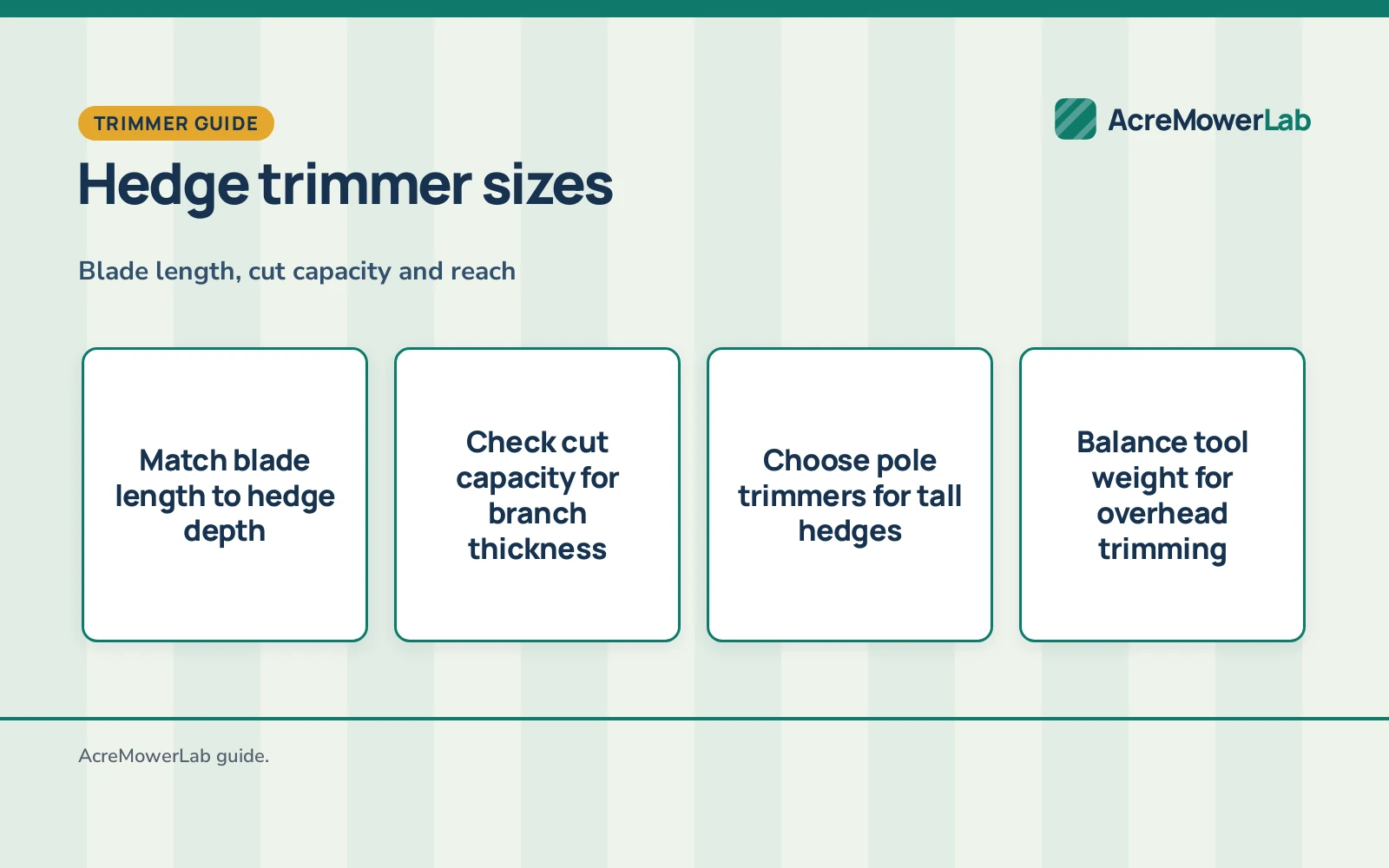
Maintaining hedges and brush lines across a rural property requires matching cutting equipment to vegetation height and branch thickness. On acreage with long fence lines and varied terrain, understanding hedge trimmer sizes ensures you pick the right blade length, cut capacity, and reach without carrying excess weight. Hedge trimmer sizes are defined by three dimensions: blade length, tooth cut capacity, and working reach. Specifications span 10 inches on manual shears, 12 to 20 inches on pole trimmers, and 22 to 26 inches on handheld power units. Cut capacities range from 5/8 inch to 1.1 inches, and pole trimmers reach 7 to 15 feet from the ground. Here is how to choose each dimension.
AcreMowerLab earns a commission when you shop through links here. It never changes your price. Affiliate disclosure.
Hedge trimmer sizes: pick the right blade length and reach
| Tool type | Stated specs in listings | Best for | Limit |
|---|---|---|---|
| Manual extendable shears | 10-inch blade, 25 to 33-inch reach, 16 ounces | Precision shaping, tight garden beds, quiet touch-ups | Slow progress on long boundary lines |
| Pole hedge trimmer | 12 to 20-inch blades, 7 to 15-foot reach | Tall hedges, elevated branches, trimming without ladders | Shorter blades than handhelds; overhead leverage |
| Handheld cordless trimmer | 22 to 26-inch blades, 5/8 to 1.1-inch cut capacity | Waist to shoulder-height hedges, flat top leveling | Reach limited to arm height without a platform |
| Gas multi-tool system | 43CC engine, 1200ml fuel tank, 26.5 pounds | Remote property lines, dense brush, multi-task clearing | Heavy carried weight, engine maintenance |
Most rural property owners combine a handheld trimmer with a pole unit for tall screens. See our hedge trimmers for tall hedges roundup for high-reach options.
Step 2: measure your hedge depth and height
Measure hedge depth and height before choosing a blade. Low shrubs require agile handling, while wide boundary plantings demand longer cutter bars. When accessible from both sides, a blade spanning half the hedge width trims the top evenly. Along fence lines or ditches where only one side is accessible, you need enough blade length or pole reach to sweep the full depth.
For ornamental shrubs, Fiskars lists 10-inch serrated steel blades on extendable handles adjusting from 25 to 33 inches, weighing 16 ounces. On handheld power trimmers, listings range from 22 inches on DEWALT and BeautFirst to 24 inches on EGO and 26 inches on Greenworks for broad, level passes.
Step 3: check the branch cut capacity
Cut capacity is the gap between blade teeth, dictating the maximum branch diameter a trimmer cuts cleanly without stalling. Matching cut capacity to stem thickness protects the motor and prevents ragged cuts.
TaskStar lists a 5/8-inch capacity on its 16-inch cordless pole model, BeautFirst lists 5/8 inches on its 22-inch handheld unit, and GARCARE lists 5/8 inch (0.63 inches) on its 18-inch corded pole tool. For heavier stems, DEWALT lists 3/4 inch on its 22-inch model, Supstable lists 3/4 inch on its 12-inch attachment, and SOARFLY lists 0.8 inch. For mature growth, EGO lists a 1-inch capacity on its 24-inch blade, and Greenworks lists 1.1 inches on its 26-inch trimmer. Cut branches exceeding your trimmer’s stated capacity with manual loppers or a pruning saw.
Step 4: decide between handheld and pole reach
Working height determines whether a handheld trimmer or an extended pole system is safer. Operating power trimmers from ladders on uneven rural ground creates severe fall hazards; hedges above shoulder height call for pole-mounted cutting heads.
Handheld models provide direct control for waist to shoulder-height hedges. For taller screens, telescopic poles bridge the reach. SOARFLY lists a 20-inch blade on a pole extending from 7 to 8.5 feet with 11 angles pivoting up to 150 degrees. GARCARE lists an 18-inch blade on a pole extending to 9.1 feet for reach up to 12 feet. Supstable lists an extension reaching up to 15 feet based on a 6-foot user, with a 12-inch blade and a head pivoting 180 degrees across 5 positions.
Step 5: balance tool weight for long property lines
Tool weight directly affects fatigue along long fence lines and driveways. Extended blades and pole shafts increase leverage, placing strain on shoulders and arms.
Among handheld models, BeautFirst lists a 22-inch cordless trimmer at 5.6 pounds, EGO lists a 24-inch bare tool at 6.2 pounds, Greenworks lists an 80V 26-inch unit at 7.2 pounds, and DEWALT lists a 22-inch bare tool at 9.7 pounds. On pole tools, GARCARE lists a corded model at 7.9 pounds, while cordless pole trimmers from TaskStar and SOARFLY each weigh 8 pounds with shoulder straps to distribute weight. Multi-tool rigs carry more mass: Supstable lists a 6-in-1 cordless system at 14.4 pounds, and Garvee lists a 43CC gas unit at 26.5 pounds.
Match the blade length to tool design and hedge depth
Blade length sets cutting swath, tool balance, and sweeping effort. Length choices correspond directly to tool configuration.
Manual shears use 10-inch blades, as listed by Fiskars, providing precise tactile control for detailed ornamental shaping. Pole trimmers keep blades shorter, from 12 to 20 inches, to prevent front-heavy torque on extended shafts: Supstable lists 12 inches, TaskStar lists 16 inches, GARCARE lists 18 inches, and SOARFLY lists 20 inches. Handheld power trimmers support longer cutter bars held close to the body, including 22 inches on DEWALT and BeautFirst, 24 inches on EGO, and 26 inches on Greenworks, enabling broad leveling passes across deep boundary hedges.
Match the trimmer to your hedge type
Hedge species dictate tooth spacing requirements. Soft, leafy shrubs like boxwood and privet feature dense, thin stems where fine tooth spacing shears foliage cleanly without browning.
Hardwood shrubs, mature cedar, and mixed field-edge brush feature tough, fibrous growth. For thick perimeter brush, select wider tooth gaps such as 3/4 inch, 0.8 inch, 1 inch, or 1.1 inches so woody stems seat fully between teeth rather than deflecting. Along untamed pastures or woods, pair your hedge trimmer with a string trimmer for acreage to clear fence-line ground growth in the same maintenance pass.
Plan your property trimming in zones
Divide rural properties into zones based on hedge height and growth rate. Start with high-visibility entryways and garden beds requiring detailed shaping. Move next to boundary fence lines where longer blades allow continuous sweeping passes. Reserve tall windbreaks for dedicated pole-trimming sessions focused on overhead balance. Complete each zone and clear cuttings onto tarps or utility carts before moving forward, keeping stray branches from tangling in mower decks during later grass passes.
Mind the power source and runtimes
Power platforms dictate runtime and portability on acreage. Cordless tools avoid fumes and cords, with duration varying by branch load.
DEWALT lists up to 78 minutes of runtime on its 20V platform. SOARFLY lists about 90 minutes of continuous operation from two 20V 4.0Ah batteries, TaskStar lists 90 to 100 minutes from two 20V 4.0Ah packs, and BeautFirst lists 100 to 120 minutes from two 20V 5.0Ah packs with a 2-hour recharge. Greenworks provides 80V power with a 2.0Ah pack. For continuous power, GARCARE lists 500W on 120V corded electric, while Garvee uses a 43CC 2-cycle engine with a 1200ml fuel tank for distant fence rows.
Safety
Always wear eye and hearing protection, heavy gloves, and sturdy non-slip boots. Inspect fence lines before trimming and clear wire, irrigation tubing, and hidden debris that could jam reciprocating teeth. Keep children, pets, and bystanders clear of the cutting radius. Never use power trimmers from ladders: use pole extensions to work from stable ground. Refuel gas engines outdoors only when cool. Disconnect batteries or power cords before clearing jams, applying lubricant, or checking cutter teeth.
FAQ: mowing large lots
What hedge trimmer blade length do I need for standard yard shrubs?
For waist to chest-height shrubs, handheld blades between 22 and 24 inches balance cutting coverage with maneuverability, allowing level top passes without unnecessary forward weight.
What is the difference between blade length and cut capacity?
Blade length (10 to 26 inches) measures the cutter bar reach and surface area covered per pass. Cut capacity (5/8 inch to 1.1 inches) measures the gap between teeth, setting maximum branch thickness.
When should I choose a pole hedge trimmer over a handheld model?
Choose a pole trimmer whenever hedges exceed shoulder height. Pole shafts reach 7 to 15 feet from the ground, avoiding hazardous ladder use on uneven rural ground.
Can a hedge trimmer cut branches thicker than its rated capacity?
No. Forcing oversize stems stalls motors, damages clutches, and bends teeth. Stems exceeding stated ratings (such as 5/8 inch, 3/4 inch, or 1.1 inches) should be pruned with manual loppers or saws.
How do I maintain hedge trimmer blades after cutting dirty or sap-heavy branches?
Clean sap with resin cleaner after each session, apply protective oil to cutter teeth, and inspect blade tightness. See our hedge trimmer maintenance guide for full care steps.
More mowing guides
- Best Hedge Trimmer for Tall Hedges (2026): 5 Picks Compared
- Hedge Trimmer Maintenance: Step-by-Step Care Guide
- Best Hedge Trimmer for Seniors (2026): 5 Picks Compared
- Best String Trimmer for Acreage: 4 Gas and Battery Picks
Explore our complete trimmers and blowers section for equipment guides, seasonal maintenance tips, and acreage property care advice.