Can a Zero Turn Pull Attachments?
A practical guide to pulling tow-behind attachments with a zero-turn mower, covering hitch mounting, towing limits, transmission care and yard safety.

On this page
Top picks at a glance
As an Amazon Associate I earn from qualifying purchases.
- 1
 HOWBOW Zero Turn Mower Trailer Tow Hitch with Pin9.6/10View on Amazon
- 2
 CZC AUTO Zero Turn Mower Trailer Hitch & 5/8 in Magnetic Pin9.4/10View on Amazon
- 3
 Master Mfg Revolt Lithium-Ion 9-Gallon Pull and Tow Sprayer9.4/10View on Amazon
- 4
 Z-Trimmer PRO ZT-5000 Zero Turn Mower Trimmer AttachmentView on Amazon
- 5
 Titan Attachments 3 Point PTO Finish MowerView on Amazon
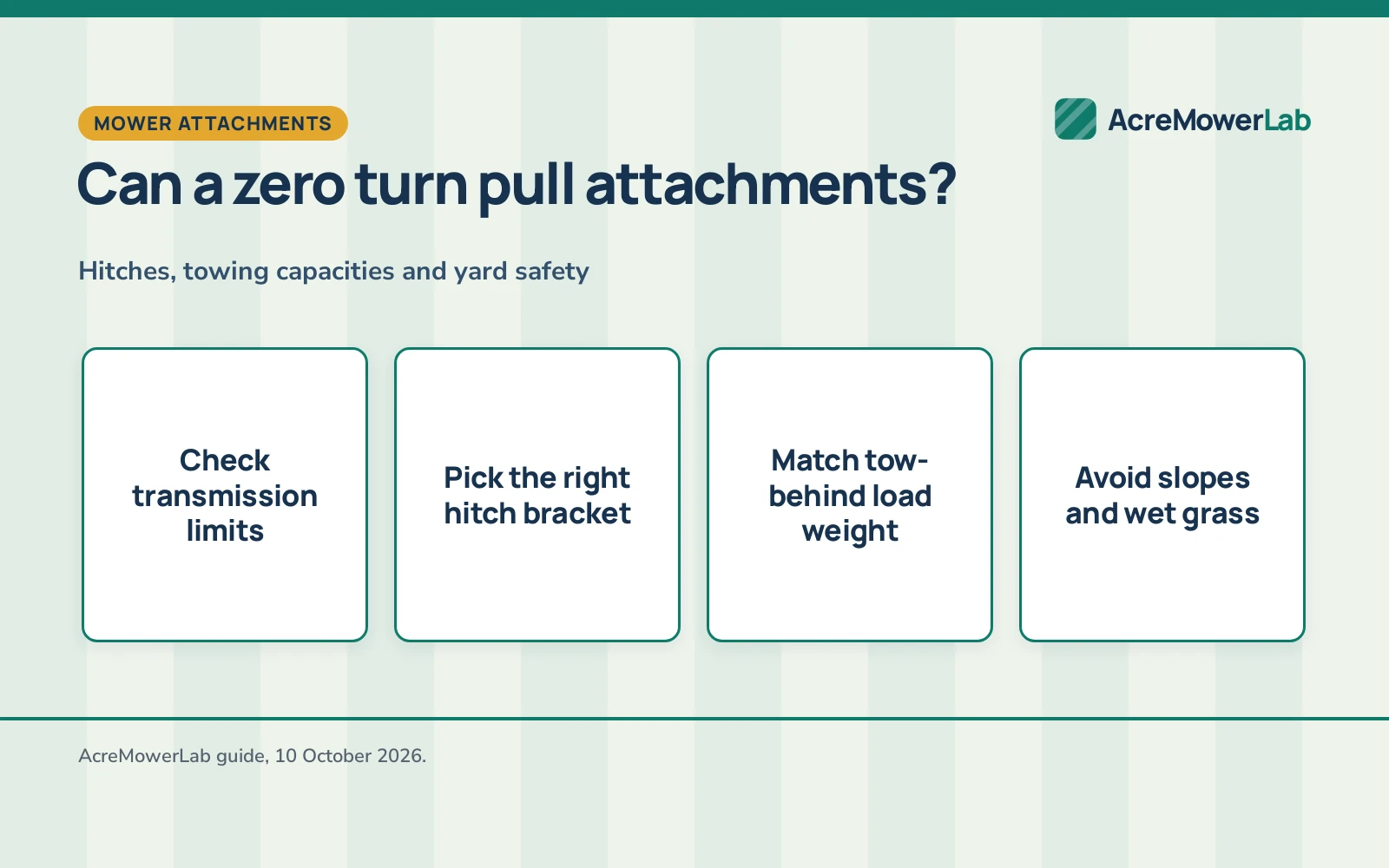
Can a zero turn pull attachments? Yes, a zero-turn mower can pull attachments if it is equipped with a compatible rear hitch bracket and the trailing load stays within the mower towing capacity. Because zero-turn machines rely on independent hydraulic wheel motors for steering and forward movement, towing adds mechanical strain and heat to the transaxles. Light rolling implements such as dump carts, lawn sweepers, and broadcast spreaders pull smoothly across level turf, whereas ground-engaging tools or steep slopes create heavy resistance that can cause wheel spin, overheat transmissions, or compromise steering control.
Other machines to compare
 Z-Trimmer PRO ZT-5000 Zero Turn Mower Trimmer AttachmentCheck price on Amazon
 Titan Attachments 3 Point PTO Finish MowerCheck price on Amazon
AcreMowerLab earns a commission when you shop through links here. It never changes your price. Affiliate disclosure.
Can a zero turn pull attachments: hitch types and towing limits
| Attachment type | Hitch connection | Key limit |
|---|---|---|
| Utility cart or dump trailer | Hitch pin or ball mount | Stopping distance and payload weight on turf |
| Plug aerator | Hitch pin or clevis connection | Soil drag and ballast weight |
| Lawn sweeper | Hitch pin plate | Hopper bulk and wide swing during turns |
| Spreader or sprayer | Pin hitch | Liquid slosh and tongue balance |
Many residential zero-turn mowers do not include a factory rear hitch, requiring owners to install an aftermarket bolt-on bracket matched to the frame. Once equipped, a zero-turn mower can handle routine hauling and turf maintenance across large lawns. Review our tow-behind attachments guide to see how different pull-behind implements fit acreage properties.
Step 2: check your transmission and towing capacity
Before hitching any implement, you must verify your mower zero turn towing capacity. Aftermarket hitch listings often publish impressive pull ratings. For example, HOWBOW lists a maximum towing capacity and pull force of 2000 pounds for its heavy-duty steel hitch, while EilxMag and leevanoo each list a maximum towing capacity of 1500 pounds. For a lighter bracket, KMFCDAE states a max loaded weight up to 250 LBS for its universal hitch adapter.
However, hitch strength is rarely the limiting factor. The true limit is your mower hydrostatic transaxles and chassis design. Entry-level residential zero-turns use sealed transaxles engineered primarily for grass cutting rather than pulling draft. Excess trailing weight elevates internal hydraulic operating pressure, generating heat that degrades hydrostatic fluid and pump seals over time. Commercial mowers with heavier-duty transaxles generally tolerate more pulling strain, but you should always consult your operator manual for the rated towing limit. If your manual lists no towing specification, keep trailing loads light and avoid pulling heavy ground-engaging tools. Learn more about hydraulic drive systems in our guide to zero-turn transmission types.
Step 3: choose the right hitch setup
Because zero-turn frames differ across brands, hitch brackets use slotted mounting holes to span different bolt patterns. When choosing a hitch, measure the hole spacing on your rear engine guard or bumper plate. The joytrace hitch kit accommodates bolt spacing from 2.9 to 5.3 inches, the HOWBOW hitch fits 2″-5.1″ bolt mounting spacing, and the leevanoo hitch fits 4.2 inch -6.8 inch bolt mounting spacing. The EilxMag hitch specifies a 5 inch outside hole center with an inside hole center of 2 to 3 inch.
Material thickness also varies among aftermarket options. HOWBOW and Adorish use 1/4″ (6mm) plate steel, joytrace uses 6mm solid steel plate, leevanoo uses 6mm carbon steel, and KMFCDAE uses 0.17″ thickness steel. In addition, consider connection styles. Adorish highlights 3 different ways to attach equipment, accommodating a pin, chain, or hitch ball. Pin hole sizes also vary across individual kits: HOWBOW, Adorish, and KMFCDAE provide 3/4″ pin holes, joytrace and leevanoo provide 5/8″ pin holes, while EilxMag and joytrace include 1/2 inch hitch pins. Receiver tubes appear on select options: joytrace provides a 1-1/4″ receiver, while leevanoo features a 2″ receiver. For quick implement swaps, EilxMag supplies a 1/2 inch diameter magnetic hitch pin with a 1 inch outer diameter ring magnet.
Step 4: connect and balance the load
Proper tongue weight is essential for zero-turn control. Because a zero-turn hitch mounts behind the rear drive axle, the rear axle acts as a fulcrum. Excessive downward tongue weight from cargo placed too far forward on the trailer levers the front of the machine upward, lifting the front caster wheels and compromising balance. Conversely, if cargo sits too far behind the trailer axle, negative tongue weight pulls upward on the hitch, taking weight off the rear drive tires and causing wheel spin or loss of braking traction.
Keep your trailer tongue balanced so modest downward force rests on the hitch pin. For specialized accessories mounted directly to the frame or deck, respect stated load limits. For example, SDSNTE produces a mower handle bracket designed to carry a 5-gallon bucket with a maximum load of 20 lbs using 1-inch square tubing. For deck-mounted equipment, the Generic Z-Trimmer attachment requires a 6″ x 4″ flat surface on the mower deck, weighs 51 pounds, and specifies a minimum 15 Amp charging system with an operating range of 15-30 Amps and a recommended run time of approximately 20 minutes per hour of mowing. When pulling turf implements such as a best tow-behind aerator, distribute cinder blocks or weight jugs evenly across the aerator tray so the spoons penetrate the soil without twisting the hitch bracket.
Step 5: adjust your driving technique
Operating a zero-turn mower with a trailer requires different habits than mowing open turf. Never execute a zero-radius spin while towing. If you pull a steering lever backward while pushing the other forward, the mower pivots sharply, immediately jackknifing the trailer tongue against the drive tires. This can bend the hitch pin, crush the trailer drawbar, or puncture a tire.
Instead, make broad, teardrop turns around trees, fence corners, and garden beds. Advance both steering levers smoothly and use gradual, gentle differences between levers to steer. Accelerate smoothly: snapping the steering levers forward jerks the trailing weight and shocks the transaxle gear teeth. Because trailing carts lack brakes, plan your stops well in advance and decelerate gradually on level grass.
Match the attachment to your yard tasks
Tow-behind implements fall into distinct categories: rolling equipment and ground-engaging equipment. Rolling implements, including poly dump carts, broadcast spreaders, tank sprayers, and lawn sweepers, roll smoothly on pneumatic tires and place minimal draft on the mower. They are practical companions for zero-turn mowers because they allow efficient yard cleanup and fertilization without bogging down the drive wheels.
Ground-engaging implements, by contrast, pull steel tines or knives deep into the soil. A tow-behind dethatcher or core aerator creates significant resistance that pulls backward on the mower frame. When pulling ground-engaging tools, monitor mower ground speed and tire grip. If you notice the drive wheels slipping or the hydraulic pumps whining, reduce extra tray weight or make passes only when soil moisture is ideal.
Why zero-turn steering reacts differently when towing
Lawn tractors steer through geared front wheels, keeping the tractor tracking straight even when pushed from behind. Zero-turn mowers differ fundamentally because their front wheels are passive swivel casters. All steering, propulsion, and braking happen entirely at the rear drive tires through independent hydraulic wheel motors.
When you pull a heavy trailer, any sudden change in ground slope or traction causes the trailer momentum to push against the hitch. If a drive wheel loses traction, the trailing load pivots the rear of the mower sideways in an uncontrolled slide. Understanding these steering dynamics is critical for yard safety. Read our detailed analysis on whether zero-turn mowers on hills remain stable before attempting any slope work with a trailer.
Watch the weight and ground conditions
Ground conditions dictate how safely a zero-turn mower can tow. Dry, level turf offers firm traction for standard turf tires. However, early morning dew, wet grass clippings, and damp clay drastically reduce tire adhesion. If the drive tires lose their grip while pulling a loaded cart, the mower can spin out or slide downhill.
Avoid towing across muddy patches, ditch banks, or steep yard contours. If your property includes uneven ground or drainage swales, plan your hauling path along the flattest terrain available. Never overload a cart with wet firewood, gravel, or soil beyond what your mower can smoothly stop without skidding.
Inspect hardware and hitch mounting points
Towing introduces persistent vibration that can loosen fasteners over time. Before each work session, inspect the bolts securing the hitch plate to the mower frame. Confirm that lock washers and locking nuts remain tight and that the mounting plate shows no metal fatigue, hairline cracks, or warping.
Examine the hitch pin and retention clip before hauling. If your kit uses a magnetic hitch pin, ensure the neodymium magnet sits flush against the bracket and always insert the safety hairpin or R-clip into the cross hole. Regularly inspect trailer tire pressure, wheel bearings, and drawbar welds to ensure trailing gear rolls freely behind your machine.
Safety
Safety requires disciplined operation whenever you attach trailing loads to a zero-turn mower. Always follow your mower manufacturer published maximum slope rating, and never tow on steep inclines. Zero-turn mowers readily lose traction on slopes, wet grass, and near pond banks, drainage ditches, or retaining walls. Where equipped, deploy the roll-over protective structure (ROPS) and fasten your seat belt.
Never carry passengers on the mower or inside a towed utility cart. Keep children, pets, and bystanders completely clear of the operating area. Always disengage mower blades and shut off the PTO when driving in reverse. Wear eye protection, hearing protection, and sturdy work boots during operation. Clear sticks, rocks, wire, and loose yard debris from your route before towing. Finally, refuel your mower only when the engine is completely shut off and cool to the touch.
FAQ: mowing large lots
Will pulling attachments damage a zero-turn transmission?
Pulling attachments can damage a zero-turn transmission if the trailing load exceeds the manufacturer towing rating or if you haul heavy cargo up steep inclines. Hydrostatic transaxles generate excess heat under heavy draft loads, which can break down hydraulic fluid and wear out pump seals. Light rolling loads on flat ground are generally safe for healthy transmissions.
Can every zero-turn mower accept a trailer hitch?
Many zero-turn mowers can accept an aftermarket bolt-on hitch, provided the rear frame or engine guard offers flat mounting surfaces. Slotted universal hitches accommodate various bolt spacing patterns. However, some compact residential models with lightweight stamped frames lack adequate mounting points for towing.
How much weight can a zero-turn mower pull?
Aftermarket hitch brackets boast high ratings, such as 2000 pounds for HOWBOW, 1500 pounds for EilxMag and leevanoo, and 250 LBS for KMFCDAE. However, your mower safe towing capacity is governed by its hydrostatic transaxles, chassis build, and braking ability. Always consult your operator manual for the exact manufacturer towing limit.
Can you pull a plug aerator with a zero-turn mower?
Yes, you can pull a plug aerator with a zero-turn mower if the ground is relatively flat and the mower possesses sufficient transaxle power. Because aerator spoons penetrate the soil, ground drag is substantial. Use wide turns to avoid tearing turf or bending the aerator tongue, and avoid aerating on slopes.
Can a zero-turn mower pull attachments on hills?
Towing on hills with a zero-turn mower is risky and generally discouraged. Trailing weight pushes against the rear drive tires when traveling downhill, easily breaking tire traction. Once traction is lost, the passive front caster wheels cannot steer the machine, creating a severe slide hazard.
More mowing guides
- Best Tow-Behind Aerator: 4 Plug Aerators for 1 to 10 Acres
- Best Tow Behind Dethatcher (2026): 5 Picks Compared
- Zero Turn Transmission Types Explained
- Are Zero Turn Mowers Safe on Hills?
Explore our tow-behind attachments guide to choose the right implements for your acreage.