Core Aerator vs Overseeder: Which One Should You Buy?
A guide to core aerators and overseeders: what each tool does, when to aerate, when to overseed, and the core aerators to match to a lawn.

On this page
Top picks at a glance
As an Amazon Associate I earn from qualifying purchases.
- 1
 VEVOR Tow Behind Plug Aerator9.6/10View on Amazon
- 2
 Xuperace Lawn Core Aerator9.6/10View on Amazon
- 3
 LawnVigor Manual Lawn Core Aerator9.6/10View on Amazon
- 4
 Heavy-Duty Rolling Core Lawn Aerator with Dual-Row HollowView on Amazon
- 5
 Heavy Duty Steel Hollow Tine Core Aerator for Clay SoilView on Amazon
A lawn that has gone thin and patchy, with bare spots that seed alone never seems to fix, usually has a soil problem underneath the grass. The answer to core aerator vs overseeder is that the two tools do different jobs: a core aerator pulls small soil plugs out of compacted ground so air, water and nutrients can reach the roots, while an overseeder spreads seed over a lawn that needs thickening. Aerate first, then overseed, so seed lands on loosened soil rather than on hard ground.
Other machines to compare
 Heavy-Duty Rolling Core Lawn Aerator with Dual-Row HollowCheck price on Amazon
 Heavy Duty Steel Hollow Tine Core Aerator for Clay SoilCheck price on Amazon
AcreMowerLab earns a commission when you shop through links here. It never changes your price. Affiliate disclosure.
Core aerator vs overseeder: what each tool does
A core aerator removes plugs of soil. The Josmimic Black listing states that four reinforced hollow tines pull soil cores from compacted ground, and the open channels help air, water and nutrients travel deeper into the root zone, supporting stronger roots, improved drainage and healthier grass growth. The Bigwish listing states the same idea in plainer terms: removing soil plugs relieves compaction at the root level, improves airflow, water penetration and nutrient absorption, and supports thicker, stronger grass over time.
An overseeder does a different job: it spreads seed. Seed thickens a thin lawn, but seed on compacted ground sits on a hard surface with little soil contact. That is why the two tools are often paired rather than swapped: aeration opens the ground, and overseeding fills it in. The gear section below covers core aerators only, since an overseeder is a separate purchase.
| Tool | Does | Best for |
|---|---|---|
| Core aerator | Pulls soil plugs from compacted ground | Compacted soil, clay-heavy yards, lawns before overseeding |
| Overseeder | Spreads seed over the lawn | Thin or patchy lawns that need thickening |
| Aerate, then overseed | Opens the soil, then seeds it | Thin lawns on compacted ground |
When to aerate, when to overseed, and when to do both
Aerate when the ground is compacted. The Bigwish listing states its tool suits compacted soil, clay-heavy yards and seasonal lawn restoration, and the Josmimic listings describe firm soil, dense turf and compacted lawn sections. Overseed when the lawn itself is thin or patchy but the soil underneath is loose enough for seed to make soil contact. Do both when a lawn is thin and compacted at the same time, since seed without open soil has a poor start and aeration without seed leaves the thin spots thin.
Order matters. The Josmimic Silver listing states its aerator is useful before fertilizing, watering or overseeding, and the Bigwish listing gives one piece of preparation advice: lightly water dry lawn areas 12–24 hours before use, since moist soil lets the tines penetrate more easily and reduces effort during aeration. Aerate on soil that gives a little, then overseed while the channels are open. See the best lawn aerator for overseeding roundup for more aerator picks aimed at this pairing.
Core aerators in this guide
The aerators below are listed from the widest coverage to the most compact hand tool. First is the VEVOR tow-behind plug aerator, the only tow-behind pick here. The listing states a 40-inch working width, coring tines that penetrate up to 3 inches deep, a weight tray that supports up to 120 lbs of additional weight, 10.6-inch pneumatic tires, a universal hitch for a lawn tractor or riding mower, pre-assembled tines, and a socket tool and wrench in the package. It weighs 58.2 pounds, and its dimensions are 50.79 inches by 37.4 inches by 15.35 inches. Note a contradiction in its listing: the title uses both ‘Plug Aerator’ and ‘Spike Aerators’, but the bullets describe coring tines, so it is treated here as a plug aerator on the bullets’ evidence. It suits larger, open lawns where a tractor or riding mower can tow it in fewer passes.
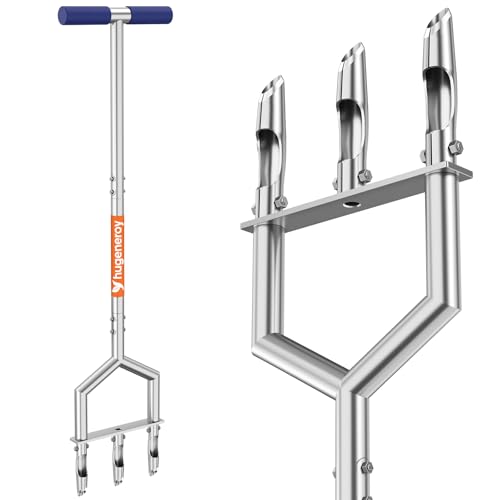
Next are the two Josmimic manual aerators, both with four hollow tines, an adjustable handle from 43.3 to 48.5 inches, and a weight of 5.5 pounds. The Black version adds a thickened dual step for downward leverage and an anti-clog side outlet that guides soil plugs out sideways as work continues, and its dimensions are 11.8 inches by 1.0 inches by 48.5 inches. The Silver version adds a cushioned non-slip grip and quick assembly, and its dimensions are 12.0 inches by 1.0 inches by 48.5 inches. Both are stainless steel. The Silver version suits small lawns, edges, narrow strips and isolated hard-soil spots, while the Black version is described for lawns, garden paths, corners and narrow grass areas.
Last is the Bigwish manual aerator, with 3 hollow tines rather than 4, full stainless steel construction, an adjustable handle with no range stated, and dimensions of 9.45 inches by 0.9 inches by 40.0 inches. No weight is stated for this pick. It states the same core job as the others, removing soil plugs to relieve compaction, and it carries the clearest preparation advice of the four: lightly water dry lawn areas 12–24 hours before use. It suits a buyer who wants a simple stainless plug aerator and does not need a stated handle range or a stated weight.
Safety
Wear sturdy shoes and clear sticks, stones and other debris from the lawn before stepping an aerator into the ground or towing one behind a mower. Keep children and pets away from the work area, step with controlled pressure rather than jumping on the tool, and follow the manual for any towed attachment, including its hitch and weight limits. Work at a steady pace, and store the tool where the tines cannot catch a foot or a tire.
FAQ: mowing large lots
Can you overseed without aerating?
Yes, when the soil is already loose enough for seed to make soil contact. On compacted ground, seed sits on a hard surface, so aerating first gives the seed open soil to settle into.
Should you aerate before overseeding?
Yes, when the lawn is both thin and compacted. The Josmimic Silver listing states its aerator is useful before overseeding, and aeration opens channels for air, water and nutrients before the seed goes down.
Is a core aerator better than a spike aerator?
For compaction, yes: a core aerator removes soil plugs, while a spike tool only pokes holes. The Josmimic Black listing states its tines remove plugs instead of merely creating surface holes. See core aerator vs spike aerator for the full comparison.
Can a manual aerator handle a large lawn?
A manual aerator suits the smaller jobs its listing describes: the Josmimic Silver listing states its manual aerator suits small lawns, edges, narrow strips and isolated hard-soil spots. For larger, open lawns, the VEVOR tow-behind pick covers a 40-inch width behind a lawn tractor or riding mower. See the best tow-behind aerator roundup for more towed options.
How do you prepare a lawn for aeration?
Follow the Bigwish listing advice: lightly water dry lawn areas 12–24 hours before use, since moist soil lets the tines penetrate more easily and reduces effort. Clear debris first, then work across the compacted areas at a steady pace.