Do Pressure Washers Use a Lot of Water?
A pressure washer cleans with pressure instead of volume, so flow ratings, nozzles and trigger habits decide how much water a job takes.

On this page
Top picks at a glance
As an Amazon Associate I earn from qualifying purchases.
- 1
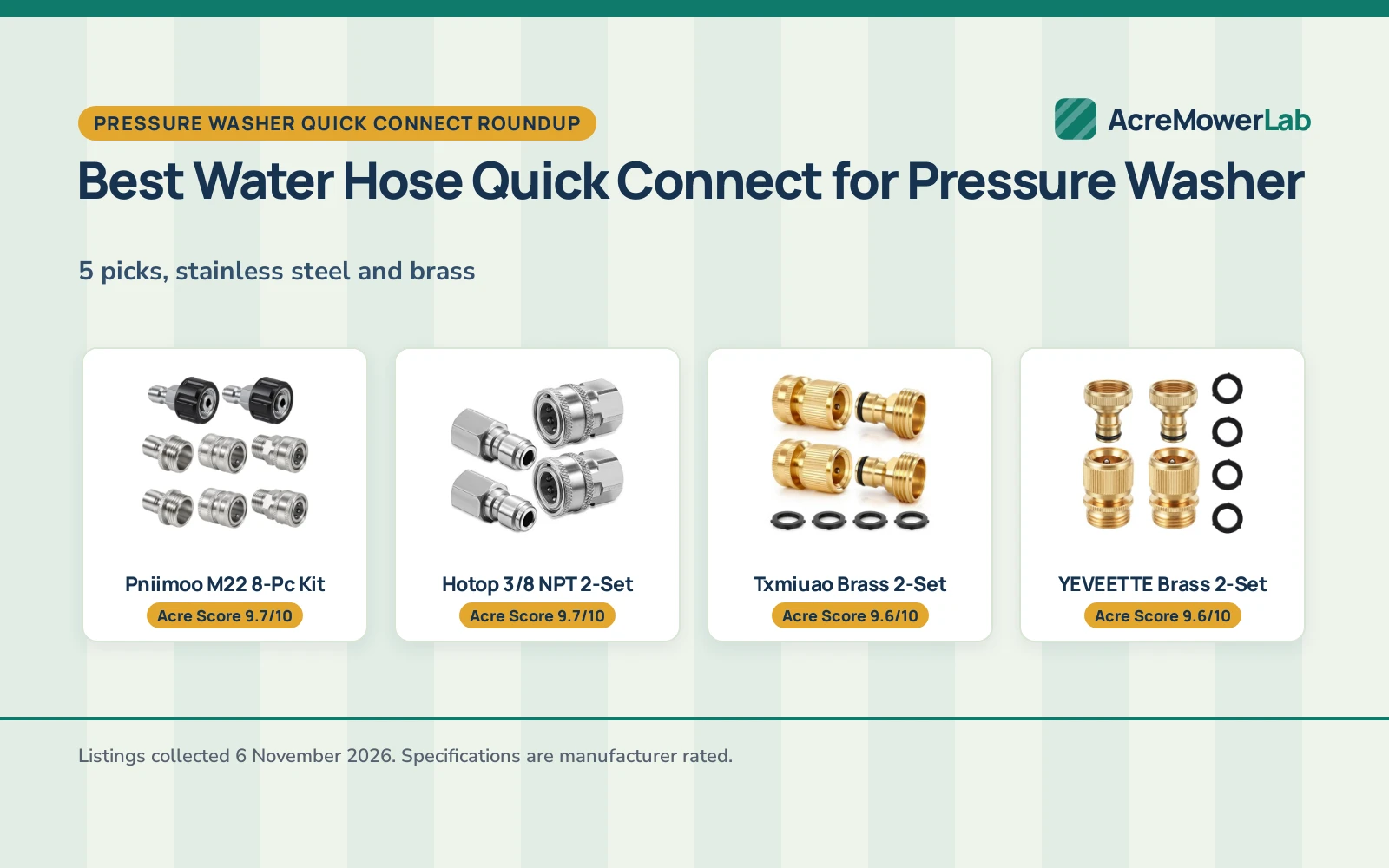
 Pniimoo M22 to 3/8 Pressure Washer Quick Connect Kit9.7/10View on Amazon
- 2
 Hotop 3/8 NPT Stainless Steel Pressure Washer Quick Connect9.7/10View on Amazon
- 3
 OEM Technologies 3400 PSI 2.5 GPM Horizontal Pressure Washer9.7/10View on Amazon
A driveway stained green after a wet winter, a patio filmed with grime, siding dulled by a season of dust. That kind of buildup calls for more than a bucket and a brush, and a pressure washer answers with a narrow jet instead of a flood. Do pressure washers use a lot of water? No, not for the cleaning they do. Pressure does the work that volume would otherwise have to do, so a washer can strip grime from concrete and siding with a modest flow while the trigger is held. The amount still varies by model, nozzle and habit, and the flow rating on the listing tells the story before the first pass.
AcreMowerLab earns a commission when you shop through links here. It never changes your price. Affiliate disclosure.
Do pressure washers use a lot of water? What the flow ratings say
The figure that answers the question is GPM, gallons per minute. PSI is pressure, while GPM is flow, the volume of water leaving the nozzle each minute. A washer rated at 4.0 GPM moves 4.0 gallons each minute the trigger is held. A washer rated at 2.5 GPM moves less in the same minute.
| Model | Rated pressure | Rated flow | What the listing states |
|---|---|---|---|
| Imdot electric pressure washer | 4800 PSI | 4.0 GPM | 23 ft hose with reel, 4 quick-connect nozzles, Total Stop System, foam cannon |
| BULOFE electric pressure washer | Not stated | 2.5 GPM | 4 quick-connect nozzles, GFCI plug, faucet or bucket supply |
| DECOKTOOL cordless pressure washer | 1480 PSI | Not stated | 21V battery, 4.0Ah, foam cannon |
Not every listing states a flow figure, and the spread between the ones that do is the point: flow is a choice, not a fixed trait of pressure washers. Both listings name the same surfaces, cars, driveways, patios and fences, so flow alone does not sort one unit to one surface. Where a listing states no flow figure, the buyer has no stated basis to compare water use. See our best pressure washer for home use roundup for how these ratings sort across home-use picks.
Why pressure does more with less water
Dirt holds to a surface by grip, and a jet breaks that grip with force aimed at a small area. An open garden hose relies on volume to carry dirt away, so it needs a wide, steady stream to do the same work. A pressure washer narrows the supply into a jet, so the water that leaves the nozzle works harder before it runs off.
The nozzle sets the shape of that jet. The BULOFE listing gives four nozzle angles, 0, 15, 25 and 40 degrees. A narrow angle concentrates the jet on a stubborn spot, such as a stain on concrete, while a wide angle spreads the jet for rinsing a broad surface, such as siding or a deck. Our pressure washer nozzle chart explains each tip size and where it belongs. The wrong angle either wastes passes on a spot that needs a tighter jet or scours a surface that needed a gentler fan.
What changes how much water a job takes
Flow rating is only the start. How the washer is used during the job decides how much of that rated flow actually leaves the nozzle.
- Trigger time: water flows only while the trigger is held, so pauses between passes are pauses in water use. The Imdot listing states a Total Stop System that shuts the unit off when the trigger is not in use.
- Nozzle choice: a fan that covers the surface in a single pass needs fewer repeat passes than a jet that is too narrow for the area.
- Foam first: the Imdot, BULOFE and DECOKTOOL listings all state a foam cannon, which lays soap on the surface so dirt loosens before the rinse pass.
- Supply: the BULOFE listing states a faucet or bucket water supply, so the washer can draw from a bucket where a hose hookup is out of reach.
- Job size: the DECOKTOOL listing states a 21V battery with 4.0Ah and a 1480 PSI rating, a cordless unit listed for cars, fences, floors and patios.
- Reach: the Imdot listing states a 23 ft hose with a reel, so the washer can stay put while the wand covers the area around it.
None of these factors shows up in the headline flow figure. The habits around the trigger and the nozzle matter as much as the number on the listing.
How to keep water use down
Sweep loose dirt off the surface first, so the washer deals with stuck grime instead of loose debris. Work in sections, and finish each section before moving on, so no area gets washed twice. Choose the widest nozzle that still cleans the surface, and step to a narrower angle only for spots that resist. Let the foam cannon do its work before rinsing, release the trigger whenever the wand is not aimed at the surface, and stop when the surface runs clear.
Safety
Never point the jet at people or animals, and keep children and pets out of the work area. Gas units run outdoors only, away from open doors and windows. Electric units need GFCI protection outdoors, and the BULOFE listing states a GFCI plug for that reason. Wear eye protection, clear sticks, stones and other debris before washing, and follow the manual for the unit in hand.
FAQ: mowing large lots
Do pressure washers use more water than a garden hose?
For the same cleaning job, a pressure washer uses less water than an open hose, because pressure breaks the dirt loose instead of volume carrying it away. A hose needs a wide, steady stream to move grime, while a washer narrows the supply into a jet. A high-flow unit still uses more than a low-flow unit, so the GPM rating is the figure to compare.
How much water does a 4.0 GPM pressure washer use?
A washer rated at 4.0 GPM moves 4.0 gallons each minute the trigger is held. Releasing the trigger stops the flow, and the Imdot listing states a Total Stop System that shuts the unit off when the trigger is not in use.
Does a higher PSI mean more water use?
No. PSI is pressure and GPM is flow, and they measure different things. The Imdot listing states 4800 PSI with 4.0 GPM, while the DECOKTOOL listing states 1480 PSI with no flow figure given, so a higher pressure rating does not by itself mean a higher flow.
Can a pressure washer run from a bucket?
Some can. The BULOFE listing states a faucet or bucket water supply, so that unit can draw from a bucket where a hose hookup is out of reach. Check the listing for the unit in hand, since not every washer states a bucket supply, and a bucket that runs dry can starve the pump.
Does a cordless pressure washer use less water?
Not necessarily. The DECOKTOOL listing states a 21V battery, 4.0Ah and 1480 PSI, but states no flow figure, so there is no stated basis to say it uses less water than a corded unit. A cordless washer suits smaller jobs, such as a car, fence or patio, and its battery sets how long it can run.
More mowing guides
- Best Pressure Washer for Home Use (2026): 5 Picks Compared
- Pressure Washer Hose vs Garden Hose: Which One Should You Buy?
- Pressure Washer Nozzle Chart: Tip Sizes Explained
- Can You Use Pressure Washer on Car
See the pressure washer guides for more on nozzles, hoses and home-use picks.