How to Fix Lawn Mower Pull Cord Spring
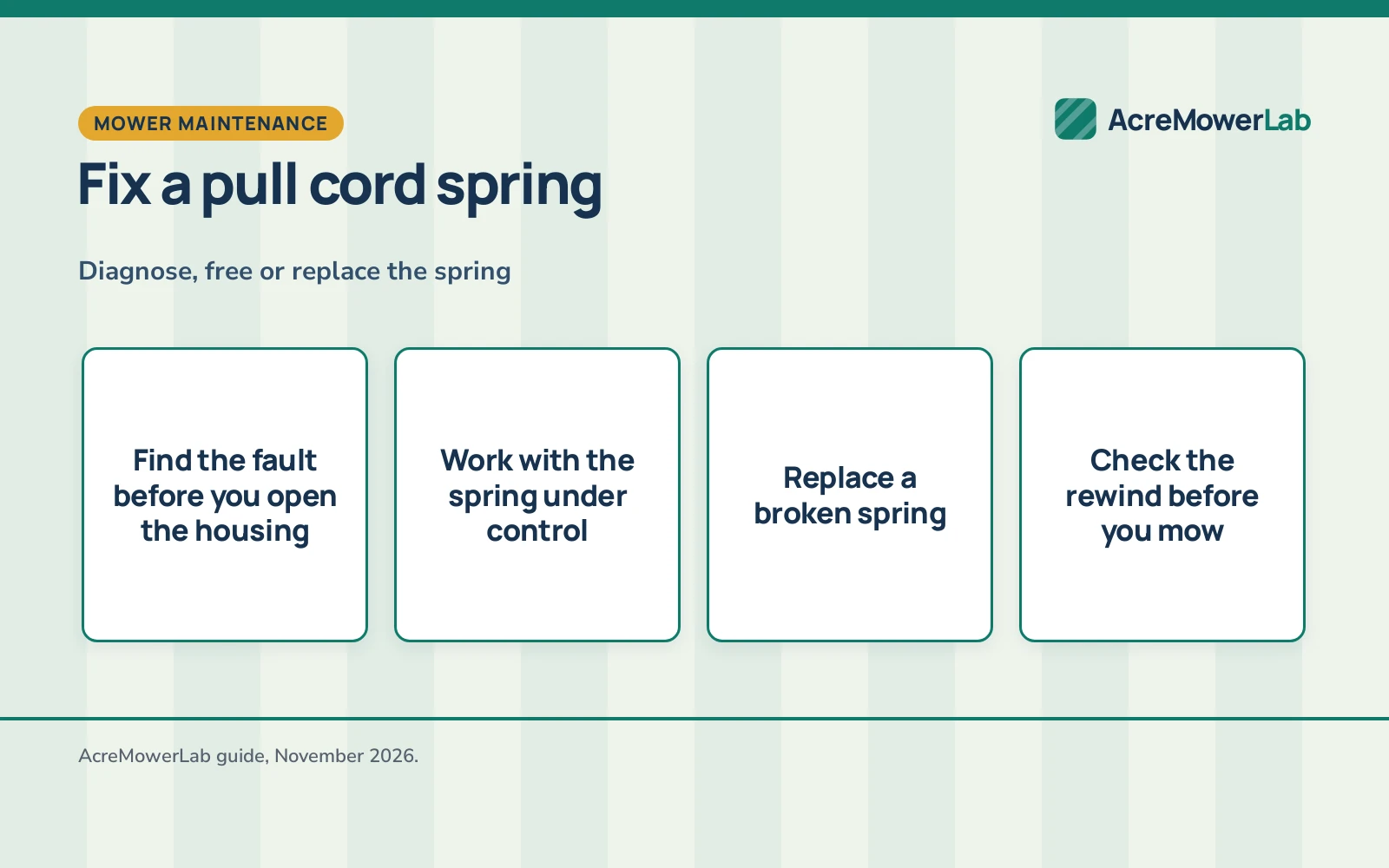
A stuck or slack pull cord can point to the recoil spring: find the fault, free or replace the spring, and check the rewind before you mow.

On this page
A pull cord that sticks, drags or hangs slack can mean the recoil spring inside the starter housing has jammed, slipped off its hook or broken, or that the cord has tangled. This guide explains how to fix lawn mower pull cord spring faults: find the fault, make the mower safe, open the housing, and either free the spring or fit a new spring. For the seasonal upkeep that keeps the starter healthy, see the mower maintenance hub.
As an Amazon Associate I earn from qualifying purchases. AcreMowerLab earns a commission when you shop through links here. It never changes your price. Affiliate disclosure.
How to fix lawn mower pull cord spring: find the fault
The spring winds the cord back after each pull, so the way the cord behaves tells you what broke. A cord that will not move can mean the spring has jammed inside the housing, the cord has tangled, or the engine and blade will not turn. A cord that pulls out and hangs slack, or pulls out with almost no resistance, can mean the spring has broken, slipped off its hook, or lost preload so it no longer rewinds the pulley. Match the symptom to the table below, then open the housing to confirm what you found.
| Symptom | Likely fault |
|---|---|
| Cord will not pull out | Spring jammed, cord tangled, or engine will not turn |
| Cord pulls out and stays out | Spring broken or unhooked |
| Cord pulls out with no resistance | Spring broken, unhooked, or without preload |
| Cord stops partway out | Cord tangled or coil caught |
Make the mower safe to work on
Work on the mower only with the engine off and cool, on flat ground, with the mower parked where it cannot roll. Pull the spark plug wire off the plug and tuck it away so the engine cannot start while your hands are near the starter; see how to check a spark plug for the plug itself. Wear eye protection and work gloves, since a recoil spring holds tension and can snap free with force. Keep children and pets away from the work area.
Take off the recoil starter housing
The recoil starter sits on top of the engine, under a cover held by fasteners around its edge. Remove the fasteners with the tool that fits them and set them aside where they cannot roll away. Lift the housing straight up and set it on a clean surface with the pulley facing up, so the spring and cord stay in place. Note how the cord runs through the housing and where the handle sits.
Look at the spring, the pulley and the cord
With the housing open, look at the spring, the pulley and the cord before you touch any of them. A healthy spring sits flat in its pocket, each coil tight against the next, with the ends hooked onto the pulley and the housing. A broken spring shows a gap in the coil or a loose end off its hook. A jammed spring shows coils that have ridden up over each other or caught on the housing wall. Check the cord for fraying and tangles, and check the pulley for cracks and wear. When the cord is frayed, fit a new cord made for your mower model; see starter rope for lawn mower picks.
Free a jammed spring
When the spring is whole and the coils are not kinked or bent, you can try to free it without a new part. Hold the housing steady on a flat surface and ease the coils back into their pocket with a flat tool, keeping your fingers clear of the spring ends. Do not yank the spring or pry at the coils with force: a spring under tension can snap out of the housing and cut skin or damage eyes. When the coils sit flat again, turn the pulley by hand and watch the cord wind back smoothly.
Replace a broken spring with a new spring
A spring with a break or a bent end will not rewind the pulley reliably, so fit a new spring made for your mower model. Lift the old spring out with care, keeping it pointed away from your face and hands. Seat the new spring in its pocket with the outer end hooked to the housing and the inner end hooked to the pulley, so the coils lie flat. Wind the pulley by hand in the direction the cord pulls the pulley when you start the engine, until the spring feels taut, then thread the cord through the housing and tie off the handle end. Pull the cord out and let it rewind until the rewind feels smooth and even.
Put the starter back and check the pull
Set the housing back on the engine in the same position it came from, with the cord routed the way you noted it. Refit the fasteners and tighten them evenly so the housing sits flat and the pulley turns freely. Push the spark plug wire back onto the plug. Pull the cord with a smooth, steady pull and let it rewind fully, and check that the rewind holds. When the cord still hangs slack or sticks, open the housing again and check the spring hooks. See the push mower maintenance checklist for routine checks.
When to replace the whole recoil starter
A new spring fixes a broken or jammed spring, but it cannot fix damage elsewhere in the starter. Replace the whole recoil starter when the housing is cracked, the pulley is worn or cracked, or the cord guide is broken. When wear shows on the housing, the pulley and the cord guide at the same time, replacing the whole unit saves a repeat repair. Match the replacement starter to your mower model, and follow the maker manual for the fit. See the lawn mower maintenance schedule for the seasonal checks.
Safety
Treat the recoil spring with respect: it holds tension even when the mower is off, and a loose spring can snap out of the housing. Wear eye protection and work gloves while you work on the starter. Keep the spark plug wire off the plug. Keep children and pets away from the work area, and never pull the cord while your hands are inside the housing. When the spring will not seat, the housing is cracked, or the pulley is damaged, take the mower to a repair shop instead of forcing the repair.
FAQ: mowing large lots
Why is a lawn mower pull cord stuck?
A stuck cord can mean the recoil spring has jammed inside the housing, the cord has tangled around the pulley, or the engine and blade will not turn. Make the mower safe, open the starter housing, and look at the spring and cord before you force the cord.
What to do when the lawn mower string will not pull?
Do not yank the cord. Disconnect the spark plug wire, let the engine cool, and open the recoil starter housing to find the fault. A jammed spring with undamaged coils can be freed, while a broken spring needs a new spring made for your mower model.
Can a pull cord spring be fixed without replacing it?
Yes, when the spring is whole, the coils are not kinked or bent, and the spring is jammed. Ease the coils back into their pocket, keep your fingers clear of the spring ends, and turn the pulley by hand to confirm the cord rewinds smoothly. When the spring is broken or a coil end is bent, fit a new spring instead.
How can you tell the recoil spring is the problem?
Watch how the cord behaves. A cord that will not move can point to a jammed spring, a tangled cord, or an engine that will not turn. A cord that pulls out and stays out, or pulls out with no resistance, can point to a broken or unhooked spring or a spring without preload.
Should the whole recoil starter be replaced instead of the spring?
Replace the whole starter when the housing is cracked, the pulley is worn or cracked, or the cord guide is broken. A spring alone fixes a broken or jammed spring, but it cannot fix damage to the rest of the starter.