How to Use Dielectric Grease on Battery Terminals
Clean the terminals, reconnect and tighten, then coat the outside: how dielectric grease helps keep corrosion from building up on battery terminals.

On this page
Top picks at a glance
As an Amazon Associate I earn from qualifying purchases.
- 1
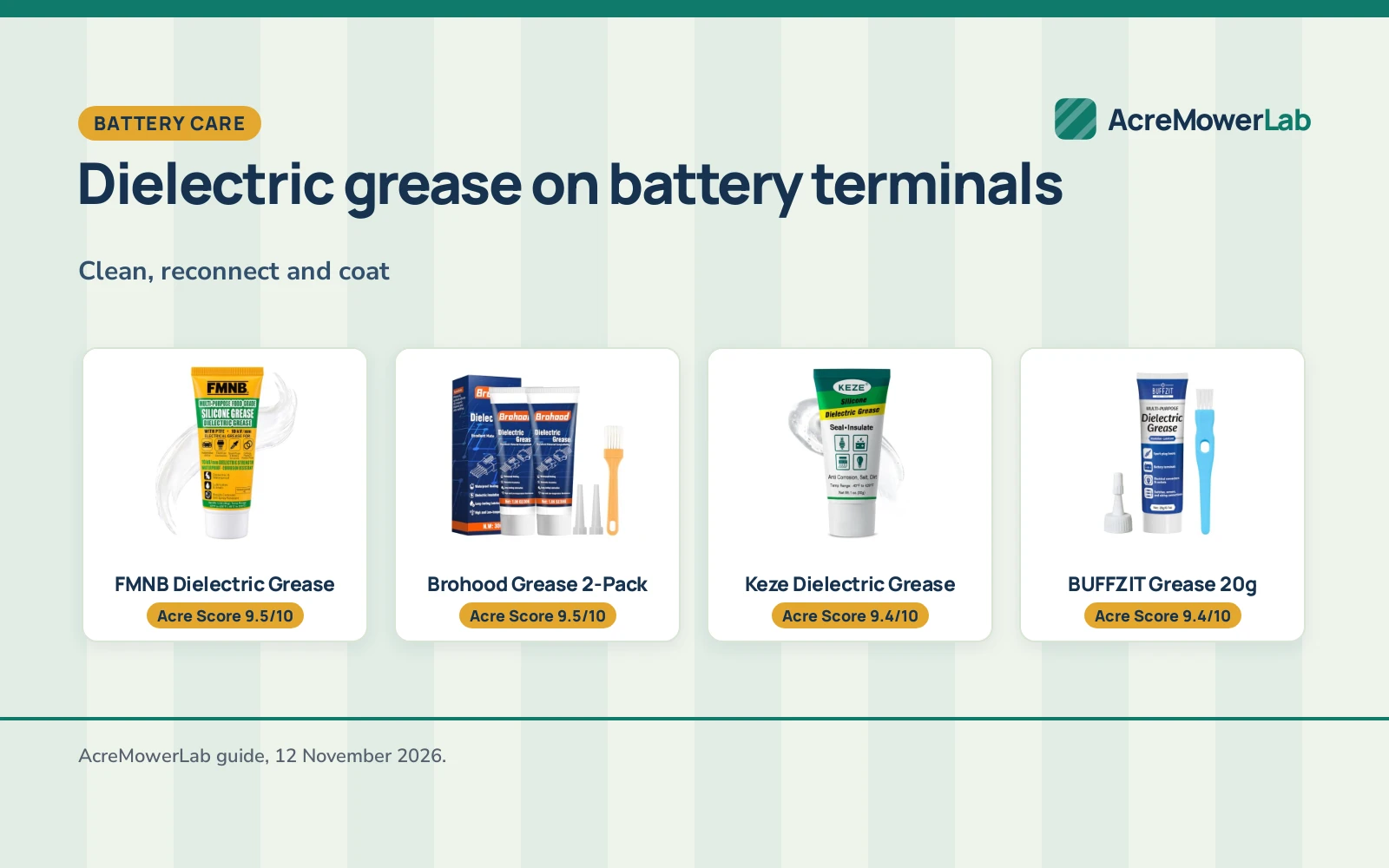
 FMNB Dielectric Grease 1 oz Silicone Battery Terminal Grease9.5/10View on Amazon
- 2
 Brohood Dielectric Grease 1 oz 2-Pack with Brush9.5/10View on Amazon
- 3
 Keze Dielectric Grease 1 oz Battery Terminal Grease9.4/10View on Amazon
- 4
 BUFFZIT Dielectric Grease 20g with Brush Applicator9.4/10View on Amazon
Across a few acres of lawn, pasture and fence line, the mower, the tractor and the trailer all share the same weak point: battery terminals left out through wet seasons. To use dielectric grease on battery terminals, clean the terminals, apply a thin coat on the outside of the connection after it is tight, and leave the mating metal faces clean. The grease seals out moisture and salt to help slow corrosion buildup between services. This guide shows the order to do it in, and the grease tubes that suit the job.
AcreMowerLab earns a commission when you shop through links here. It never changes your price. Affiliate disclosure.
FMNB Dielectric Grease 1 oz Silicone Battery Terminal Grease
Silicone dielectric grease in a 1 oz tube, with a stated 10 kV/mm rating and a range of -40°F to 428°F.
Who it's for: owners who want the most complete stated spec sheet here, including a dielectric strength figure.
Who should skip it: anyone who wants a brush applicator in the box, or a larger tube.
The FMNB tube handles the coating step: a thin layer on the outside of the terminal and connector after the connection is made. The maker states a range of -40°F to 428°F, a dielectric strength of 10 kV/mm, and a PTFE-enhanced formula that resists water washout. It is a 1 oz tube weighing 0.0625 lb, NSF-registered for maintenance use.
Pros
- Stated range of -40°F to 428°F for engine bays and outdoor equipment
- 10 kV/mm dielectric insulation rating stated
- PTFE-enhanced formula that resists water washout
- NSF-registered formula for maintenance use
Cons
- A 1 oz tube covers a small job, so several machines need extra tubes
- No applicator brush is stated
- No warranty term is stated
- Non-conductive, so it belongs on the outside of the connection
Brohood Dielectric Grease 1 oz 2-Pack with Brush
Two 1 oz tubes of dielectric grease with a brush, stated for -50℃ to 200℃.
Who it's for: owners with several machines to protect, or anyone who wants a brush with the grease.
Who should skip it: anyone who wants a single larger tube.
The Brohood pack handles the coating step for several machines, with a brush in the box. Each tube is 1 oz, and the maker states a range of -50℃ to 200℃ for automotive, marine and household connections.
Pros
- Two 1 oz tubes with a brush for application
- Stated temperature range of -50℃ to 200℃
- Made for automotive, marine and household use
- Waterproof and anti-corrosion for outdoor connections
Cons
- Two 1 oz tubes to store instead of a larger tube
- Non-conductive, so keep it off the mating metal faces
- It seals and protects; it does not clean corrosion
- A general-purpose tube, not a tube made only for battery terminals
Keze Dielectric Grease 1 oz Battery Terminal Grease
Silicone dielectric grease in a 1 oz tube, stated for battery terminals and spark plugs from -40°F to 428°F.
Who it's for: owners who want a tube for terminals and ignition parts.
Who should skip it: anyone who wants a brush applicator or a stated dielectric strength figure.
The Keze tube handles the coating step on battery terminals and connectors, and the maker lists it for spark plugs, bulb sockets and ignition coils as well. It is a 1 oz tube with a stated range of -40°F to 428°F, a smooth, non-drying silicone that seals out moisture, salt and corrosion.
Pros
- Stated temperature range of -40°F to 428°F
- Non-conductive silicone that seals out moisture and salt to slow corrosion
- Made for battery terminals, spark plugs and ignition coils
- Smooth, non-drying formula that is easy to apply
Cons
- A 1 oz tube covers a small job, so several machines need extra tubes
- No applicator brush is stated
- No warranty term is stated
- Not a cleaner, so corrosion must be removed before it goes on
BUFFZIT Dielectric Grease 20g with Brush Applicator
Small 20g tube of red dielectric grease with a brush applicator.
Who it's for: owners who need a little grease for a few terminals and want a brush in the box.
Who should skip it: anyone coating terminals across several machines.
The BUFFZIT tube handles the coating step in a small package: 20g, 0.7 oz, with a brush applicator and a red color that shows where it has been applied. The maker lists it as waterproof and non-conductive for spark plugs, battery terminals and electrical connectors.
Pros
- Brush applicator included for a thin, even coat
- Waterproof, non-conductive grease for spark plugs and battery terminals
- Small 20g tube for a few terminals at a time
- Red color makes it easy to see where it has been applied
Cons
- Smallest tube here at 20g, 0.7 oz
- No temperature range is stated for hot engine bays
- No dielectric strength figure is stated
- Red grease shows on hands and light-colored parts
How to use dielectric grease on battery terminals: start with clean terminals
Grease seals a clean connection; it does not clean a dirty terminal. Start with the battery out of the circuit: disconnect the cables, negative cable off before positive, and keep the cable ends apart while you work. Brush the posts and the inside of the cable ends until the metal is bright, and wipe away the loose corrosion.
Check the cable ends as you clean. A cable end that is cracked, stretched or eaten through by corrosion will not clamp tight, and grease cannot fix that. Replace a damaged cable end before reconnecting. See the picks for the best battery terminal cleaner kit for brushes and sprays made for this step.
Apply a thin coat after the connection is tight
Reconnect the cables, positive cable on before negative, and tighten the clamps so they cannot twist on the post by hand. Then coat the outside of the connection: a thin layer over the post, the clamp and the exposed metal where the cable enters the clamp. Dielectric grease is non-conductive, so it belongs on the outside of the connection, not between the post and the clamp.
The grease you pick should hold up to heat under a hood and to cold storage. The Keze and FMNB tubes state a range of -40°F to 428°F, and the Brohood tubes state -50℃ to 200℃. A brush applicator lays down a thin, even coat, and without a brush, a gloved fingertip works. Recoat when the old coat is gone or washed away, and always after cleaning the terminals.
Grease tubes for battery terminals
The coating step needs a small tube of non-conductive silicone grease, and the tubes below cover that step.
What not to do with dielectric grease
Do not use dielectric grease as a cleaner: it seals in whatever corrosion is already there. Do not pack it between the post and the clamp, since it does not conduct. Do not use it to hold a loose clamp tight; a clamp that twists on the post needs replacing, not grease. And do not coat a hot terminal or a battery that is cracked or leaking.
Safety
Wear eye protection and gloves when cleaning terminals, and keep sparks, flames and cigarettes away from the battery. Batteries can give off gas while charging, so work with fresh air and never lean over the battery while connecting a charger. Wash hands after handling terminals and grease, and keep children and pets away from the work area.
FAQ: mowing large lots
Should dielectric grease go on before or after connecting the terminal?
After. Tighten the clamp on the clean post, then coat the outside of the connection. Grease between the post and the clamp sits between the metal faces and does not conduct.
Does dielectric grease improve the connection?
No. Dielectric grease is non-conductive, so it does not carry current. What it does is seal the outside of a tight connection against moisture and salt, which helps slow corrosion buildup over time.
How much grease should go on a battery terminal?
A thin, even coat over the outside of the post, the clamp and the exposed metal is enough. A brush applicator lays it down thin, and a gloved fingertip works too.
Can dielectric grease go on spark plug boots?
Yes. The makers of the Keze, FMNB and Brohood tubes list spark plugs and spark plug boots among the uses, and the grease keeps moisture out of the boot.
Will dielectric grease stop corrosion on its own?
No. Grease seals a clean connection; it does not remove corrosion that is already there. Clean the posts and cable ends until the metal is bright, then coat.
What temperature range should the grease handle?
It should hold up to engine bay heat and cold storage. The Keze and FMNB tubes state -40°F to 428°F, and the Brohood tubes state -50℃ to 200℃. The BUFFZIT tube states no temperature range.