Safety Can vs Gas Can: Which One Should You Buy?
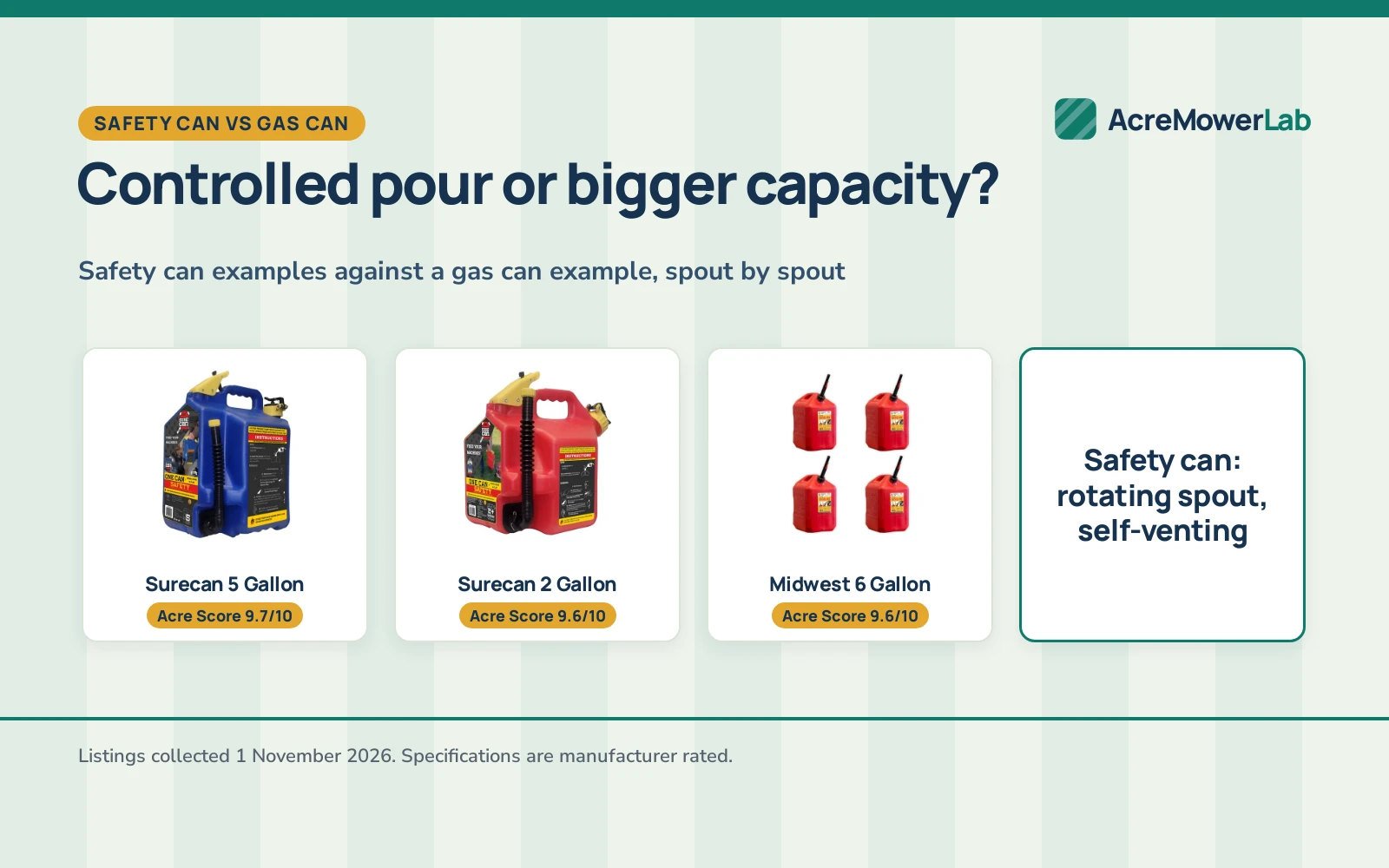
Safety cans and gas cans compared on spout design, safety systems, capacity, stated standards and warranty, with 2 safety can examples and 1 gas can example.

On this page
Top picks at a glance
As an Amazon Associate I earn from qualifying purchases.
- 1
 Scepter 2 Gal Gas Can9.7/10View on Amazon
- 2
 Scepter 1 Gallon Gas Can with SmartControl Spout9.7/10View on Amazon
- 3
 Midwest Can 2310 Safe-Flo Auto Shut Off 2 Gallon Gas Can9.6/10View on Amazon
- 4
 VEVOR Safety Gas CanView on Amazon
- 5
 No Spill 1405 2.5 Gallon Gasoline Gas CanView on Amazon
- 6
 Inductive Hour Meter for Gas Engine Generator Lawn Mower RedView on Amazon
- 7
 Inductive Hour Meter for Gas Engine Generator Lawn MowerView on Amazon
Verdict: Choose a safety can if controlled, spill-controlled dispensing matters most, with a rotating spout, thumb trigger and self-venting design. Choose a gas can if capacity matters most, with the larger 6-gallon size, a Quick-Flow spout and the FlameShield system on the Midwest example.
Filling a mower or a tractor from a can in the shed looks simple until the spout glugs, the can tips, or the fill cap fights back. The safety can vs gas can question is about what the can is built to do: the safety can examples here are Type II containers with venting and controlled dispensing built in, while the gas can example here is a general fuel container, and the examples here show both sides with real differences in spout, safety system and capacity.
AcreMowerLab earns a commission when you shop through links here. It never changes your price.
| # | Product | Acre Score | Buy |
|---|---|---|---|
| 1 |  Surecan 5 Gallon Type II Safety Can | 9.7/10 | Buy on Amazon |
| 2 |  Surecan 2 Gallon Type II Safety Can | 9.6/10 | Buy on Amazon |
| 3 |  Midwest Can 6 Gallon Gas Can | 9.6/10 | Buy on Amazon |
Surecan 5 Gallon Type II Safety Can
A 5-gallon Type II safety can with a rotating spout, ergonomic thumb trigger, self-venting design and a safety fill cap, presented as a kerosene container.
Who it's for: owners who want controlled dispensing at 5 gallons with a self-venting Type II design.
Who should skip it: anyone who needs a stated CARB or EPA standard, or a 6-gallon capacity, where the Midwest example fits instead.
Read the full review
The 5-gallon Surecan is the larger safety can example: a Type II container with a downward-rotating spout, an ergonomic thumb trigger for smooth, controlled dispensing, a self-venting mechanism and a safety fill cap. The listing presents it as a kerosene container and states a 3-year limited warranty in its bullets, while its spec table warranty field states only the word Warranty with no term.
Pros
- 5-gallon capacity, the largest safety can here
- Rotating spout with thumb trigger for controlled dispensing
- Self-venting Type II design that reduces splashing
- 3-year limited warranty stated in the bullets
Cons
- Listed weight of 1.0 pounds looks light against the 2-gallon listing at 2.68 pounds
- No CARB or EPA standard stated
- No flame mitigation device stated, unlike the Midwest listing
- Spec table warranty field states only the word Warranty, with no term
Surecan 2 Gallon Type II Safety Can
A 2-gallon Type II safety can with a rotating spout, ergonomic thumb trigger, self-venting design and a safety fill cap, presented as a gasoline container.
Who it's for: owners who want the safety can design in a smaller size for careful fills.
Who should skip it: anyone who needs more capacity per can, where the 5-gallon Surecan or the 6-gallon Midwest example fits instead.
Read the full review
The 2-gallon Surecan carries the same Type II safety can design as its 5-gallon sibling: a downward-rotating spout, an ergonomic thumb trigger, a self-venting mechanism and a safety fill cap, at 2.68 pounds as listed and dimensions of 14.0 x 9.0 x 12.12 inches. One contradiction sits in this listing: the bullets state a 3-year limited warranty, while the spec table states a 1-year manufacturer warranty. This guide uses the bullets figure of 3 years.
Pros
- Rotating spout with thumb trigger for controlled dispensing
- Self-venting Type II design that reduces splashing
- 3-year limited warranty stated in the bullets
- Smallest size here, for careful fills near the shed
Cons
- 2-gallon capacity, the smallest here
- Spec table states a 1-year manufacturer warranty against 3 years in the bullets
- No CARB or EPA standard stated
- No flame mitigation device stated, unlike the Midwest listing
Midwest Can 6 Gallon Gas Can
A 6-gallon HDPE plastic gas can with a Quick-Flow spout, auto shutoff, FlameShield Safety System, a wide base, 2 ergonomic handles and stated CARB and EPA standards.
Who it's for: owners who want the largest capacity with a stated standards compliance and a flame mitigation system.
Who should skip it: anyone who wants a rotating spout with thumb trigger control or a self-venting design, where the Surecan examples fit instead.
Read the full review
The Midwest can is the gas can example: a 6-gallon HDPE plastic can with a wide base and low center of gravity, 2 ergonomic handles, a Quick-Flow spout with auto shutoff and an automatic closing valve, and a FlameShield Safety System built from an internal flame mitigation device and a vapor locking spout. The listing states CARB and EPA standards and a 1-year warranty, and describes the plastic with barrier materials that virtually eliminate hydrocarbon emissions.
Pros
- 6-gallon capacity, the largest here
- Quick-Flow spout with auto shutoff and automatic closing valve
- FlameShield Safety System with flame mitigation device and vapor locking spout
- CARB and EPA standards stated, the only stated standards here
Cons
- Spec table weight of 150.0 pounds and 4 items do not match the single-can title
- No self-venting design stated
- No rotating spout or thumb trigger stated
- 1-year warranty, shorter than the 3-year term stated on the Surecan listings
Other machines to compare
 VEVOR Safety Gas CanCheck price on Amazon
 No Spill 1405 2.5 Gallon Gasoline Gas CanCheck price on Amazon
 Inductive Hour Meter for Gas Engine Generator Lawn Mower RedCheck price on Amazon
 Inductive Hour Meter for Gas Engine Generator Lawn MowerCheck price on Amazon
Safety can vs gas can side by side
| Factor | Safety can (Surecan 5 Gallon) | Safety can (Surecan 2 Gallon) | Gas can (Midwest 6 Gallon) |
|---|---|---|---|
| Capacity | 5 gallons | 2 gallons | 6 gallons |
| Can type | Type II safety can | Type II safety can | Plastic gas can |
| Spout | Rotating spout, thumb trigger | Rotating spout, thumb trigger | Quick-Flow spout, auto shutoff |
| Venting and safety | Self-venting Type II design | Self-venting Type II design | FlameShield Safety System |
| Standards stated | Not stated | Not stated | CARB and EPA standards |
| Warranty | 3-year limited warranty | 3-year limited warranty | 1-year warranty |
| Weight as listed | 1.0 pounds | 2.68 pounds | Unclear: spec table states 150.0 pounds |
Figures are manufacturer stated for the examples, collected 1 November 2026.
Spout and dispensing
The safety can side dispenses through a downward-rotating spout worked by an ergonomic thumb trigger, as stated on both Surecan listings. The spout rotates down to direct flow into the opening, and the trigger gives smooth, controlled dispensing, with a self-venting mechanism that supports steady flow and reduces splashing. The gas can side dispenses through the Midwest Quick-Flow spout, which the listing states delivers faster flow with an auto shutoff to prevent overfilling, plus an automatic closing valve for a tight seal. The Midwest listing states its flow as faster by a factor of 2.5, as a maker claim, with no baseline stated for that figure, so it is reported here as the listing states it and not as a measured comparison against the Surecan spouts.
Safety systems
Each side states a different safety system, so neither side wins on safety by default. The Surecan listings state a Type II design with a built-in self-venting mechanism and a safety fill cap. The Midwest listing states a FlameShield Safety System made of an internal flame mitigation device and a vapor locking Quick-Flow spout, giving a double layer of protection as the listing describes it. Only the Midwest listing states CARB and EPA standards, and only the Surecan listings state self-venting, so a buyer who wants a stated standard should look at the gas can example, while a buyer who wants self-venting should look at the safety can examples. Neither listing states the other side’s system.
Capacity and weight: what the listings leave unclear
Capacity is clear on all 3 listings: 2 gallons and 5 gallons on the Surecan listings, and 6 gallons on the Midwest listing. Weight is not clear. The 5-gallon Surecan listing states 1.0 pounds, while the 2-gallon Surecan listing states 2.68 pounds, so the larger can is listed as lighter than the smaller can. The Midwest spec table states 150.0 pounds and 4 items, while its title describes a single 6-gallon can, so the spec table does not match the title. Weight is therefore left unclear by these listings.
The examples
Acreage and terrain fit
Surecan 5 Gallon
Surecan 2 Gallon
Midwest 6 Gallon
How the cans were scored
The Acre Score weighs five factors: performance, build quality, value, safety and warranty. A factor the listing does not state scores zero. Safety scores come only from systems the listings state, and warranty scores come only from warranty terms the listings state, which is why the warranty figures differ between the examples.
| Product | Acre Score | Perf. /35 | Build /25 | Value /25 | Safety /10 | Warranty /5 |
|---|---|---|---|---|---|---|
| Surecan 5 Gallon | 9.7 | 30 | 21 | 21 | 8 | 4 |
| Surecan 2 Gallon | 9.6 | 28 | 21 | 20 | 8 | 4 |
| Midwest 6 Gallon | 9.6 | 29 | 20 | 21 | 9 | 3 |
Scores run from 9.2 to 9.8: each product’s point total is placed on that range, so more points always means a higher score.
Many acreage owners keep more than one can. For the plastic against metal question, see the metal against plastic gas can comparison.
Read the manual, keep children and pets out of the yard while you work, wear eye and hearing protection and sturdy footwear, and never exceed the slope rating of your machine. Refuel only with the engine off and cool. See CPSC lawn mower safety. Read our Safety Disclaimer.
Matching It to Your Property
- Storage. The Surecan listings state storage on a shelf, in a garage, or on the go, so the Surecan examples fit shed shelf storage.
- Stability. The Midwest listing states a wide base and low center of gravity to reduce tipping, plus 2 ergonomic handles for lifting and carrying.
- Capacity. The Midwest listing at 6 gallons holds more per can than the Surecan listings at 5 gallons and 2 gallons, for properties with more equipment to fill.
- Obstacles. The Surecan rotating spout directs flow into tight openings, as stated in its listings.
FAQ: mowing large lots
What makes a can a safety can?
The safety can examples here are Type II containers with safety features built into the design. Both Surecan listings state a Type II design with a self-venting mechanism, a downward-rotating spout, an ergonomic thumb trigger and a safety fill cap. Those features, taken together, are what the listings present as the safety can side, against the general gas can side.
Can a safety can hold kerosene?
The 5-gallon Surecan listing is presented as a kerosene container, while the 2-gallon Surecan listing is presented as a gasoline container. Match the can to the fuel named on its listing, and do not assume one can covers every fuel. The Midwest listing is presented as a gasoline can.
Is a bigger can always better?
Not necessarily. The Midwest listing at 6 gallons holds the most fuel per can, but the Surecan listings offer the rotating spout, thumb trigger and self-venting design for controlled dispensing. The weight figures on these listings are unclear, as noted above, so weight cannot settle the choice. Pick capacity against control, not capacity alone.
What do CARB and EPA mean on the Midwest listing?
The Midwest listing states that the can meets CARB and EPA standards, naming the California Air Resources Board and the EPA, and states that it exceeds those regulations. The Surecan listings state no CARB or EPA standard, so that stated compliance belongs to the Midwest listing only. It is reported here as the listing states it.
What warranty do these cans carry?
The Surecan listings state a 3-year limited warranty in their bullets, while the Midwest listing states a 1-year warranty. One contradiction sits in the 2-gallon Surecan listing: its spec table states a 1-year manufacturer warranty against the 3-year limited warranty in its bullets. This guide uses the bullets figure, and the 5-gallon Surecan listing states the same 3-year term in its bullets.
More mowing guides
- Fuel Caddy vs Gas Can: Which One Should You Buy?
- Metal vs Plastic Gas Can: Which One Should You Buy?
- Best Gas Can for Lawn Mower (2026): 4 Compared
See the mower maintenance hub for more maintenance gear.