Should You Leave Gas in a Mower Over Winter?
A complete guide on whether to leave gas in a mower over winter, explaining when to add fuel stabilizer, when to drain the fuel system, and how to protect small engines during cold storage.

On this page
Top picks at a glance
As an Amazon Associate I earn from qualifying purchases.
- 1
 Magicalmai Inductive Gas Engine Hour Meter9.4/10View on Amazon
- 2
 Inductive Hour Meter for Gas Engine Generator Lawn MowerView on Amazon
- 3
 2 Pieces Inductive Hour Meter for Gas Engine Lawn Mower DirtView on Amazon
- 4
 SENIX 22'' Self Propelled Gas Lawn MowerView on Amazon
- 5
 SENIX Gas Lawn MowerView on Amazon
- 6
 SENIX 21" 144cc Gas Push Lawn MowerView on Amazon
- 7
 SENIX 20" Gas Lawn MowerView on Amazon
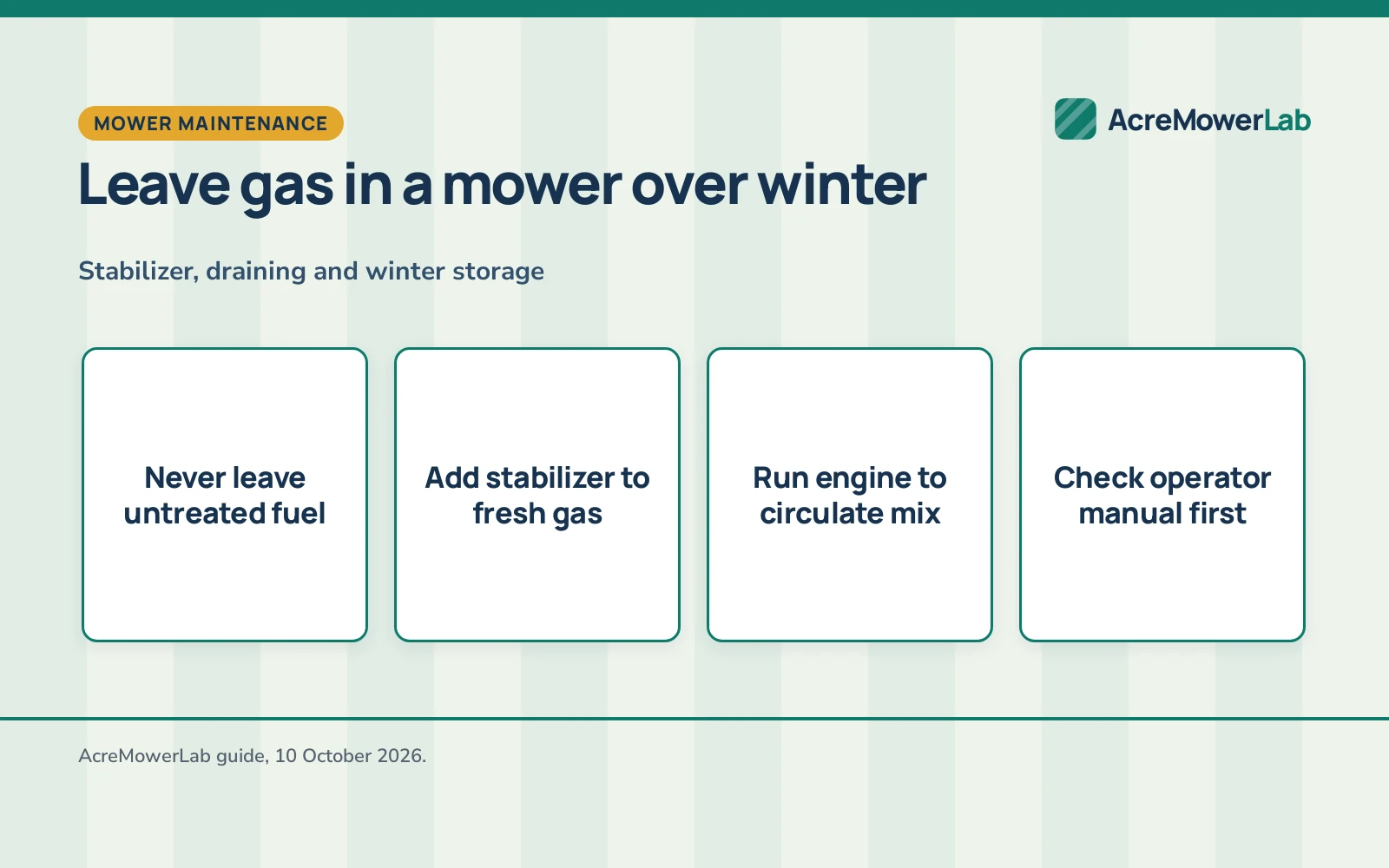
If you are asking should you leave gas in a mower over winter, the answer depends on whether fuel is treated and what your operator manual specifies. You should never leave untreated gas in a mower over winter: untreated gasoline degrades over weeks of storage, forming varnish and gum that clog carburetor passages and prevent spring starting. However, leaving a full tank of fresh fuel treated with stabilizer is a widely approved storage method, while some manufacturers advise draining the system completely dry. This step-by-step guide explains how to check your manual, stabilize or drain fuel, and protect your mower through the off-season.
Other machines to compare
 Inductive Hour Meter for Gas Engine Generator Lawn MowerCheck price on Amazon
 2 Pieces Inductive Hour Meter for Gas Engine Lawn Mower DirtCheck price on Amazon
 SENIX 22'' Self Propelled Gas Lawn MowerCheck price on Amazon
 SENIX Gas Lawn MowerCheck price on Amazon
 SENIX 21" 144cc Gas Push Lawn MowerCheck price on Amazon
 SENIX 20" Gas Lawn MowerCheck price on Amazon
AcreMowerLab earns a commission when you shop through links here. It never changes your price. Affiliate disclosure.
Should you leave gas in a mower over winter: check your manual first
| Storage method | Best for | Limit |
|---|---|---|
| Full tank with fuel stabilizer | Riding mowers and lawn tractors stored in unheated sheds | Requires running engine to circulate treated fuel |
| Empty fuel tank and dry carburetor | Push mowers and equipment stored near living spaces | Carburetor seals and fuel lines can dry out in older designs |
| Ethanol-free canned fuel | Final seasonal run on small engines | Higher cost per gallon than pump fuel |
Always defer to your engine operator manual when choosing a winter fuel strategy. Most small-engine builders support storing equipment with treated fuel in a full tank, while others direct owners to drain the system dry. For comprehensive seasonal checklists on larger equipment, see our how to store a riding mower for winter walkthrough.
Step 2: add fuel stabilizer to fresh fuel
If your operator manual supports storing the mower with fuel in the tank, add fuel stabilizer before parking the machine for winter. Stabilizer slows oxidation, reduces moisture corrosion, and keeps fuel chemically stable. Always add stabilizer to fresh gasoline rather than fuel that has already degraded in the tank.
Follow the mixing proportion on your stabilizer package, as application ratios differ across formulations. For example, on its 4 oz bottle, STA-BIL lists a treatment ratio of 1 oz of storage stabilizer for every 2.5 gallons of gasoline, treating 10 gallons total to keep fuel fresh for up to 24 months. Gold Eagle Co., the maker of STA-BIL, notes on its listing that the formula is effective in all gasoline including ethanol blends and is designed to eliminate the need to drain fuel prior to storage. Fill the mower tank nearly full of treated fuel, leaving a small air gap at the top for expansion.
Step 3: run the engine to circulate treated fuel
Adding stabilizer to the tank only treats the fuel in the reservoir. Start the mower immediately after adding stabilized fuel so the mixture circulates through the fuel filter, lines, and carburetor float bowl.
Run times vary by brand, so check your stabilizer label and engine manual. For example, STA-BIL directs equipment owners to run the engine for 5 minutes after adding fuel to treat the entire fuel system. Running the engine allows stabilized fuel to coat carburetor jets and internal passages. Once the treated fuel circulates, shut off the engine and let it cool completely.
Step 4: close the fuel shutoff valve and inspect the cap
If your mower has an inline fuel shutoff valve between the tank and carburetor, turn the valve to the closed position for off-season storage. Closing the valve isolates fuel in the tank and prevents fuel from migrating into the crankcase if the float needle fails to seat.
Inspect the fuel cap vent to ensure it is clear of dirt and grass debris. If your manual recommends running the carburetor dry while leaving treated fuel in the tank, close the fuel shutoff valve while the engine idles and let it run until it stalls from fuel starvation, leaving stabilized fuel in the tank while emptying the bowl.
Step 5: store the mower in a dry shelter
Park the mower in a clean, dry, well-ventilated shelter such as a garage or garden shed. Never store power equipment near appliances with open flames, pilot lights, water heaters, or furnaces, as fuel vapors can ignite. Keep the machine on a solid floor to minimize rising soil moisture.
If storing in an unheated shed or carport, a protective cover shields controls and engine components from dust and moisture. For example, Himal Outdoors lists mower covers made from 420D and 600D polyester Oxford cloth with double stitching, waterproof coatings, and drawstring closures, including options sized for push models as well as riding tractor decks up to 54 inches. Allow the engine and muffler to cool completely before covering.
How to drain the fuel system for dry storage
If your manufacturer specifies dry storage, or if you store a walk-behind push mower in an attached garage where fuel fumes are unwelcome, drain the fuel system completely dry.
Siphon remaining gasoline from the fuel tank using a manual siphon pump into an approved container. Never siphon fuel by mouth. Restart the engine and let it idle until it stalls from fuel starvation, then crank the engine again for several seconds to clear residual droplets. If the carburetor has a float bowl drain screw, loosen it over a small catch container to empty the final pool of fuel, then retighten the screw.
Why untreated gas damages small engines
Modern pump gasoline is refined for prompt use, not months of motionless storage. Over winter, volatile hydrocarbons evaporate through the fuel cap vent, leaving heavier fractions that oxidize into thick varnish and dark gum deposits.
These sticky residues clog the tiny orifices inside carburetor idle circuits and main jets. When spring arrives, a clogged carburetor causes hard starting, surging, or failure to run. Furthermore, pump gasoline commonly contains ethanol blends. Ethanol absorbs moisture from the air, causing phase separation where a corrosive water and ethanol mix sinks to the bottom of the carburetor bowl, corroding aluminum castings and rusting steel fuel tanks.
Choosing between full tank and empty tank
Both storage methods work well when executed properly, and the right pick depends on your operator manual and storage space.
A full tank of fresh, stabilized fuel leaves little air space, reducing condensation on tank walls during winter freeze-and-thaw cycles while keeping fuel lines and carburetor seals moist. However, it stores a larger volume of fuel. Draining the system dry eliminates fuel degradation entirely, though gaskets in older carburetor designs can dry out during prolonged storage. See our best gas for mowers overview for details on selecting clean-burning fuel.
Fuel selection and storage precautions
The fuel you use during late fall influences how well your engine fares over winter. If ethanol-free gasoline is available locally, running ethanol-free fuel through your mower during the final cuts provides strong defense against phase separation and corrosion.
Packaged small-engine fuel sold in sealed cans is another convenient option for the final seasonal run. Because canned fuels contain no ethanol and feature extended shelf stability, running a small quantity through the engine leaves clean, stable fuel in the lines. If using pump gasoline, buy only what you need in late fall so you do not store leftover untreated fuel in portable cans.
Preparing the mower for spring restart
When spring arrives, inspection ensures a smooth restart. If stored with stabilized fuel, check fuel level, oil, and fuel lines for leaks, reopen the fuel shutoff valve, and start the engine.
If stored dry, fill the tank with fresh fuel from a new supply, inspect the fuel filter, open the shutoff valve, and allow fuel to fill the carburetor bowl before starting. For owners using electric equipment alongside gas mowers, see our guide on how to store a battery mower for winter.
Safety
Always handle fuel outdoors in a well-ventilated space away from sparks, open flames, heaters, and pilot lights. Never refuel or drain gasoline while the engine is hot: let the machine cool completely before servicing fuel components. Disconnect the spark plug wire before inspecting fuel lines or working near the deck. Wear eye protection and fuel-resistant gloves. Keep children, pets, and bystanders away, and store fuel only in approved, sealed fuel cans.
FAQ: mowing large lots
What happens if you leave untreated gas in a mower over winter?
Untreated gasoline oxidizes and evaporates during storage, leaving varnish and gum that clog carburetor jets. In fuels with ethanol blends, moisture absorption leads to phase separation and internal corrosion, causing starting failures in spring.
Is it better to store a mower with a full or empty gas tank?
Follow your operator manual. A full tank treated with fuel stabilizer prevents internal tank condensation and keeps seals moist for riding mowers. Draining dry eliminates fuel breakdown risks, which suits push mowers and equipment stored near living spaces.
Can fuel stabilizer restore old gas that sat all summer?
No. Stabilizer preserves fresh gasoline by slowing oxidation, but cannot reverse chemical breakdown once fuel has turned stale. Drain stale fuel and add fresh gasoline with stabilizer.
How long should you run a mower after adding fuel stabilizer?
Run the engine for several minutes to circulate treated fuel through lines and the carburetor. Required run times vary by brand: for example, STA-BIL directs owners to run the engine for 5 minutes after adding treatment.
Do battery-powered lawn mowers require fuel winterization?
Battery mowers have no fuel lines, carburetors, or gas tanks, avoiding fuel storage issues completely. However, cordless electric mowers require storing lithium-ion battery packs in a climate-controlled space away from freezing temperatures.
More mowing guides
- How to Store a Riding Mower for Winter
- How to Store a Battery Mower for Winter
- Best Battery Maintainer for Winter Storage (2026): 5 Picks Compared
Visit our mower maintenance section for seasonal maintenance checklists, winter storage advice, and tune-up tips for all lawn equipment.