What Is the Best Cordless String Trimmer?
A practical guide to choosing the best cordless string trimmer: battery platforms, cutting width, shaft design, line systems and property needs.

On this page
Top picks at a glance
As an Amazon Associate I earn from qualifying purchases.
- 1
 EGO POWER+ 15" Cordless Weed Trimmer with Battery and Charger9.6/10View on Amazon
- 2
 Greenworks 24V 12 in Cordless String Trimmer9.6/10View on Amazon
- 3
 BLACK+DECKER 40V MAX 13 in String Trimmer Edger Cordless with9.5/10View on Amazon
- 4
 BLACK+DECKER String Trimmer / EdgerView on Amazon
- 5
 Supstable Cordless Pole Saw & Hedge Trimmer 6-in-1View on Amazon
- 6
 Husqvarna 130L Gas String TrimmerView on Amazon
- 7
 Wild Badger Power Gen2 26cc Gas String TrimmerView on Amazon
- 8
 Scotts LSS10172S 7.2-Volt Cordless Grass Shear/Shrub TrimmerView on Amazon
- 9
 095 Trimmer LineView on Amazon
To answer what is the best cordless string trimmer for your property, the best model depends on yard size, cutting swath, and battery platform: a lightweight 20V or 21V trimmer handles small lawns, while a high-voltage 56V or 60V brushless trimmer with a wide 15-inch or 16-inch swath delivers the cutting power and runtime needed for larger properties and thick weeds. The ideal choice matches your existing cordless tool batteries, balances overall tool weight with runtime, and uses durable trimmer line to clear grass cleanly with minimal motor drag. This guide breaks down voltage platforms, cutting widths, line feed styles, and motor designs step by step so you can select the right equipment for your yard.
Other machines to compare
 BLACK+DECKER String Trimmer / EdgerCheck price on Amazon
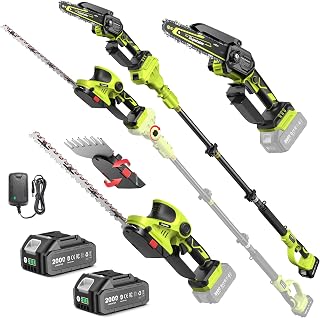 Supstable Cordless Pole Saw & Hedge Trimmer 6-in-1Check price on Amazon
 Husqvarna 130L Gas String TrimmerCheck price on Amazon
 Wild Badger Power Gen2 26cc Gas String TrimmerCheck price on Amazon
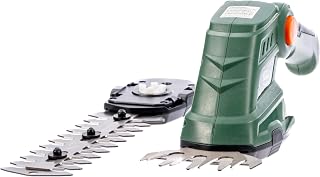 Scotts LSS10172S 7.2-Volt Cordless Grass Shear/Shrub TrimmerCheck price on Amazon
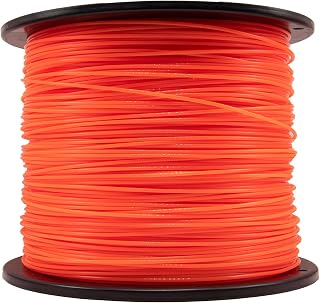 095 Trimmer LineCheck price on Amazon
AcreMowerLab earns a commission when you shop through links here. It never changes your price. Affiliate disclosure.
What is the best cordless string trimmer: pick the right platform
Understanding what is a cordless string trimmer begins with the power head and battery ecosystem. Unlike gas trimmers that require mixing fuel and pulling recoil cords, a cordless string trimmer runs on a removable lithium battery pack. The spinning head drives flexible line that shears grass against fences, around foundations, and along garden borders where a lawn mower cannot reach.
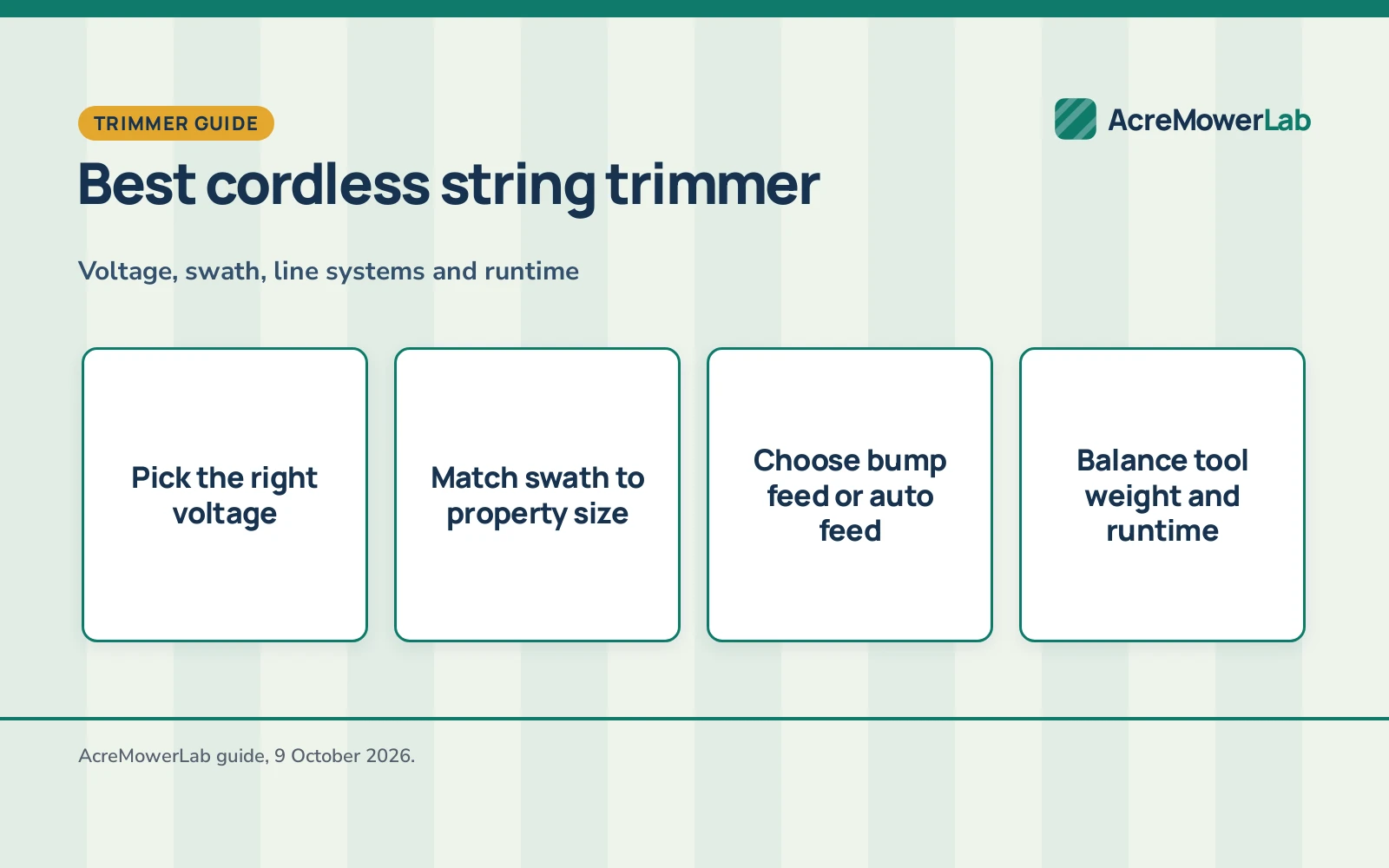
Selecting a trimmer platform comes down to cutting power, operating weight, and runtime. The market divides into distinct categories based on battery voltage and build class:
| Trimmer class | Best for | Limit |
|---|---|---|
| Compact 20V to 21V trimmer | Tight trimming along garden borders, patio edges, and small yards | Narrower cutting width and shorter runtime in dense brush |
| Mid-range 40V trimmer | Suburban yards and fence lines needing a balance of weight and power | Heavier than compact models without high-voltage cutting power |
| Heavy-duty 56V to 60V trimmer | Acreage properties, tough weeds, and extended trimming sessions | Higher overall weight and larger battery pack |
| Multi-head attachment system | Property owners who want one power head for trimming, edging, and pruning | Heavier shaft coupling and separate attachment costs |
Most property owners choose a platform that shares batteries with their other outdoor tools. See our best cordless string trimmer comparison for top picks across voltage classes, or our best string trimmer for acreage guide for heavy-duty options on larger parcels.
Step 2: evaluate battery voltage and runtime
Battery voltage determines the total electrical power delivered to the trimmer motor. Tools in the 20V and 21V range handle light grass along lawn borders, but can struggle in dense weeds. Higher voltage tools in the 56V and 60V classes deliver power comparable to small gas engines, cutting thick growth with less motor bogging.
Runtime depends on battery capacity in ampere-hours (Ah) and motor draw. The listings show several configurations. MZK lists a 20V trimmer with a 4.0Ah battery. Greenworks publishes a 40V trimmer with a 2.0Ah battery, listing a 60-min charge time and 2 hours average battery life in its spec table. EGO Power+ lists up to 45 minutes of runtime on its 15-inch multi-head kit with a 5.0Ah battery, and also publishes up to 45 minutes on its 16-inch carbon fiber trimmer when paired with a 2.5Ah battery. NovorikX publishes a 60V trimmer with a 2.5Ah battery running up to 27 minutes. Greenworks also lists a 60V trimmer with a 4.0Ah battery. Boltarc lists a 21V trimmer with dual 4.0Ah batteries claiming up to 120 minutes of runtime, while AZZUNO lists a 21V model with a 4.0Ah battery delivering up to 60 minutes per charge. Larger 4.0Ah or 5.0Ah packs extend runtime but add weight to the rear handle.
Step 3: select cutting swath and line diameter
Cutting swath is the cutting diameter swept by the trimmer line. A wider path clears more ground in each pass, while a narrower path gives tighter control around delicate plantings.
The reference listings show varied cutting widths. Boltarc lists a compact 5.8-inch cutting width for tight borders. FULLYEA lists a 9-inch cutting width. A 12-inch swath is standard for residential yards: Greenworks, MZK, AZZUNO, and RAXONE each list 12 inches. For larger lawns, EGO Power+ lists a 15-inch swath on its multi-head system and a 16-inch swath on its carbon fiber model. Greenworks lists a 16-inch width on its 60V trimmer, and NovorikX advertises a 17-inch cutting swath, though its spec table lists 14 inches. Pointing out contradictions like this helps buyers verify stated dimensions.
Line diameter dictates cutting durability and motor load. Standard thin line cuts tender grass with minimal drag on compact motors, but wears fast against stone. Heavier 0.095-inch line, specified on higher-voltage EGO Power+, Greenworks 60V, and NovorikX models, handles woody stems and hard borders without breaking, but requires a motor designed for heavier line. AZZUNO and FULLYEA also include metal blades, such as a 40T-2.0mm alloy saw blade, for thick brush. See our best gas string trimmer guide to compare gas models.
Step 4: assess motor power and shaft design
Brushless motors deliver higher efficiency and longer motor life than brushed designs by reducing internal friction. Boltarc lists a 500W motor spinning at 9000 RPM, FULLYEA publishes an 800W brushless motor running up to 18,000 RPM, and NovorikX lists a 1200W brushless motor with dual speeds of 6100 RPM and 4600 RPM. Other listings publish high rotational speeds: MZK lists 8000 RPM, RAXONE lists 9500 RPM, Greenworks lists 10000 RPM on its 60V model, and AZZUNO lists 25000 RPM.
Shaft design influences reach and comfort. Straight shafts reach under low branches, decks, and fence rails more easily while keeping the cutting head farther from the operator. Curved shafts are shorter and nimble in tight spots, but can force taller users to stoop.
Tool weight directly affects fatigue. FULLYEA lists 4.4 pounds, AZZUNO lists 5.5 pounds, RAXONE lists 6.2 pounds, and MZK lists 6.3 pounds. EGO Power+ lists its carbon fiber bare tool at 7.5 pounds and its multi-head kit at 12 pounds. Greenworks lists its 40V trimmer at 8 pounds, while its 60V kit lists 18.7 pounds in the spec table. NovorikX lists 15 pounds for its 60V tool. Contradictions appear in combo listings: Greenworks bullets state an 8-pound trimmer, but the combo shipping weight reads 16.5 pounds due to the blower. Always check the working weight with battery attached.
Step 5: compare line feed systems and attachments
The mechanism used to advance trimming line determines how smoothly your work proceeds. Clearing grass requires regular line replenishment because nylon line wears down and snaps against hard edges.
Line feed systems release fresh line during work, while modern head designs simplify spool reloading:
- Bump feed: tapping the bottom of the trimmer head against firm ground releases line from the spool while the head spins.
- Auto feed: centrifugal mechanisms advance a short length of line automatically when the trigger is cycled, eliminating the need to tap.
- Rapid reload heads: fresh line feeds straight through the head eyelets and winds onto the spool manually without opening the housing.
- Power winding heads: electric push-button motors retract and wind the trimmer line onto the spool automatically.
Several listings feature head adjustments. Boltarc and RAXONE rotate 90 degrees for vertical edging along walks. AZZUNO pivots from 0 to 90 degrees, and FULLYEA adjusts from 0 to 75 degrees. Multi-head couplers on EGO Power+ and Greenworks accept attachments like edgers, pole saws, and brush blades from a single power head.
Warranty terms indicate manufacturer backing. Greenworks offers a 3-year warranty on its 40V model and a 4-year warranty on its 60V platform. EGO Power+ provides a 5-year tool warranty and a 3-year battery warranty, with a lifetime warranty on its carbon fiber shaft. NovorikX lists a 3-year tool warranty and a 2-year battery warranty.
Plan your trimming pattern
Cutting direction depends on head rotation. Straight-shaft trimmers rotate counter-clockwise, throwing clippings to the operator’s left. When operating a counter-clockwise trimmer, keeping your right side toward walls, buildings, and fences directs cut debris inward onto the lawn rather than packing it against fence rails or scattering it over driveways. Curved-shaft trimmers rotate clockwise and discharge debris to the right, requiring the opposite approach.
When edging along sidewalks and curbs, walk forward smoothly with the line vertical or slightly angled, or rotate the trimmer head if equipped with a 90-degree pivoting mechanism. Keep the line skimming the turf edge without grinding the spool housing against concrete, which wears plastic parts rapidly.
Match the trimmer to grass density
Light grass along foundations cuts easily at moderate speeds, allowing you to feather the trigger and extend runtime. Heavy field grass, weeds, and ditch growth create severe drag. For thick brush and woody growth, our best brush cutter with blade guide covers blade-equipped alternatives.
Cut tall grass in layers from top to bottom. Trimming the upper section first prevents long stalks from wrapping around the drive spindle, avoiding motor stalls and heat buildup.
Plan the property in zones
Dividing a property into zones prevents running out of charge before key areas are finished. On properties of 1 to 10 acres, completing the entire parcel on one charge is rare.
- House perimeter: foundation beds, patios, and entrance walkways.
- Driveways: curb lines, mailbox posts, and approach edges.
- Fences and buildings: livestock enclosures, sheds, and barn walls.
- Property edges: road ditches, tree lines, and rough borders.
Complete high-visibility areas around the home first. Keeping a spare battery on a charger enables continuous rotation across zones.
Mind the weather and the ground
Dry grass cuts cleanly and disperses evenly. Wet grass sticks to the debris guard, creating heavy motor drag that drains batteries quickly.
Slippery slopes demand caution. Trimming steep banks while carrying a battery tool increases slip risks. Maintain firm footing, trim across slopes, and never work on muddy banks. Store lithium batteries indoors away from extreme heat and freezing temperatures to protect cell life.
Safety
Trimmer lines spinning at high speed can throw pebbles, wood chips, and wire fragments with force.
Wear eye and hearing protection, sturdy boots, and long pants. Clear sticks, stones, and wire from the work area before trimming. Keep children, pets, and bystanders away. Keep the debris guard securely installed to deflect fragments and control line length. Always remove the battery before clearing tangled grass or changing line spools.
FAQ: mowing large lots
What is the best cordless string trimmer for a typical home lawn?
For a typical lawn, a balanced 20V or 40V trimmer with a 12-inch cutting swath and a 2.0Ah to 4.0Ah battery offers the best mix of lightweight handling and enough runtime for borders without causing arm fatigue.
How much battery voltage do I need for yard trimming?
A 20V or 21V trimmer handles light grass and routine edging on smaller yards. Mid-range 40V models balance weight and power for typical suburban lots, while 56V or 60V platforms deliver the power needed for thick weeds, long fence lines, and heavy acreage growth.
Is a straight shaft or curved shaft better on a battery weed trimmer?
Straight shafts provide longer reach under decks and fence rails and offer better ergonomics for taller users. Curved shafts are lighter and nimble in tight gardens, but require working closer to the head.
What line diameter should I use in a cordless trimmer?
Match line diameter to your trimmer’s specifications. Use light line for routine trimming on compact models to minimize motor drag and extend runtime. For heavy weeds on higher-voltage trimmers rated for heavier line, 0.095-inch line resists snapping against hard surfaces.
How long does a cordless string trimmer battery last on a single charge?
Runtime depends on battery capacity, motor draw, and grass density. Reference listings publish single-battery runtimes ranging from 27 minutes up to 60 minutes, with some spec tables listing up to 2 hours of average battery life or 120 minutes on dual-battery kits under lighter trimming conditions.
More mowing guides
- Best Cordless String Trimmer: 5 Top Picks Compared (2026)
- Best String Trimmer for Acreage: 4 Gas and Battery Picks
- Best Gas String Trimmer (2026): 5 Top Picks for Large Lawns and Acreage
- Best Brush Cutter with Blade (2026): 5 Top Picks Compared
Use the Mower Matcher to narrow down choices by acreage, terrain, budget, and power type.