What Is a Mower Lift?
A comprehensive guide explaining what a mower lift is, how wheel-cradle and deck-jack designs work, weight limits, and safe maintenance steps.

On this page
Top picks at a glance
As an Amazon Associate I earn from qualifying purchases.
- 1
 MoJack EZ Max 45001 Lawn Mower Lift Jack9.7/10View on Amazon
- 2
 VEVOR 880 Lbs Ride On Lawn Mower Lift Jack9.6/10View on Amazon
- 3
 RocVanc 880 Lbs Riding Mower Lift Jack9.6/10View on Amazon
What is a mower lift? A mower lift is a specialized mechanical or hydraulic lifting device designed to raise the front end of a riding lawn mower, lawn tractor, or zero-turn mower off the ground. Elevating the cutting deck provides clear, stable access to the underside of the machine for routine maintenance tasks such as scraping away grass buildup, inspecting drive belts, and removing or sharpening cutting blades. Unlike improvised wooden blocks, automotive ramps, or floor jacks, a dedicated mower lift holds equipment securely at fixed working heights with positive mechanical locking mechanisms. For homeowners and landscape professionals maintaining acreage, a mower lift turns difficult under-deck service into a safe, routine job.
AcreMowerLab earns a commission when you shop through links here. It never changes your price. Affiliate disclosure.
What is a mower lift: pick the right lifting design
| Lift type | Best for | Limit |
|---|---|---|
| Hydraulic wheel cradle | Zero-turn mowers and heavy lawn tractors | Heavier unit weight than compact deck jacks |
| Manual screw wheel lift | Budget maintenance and drill-assisted lifting | Slower manual lifting speed when operated with hand crank |
| Deck baffle bracket jack | Quick front-end lifting on commercial zero-turns | Requires accessible front deck baffle lip |
| Scissor platform stand | Multi-vehicle service and total undercarriage access | Higher overall weight and larger shop footprint |
Most acreage owners choose a wheel-cradle jack for seasonal maintenance. See our lift for working on lawn mower guide for equipment comparisons.
Step 2: check mower weight and wheel span
Before selecting or operating any lifting equipment, verify that the unit matches your mower dimensions and front axle weight. A front-end mower lift only supports the weight resting on the front tires, which is a fraction of total machine weight. Exceeding published ratings creates severe safety hazards.
Published load ratings vary across available models. Compact options include the Maxority riding lift jack rated for 300 pounds and the Pro-LifT model rated for 350 pounds. Several models offer a 500 pounds capacity, including the MoJack HDL500, the TOLGORN carbon steel jack, and EROMMY. For heavier machines, higher ratings are available: the MoJack MJ750XT publishes a 750 pounds rating, Maxority lists a hydraulic model rated for 750 pounds, Jungle Jim’s rates the Jungle Jack for 800 pounds, FozsKeylf lists an 880 pounds capacity, and YXFAIRY publishes a load capacity of 1400 pounds.
Wheel span compatibility is equally critical. The front tires of your machine must sit squarely inside the wheel pads without hanging over the edges. MoJack HDL500 lists an adjustable wheel span from 18.5 inches to 47.5 inches. MoJack MJ750XT expands from 31.5 inches to 62.5 inches to accommodate broad commercial zero-turn frames. Pro-LifT specifies wheel track compatibility from 40-3/4 inches to 49-1/4 inches outside span. EROMMY lists an outer wheel track range from 40 inches to 47.6 inches, while Maxority accommodates axle widths from 36 inches to 50.5 inches on its hydraulic lift.
Step 3: position on flat, solid ground
Proper ground conditions are essential before lifting. Always position the lift on flat, stable ground. While models such as FozsKeylf and YXFAIRY feature foot caps designed for grass or cement floors, level shop floors provide the greatest stability. Avoid uneven slopes or loose gravel where base supports could shift under load.
Drive or roll the mower into position so the front tires are centered squarely in the lift wheel cradles and resting against the stops. Once the machine is properly positioned, shut off the engine, disengage the blade clutch, set the parking brake, and remove the ignition key. Disconnect the spark plug boot before performing any service to prevent accidental engine startup.
Step 4: engage mechanical safety locks
Mower lifts raise equipment using hydraulic cylinders, threaded screw rods, or foot pedals. Regardless of the lifting method, mechanical safety stops are mandatory. Hydraulic fluid pressure can bypass internal seals over time, leading to gradual descent or sudden failure.
Once raised, verify that the steel safety lock engages completely before placing any tool or body part near the cutting deck. MoJack HDL500 lists a maximum lifting height of 24 inches and includes 3 built-in safety stops at 12, 18, and 24 inches. Jungle Jim’s lifts up to 19 inches using a twist handle safety arm with a standard 2″ lifting tooth or optional 3″ tooth. Pro-LifT achieves a maximum lift height of 23-1/4 inches secured by a steel safety lock. Maxority reaches a 24 inches lifting height with an integrated locking bar, EROMMY provides 3 fixed locking heights up to 24 inches using dual locking pins, and TOLGORN provides 3 adjustable height levels. YXFAIRY lists height adjustability from 2 inches to 26 inches. Lower the hydraulic ram slightly so the mechanical lock bears the load.
Step 5: complete deck and blade service
With the machine elevated and locked, you gain unobstructed access to the mower undercarriage. Scrape away packed grass clippings and dried mud from under the deck shell using a putty knife or scraper. Clearing caked clippings restores designed airflow, prevents uneven discharge, and stops moisture from rusting the steel housing.
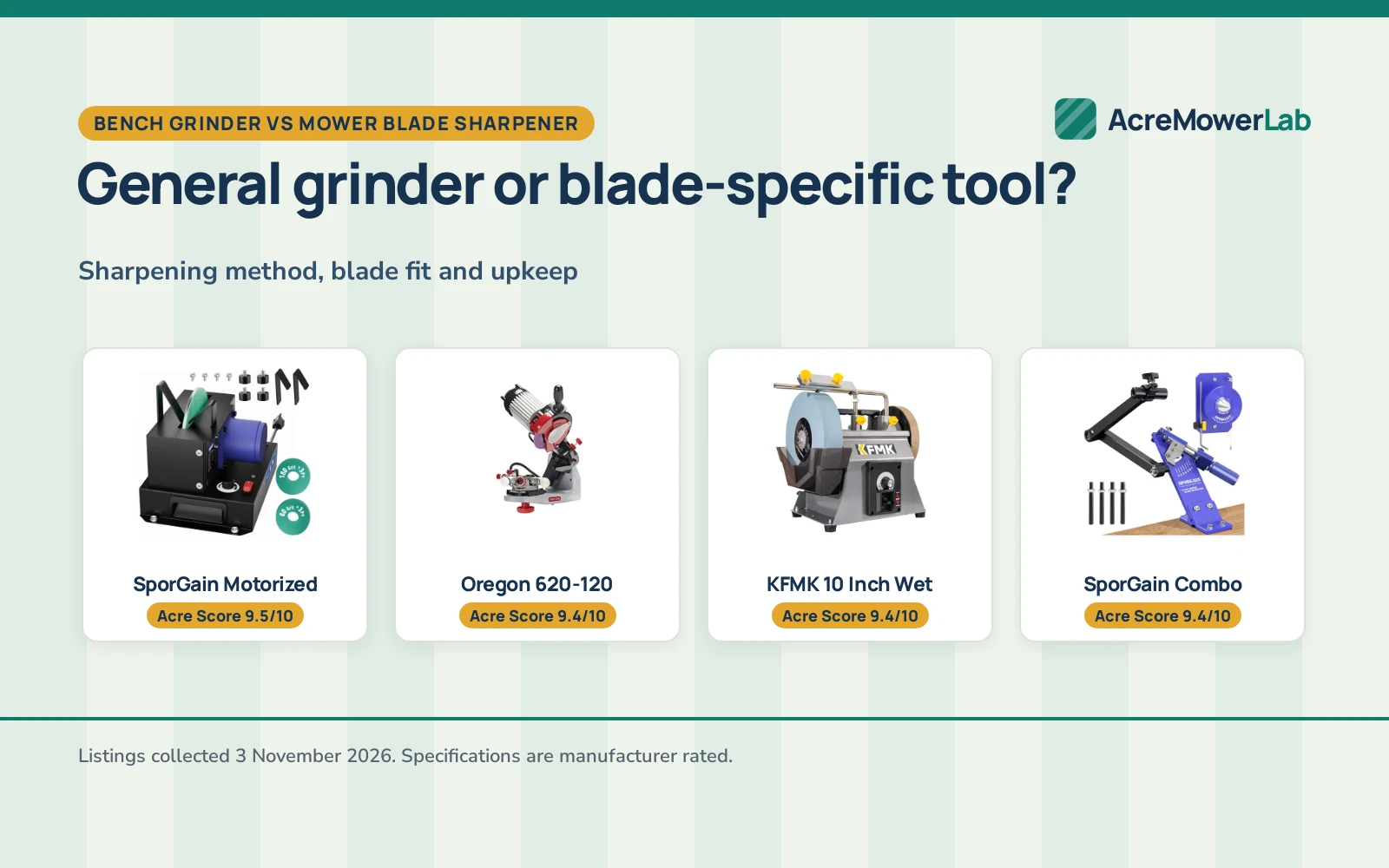
Next, inspect cutting blades for nicks and bends. Secure the blade with a wooden block wedged against the deck baffle, then loosen the retaining bolt with a wrench. Keep cutting edges sharp for a clean lawn finish: see our mower blade sharpener recommendations. Check spindle bearings for play, inspect drive belts, and lubricate grease fittings before lowering the mower. Regular under-deck cleaning forms the backbone of seasonal mower maintenance.
Select an ideal service location
A clean, well-lit workspace inside a garage, barn, or workshop makes routine maintenance safer and more convenient. Ensure ample open clearance on all sides of the mower so you can maneuver breaker bars, scrapers, and tools without bumping against walls or storage racks.
Storage requirements depend on the weight and frame design of the lift. Compact models can hang from wall hooks or stow inside landscape trailers: Jungle Jim’s lists an item weight of 15 pounds, YXFAIRY lists 20 pounds, and FozsKeylf lists 24 pounds. Heavier shop jacks feature rolling wheels for repositioning across concrete floors: Pro-LifT weighs 51.4 pounds and includes 4 steel wheels, TOLGORN lists a weight of 51.8 pounds, EROMMY weighs 52.3 pounds, MoJack HDL500 weighs 68 pounds, Maxority lists an 85 pounds item weight, and MoJack MJ750XT weighs 99 pounds.
Match the lift mechanism to your deck
Mower lift designs interact with your machine in two distinct ways: by cradling the front tires or by hooking onto the deck baffle.
Wheel-cradle lifts support the mower by its front wheels. Because the lifting pads contact only the tires, the cutting deck, anti-scalp wheels, and belt covers remain untouched during the lift. Compatibility depends on matching the front tire width to the cradle span. In contrast, deck-bracket jacks (such as Jungle Jim’s) lift from the center using a spring-loaded tooth that hooks under the front deck baffle. Jungle Jim’s lists a standard 2″ tooth designed to fit 90% of mowers, with an optional 3″ tooth for wider baffles. When choosing between these styles, inspect your front end to verify whether the deck baffle is accessible or whether wheel cradles provide a more direct fit. If you need replacement hardware, consult our guides for lawn tractor parts and zero turn mower parts.
Follow a systematic maintenance routine
Establishing a consistent service schedule extends the operational lifespan of your riding mower and produces cleaner cutting results across acreage lawns. Scrape the underside of the deck regularly during spring and early summer when high moisture content causes heavy clipping buildup. Inspect blade sharpness frequently, especially after hitting hidden tree roots or stones.
When selecting maintenance tools for your property, review the manufacturer warranty terms listed in published specifications. Maxority lists a 90 days limited warranty on its lift models, Pro-LifT specifies a 1 year warranty, FozsKeylf lists a 1 year warranty, YXFAIRY publishes a 365 days warranty, MoJack MJ750XT provides a 2-year warranty, and Jungle Jim’s provides a 2-year weld warranty on its steel frame.
Mind the surface stability and hydraulic drift
Understanding equipment mechanics helps avoid workshop hazards. Hydraulic cylinders operate via pressurized oil acting against internal pistons. Over prolonged periods, fluid bypass around piston seals can cause hydraulic rams to creep downward. Never crawl under or reach beneath equipment supported solely by hydraulic pressure; always confirm that the steel locking pawl or pin supports the structural weight.
Tilting a riding mower alters fluid distribution inside the crankcase and fuel tank. Front-end lifts raise only the front wheels while rear drive wheels remain on the floor, maintaining a moderate incline. Operating within manufacturer height ratings (such as the 24 inches maximum lifting height on the MoJack HDL500 or 19 inches on the Jungle Jim’s) keeps oil settled in the engine rather than flowing toward the air cleaner or exhaust. Verify that the fuel cap is secure, avoid servicing right after fueling, and place wheel chocks at the rear tires once elevated.
Safety
Operating a mower lift safely requires strict adherence to workshop procedures. Always turn off the mower engine, remove the ignition key, and disconnect the spark plug wire before beginning maintenance beneath the deck. On battery-powered electric riding mowers, remove the safety disconnect key or main power pack before servicing blades.
Never bypass mechanical locking pins or safety arms. Once elevated, confirm stability before reaching underneath. Wear thick leather work gloves when handling mower blades, as edges can slip unexpectedly. Keep bystanders, children, and household pets away from the service area while equipment is elevated. When lowering the machine, ensure all tools, scrapers, and feet are completely clear of the descending frame.
FAQ: mowing large lots
What is a lawn mower lift used for?
A lawn mower lift raises the front end of a riding mower or zero-turn machine off the ground. It provides safe clearance to clean caked grass from under the cutting deck, inspect drive belts, change spindle pulleys, and remove cutting blades for sharpening or replacement.
Can a regular automotive jack be used instead of a mower lift?
Automotive floor jacks and car ramps are poorly suited for lawn equipment. Standard car jacks contact a single small point on the frame, which can easily slip off rounded mower tubing, while car ramps lack proper width for mower wheelbases. Dedicated mower lifts feature wide wheel cradles and mechanical safety locks designed specifically for mower stability.
What is the best mower lift capacity for a riding mower?
When evaluating what is the best mower lift or what is the best lawn mower lift for your machine, check the front axle weight against published load ratings. Available options include Maxority at 300 pounds and Pro-LifT at 350 pounds; mid-capacity jacks include MoJack HDL500, TOLGORN, and EROMMY at 500 pounds; and higher-capacity models include MoJack MJ750XT and Maxority at 750 pounds, Jungle Jim’s at 800 pounds, FozsKeylf at 880 pounds, and YXFAIRY at 1400 pounds.
Will fuel or engine oil leak when using a mower lift?
Front-end mower lifts raise only the front wheels while rear tires remain on the floor, keeping the machine at a moderate tilt. Under normal operation within published height limits, oil remains in the crankcase and fuel stays inside the tank. Avoid filling the fuel tank to the brim right before maintenance, and verify that the fuel cap is secure.
How high does a mower lift raise a machine?
Lifting height varies by model and mechanism. For example, MoJack HDL500 lists a maximum lifting height of 24 inches with safety stops at 12, 18, and 24 inches, Jungle Jim’s lifts up to 19 inches, Pro-LifT provides a maximum lift height of 23-1/4 inches, Maxority and EROMMY reach 24 inches, and YXFAIRY lists height adjustability from 2 inches to 26 inches.
More mowing guides
- Lift for Working on Lawn Mower: 5 Picks Compared (2026)
- Best Mower Blade Sharpener: 4 Picks for Riders and Large Lawns
- Zero Turn Mower Parts: Maintenance and Replacement Guide
- Lawn Tractor Parts: Maintenance and Replacement Guide
Use the Mower Matcher to narrow down choices by acreage, terrain, budget, and power type.