What Size Trailer for Riding Lawn Mower?
How to choose the right size tow-behind trailer or dump cart for your riding lawn mower based on cargo volume, weight rating, hitch size and terrain.

On this page
Top picks at a glance
As an Amazon Associate I earn from qualifying purchases.
- 1
 ECOTRIC Adjustable Lawn Mower Trailer Towing Hitch9.8/10View on Amazon
- 2
 Eapele Solid Iron Lawn Mower Trailer Hitch9.6/10View on Amazon
- 3
 lifgarfe Steel Lawn Mower Trailer Tow Hitch9.5/10View on Amazon
- 4
 VEVOR 22 Cu.Ft 1600Lbs Steel ATV UTV Trailer Tow Behind DumpView on Amazon
- 5
 YINTATECH ATV Trailer Steel Dump Cart Pull Behind DumpView on Amazon
- 6
 VEVOR Heavy Duty ATV Trailer Steel Dump Cart Tow BehindView on Amazon
- 7
 VEVOR ATV UTV Trailer Tow Behind Dump Cart 1500lbs CapacityView on Amazon
- 8
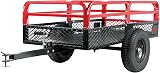 Big RED Heavy Duty ATV Trailer Steel Dump Cart: Yard GardenView on Amazon
- 9
 Ironton Tow-Behind Trailer Broadcast and Spot SprayerView on Amazon
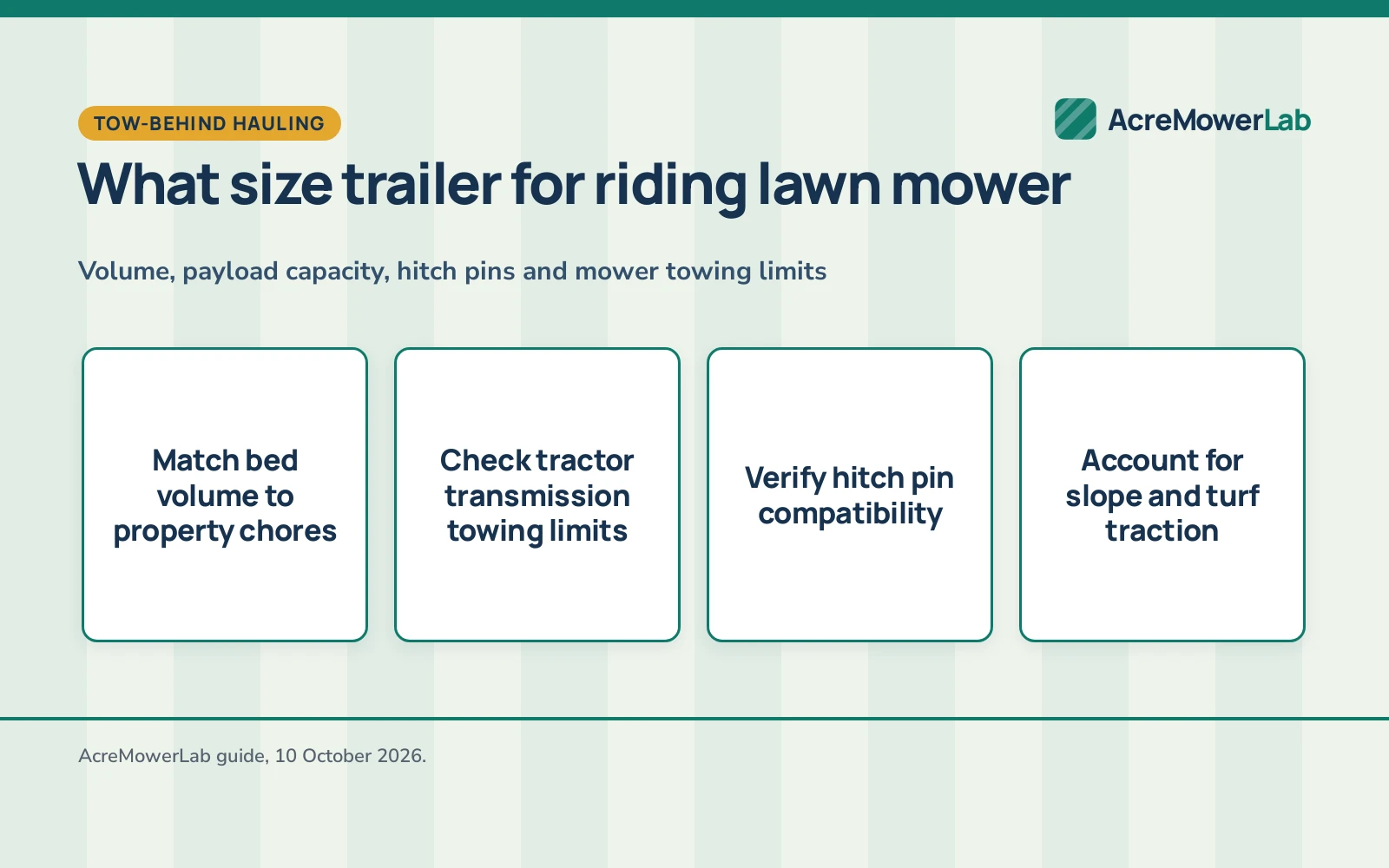
To determine what size trailer for riding lawn mower chores fits your property, match bed volume and payload capacity to your materials and tractor limits. Bulky leaves and clippings require volume: mid-size to large trailers offering 11.4 cu. ft. from ExploreHorizon and Garvee, 17 cu. ft. from Clyrava and VEVOR, or 22 cu. ft. from VEVOR clear acreage efficiently. Dense soil, gravel, and logs demand payload: an 8 cu. ft. cart from TricaLktdp supporting 750 lbs or a 10 cu. ft. poly cart from Brinly supporting 650 lbs handles heavy mass. Across reference models, payload spans from 350 lbs on YINTATECH, 500 lbs on Garvee, ExploreHorizon, and YINTATECH, 600 lbs on Clyrava and VEVOR, to 1600 lbs on VEVOR.
Other machines to compare
 VEVOR 22 Cu.Ft 1600Lbs Steel ATV UTV Trailer Tow Behind DumpCheck price on Amazon
 YINTATECH ATV Trailer Steel Dump Cart Pull Behind DumpCheck price on Amazon
 VEVOR Heavy Duty ATV Trailer Steel Dump Cart Tow BehindCheck price on Amazon
 VEVOR ATV UTV Trailer Tow Behind Dump Cart 1500lbs CapacityCheck price on Amazon
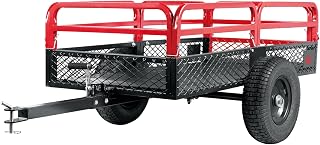 Big RED Heavy Duty ATV Trailer Steel Dump Cart: Yard GardenCheck price on Amazon
 Ironton Tow-Behind Trailer Broadcast and Spot SprayerCheck price on Amazon
AcreMowerLab earns a commission when you shop through links here. It never changes your price. Affiliate disclosure.
What size trailer for riding lawn mower: sizing overview
| Trailer Class | Reference Models | Volume Capacity | Payload Rating | Ideal Chores |
|---|---|---|---|---|
| Compact Utility | TricaLktdp | 8 cu. ft. | 750 lbs | Dense materials in compact loads, firewood, tools |
| Standard Poly | Brinly | 10 cu. ft. | 650 lbs | Mulch spreading, compost, fertilizer, garden upkeep |
| Mid-Size Yard | ExploreHorizon, Garvee | 11.4 cu. ft. | 500 lbs | General yard debris, branches, bagged mulch |
| Large Property | Clyrava, VEVOR | 17 cu. ft. | 600 lbs | Bulky brush, fallen leaves, acreage cleanup |
| Heavy-Duty Hauler | VEVOR | 22 cu. ft. | 1600 lbs | Dense soil, gravel, heavy estate hauling |
| Light Duty Steel | YINTATECH | Not stated | 350 lbs | Basic garden chores, potted plants, light tools |
Selecting the proper trailer balances volume, weight limits, and ground stability behind your machine. For detailed equipment evaluations, explore our guide on the trailer for riding lawn mower categories.
Match trailer volume to your property chores
Trailer bed volume indicates how much material you can load before debris spills over the sides. Bulky debris like dry leaves, shrub clippings, and branches takes up substantial space while remaining light. For these tasks, high-volume utility trailers save trips across the yard: 17 cu. ft. models from Clyrava and VEVOR or 22 cu. ft. from VEVOR hold large piles of yard waste in a single pass.
Dense materials behave differently. Topsoil, gravel, sand, and green firewood carry heavy mass per cubic foot. Filling a 17 cu. ft. bed rated at 600 lbs with wet soil will quickly exceed trailer axle and tractor transmission limits. Compact carts such as the 8 cu. ft. hauler from TricaLktdp provide a 750 lbs rating, moving heavy cargo without overfilling risk. For estate-scale dirt hauling, the 22 cu. ft. VEVOR hauler is reinforced for up to 1600 lbs. Mid-size 10 cu. ft. carts from Brinly or 11.4 cu. ft. models from ExploreHorizon and Garvee offer a balanced footprint for mixed lawn upkeep.
Check weight ratings and mower towing capacity
Payload capacity is the maximum cargo weight the trailer frame, axle, and wheels support. Entry carts from YINTATECH list 350 lbs capacity, moving up to 500 lbs on YINTATECH, ExploreHorizon, and Garvee models. Standard haulers from Clyrava and VEVOR carry 600 lbs, Brinly supports 650 lbs, TricaLktdp handles 750 lbs, and heavy-duty steel trailers from VEVOR support 1600 lbs.
Towing strain includes the tare weight of the empty cart: YINTATECH lists 74 pounds, Garvee 84.4 pounds, TricaLktdp and YINTATECH 86 pounds, ExploreHorizon 91.5 pounds, VEVOR 99.2 pounds, Clyrava 106 pounds, and the larger VEVOR model 118 pounds. Your riding mowers must provide adequate traction and braking for this combined mass. Hydrostatic transmissions overheat under excessive loads, causing drive wear. Always check your tractor manual for manufacturer towing limits. See our roundup on the pull behind dump cart options.
Hitch pin sizing and trailer tongue connections
Most lawn tractors feature a stamped steel rear hitch plate with a central pin hole. Tow-behind carts connect via a vertical hitch pin through the trailer tongue clevis.
VEVOR and Clyrava include a 0.47-inch (12mm) hitch pin with their utility trailers, while Brinly includes a magnetic hitch pin. Because rear hitch pin hole diameters vary across mower brands, measure your tractor bracket before ordering to ensure a 0.47-inch pin passes through cleanly without binding or excess play. VEVOR incorporates dual pin holes on the tongue for coupling adjustments. Brinly builds its cart with a solid steel axle to resist bending stress under full loads.
Bed materials and dumping design
Brinly constructs its 10 cu. ft. cart with a compression-molded polypropylene bed that is rust-proof and dent-proof, completing over 1000 flex cycles in manufacturer evaluation. Poly beds excel for hauling wet compost, grass clippings, and fertilizer without corrosion. Steel carts from VEVOR and Clyrava feature 1mm thick steel side walls reinforced by 8 structural ribs and hammer-tone powder coat paint, offering rigidity for abrasive rocks and firewood.
For unloading, ExploreHorizon features a pedal release mechanism tipping the bed to a 45-degree angle. Brinly provides a steep 56-degree dump angle via a tongue foot pedal, letting sticky material slide out cleanly. VEVOR and Clyrava include dual controls with a hand lever and foot pedal. Removable tailgates on ExploreHorizon, Garvee, and YINTATECH, plus detachable sides on TricaLktdp, ease cargo loading.
Tire dimensions and lawn terrain
Narrow tires sink into soft turf, leaving ruts and increasing transaxle drag. Large pneumatic tires cushion loads and distribute weight across a wider footprint.
Listings from VEVOR and Brinly specify 16″ x 4″ pneumatic tires with turf tread. Clyrava uses 15×4-inch pneumatic tires, while ExploreHorizon and TricaLktdp equip 16″ pneumatic tires. For soft turf, muddy lanes, and rough terrain, the heavy-duty hauler from VEVOR features extra-wide 16″ x 8″ pneumatic tires for flotation.
Hauling your riding mower on a transport trailer
Transporting a riding mower on public roads requires matching trailer dimensions to your machine footprint and deck width. Check our guide on riding lawn mower sizes to verify trailer deck clearance.
When loading equipment into a transport trailer or shed, Vlaeng lists aluminum ramps measuring 48″L x 10″W x 3″H (also listed as 47″L x 9″W) supporting up to 880 lbs for the set at step heights up to 13.5 inches. Vlaeng instructs users not to ride equipment when using the ramp.
Safety while towing with a riding mower
Towing with a riding lawn mower requires strict adherence to operating limits:
- Never exceed the maximum slope rating in your tractor manual. Heavy trailers downhill increase stopping distance and risk jackknifing.
- Avoid towing heavy carts across wet grass or steep slopes where tires lose traction.
- Always disengage mower blades when towing utility carts.
- Keep children, pets, and bystanders away from the work area.
- Never carry passengers inside a utility dump cart.
- Allow the engine to cool completely before refueling.
- Inspect hitch pins and hardware before each hauling job.
Review our Safety Disclaimer for additional details.
FAQ: mowing large lots
How much weight can a riding lawn mower safely pull?
Mowers safely pull utility trailers matching their transmission rating, with reference carts spanning 350 lbs on YINTATECH, 600 lbs on Clyrava and VEVOR, 650 lbs on Brinly, 750 lbs on TricaLktdp, and 1600 lbs on heavy-duty VEVOR models. Always consult your tractor manual for specific limits.
What size trailer is best for typical yard maintenance?
For standard mulch, compost, and bagged fertilizer, a 10 cu. ft. poly cart from Brinly or an 11.4 cu. ft. steel hauler from ExploreHorizon and Garvee offers ample capacity while staying nimble around obstacles.
Will a 0.47-inch hitch pin fit my riding mower?
A 0.47-inch (12mm) hitch pin, supplied by VEVOR and Clyrava, fits many common lawn tractor hitch plates. Measure your tractor hitch hole before ordering to verify clearance.
Is a poly or steel dump cart better for garden work?
Poly beds, like the 10 cu. ft. Brinly cart, are ideal for wet compost, clippings, and fertilizer because polypropylene will not rust. Steel carts, like the 1mm thick models from Clyrava and VEVOR, provide superior impact resistance for rocks and firewood.
Can I tow a loaded utility trailer on slopes?
Towing on slopes requires extreme caution because trailer weight pushes the mower downhill, extending stopping distances. Stay within manual slope limits and avoid wet turf.
More mowing guides
- Best Trailer for Riding Lawn Mower (2026): 5 Top Picks Compared
- Best Pull Behind Dump Cart: 5 Picks for Lawn Tractors and UTVs (2026)
- Best Dump Cart Under 300 (2026): 5 Top Picks Compared
Use the Mower Matcher to narrow down choices by acreage, terrain, budget, and power type.