Riding Lawn Mower Sizes: Deck Width, Dimensions and Storage Guide
A complete guide to riding lawn mower sizes, covering cutting deck widths, physical machine dimensions, gate clearance, trailer transport, and storage requirements.

On this page
Top picks at a glance
As an Amazon Associate I earn from qualifying purchases.
- 1
 Eparts Riding Mower Garden Tractor Seat9.4/10View on Amazon
- 2
 Greenworks 80V 42" CrossoverT Cordless Riding Lawn Tractor9.5/10View on Amazon
- 3
 Electric Riding Lawn Mower9.5/10View on Amazon
Riding lawn mower sizes encompass cutting deck width, overall machine footprint, storage requirements, and gate clearance. Deck widths determine the cutting path across open ground, while total physical length, width with the discharge chute, and machine height dictate whether equipment fits through yard gates, onto utility trailers, and inside storage sheds. Selecting the proper size requires balancing acreage mowing time against storage space and boundary clearance. This guide explains how to measure, evaluate, and choose riding lawn mower sizes for your property.
AcreMowerLab earns a commission when you shop through links here. It never changes your price. Affiliate disclosure.
Riding lawn mower sizes: pick the right deck width
Cutting deck width represents the primary measurement used to categorize riding lawn mower sizes. The cutting deck houses the spinning blades and sets the width of turf trimmed in a single pass. Narrower decks suit residential yards with fence gates and landscaped beds, while broader decks maximize productivity on expansive, open ground. However, the cutting width only accounts for the blade swath; the physical deck shell, side discharge deflector, and outer wheels extend past the cut line.
| Category | Relative Size and Footprint | Best Fit | Storage and Gate Clearance |
|---|---|---|---|
| Rear-engine rider | Compact cutting deck and short wheelbase | Smaller properties with narrow access gates | Occupies minimal storage space and navigates tight gates |
| Lawn tractor | Midsize cutting deck with front-mounted engine | Residential acreage with open turf | Requires standard garage or utility shed space |
| Garden tractor | Heavy-duty frame, wider deck options, and larger drive tires | Large acreage requiring ground attachments | Demands wide storage doors and heavy trailer capacity |
| Zero-turn mower | Maneuverable platform with lap-bar steering and front casters | Properties with multiple trees and obstacles | Requires extra floor depth for forward caster arms |
Choosing between these configurations depends on property boundaries and storage buildings. See our riding lawn tractor guide for tractor evaluations, or explore our riding mowers section to compare categories.
Step 2: measure gate and entry clearance
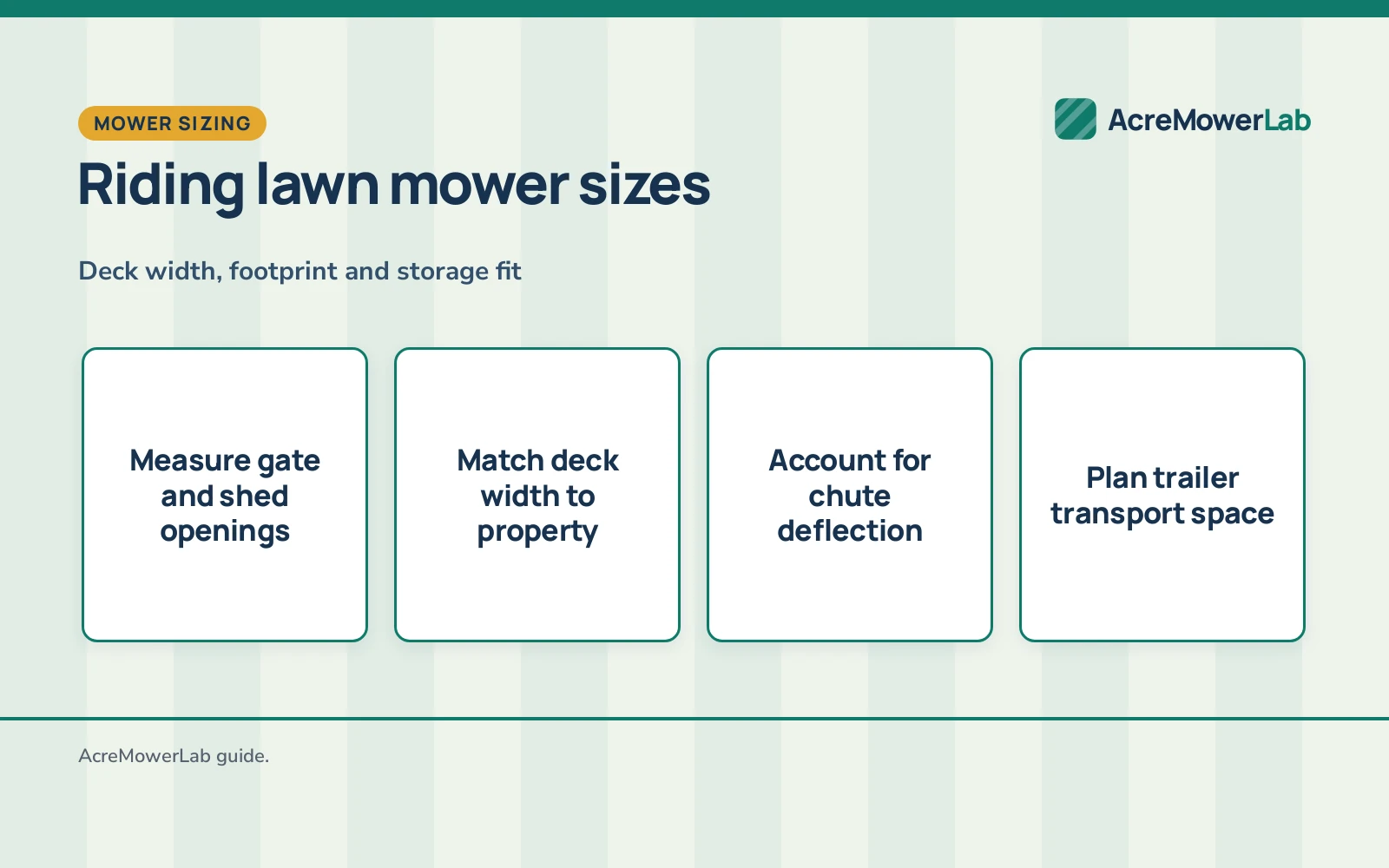
Before purchasing any machine, measure every gate and narrow passageway the mower must navigate. Measure the clear opening between gate posts at the narrowest point, accounting for latch hardware, post hinges, and open gate panels that may protrude into the walkway. Ground clearance also matters if the path slopes or crosses uneven roots near fence posts.
Always compare gate measurements against the total machine width with the discharge deflector chute lowered in the operating position. Operating a riding mower with the discharge chute tied up or removed creates a severe safety hazard from thrown debris. Some mowing decks feature flexible or spring-loaded chutes that can fold or pivot when passing through tight access points, but clearance should allow unobstructed movement without damaging protective guards.
Step 3: calculate shed and garage storage footprint
A riding mower demands dedicated floor space. Calculate storage requirements by measuring total machine length from the front bumper or front casters to the rear hitch plate, overall height to the top of the steering wheel or seat back, and total deck width. When planning floor space, account for whether the discharge deflector remains down or folds up on models equipped with spring-loaded chutes.
If your mower includes a rollover protective structure, verify vertical clearance against shed door headers and interior ceiling joists. Beyond the static machine dimensions, maintain walking clearance around the perimeter of the parked machine. This surrounding space allows safe operator access, room to perform pre-mow fluid checks, connection space for battery chargers, and clearance to inspect cutting blades.
Step 4: verify trailer transport capacity
If you transport your mower between properties, to a service shop, or between separated fields, confirm trailer bed dimensions. Measure the clear width between trailer side rails, wheel fenders, and rear gate ramp uprights to ensure the cutting deck clears with margin on both sides.
Ramp angle represents another critical sizing factor. Riding mowers feature low ground clearance under the cutting deck and frame. Steep loading ramps can cause the deck shell or anti-scalp wheels to high-center and hang up on the ramp threshold. For guidance on trailer selection and tie-down requirements, see our utility trailer for riding lawn mower overview.
Step 5: match dimensions to terrain and property layout
Property layout directly influences optimal machine dimensions. While broader decks trim large open areas in fewer passes, wide rigid decks can scalp undulating turf when crossing sharp knolls, terrace ridges, or drainage swales. When a wide deck crests a high mound, the center of the deck drops closer to the turf and scalps the crown, while the outer ends lift. Conversely, when crossing a depression or ditch, the outer edges can scalp the higher banks while the center blades cut too high.
Narrower decks follow uneven ground contours more smoothly with less risk of scalping. In addition, examine narrow property bottlenecks, such as gaps between trees, garden beds, outbuildings, and fence corners, to ensure the mower can navigate the entire yard without leaving hard-to-reach patches.
Deck cutting width versus total machine footprint
A frequent error when sizing equipment is confusing stated cutting deck width with total machine width. Stated cutting width reflects only the circular blade cutting swath under the deck housing. The steel deck housing extends beyond the cut path to contain airflow and clippings, while anti-scalp gauge wheels, bracketry, and the discharge deflector add significant additional width.
The side-discharge chute extends lateral clearance beyond the cutting width during operation. Optional bagging systems and rear attachments also change machine dimensions. Rear-mounted baggers or collection hoppers increase total machine length, while side-mounted collection tubes widen the operating profile. Always evaluate the full operating envelope rather than the cutting swath alone.
Comparing riding mowers to walk-behind equipment
Walk-behind mowers illustrate how cutting width relates to machine footprint. For example, the Greenworks 40V push mower lists an 18.1 inches cutting width and a 40 pounds weight, while the larger Greenworks 60V self-propelled mower lists a 23.96 inches cutting width and a 67.2 pounds weight rated for up to 3/4 acre.
Riding lawn mowers scale well beyond these walk-behind cutting widths and weights, requiring wider transport trailers, broader garage bays, and expanded gate clearance. For details on push mower dimensions, consult our push lawn mower sizes guide.
Wheelbase, turning radius and steering systems
Steering design and wheelbase directly dictate machine agility. Traditional lawn tractors utilize automotive-style steering wheels linked to the front steering spindles. These machines turn along an arc, leaving an uncut circle of turf at full steering lock that requires reversing or trimming around tight trees and posts.
Zero-turn mowers feature independent hydraulic wheel drive systems steered with dual lap bars. By controlling drive wheels independently, zero-turn machines can rotate within their own footprint, eliminating the uncut circle and speeding up trimming around yard obstacles. However, zero-turn frames feature extended forward caster arms that increase total machine length. See our zero turn mower sizes guide for details on zero-turn footprints. For battery-powered options that eliminate fuel storage, review our best electric riding mower guide.
Weight, stability and terrain considerations
Machine weight and center of gravity scale alongside deck width. Larger garden tractors and commercial-grade riders feature heavy steel frames, cast-iron front axles, and large rear drive tires. This weight aids traction when pulling heavy tow-behind ground attachments, but heavy equipment requires care on soft ground, damp turf, or septic drainage fields.
On sloping ground, machine stance and tire track width provide stability. Tractors feature steered front wheels that help maintain directional tracking across moderate slopes. However, all equipment faces traction limits on wet grass or steep inclines. Zero-turn mowers rely entirely on rear drive wheel traction for steering and braking; swiveling front casters do not steer and can slide downhill if rear wheel traction is lost. For guidance on handling inclines, read our best riding mower for hills guide.
Safety
Operating riding lawn equipment requires strict attention to manufacturer operating procedures. Never exceed the manufacturer’s maximum slope rating for your machine. Zero-turn mowers can lose steering traction on slopes, near retention ponds, drainage ditches, and sharp drop-offs. If your machine features a rollover protective structure, always wear your seat belt with the structure locked in the upright position.
Never carry passengers or children on riding equipment. Keep children, pets, and bystanders completely away from the mowing area during operation. Disengage cutting blades before shifting into reverse. Wear proper eye protection and hearing protection to guard against thrown debris and sustained engine noise. Clear fallen tree limbs, rocks, wire, and loose debris before mowing. Allow the engine or electric drive system to cool before refueling or connecting charging equipment. Consult our Safety Disclaimer.
FAQ: mowing large lots
How do riding lawn mower sizes affect storage shed requirements?
Riding mowers require floor space matching their total length, height, and deck width, accounting for whether the discharge deflector chute remains lowered or folds up for storage. You must also allocate surrounding walking space for parking, maintenance, and battery charging access.
What is the difference between deck width and overall machine width?
Deck width measures the circular swath cut by the mower blades. Overall machine width includes the steel deck housing, outer gauge wheels, and the protruding side discharge deflector chute, which extends lateral clearance beyond the cutting width.
Will a riding lawn mower fit through a standard yard gate?
Many standard yard gates are narrower than a riding mower’s operating width with the discharge chute in place. Measure the clear distance between gate posts before selecting a mower to verify that the equipment can enter the backyard.
How do I know what size trailer I need for a riding mower?
Measure the clear width between trailer rails and fenders, comparing it against the mower’s total width with the chute in place. Verify that the trailer deck length accommodates the front-to-rear wheelbase and that ramp angles prevent the deck from high-centering.
How does deck width impact mowing efficiency on acreage?
Broader cutting decks cover more ground per pass, reducing total operating time across open acreage. However, overly wide decks reduce agility around landscaped beds, increase storage space demands, and can scalp turf on rolling or uneven terrain.
More mowing guides
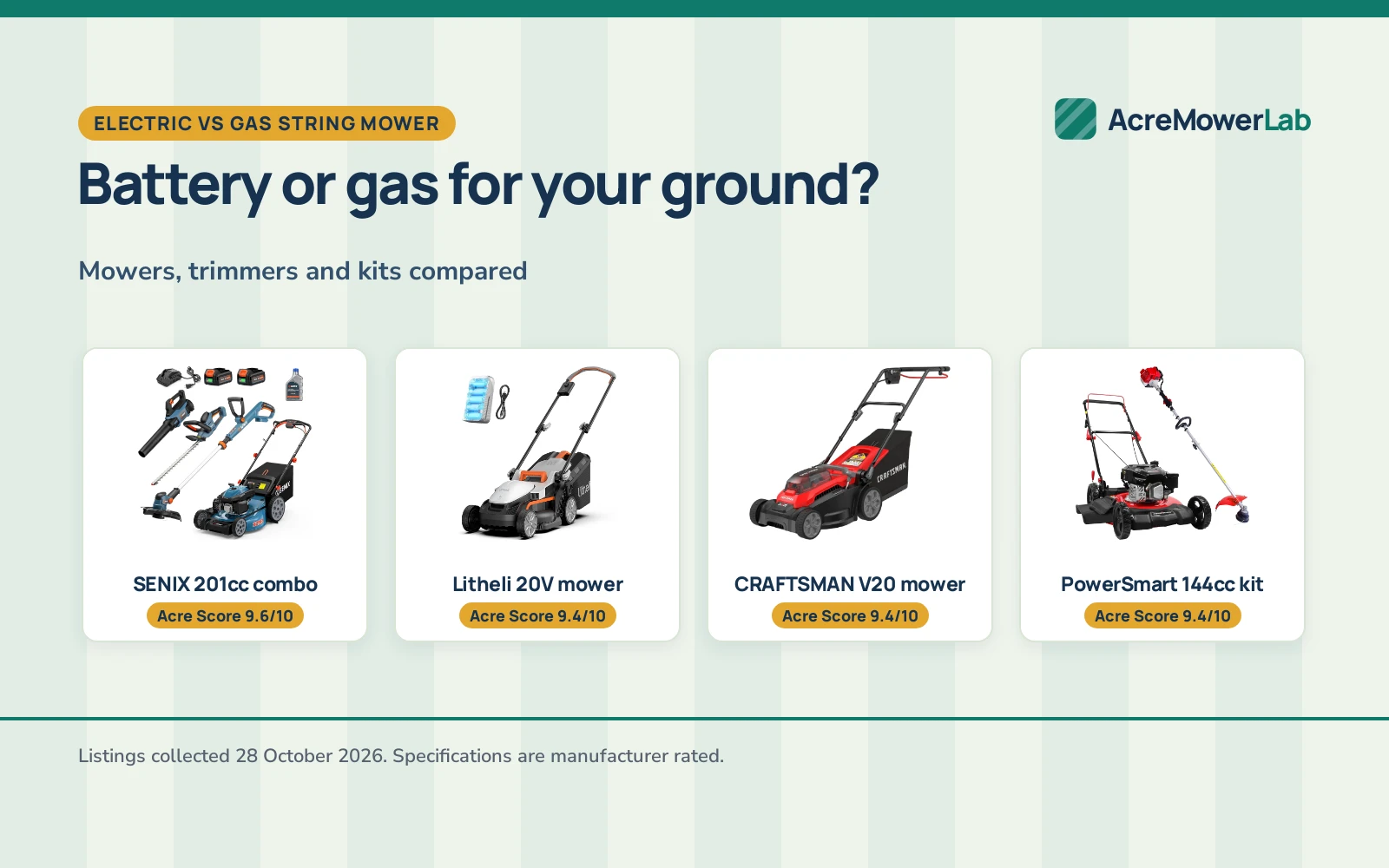
- Electric vs Gas String Mower: Which One Should You Buy?
- Zero Turn Mower Sizes: Deck Width and Footprint Guide
- Push Lawn Mower Sizes: Width and Deck Guide
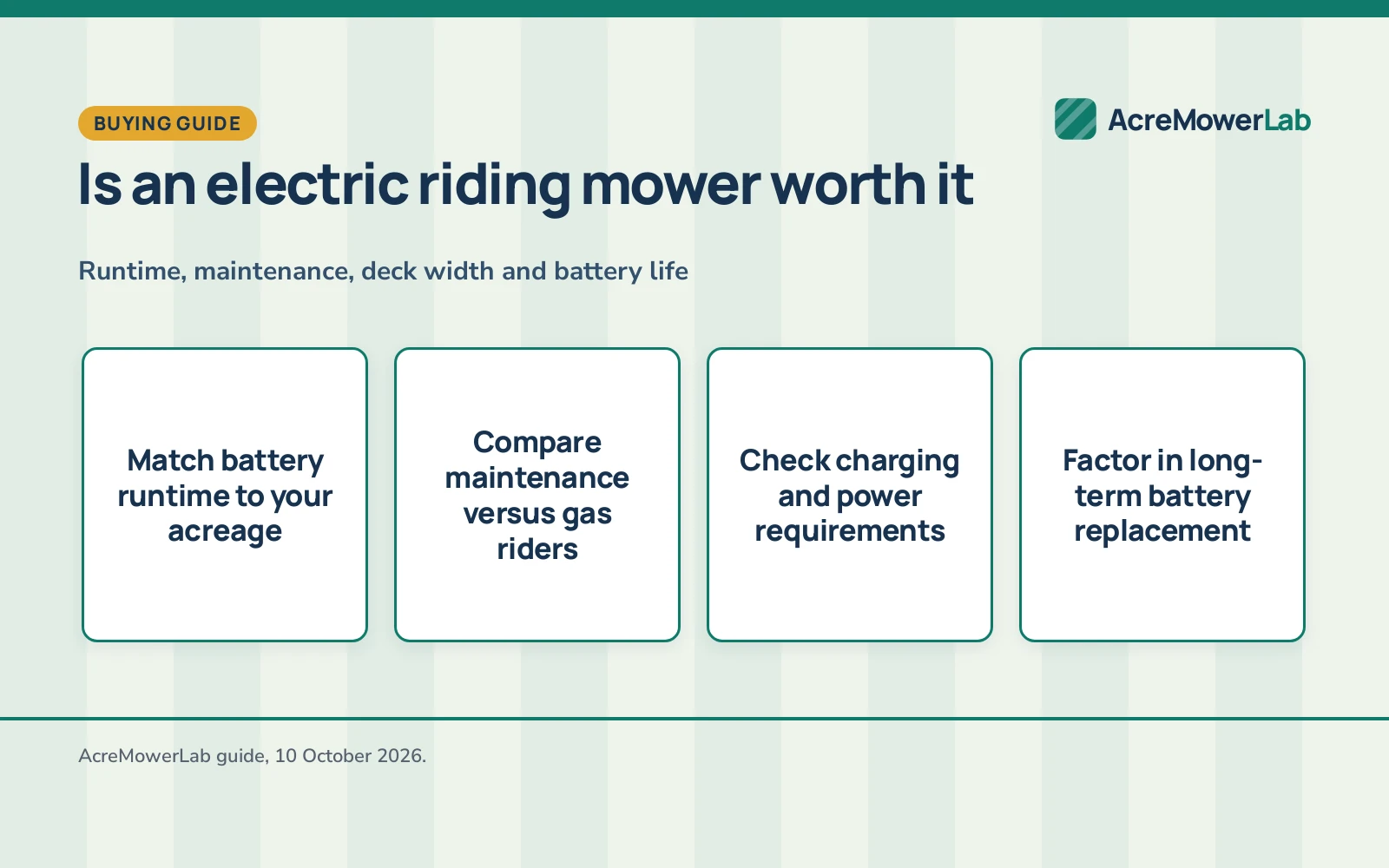
- Best Electric Riding Mower: 4 Picks by Rated Acres
Use the Mower Matcher to narrow down choices by acreage, terrain, budget, and power type.