Best Time to Aerate a Large Lawn
The best time to aerate a large lawn depends on your grass type, with early fall ideal for cool-season turf and late spring best for warm-season varieties.

On this page
Top picks at a glance
As an Amazon Associate I earn from qualifying purchases.
- 1
 Brinly PRT-482SBHC-A 48 in Tow-Behind Poly Lawn Roller9.8/10View on Amazon
- 2
 VEVOR Tow Behind Lawn Roller9.7/10View on Amazon
- 3
 VEVOR Lawn Roller 13 Gallon Large Capacity Sand/Water Filled9.7/10View on Amazon
The best time to aerate a large lawn is during the active growing season of your turfgrass, which typically means early fall for cool-season grasses and late spring through early summer for warm-season varieties. Aerating while grass actively grows helps turf recover quickly, fill aeration holes, and withstand weed pressure. On large acreage, timing also hinges on soil moisture: the ground should be moist enough for aerator tines to penetrate deeply without tearing turf or compacting saturated soil. This guide explains seasonal timing, soil conditions, and equipment selection step by step.
AcreMowerLab earns a commission when you shop through links here. It never changes your price. Affiliate disclosure.
Best time to aerate a large lawn: pick the right equipment
| Tool | Best for | Limit |
|---|---|---|
| Manual step aerator | Tight corners, gate openings, and small compacted spots | Slow and exhausting across broad lawn areas |
| Rolling push aerator | Moderate yard sections and open garden borders | Requires manual pushing effort and adds fatigue across acreage |
| Tow-behind plug aerator | Broad acreage with heavy soil compaction and clay turf | Requires a tractor or mower equipped with a rear tow hitch |
| Tow-behind spike aerator | Light maintenance and surface loosening on sandy or loose soil | Does not remove soil cores and can compact hole sidewalls in heavy clay |
Most acreage owners pull an attachment behind a riding lawn tractor or zero-turn mower for open ground and keep a manual core tool for tight borders. See our best tow-behind aerator roundup for tractor attachments.
Step 2: match aeration timing to your grass type
Lawn grasses divide into cool-season and warm-season species, and each requires a different calendar window for aeration. Aerating during peak vegetative vigor allows root systems to expand into open soil channels before climate stress arrives.
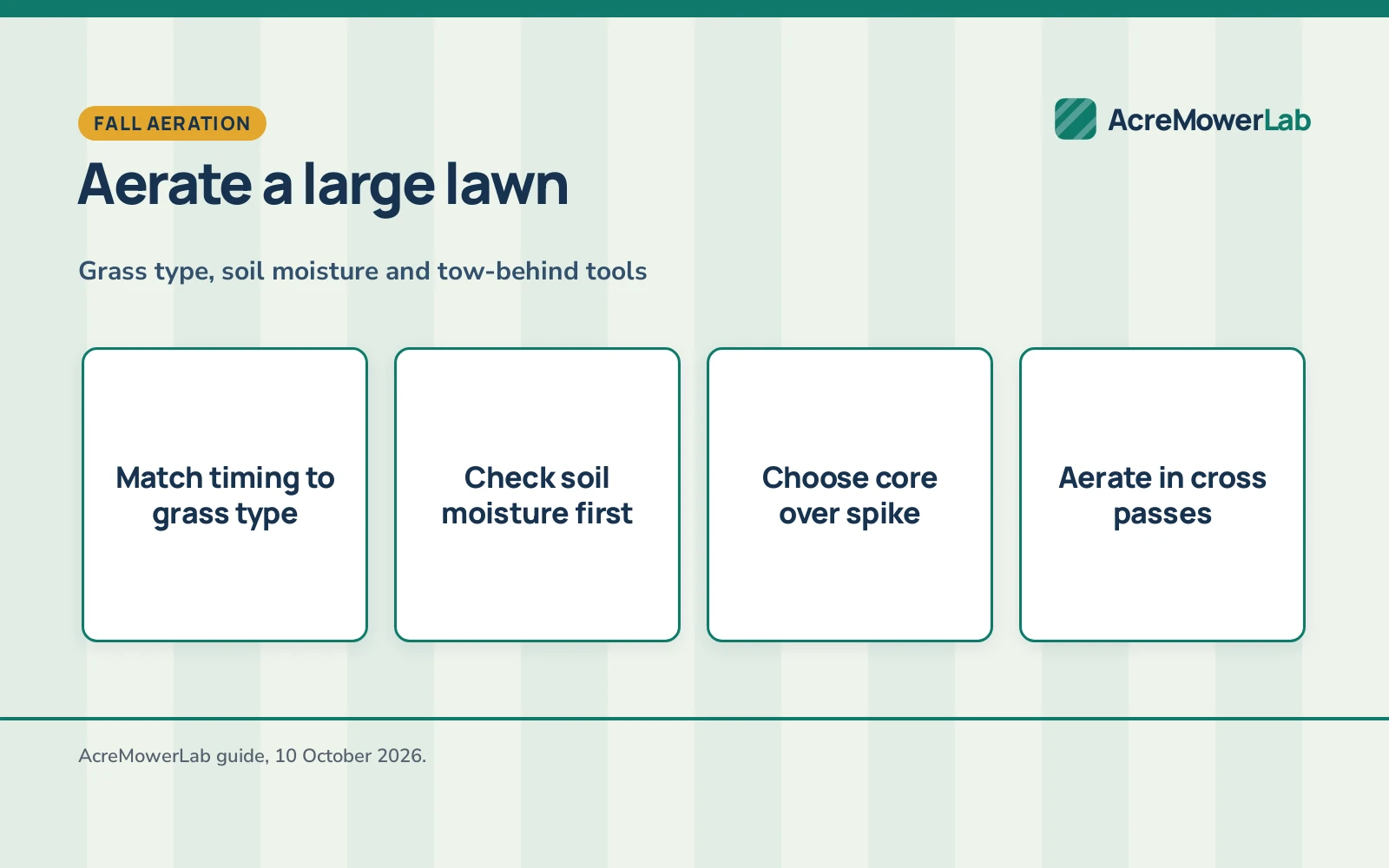
Cool-season grasses, including Kentucky bluegrass, perennial ryegrass, tall fescue, and fine fescue, thrive in northern climates and transitional zones. For most cool-season lawns, the primary aeration window is early fall. During early fall, soil retains warmth from late summer while air temperatures moderate, creating favorable conditions for root recovery. A secondary window can occur in early spring as turf breaks winter dormancy, though fall is generally preferred because weed pressure is lower.
Warm-season grasses, such as Bermuda, zoysia, St. Augustine, centipede, and bahiagrass, dominate southern regions. These grasses enter dormancy during cooler weather and green up in spring. Aerate warm-season lawns in late spring or early summer once active top growth and root spreading are fully underway. Aerating warm-season lawns too early in spring while turf is still sluggish leaves open holes where opportunistic annual weeds can take hold before grass begins rapid growth.
Step 3: check soil moisture
Operating an aerator across large acreage requires workable ground conditions. Dry, sun-baked soil resists tine penetration, causing aerator weight trays to bounce and leaving shallow impressions rather than deep extraction holes. Conversely, waterlogged ground causes tractor drive tires to spin, ruts soft topsoil, and clogs coring spoons with muddy paste.
Moisten dry turf before aeration by irrigating beforehand or waiting for moderate rainfall, ensuring the soil is moist enough for tine penetration but firm enough to prevent tire ruts. As makers of coring tools note across product manuals, slightly moistening the ground allows tines to enter smoothly without tearing turf roots. Inspect soil consistency across different elevations of your property: low swales often retain excess moisture while south-facing slopes dry out faster.
Step 4: prepare the ground before aerating
Preparation saves equipment from damage and prevents wasted passes across large turf acreage. Many homeowners begin by mowing the lawn slightly shorter than regular cutting height, taking care not to scalp the turf. Shorter turf grass blades allow aerator tines to contact the soil directly without flattening dense top growth.
Mark all buried obstacles and utility lines across the yard before pulling an aerator. Flag sprinkler heads, shallow irrigation pipe runs, landscape lighting wires, drain cleanouts, tree stumps, exposed surface roots, and septic tank lids. Striking a hidden metal or plastic pipe with weighted steel coring tines can puncture irrigation lines or bend attachment frames. Remove fallen tree limbs, pine cones, and loose rocks from mowing paths so tines penetrate clean soil.
Step 5: aerate in overlapping passes
When pulling an aerator with a riding lawn tractor or zero-turn, drive in straight, parallel lines across the longest section of the lawn. Maintain a steady, moderate forward ground speed to allow tines to enter and exit the turf vertically without elongating or tearing the puncture holes.
Where soil is heavily compacted clay or along high-traffic acreage paths, completing a second pass perpendicular to your initial pattern can improve core density. Cross-aerating creates a grid of core holes, increasing the surface area for moisture, oxygen, and root expansion. Overlap each swath slightly along the edge of the previous wheel track to ensure thorough coverage without leaving unworked strips of compact soil.
Choose between core aeration and spike aeration
Understanding the distinction between hollow-tine core aerators and solid-spike aerators is essential when maintaining large property turf. Core aerators pull out physical soil plugs, depositing them on the surface and relieving subterranean soil density. Spike aerators press solid steel prongs into the dirt, creating temporary openings by pushing surrounding soil outward.
For compacted clay soils across acreage, core aerators provide superior long-term soil loosening by extracting physical soil plugs. Individual tools vary widely in their tine designs, operating depths, and overall weights across maker listings. For manual tools, Lawnira lists a steel core aerator engineered to penetrate up to 4 inches deep to relieve compaction in heavy clay. Landzie lists a manual hollow-tine aerator with 3 solid stainless steel tines weighing 5.6 pounds, as well as a rolling push core aerator weighing 38.8 pounds equipped with 7 hollow tines. LawnVigor lists a rolling core aerator weighing 31.5 pounds with 6 hollow tines. Josmimic lists a stainless steel core aerator weighing 5.5 pounds featuring 4 hollow tines with lateral discharge openings to keep extracted soil moving.
Spike aerators serve lighter maintenance duties on sandy or silty soil that already drains freely. Among specific models, Walensee lists a spike aerator with 20 steel spikes measuring 2.8 inches across a wide footplate. RIFPOD lists an iron spike aerator with 15 iron spikes measuring 1.74 inches. For rolling options, Seeutek lists a rolling aerator with 2-inch star-shaped spikes and a weight of 24 pounds, featuring a small drum opening measuring 2.5 cm where water or sand can be added for extra downward force. However, on dense clay turf, solid spikes can compact the sidewalls of each hole rather than removing compacted earth, which makes hollow-tine core units the preferred choice for extensive turf renovation. For an in-depth breakdown of hollow-tine performance, read our guide on whether do tow-behind plug aerators work.
Match the aerator to your acreage
The size and layout of your property determine the most practical aerating equipment. Walking behind a manual coring tool is practical for small courtyard lawns, narrow side yards, and dog runs where tractor decks cannot maneuver. However, covering multiple acres on foot with a manual step tool requires excessive physical effort and days of labor.
For acreage properties, tow-behind plug aerators hitched to a riding mower, lawn tractor, or garden tractor deliver the required efficiency and weight capacity. These attachments allow operators to aerate wide swaths per pass while carrying ballast weights, such as concrete blocks or sandbags, on their top weight trays to achieve full tine penetration. If you are shopping on a set budget, review our guide to budget tow-behind aerators for affordable tractor attachments, or browse our complete tow-behind attachments hub.
Plan the property in zones
Managing large properties becomes simpler when dividing acreage into distinct management zones. High-visibility turf surrounding the residence, shaded orchard borders, open recreational fields, and perimeter fence lines each exhibit different soil compaction levels and sun exposure.
Prioritize your primary home lawn and high-traffic pathways where family, pets, and riding equipment concentrate soil compaction. Complete full cross-pass aeration in these heavy-wear zones before moving outward to open pasture perimeters or field edges that receive less foot traffic. In sections planned for turf renovation, overseeding immediately after aeration allows desirable grass seed to fall directly into open core holes for good seed-to-soil contact.
Mind the weather and soil conditions
Weather patterns before and after aerating influence turf recovery and equipment safety. Avoid aerating during periods of intense summer drought or extreme heat waves, as exposing stressed root systems to hot, dry air causes turf dehydration and browning. Similarly, avoid operating heavy towing equipment over water-saturated ground following severe thunderstorms to prevent deep soil ruts and mower tire slippage.
Cool, overcast days with moderate soil moisture offer the best conditions for aerating large lawns. If an autumn cold snap threatens hard ground freezing, complete aeration well before the ground freezes solid so grass roots establish deep soil anchoring before entering winter dormancy.
Safety
Operating riding mowers, lawn tractors, and zero-turn machines with tow-behind aerators requires strict adherence to equipment safety standards. Wear eye protection, hearing protection, and sturdy steel-toe footwear during all yard maintenance operations. Clear the lawn of sticks, large stones, loose wire, toys, and surface debris before beginning aeration passes.
When operating riding mowers or zero-turn mowers, never exceed the maker’s stated maximum slope rating. Zero-turn mowers can lose steering traction on slopes and near ponds, ditches, streams, or steep drop-offs, especially when towing heavy weighted ground attachments. Deploy the rollover protective structure (ROPS) and fasten your seat belt where equipped on your tractor or zero-turn. Carry no passengers on the machine or on the aerator weight tray under any circumstances, and keep children, pets, and bystanders completely out of the yard and away from the work area. Keep mower blades disengaged when towing attachments, and turn mower blades completely off when reversing. Always shut off the engine and allow all mechanical components to cool completely before refueling or clearing clogged soil from aerator tines.
FAQ: mowing large lots
When is the best time to aerate cool-season grass on a large lawn?
For cool-season turfgrass varieties like Kentucky bluegrass and fescue, early fall is generally the best window. During early fall, soil retains warmth from late summer while air temperatures moderate, supporting root recovery before winter dormancy sets in.
When should warm-season lawns be aerated?
Warm-season grasses such as Bermuda, zoysia, and St. Augustine should be aerated in late spring or early summer. Aerating during this phase of vigorous growth enables grass to recover rapidly and spread into open tine holes before midsummer heat.
Should you aerate wet or dry soil?
Aerate moist, workable soil. Extremely dry ground causes aerator tines to bounce and produce shallow holes, while muddy or saturated ground sticks to hollow spoons and causes tractor drive tires to rut the lawn. Aerating shortly after moderate rainfall or irrigation, once excess surface moisture has drained, provides the easiest tine penetration.
Is plug aeration better than spike aeration for large acreage?
Yes, hollow-tine plug aerators are superior for large lawns, particularly those on heavy clay soil. Core units extract physical dirt plugs and relieve subsurface compaction, whereas solid spikes simply press soil outward and can compact the surrounding hole walls.
What should you do right after aerating a large lawn?
Leave extracted soil cores on the turf surface to break down naturally with rain and routine mowing passes. Many acreage managers follow aeration with overseeding and watering, as the open core apertures provide direct seed-to-soil contact and protect emerging grass seedlings.
More mowing guides
- Best Tow-Behind Aerator: 4 Plug Aerators for 1 to 10 Acres
- Do Tow Behind Plug Aerators Work?
- Best Tow Behind Aerator Under $300 (2026): 5 Top Picks Compared
- Lawn Roller for Tractor: 5 Picks Compared (2026)
Use the Mower Matcher to narrow down choices by acreage, terrain, budget, and power type.