How to Mow a Large Lawn Faster
A practical plan to cut mowing time on acreage: efficient striping patterns, deck overlap, ground speed, and clean yard prep.

On this page
Top picks at a glance
As an Amazon Associate I earn from qualifying purchases.
- 1
 ECOTRIC Adjustable Lawn Mower Trailer Towing Hitch9.8/10View on Amazon
- 2
 Keystone Seats Steel Pan Lawn Mower Seat9.7/10View on Amazon
- 3
 EGO Power+ Z6 Zero Turn Electric Riding Lawn Mower9.6/10View on Amazon
- 4
 Lowe's 30 Gallon Heavy Duty Brown Paper Lawn and Refuse BagsView on Amazon
- 5
 Rocky Mountain Goods Yard Waste BagsView on Amazon
- 6
 14 Inch Small Corded Lawn Mower with 12.5-Amp MotorView on Amazon
- 7
 Brinly 48" Tow Behind Grass DethatcherView on Amazon
- 8
 Suchtale 40 Inch Tow Behind Lawn Dethatcher with 20 SpringView on Amazon
- 9
 Suchtale 48 Inch Tow Behind Lawn Dethatcher with 24 SpringView on Amazon
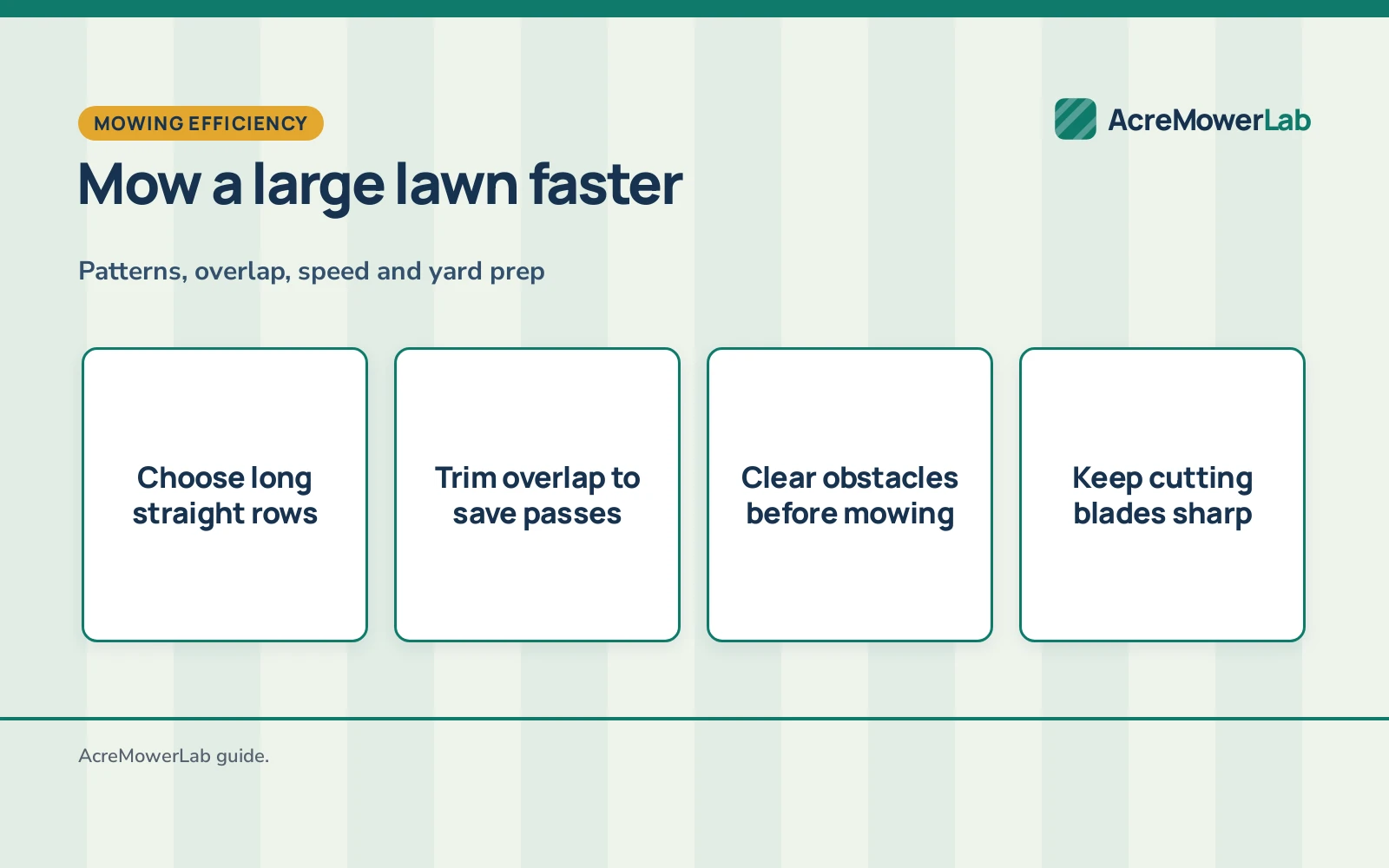
To learn how to mow a large lawn faster, cut in long straight rows along the longest boundary, widen your effective cutting path by reducing excess overlap, clear obstacles before starting, and maintain sharp cutting blades. Choosing an efficient mowing pattern and matching ground speed to turf conditions saves significant time on acreage. This guide explains each step to reduce your mowing hours.
Other machines to compare
 Lowe's 30 Gallon Heavy Duty Brown Paper Lawn and Refuse BagsCheck price on Amazon
 Rocky Mountain Goods Yard Waste BagsCheck price on Amazon
 14 Inch Small Corded Lawn Mower with 12.5-Amp MotorCheck price on Amazon
 Brinly 48" Tow Behind Grass DethatcherCheck price on Amazon
 Suchtale 40 Inch Tow Behind Lawn Dethatcher with 20 SpringCheck price on Amazon
 Suchtale 48 Inch Tow Behind Lawn Dethatcher with 24 SpringCheck price on Amazon
AcreMowerLab earns a commission when you shop through links here. It never changes your price. Affiliate disclosure.
How to mow a large lawn faster: choose the right equipment
| Equipment | Best for | Limit |
|---|---|---|
| Zero-turn mower | Open acreage with flat turf and many obstacles | Reduced traction on steep slopes or damp ground |
| Lawn tractor | Properties with gentle slopes and tow-behind chores | Slower turning response at border edges |
| Walk-behind mower | Narrow borders, fence gates, and steep ditch trim | Slow across wide acreage |
| Tow-behind gang mower | Expansive flat pastures pulled behind a tractor | Needs wide turning clearance and obstacle-free ground |
Most acreage owners pair a primary rider with a walk-behind unit for tight trim passes. Selecting the proper deck width and machine type for your yard layout eliminates wasted passes. If you are selecting a rider for smaller acreage, explore our guide to the best riding mower for 1 acre.
Step 2: pick an efficient mowing pattern
The pattern you follow across the yard directly dictates how long the job takes. Turning equipment around at the edge of each row consumes time without cutting grass. On rectangular lawns, cut parallel to the longest boundary line so you spend maximum time driving forward in straight lines and minimal time executing turns.
Before mowing the interior rows, make circular passes around the outer perimeter of the yard. These boundary passes provide a smooth turnaround zone at row ends, allowing zero-turn mowers and lawn tractors to spin or loop without slowing to a crawl. Alternating the direction of your straight rows on alternate mowing days prevents turf compaction and keeps grass standing upright for an even cut.
Step 3: clear obstacles before cutting
Stopping a mower in the middle of a row to pick up branches or move garden hoses wastes momentum. Walk your acreage before starting your engine and remove fallen limbs, rocks, pinecones, and children’s toys from the turf. Flag exposed tree roots or utility covers so you can navigate around them without stopping.
Trimming fence lines, mailbox posts, and ditch edges with a string trimmer before you start your riding mower also accelerates the job. When obstacle perimeters are pre-trimmed, you can steer your riding mower past borders without slowing down to edge around every post.
Step 4: optimize deck overlap and speed
Every inch of unnecessary overlap between cutting rows adds extra passes across your acreage. Leaving excessive overlap means your mower covers extra distance, while leaving too little overlap risks leaving uncut strips of tall grass. Aim to overlap the cut path just enough to guarantee complete coverage over uneven ground.
Ground speed must match turf smoothness and grass density. Driving too rapidly across bumpy soil causes mower decks to bounce, producing an uneven cut that requires a corrective second pass. For trim work, manufacturers design walk mowers with specific speed parameters. For example, Milwaukee lists a top speed of 4 MPH on its self-propelled mower, while Greenworks lists variable speed between 3.5 and 4.5 MPH on its self-propelled walk unit. On open terrain, zero-turn machines achieve quicker travel speeds. To understand how ground speed impacts field completion times, review our breakdown on how fast a zero-turn mows.
Step 5: maintain sharp blades and clean decks
Dull mower blades tear grass blades rather than slicing them cleanly. Torn grass requires extra engine power, forces you to drive slower, and leaves a brown, ragged lawn surface. Inspect cutting edges before mowing and restore sharp bevels regularly. See our guide to the mower blade sharpener tools to keep blades in peak shape.
A clean mower deck preserves airflow and clipping discharge. Wet clippings and dirt buildup under the deck restrict air circulation, which bogs down blades and causes unsightly clumping. Keep the underside of the deck clean by following these habits:
- Scrape away wet grass clipping buildup after mowing damp turf.
- Avoid cutting morning grass while dew remains heavy on the blades.
- Blow away debris from deck spindles and pulleys to maintain belt grip.
- Check blade mounting bolts to verify proper torque before operating.
Choose straight rows over circular patterns
Mowing in concentric circles toward the center of a yard seems intuitive, but it increases steering adjustments and creates tight turns that scalp turf. Straight passes along the longest axis reduce directional changes and allow riding equipment to maintain steady forward speed.
When approaching corners or tree clusters, mow a single clearance pass around the obstruction first, then resume your straight-line rows. This technique keeps your main rows straight without requiring awkward reversing maneuvers in the middle of open turf. Check our walkthrough on how to use a zero-turn mower for steering techniques that protect turf during directional turns.
Match cutting deck to property size
Wider mower decks cover more square footage per pass, but oversized decks struggle on undulating terrain and tight garden pathways. For tight trimming along fences and narrow gates, compact walk units provide precision where large riders cannot fit. DOVAMAN lists a 16-inch cutting width on its corded mower, while Walensee lists a 20-inch cutting width on its push reel mower for small trim zones.
On open acreage, wide rider decks cut mowing time significantly by minimizing the total number of passes needed to finish the yard. PowerSmart lists an 18-inch push gas mower for small quarters, whereas riding mowers and zero-turns feature substantially wider cutting paths for multi-acre properties. To calculate your expected working pace across different acreages, read our reference guide on how long it takes to mow an acre.
Plan the property in zones
Dividing a large parcel into distinct zones streamlines your mowing routine. Divide your land into high-visibility home lawn, open pastures, and perimeter ditches. Tackle the intricate sections around landscaping, driveways, and buildings first while your focus is sharp. Once detail areas are trimmed, you can open up higher speeds across expansive flat fields without interruption.
Zoning also helps manage fuel and battery capacity on large properties. Greenworks rates its 60V self-propelled walk unit for up to 3/4 acre per charge, making it suitable for trimming acreage zones before you deploy a primary rider across open turf. Grouping similar areas together ensures you use the right machine for each section without back-tracking across finished grass.
Mind the weather and the ground
Mowing wet grass slows your progress dramatically. Damp clippings stick to the underside of the mower deck, choke discharge chutes, and clump across the lawn. Wet turf also reduces tire traction, which causes drive wheels to spin and gouge ruts into soft ground. Wait until the afternoon sun dries morning dew before beginning large mowing jobs.
Rough ground and steep grades require extra caution. Specialized commercial machinery handles severe incline angles; for instance, INFRONT lists slope climbing capabilities up to 45 degrees on rubber tracks for its remote equipment. However, residential riding mowers require far gentler slopes to maintain stability. Slow down when approaching ditches, ponds, or uneven slopes to maintain complete steering control.
Safety
Operating outdoor power equipment across acreage requires strict adherence to operating precautions. Never exceed the maker’s maximum slope rating for your specific mower model. Zero-turn mowers lose traction easily on slopes and near ponds, drop-offs, or ditches. Keep rollover protective structures upright and fasten your seat belt where equipment is equipped. Never carry passengers on riding equipment, and ensure children and pets remain indoors or safely out of the yard during operation. Disengage cutting blades before shifting into reverse. Clear sticks, stones, and wire debris from the turf before cutting, and wear eye and hearing protection along with sturdy footwear. Always refuel gas engines outdoors only with the engine turned off and completely cool.
FAQ: mowing large lots
What is the quickest pattern to mow a large lawn?
Mowing in long, straight rows parallel to the longest boundary line is the quickest pattern. It minimizes the number of turns and maximizes time spent driving forward at full operating speed.
Does a zero-turn mower cut faster than a lawn tractor on acreage?
Zero-turn mowers typically reduce mowing time because they turn quickly at row ends and offer agile maneuvering around yard obstacles. On wide, flat terrain with trees or garden beds, zero-turns complete acreage faster than conventional tractors.
How much overlap should I leave between mower passes?
Leave only enough overlap to prevent missing patches on uneven ground. Excessive overlap forces extra passes across your acreage, while too little overlap leaves thin ribbons of uncut grass.
Should I mulch or discharge clippings to mow faster?
Side discharging is generally faster in tall or thick grass because clippings exit the deck immediately without absorbing extra engine power. Mulching produces a tidy finish on dry, regularly cut lawns but requires slower ground speeds in lush grass.
Is it faster to trim yard obstacles before or after mowing?
Trimming around fence lines, trees, and garden borders before mowing is faster. Pre-trimming lets your rider navigate borders smoothly without stopping, and the mower deck chops up and disperses string trimmer clippings during your main passes.
More mowing guides
- Best Riding Mower for 1 Acre: 4 Picks by Deck Size
- How Long Does It Take to Mow an Acre? Times by Mower Type
- How Fast Does a Zero Turn Mow?
- Best Mower Blade Sharpener: 4 Picks for Riders and Large Lawns
Explore our detailed guides to riding mowers to compare machine types, deck options, and cutting capabilities for your property.