What Is a Cultipacker?
A practical guide to cultipackers for rural acreage: how they work, wheel designs, implement weights, seed-to-soil contact, and how to prep firm seedbeds.

On this page
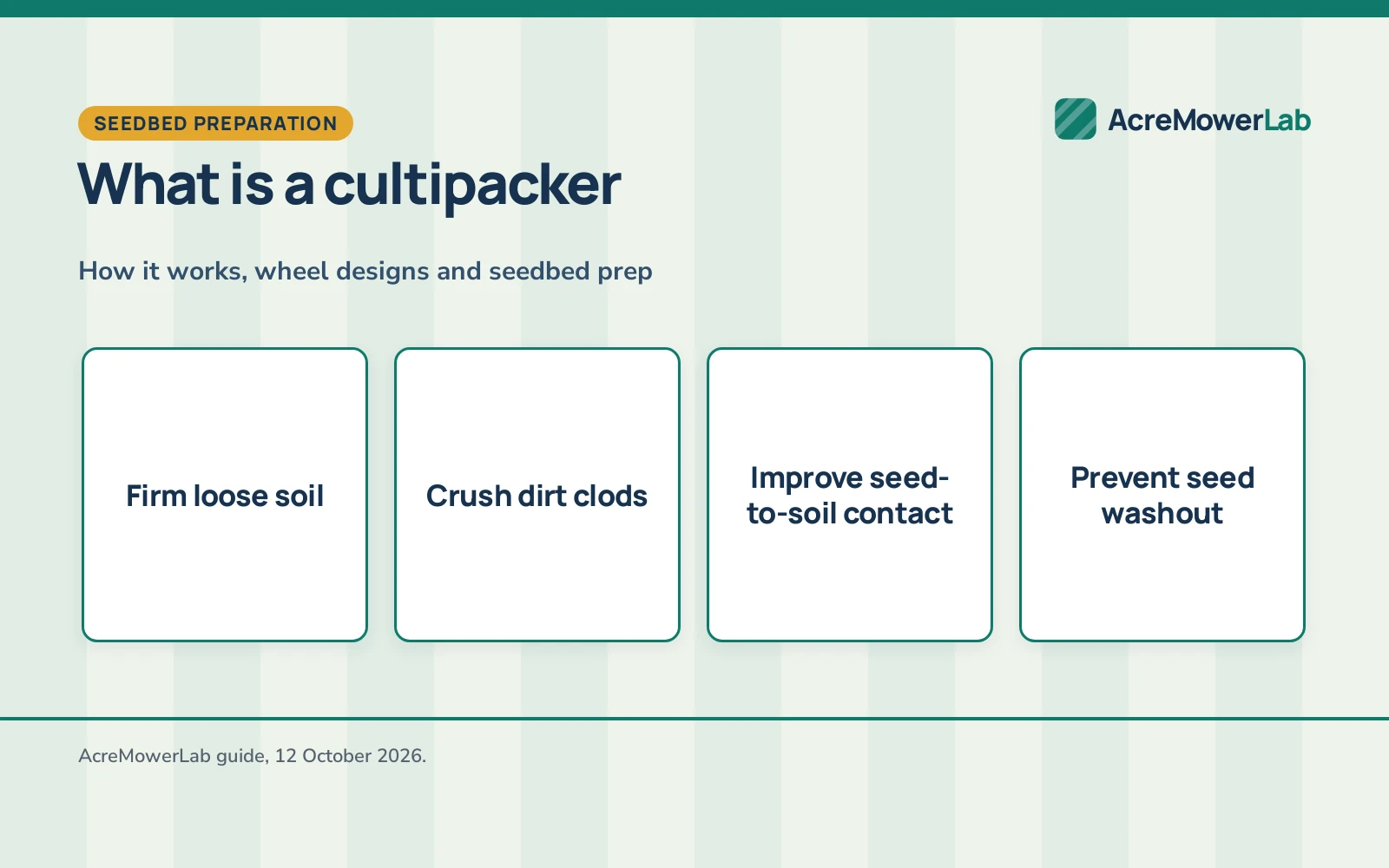
When preparing acreage, pastures, or food plots on open ground, what is a cultipacker and why do you need one? A cultipacker is a heavy tow-behind implement equipped with iron or steel roller wheels designed to crush dirt clods, remove deep air pockets, firm loose tilled soil, and press broadcast seed into the seedbed for dependable germination. By running over tilled soil before and after broadcasting seed, it creates shallow moisture-holding ridges and maximizes seed-to-soil contact so seedlings establish without washing away. This guide explains how cultipackers work, how they differ from smooth rollers, and how to run one across your property.
As an Amazon Associate I earn from qualifying purchases. AcreMowerLab earns a commission when you shop through links here. It never changes your price. Affiliate disclosure.
What is a cultipacker: pick the right implement
| Tool | Best for | Limit |
|---|---|---|
| Cultipacker | Packing loose tilled soil, crushing dirt clods, and pressing broadcast seed into seedbeds | Heavy implement that requires a tractor, ATV, or UTV with a suitable hitch |
| Smooth lawn roller | Smoothing lawn frost heaves and settling sod on established turf | Can create a flat crust on tilled dirt without forming seed grooves |
| Drag harrow | Leveling loose dirt, spreading manure, and light pasture dethatching | Lacks the weight and ridged wheels to pack soil or firm seed |
| Rotary tiller | Breaking sod, digging compacted soil, and incorporating amendments | Leaves soil fluffed with loose air pockets that dry out seed |
Most property owners pair seedbed implements with primary tillage machinery. See our guide on how does a drag harrow work or check our best lawn roller comparisons for turf smoothing options.
Step 2: prepare the rough seedbed
A cultipacker is a finishing and packing implement, not a primary tillage tool. When establishing a new seedbed from tilled ground, primary tillage tools such as a plow, disk, or tiller are used first to loosen compacted dirt, chop up root systems, and incorporate compost or lime. For breaking new ground on acreage, a rear-tine tiller provides the digging power needed to loosen stubborn hardpan.
Once primary tillage is complete, the soil is often left too loose, fluffy, and full of large dirt clumps. If you broadcast seed directly into fluffy, freshly tilled dirt, small seeds sink too deep into voids and fail to emerge. Running an initial cultipacker pass across the rough ground crushes remaining dirt clods, eliminates subsurface air pockets, and presses loose soil into a firm, level bed covered in shallow corrugated ridges.
Step 3: broadcast the seed across the ridges
After the initial packing pass leaves shallow, uniform ridges across the field, broadcast your grass seed, pasture mix, or food plot blend across the ground. Seeds broadcast onto a flat, unrolled field often scatter unevenly in the wind or wash away with heavy rainfall.
The corrugated ridges left by the cultipacker wheels act as miniature catch basins. As seeds drop from a broadcast spreader, a large portion settles naturally into the bottoms of these shallow valleys. This pattern keeps seed distributed evenly across the plot and shields delicate seeds from surface gusts and moisture evaporation.
Step 4: make the final packing pass
Once seed is spread across the corrugated ground, make an additional pass with the cultipacker. This second pass is what separates a cultipacker from ordinary drags or smoothing boards.
As the heavy wheels roll over the seeded field, the roller firms the soil around the broadcast seeds. This presses the seed into firm contact with moist earth without burying it too deep beneath loose dirt. The resulting seed-to-soil contact allows moisture to transfer directly into the seed coat, speeding up germination and establishing sturdy root networks before weeds can take over.
Step 5: inspect seedbed firmness and soil contact
Before unhitching your equipment and putting tools away, walk the treated ground on foot to evaluate the seedbed condition.
- Footprint depth: your boot heel should leave only a shallow impression in the packed ground rather than sinking deeply into loose dirt.
- Ridge definition: shallow, even grooves should run across the field to capture rainfall and minimize water runoff.
- Seed placement: broadcast seeds should sit firmly pressed into moist surface dirt rather than floating loose on dry dust.
- Clod breakdown: hard dirt chunks should be shattered into a fine, crumbly bed that surrounds developing seed sprouts.
Choose between iron wheels and steel drums
The weight and wheel design mounted along the implement axle determine how effectively a cultipacker crushes dirt clods, removes air pockets, and patterns the seedbed.
Ductile iron packer wheels feature raised outer rings or notches designed to fracture hard soil crusts and leave distinct grooves. For Category 1 and Category 2 tractors rated for 20-50 HP, MechMaxx lists three-point hitch cultipackers equipped with notched ductile iron packer wheels measuring 9 in Dia. by 2 in W. MechMaxx offers a 60in model with 26 ductile iron wheels weighing 512 pounds, a 72in model with 32 wheels weighing 595 pounds, and an 84in model with 37 wheels weighing 668 pounds. These models also include an integrated scraper bar mounted behind the wheels to scrape away sticky mud before it accumulates.
Steel press wheels also provide heavy soil compaction and create defined ridges for seed placement. Titan Attachments lists a 72in Category 1 3-point cultipacker with 12 steel press wheels prefilled at 605 pounds, stating that the roller packs soil, breaks up dirt clods, and creates ridges in the seedbed, while featuring greaseable axle bearings and built-in kickstand feet. For properties needing aeration and soil conditioning, Titan Attachments also lists a 60in Category 1 and Category 2 3-point soil yard pulverizer with welded drum spikes weighing 760 pounds, designed to promote air exposure and nutrient absorption.
Match the cultipacker to your towing machine
Choosing a cultipacker depends heavily on the towing machine available on your acreage. Because cultipackers rely on substantial weight to press soil, your machine must match the implement: tow-behind units require adequate vehicle traction and tongue weight capacity, while three-point implements require compatible hitch geometry and sufficient hydraulic lift capacity.
For owners operating an ATV or utility vehicle, Black Boar lists a durable steel cultipacker implement weighing 36 pounds featuring parallel linkage that maintains the proper working angle, designed for one person to install. For garden tractors and compact utility machines, Farm Star Equipment lists a flip-over cultipacker with a 50in working width weighing 315 pounds built with cast iron wheels. Before hitching any heavy ground-engaging tool to a lawn machine, check our guide on whether can a zero-turn pull attachments safely.
Acreage owners operating sub-compact or utility tractors with a 3-point hitch can pull wider multi-wheel implements. MechMaxx specifies a recommended tractor rating of 20-50 HP for its Category 1 and Category 2 three-point implements. The ability to raise the cultipacker off the ground using the hydraulic 3-point lift makes turning at field borders and transporting between pastures effortless. Explore our full category guide to tow-behind attachments to match additional implements to your property.
Plan your passes across the property
Operating a cultipacker across large acreage requires a steady pattern to avoid missed strips and excessive compaction. On rectangular pastures or food plots, run parallel passes along the longest boundary line to reduce the frequency of turns.
Overlap each pass slightly so the outside wheel travels along the edge of the prior run. Leave wide headlands at each end of the field where you can loop around smoothly without making sharp pivot turns that tear up the seedbed. Maintain a steady, straight travel path across the field during both passes to keep ridges uniform and ensure consistent compaction across the entire plot.
Mind soil moisture and ground conditions
Timing your cultipacker run around soil moisture levels is critical for success. Packing soil that is overly wet ruins the seedbed by forming thick, sticky mud clods that wedge between packer wheels and pull broadcast seed out of the ground.
Conversely, rolling powdery dry ground creates dust clouds and fails to form durable moisture-trapping ridges. The best time to roll is when the soil is slightly damp but crumbles cleanly in your hand without smearing. If rainfall is forecasted, completing your seeding and packing pass just ahead of light rain locks the seeds in place and gives them immediate moisture to sprout.
Safety
Cultipackers and heavy tow-behind rollers require careful operation to protect equipment and operator safety. Always wear protective eye goggles, hearing protection, sturdy work boots, and heavy work gloves when hitching, operating, or maintaining implements. Walk the property beforehand and clear away large rocks, fallen tree limbs, and foreign debris that could chip iron wheels or bend axle shafts.
Keep children, bystanders, and pets well away from the work zone at all times. Never carry riders on the tractor, ATV, UTV, or on the implement frame. Follow the tractor manufacturer’s maximum slope rating, and avoid pulling heavy ground implements across steep inclines, slick wet grass, or near pond banks and drainage ditches where traction loss could cause rollovers.
Before servicing the implement, unhitching, or dislodging compacted dirt from scraper bars, lower the cultipacker completely to flat ground, set the parking brake, shut off the engine, and remove the ignition key. When connecting 3-point hitches, lock lower lift pins and top link pin with safety clips. Utilize parking stands or kickstand feet during storage to keep the heavy frame stable. Refuel towing machinery only with the engine turned off and completely cool. See our Safety Disclaimer.
FAQ: mowing large lots
What does a cultipacker do?
A cultipacker crushes rough dirt clods, removes air voids from freshly tilled soil, creates shallow ridges that catch moisture, and presses broadcast seed into firm contact with the earth to promote rapid, uniform germination.
Why use a cultipacker instead of a lawn roller?
A smooth lawn roller flattens soil into a smooth surface that can form a hard crust after rain, making it difficult for delicate seedlings to emerge. A cultipacker uses ridged iron or steel wheels that leave corrugated surface furrows, which prevents crusting and keeps seed from blowing or washing away.
Do you cultipack before or after seeding?
Many property owners cultipack both before and after broadcasting seed: an initial pass firms the loose soil and creates ridges, while a pass after seeding firms the soil around the broadcast seed for strong seed-to-soil contact.
What size tractor do I need to pull a cultipacker?
Tractor requirements depend on the implement’s mounting type, width, and weight. For example, Black Boar lists a 36-pound implement for ATVs and UTVs, while Farm Star Equipment lists a 50in flip-over cultipacker at 315 pounds for garden tractors and ATVs. For three-point hitch setups, MechMaxx recommends 20-50 HP for its Category 1 and Category 2 cultipackers ranging from 60in at 512 pounds to 84in at 668 pounds, while Titan Attachments lists a 72in Category 1 model prefilled at 605 pounds. Always check your tractor’s rear lift capacity and operator manual before selecting an implement.
What is a cultipacker good for on acreage?
On rural properties, a cultipacker is ideal for establishing wildlife food plots, renovating pasture turf, seeding cover crops, planting native prairie grasses, and establishing expansive lawns where erosion control and dependable seed growth are needed.
More mowing guides
- How Does a Drag Harrow Work?
- Best Lawn Roller (2026): 5 Top Picks Compared
- Best Drag Harrow (2026): 5 Tow-Behind Picks Compared
- Can a Zero Turn Pull Attachments?
Use the Mower Matcher to narrow down choices by acreage, terrain, budget, and power type.