How to Use Foam Cannon
A practical step-by-step guide to setting up and using a foam cannon with your pressure washer to safely wash mowers, tractors, and equipment on acreage.

On this page
Top picks at a glance
As an Amazon Associate I earn from qualifying purchases.
- 1
 GDHXW X-887 High Pressure Washer Gun with Foam Cannon9.5/10View on Amazon
- 2
 DUSICHIN Pressure Washer Gun and Foam Cannon Kit9.4/10View on Amazon
- 3
 Sooprinse Pressure Washer Foam Cannon with Short Gun9.3/10View on Amazon
- 4
 McKillans Foam Cannon for Pressure WasherView on Amazon
- 5
 Westinghouse Foam Cannon for Pressure WashersView on Amazon
- 6
 Blackline Foam Cannon PRO for Pressure WashersView on Amazon
- 7
 Armour Detail SupplyView on Amazon
- 8
 Pressure WasherView on Amazon
- 9
 Electric Pressure Washer 5000 PSI Portable Power Washer withView on Amazon
Maintaining multiple acres of pasture, gravel driveways, and timber lines leaves riding mowers, tractors, and utility vehicles coated in dried grass juice, clay, and abrasive grit. To understand how to use foam cannon attachments effectively, mix your wash soap with warm water in the reservoir bottle, connect the 1/4-inch quick connector plug to your pressure washer spray wand, adjust the top mixture knob for thick lather, and coat your machine from bottom to top before rinsing with clean water. The thick blanket of foam clings to vertical panels, mower decks, and tractor frames, lifting grime so high-pressure water rinses it away without scratching the finish. This guide explains every step of setting up the cannon, dialing the controls, and cleaning equipment safely on acreage.
Other machines to compare
 McKillans Foam Cannon for Pressure WasherCheck price on Amazon
 Westinghouse Foam Cannon for Pressure WashersCheck price on Amazon
 Blackline Foam Cannon PRO for Pressure WashersCheck price on Amazon
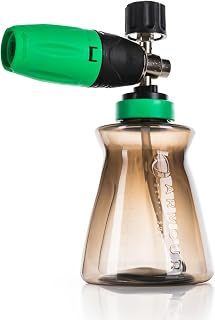 Armour Detail SupplyCheck price on Amazon
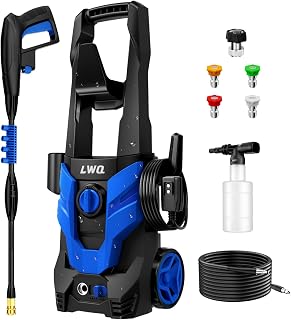 Pressure WasherCheck price on Amazon
 Electric Pressure Washer 5000 PSI Portable Power Washer withCheck price on Amazon
AcreMowerLab earns a commission when you shop through links here. It never changes your price. Affiliate disclosure.
How to use foam cannon: match the washer to the job
| Tool | Best for | Limit |
|---|---|---|
| Foam cannon with 1.1 mm orifice | Pressure washers operating below 1500 PSI, utility vehicles, mower decks | Raincovo and DANCINGBOAR specify this nozzle for pressures below 1500 PSI |
| Foam cannon with standard orifice | General farm equipment and tractors from 1000 PSI to 3000 PSI | Requires adequate water supply, with Amazon Basics listing at least 2.0 GPM |
| High-pressure foam cannon | Large acreage machinery and muddy trailers rated up to 3600 PSI | Westinghouse rates its cannon to 3600 PSI; spray must keep clear of sensitive seals |
| Direct garden hose or faucet | Basic low-pressure garden rinsing only | Tool Daily notes foam cannons do not fit garden hoses or faucets directly |
Most property owners run a foam cannon from an existing pressure washer. See our pressure washers hub and guide on what PSI pressure washer do I need to match equipment ratings.
Step 2: mix soap and water in the bottle
Start by filling the foam cannon reservoir with water and dedicated vehicle or equipment wash soap. Tool Daily, McKillans, and Raincovo feature a 1 Liter container capacity, while Amazon Basics lists a 33-Ounce (1 Liter) capacity and Westinghouse provides a 3 liters tank volume. Tool Daily also lists its 1 Liter bottle as 0.22 Gallon, and Amazon Basics lists 0.26-gallon capacity. A translucent or clear bottle, such as those from McKillans and Raincovo, allows you to observe fluid levels without removing the cap.
Fill the bottle with warm water first, then add your soap concentrate to prevent premature suds from foaming over the neck while filling. Warm water helps thick soap concentrate dissolve and blend smoothly. Gently swirl the bottle to mix the solution without creating excess froth inside the reservoir. Avoid over-tightening the bottle threads when threading the reservoir onto the brass valve body.
Step 3: connect to the pressure washer wand
Foam cannons operate under pressure and cannot run directly from a standard garden hose or household water faucet. Tool Daily, Amazon Basics, McKillans, and Westinghouse all use a standard 1/4 inch quick connector plug that snaps directly into the female quick connect socket on your pressure washer spray wand or trigger gun. Raincovo and DANCINGBOAR also accommodate M22 14mm fittings.
Pull back the brass collar on your wand coupler, press the 1/4 inch male fitting firmly into place, and release the collar until it clicks forward. Tug gently on the cannon body to confirm the connection is locked. DANCINGBOAR includes removable O-ring seals, and checking that the rubber O-ring is intact prevents high-pressure water leaks at the coupling.
Step 4: adjust the foam knob and spray pattern
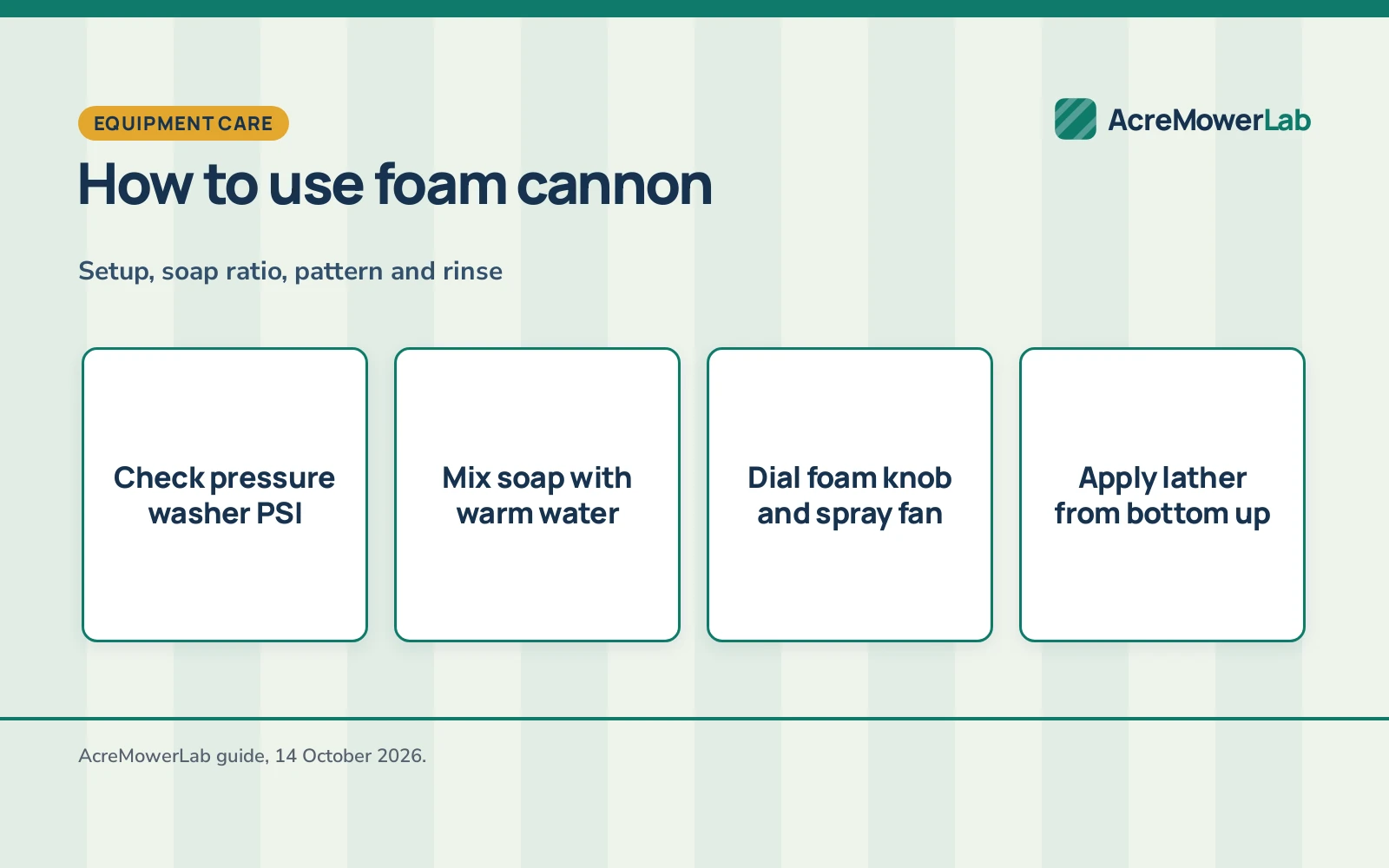
Standard foam cannons feature manual controls: a top mixture knob that controls soap concentration and a rotating front nozzle that shapes the spray pattern. The top control knob regulates foam dispensing amount and mixture thickness. Turning the knob toward the minus (-) position (turned right, as specified by Tool Daily) delivers the thickest mixture. Turning the knob toward the plus (+) position produces a lighter foam spray.
Twist the front nozzle barrel to adjust spray fan width. A wide horizontal or vertical fan pattern covers large tractor hoods, mower decks, and truck beds quickly, while a narrow pattern concentrates lather into tight corners. DANCINGBOAR features a 360° swivel nozzle that allows quick transitions between fan angles and concentrated streams. If your pressure washer operates below 1500 PSI, Raincovo and DANCINGBOAR provide an additional 1.1 mm orifice nozzle that replaces the standard internal orifice to produce dense foam under lower operating pressure.
Step 5: apply foam and rinse
Start your pressure washer following the operating manual. Aim the lance at the ground or away from equipment, pull the trigger to purge standing water from the hose line, and begin applying lather when thick foam flows from the nozzle.
- Coat from bottom to top: apply foam starting at the lower tires and deck, working upward to the hood. Coating from the bottom ensures even coverage and keeps sliding foam from masking dry dirt patches above.
- Allow dwell time: let the thick blanket of lather sit on surfaces to break down dried dust, mud, and vegetation. Rinse before the soap dries to avoid leaving spots on paint or metal panels.
- Disconnect the cannon: release the spray trigger, switch off the pressure washer, and uncouple the 1/4 inch quick connector.
- Rinse from top to bottom: attach a standard rinse nozzle to the wand and wash away loosened grime using clean water, working from the highest surfaces down to the wheels. Tool Daily includes 5 nozzle tips with angles of 0, 15, 25, 40, and 65 degree. Wide nozzles such as 25 or 40 degree rinse broad panels efficiently without damaging decals or paint.
Flush the cannon after each wash
Soap residue left inside the brass body or stainless steel mesh aerator will dry into a gummy film, blocking air passages and degrading foam quality over time. Proper post-wash cleaning preserves internal valves and prevents sudden pressure drops.
Amazon Basics provides an explicit maintenance tip: after foaming, run plain water through the lance for 30 seconds to prevent clogging. Raincovo also instructs owners to rinse the unit thoroughly with clean water after each use and store the tool indoors away from direct sunlight. Remove the reservoir bottle, rinse out leftover soap, reconnect the bottle filled with clean water, and spray for 30 seconds until only clear water emerges from the nozzle.
Match pressure and nozzles to equipment
Acreage machinery demands different pressure levels depending on surface durability. Amazon Basics specifies a minimum pressure of 70 bar-1000psi and water flow of at least 2.0 GPM. McKillans lists a maximum flow rate of 2.5 gpm and a maximum pressure of 3000 psi. Tool Daily lists an operating range of 1000 PSI to 3000 PSI, while Westinghouse rates its cannon up to 3600 PSI. Review our breakdown of pressure washer types to understand pump capabilities.
When washing farm equipment, keep high-pressure water away from sealed spindle bearings, hydraulic cylinder seals, electronic instrument clusters, and carburetor linkages. Use foam to dissolve grease and field dirt, then rinse sensitive mechanical zones with wide fan patterns. For dedicated deck maintenance advice, see our guide on how to clean a mower deck.
Plan washing zones on your acreage
Washing large tractors, zero-turn mowers, and utility trailers generates substantial runoff containing soap, grease, and field silt. Designate an outdoor washing pad located on flat gravel or upland grass well away from ponds, livestock water troughs, drainage ditches, and water wells. Permeable ground allows wash water to filter naturally through soil rather than draining directly into local waterways.
Position your pressure washer and water supply where hoses reach around machinery without kinking. Westinghouse lists a 50 feet hose length in its accessory specifications, which allows walking completely around large tractors without dragging the pressure washer unit through wet mud. Keep electrical cords for electric pressure washers elevated on dry ground away from runoff puddles.
Mind the weather and operating conditions
Weather plays a major role in wash quality. Direct midday sunlight heats sheet metal, causing soap foam to evaporate rapidly and bake residue onto vehicle finishes. Wash equipment early in the morning, in late afternoon, or under shade trees so the lather dwells without drying prematurely.
Never spray cold water onto hot tractor engines, exhaust manifolds, or mower mufflers immediately after fieldwork. Rapid thermal contraction can warp cylinder heads or crack metal castings. Allow engines and hydrostatic transmissions to cool fully before foaming. In cold seasons, drain the foam cannon, wand, and pressure washer pump completely before storing indoors to prevent freezing water from cracking brass fittings.
Safety
High-pressure water streams pose severe puncture and laceration hazards. Always wear impact-rated eye protection, sturdy work boots, and heavy work gloves when operating pressure washing equipment. Never direct the spray stream or foam discharge at people, pets, or livestock. Gas-powered pressure washers produce toxic exhaust fumes and must operate strictly outdoors in open air away from windows, doors, and barn vents.
Always shut down the pressure washer engine or motor and squeeze the spray trigger to release trapped line pressure before attaching or disconnecting the foam cannon 1/4 inch quick connector. When moving around equipment on wet grass or slippery concrete pads, maintain stable footing and keep spray hoses untangled to prevent tripping. Review our pressure washer maintenance guide to keep pressure release valves, hoses, and trigger safety locks functioning properly.
FAQ: mowing large lots
Can I connect a foam cannon directly to a garden hose?
No. Foam cannons require high water pressure and high velocity to create suction through the internal venturi valve. Tool Daily explicitly notes that foam cannons do not fit garden hoses, water hoses, or direct faucets, and must connect to a pressure washer wand via a 1/4 inch quick connect fitting.
What pressure washer PSI do I need for a foam cannon?
Operating pressure requirements depend on the individual cannon design. Amazon Basics specifies a minimum pressure of 70 bar-1000psi, Tool Daily lists a working pressure of 1000 PSI to 3000 PSI, and Westinghouse rates its cannon up to 3600 PSI. For machines operating below 1500 PSI, Raincovo and DANCINGBOAR note that installing an additional 1.1 mm orifice nozzle produces rich foam.
Why is my foam cannon producing watery foam?
Watery foam typically stems from insufficient soap concentrate, the top adjustment knob being dialed toward the plus (+) position, or inadequate pressure. Turning the top knob toward minus (-) delivers a thicker mixture. For pressure washers operating below 1500 PSI, installing a 1.1 mm orifice nozzle helps maintain rich lather.
When should I install a 1.1 mm orifice nozzle?
Install a 1.1 mm orifice nozzle when your pressure washer operates below 1500 PSI. DANCINGBOAR and Raincovo provide an additional 1.1 mm orifice nozzle to produce rich foam when working pressure falls below 1500 PSI.
How do I prevent my foam cannon from clogging?
Flush the foam cannon with clean water immediately after every washing session. Amazon Basics recommends spraying clean water through the lance for 30 seconds after foaming. Flushing prevents soap residue from hardening on internal stainless steel mesh filters and brass valves.
More mowing guides
- What PSI Pressure Washer Do I Need?
- Pressure Washer Types: Complete Guide for Acreage Owners
- Best 3000 PSI Pressure Washer: 5 Electric and Gas Picks (2026)
- Pressure Washer Maintenance: Step-by-Step Care Guide
Use the Mower Matcher to narrow down choices by acreage, terrain, budget, and power type.