How to Clean a Mower Deck
A step-by-step guide to cleaning a mower deck on acreage: safety prep, scraping compacted grass, washing the underside and rust prevention.

On this page
Top picks at a glance
As an Amazon Associate I earn from qualifying purchases.
- 1
 Lawn Mower Deck Cleaner9.4/10View on Amazon
- 2
 Heavy-Duty Lawn Mower Cleaning Scraper and Cleaning StiffView on Amazon
- 3
 BLACK+DECKER Lawn Mower Removable Deck for String TrimmerView on Amazon
- 4
 PowerSmart EasyCut 18-Inch 144cc Gas Lawn Mower 4-Cycle OHVView on Amazon
- 5
 AMERISUN 21" Gas Lawn MowerView on Amazon
- 6
 PowerSmart EasyCut 18-Inch Gas Lawn MowerView on Amazon
- 7
 EGO Power+ Electric Riding Lawn MowerView on Amazon
To clean a mower deck, park on level ground, disconnect the spark plug wire or remove the battery pack, tilt or lift the machine safely, scrape off compacted grass with a deck scraper, wash the underside clean, and apply a protective coating once dry. Regular mower deck cleaning preserves airflow, prevents steel deck rust, and maintains cut quality. This guide shows how to clean a mower deck step by step on acreage equipment.
Other machines to compare
 Heavy-Duty Lawn Mower Cleaning Scraper and Cleaning StiffCheck price on Amazon
 BLACK+DECKER Lawn Mower Removable Deck for String TrimmerCheck price on Amazon
 PowerSmart EasyCut 18-Inch 144cc Gas Lawn Mower 4-Cycle OHVCheck price on Amazon
 AMERISUN 21" Gas Lawn MowerCheck price on Amazon
 PowerSmart EasyCut 18-Inch Gas Lawn MowerCheck price on Amazon
 EGO Power+ Electric Riding Lawn MowerCheck price on Amazon
AcreMowerLab earns a commission when you shop through links here. It never changes your price. Affiliate disclosure.
How to clean a mower deck: pick the right method
| Tool | Best for | Limit |
|---|---|---|
| Manual deck scraper | Removing hardened, caked grass and mud | Requires physical effort under the deck |
| Garden hose with washout port | Rinsing fresh grass clippings immediately after mowing | Will not dislodge dried, compacted thatch buildup |
| Pressure washer | Deep cleaning stubborn grime on riding mowers and tractors | High pressure near spindles can damage seals and bearings |
| Polymer deck spray | Coating clean bare metal to resist future grass buildup | Must be applied to clean, dry surfaces over repeated sessions |
Most acreage owners combine a manual scraper with a thorough wash. Scraping removes caked thatch that water cannot penetrate, while washing flushes out plant sap and grit. For heavy seasonal buildup on farm tractors and zero-turn mowers, a pressure washer speeds up cleanup. See our best gas pressure washer roundup for farm and acreage machines, or explore our pressure washer guides to compare options.
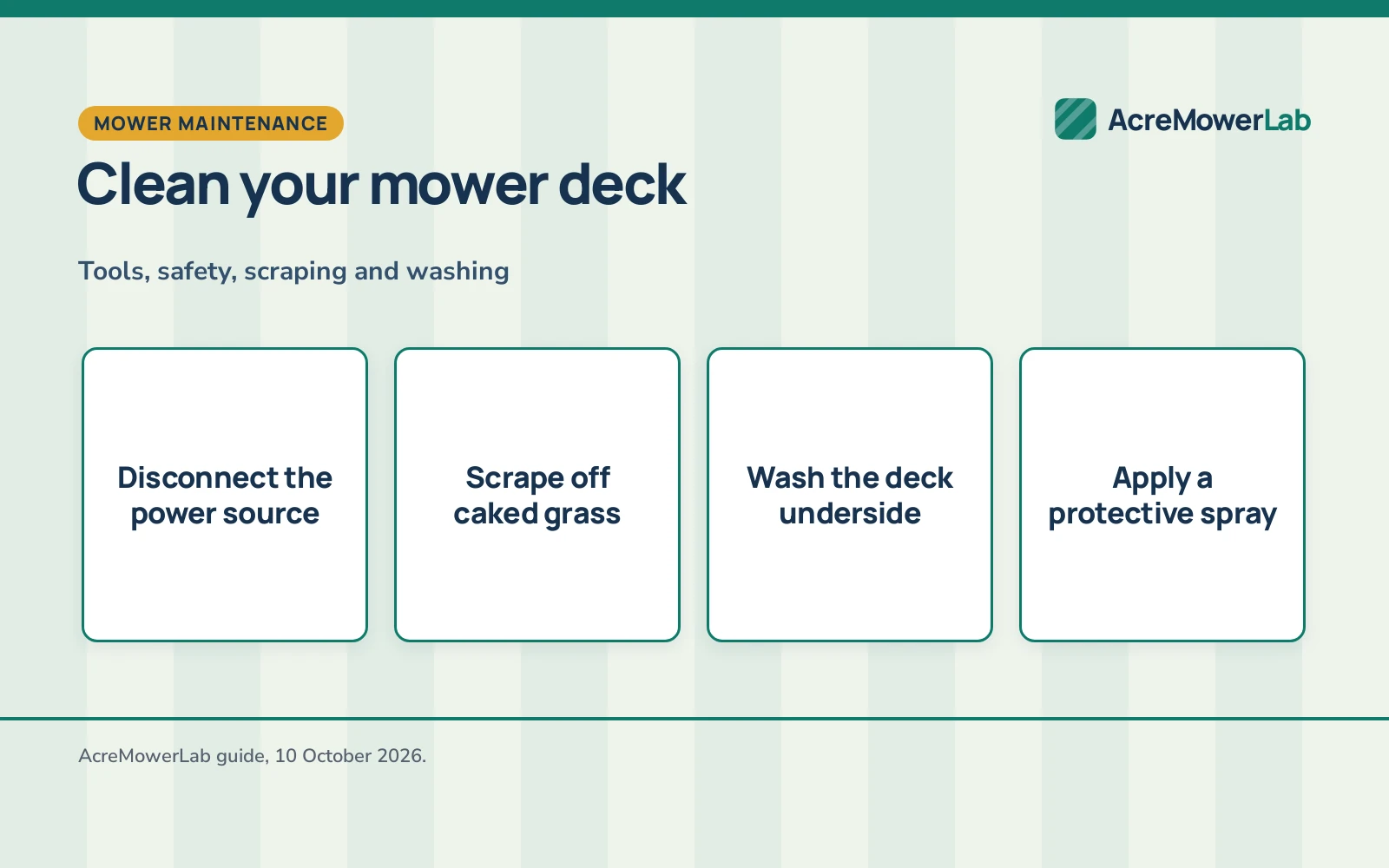
Step 2: disconnect the power source and stabilize the machine
Before placing hands or tools near any mower deck, prevent accidental engine starting. On gas equipment, including walk-behind mowers, lawn tractors, and commercial zero-turn mowers, shut off the engine, pull the boot off every spark plug, and tuck the wire away. On electric mowers, remove the battery pack and safety key. On riders and tractors, remove the ignition key and lock the parking brake.
Position the mower on level ground. Check your operator manual for the approved tilt orientation: most makers instruct owners to tilt backward toward the handlebar or tip to the side with the carburetor and air filter pointing upward so oil does not flood the air intake.
For riding mowers and tractors, gain clearance using ramps or a dedicated lift. Never work under a machine supported solely by hydraulic jacks: engage mechanical locking pins or place solid jack stands under the frame. See our guide to choosing a lift for working on lawn mower decks for stable lifting options.
Step 3: scrape off compacted grass and debris
Moist grass clippings pack inside deck baffles and blade chambers, forming a hardened crust that restricts air circulation, degrades cut quality, and traps moisture against steel shells. A specialized deck scraper with a contoured edge removes this crust without gouging the deck metal.
Work from the discharge chute inward toward the center spindle. MoJack lists its curved stainless steel scraper blade at 2 inches by 10.25 inches with an item weight of 3.2 ounces to clear debris with knuckle clearance. Good Vibrations states an 8.16 ounces item weight across dimensions of 14″D x 5″W x 4″H on its Grass Hawk dual-blade scraper, noting a 12.8 inches dimension in its spec table. Xanadued lists a long-handle scraper measuring 15.7 x 3 x 2 inches with an item weight of 7 ounces, while Global Climate Alliance lists scraper dimensions of 10 x 2 x 1 inches and an item weight of 5.6 ounces. Loyipu lists a dual cleaning tool combining a scraper with a stiff bristle brush made with an alloy handle to clear tight crevices.
While clearing the underside, inspect blade edges for dullness. See our guide on how often to sharpen mower blades and our review of the best mower blade sharpener tools to keep cutting edges clean.
Step 4: wash the deck underside
After scraping off loose crust and heavy debris, wash the deck shell to remove remaining residue and acidic plant sap.
If washing on a mower lift or ramps, spray the underside clean using a garden hose nozzle or pressure washer while the engine remains shut off and disconnected. For routine maintenance on mowers with deck wash ports, lower the mower flat to the ground, connect the hose, start the engine, and engage the cutting blades so spinning water flushes fresh clippings before they dry. Haiouus lists a wash kit weighing 1 pounds with four quick connect heads and 2 nozzles that mount through deck shells. Snow Bear lists a hose port adapter weighing 2.08 ounces with package dimensions of 3.46 x 2.4 x 2.05 inches to attach a garden hose to riding mower decks.
For stubborn grime, apply a dedicated equipment degreaser before rinsing. The Mob Chemist lists its Grass Assassin outdoor power equipment cleaner in a 32 fluid ounces spray bottle as well as a 1 gallon container with package dimensions of 10.63 x 4.8 x 4.45 inches. Spray across the deck underside, allow it to break down residue, and rinse. When pressure washing, keep the spray wand moving and avoid directing high-pressure streams directly into spindle bearing seals.
Step 5: dry and apply a protective coating
Never put a mower away wet: trapped water inside deck seams accelerates corrosion. After rinsing, wipe down accessible surfaces or park the mower in full sunlight to evaporate moisture.
Running the mower blades on a clean, dry surface for a short period generates rapid airflow that expels standing water droplets. Shut down the engine, re-check that the power source is disconnected, and allow the metal to dry completely before applying a protective coating. Stens lists an 11 Ounce aerosol spray can with an item weight of 13.6 ounces for its Mo-Deck polymer spray, formulated to build up over repeated applications so clippings slide away rather than bonding to steel.
Applying a non-stick coating creates a smooth barrier between steel and moisture. For seasonal prep, review our guide on storing a riding mower for winter to protect decks and engines during cold months.
Accessing and lifting the mower deck safely
Safe access to the deck underside depends on mower size. Walk-behind push mowers can be tilted backward onto their handlebars with a weight on the handle, or tipped to the side with the carburetor and air filter pointing upward as specified in the manual. Empty partial fuel tanks before tipping to prevent spills.
Riding mowers, garden tractors, and zero-turn machines require dedicated lifting equipment. Backing a tractor onto ramps provides clearance for scraping, but wheel-lift jacks offer greater vertical rise and stable support. Always verify that wheel chocks are seated firmly behind tires on the ground. When working under large decks, inspect suspension brackets and deck hangers for play: see our reference on lawn tractor parts for maintenance guidelines.
Deck wash ports versus pressure washing
Deck wash ports offer quick convenience for weekly maintenance, while pressure washing provides deep cleaning power for stubborn seasonal buildup.
Washout ports work through hydrodynamic agitation, using spinning blades to churn water into a scrubbing spray. This method works well immediately after mowing when grass clippings are soft and moist, but lacks the shearing force needed to dislodge dried, hardened thatch.
Pressure washers deliver concentrated mechanical force capable of stripping hardened mud and dried grass. However, careless pressure washing can force water past spindle bearing seals. Use a wide fan nozzle, maintain an indirect spray angle across deck walls, and consult our guide on what size pressure washer do I need to select suitable pressure levels.
Preventing rust and corrosion on mower decks
Grass clippings contain moisture and natural organic acids that act like a wet sponge against steel deck housings, causing surface rust and structural pitting over time.
Smooth internal deck walls promote high-velocity airflow, which lifts grass blades upright for a clean cut and expels clippings efficiently. Rough, rusted surfaces create drag, causing clippings to catch, accumulate, and bog down engine power.
After scraping and washing, inspect the underside for bare metal patches. Wire-brush away loose rust, wipe the surface dry, and coat exposed steel with rust-inhibiting metal primer before the next cutting season. Routine application of polymer barrier sprays keeps clippings from sticking to minor surface imperfections.
Cleaning schedules for acreage equipment
Maintaining clean mower decks on acreage requires a routine matched to field conditions. Mowing damp spring grass causes rapid deck buildup, whereas dry summer cutting leaves light dust that blows away easily.
Clear loose grass from the top of the deck shell, around pulleys, and near belts after every mowing session to prevent debris from trapping engine heat. If using a washout port, run the rinse cycle right after mowing while clippings remain moist.
Plan a thorough underside scraping whenever you notice clumps dropping onto cut turf or when airflow lags. Complete a full deep clean, metal inspection, and protective spray application at the close of the mowing season before winter storage.
Safety
Wear eye protection, hearing protection, and sturdy work gloves when cleaning under a mower deck. Mower blades are sharp, and compacted grass can conceal hidden wire, stones, or metal debris. Disconnect the spark plug boot or remove the battery pack before placing hands or tools near cutter blades. Never work under a machine supported solely by hydraulic jacks: engage mechanical locking pins or rest the mower on solid jack stands. For pressure washers, operate gas units outdoors only, and never point high-pressure spray at people or animals. Refuel gas equipment only with the engine off and cool. Keep children, pets, and bystanders away from the work area. See our Safety Disclaimer.
FAQ: mowing large lots
How often should you clean a mower deck?
Clear loose clippings from the top of the deck after every mow. Scrape the underside whenever grass forms a compacted layer restricting airflow, and perform a full wash and scraper pass before winter storage.
Can I use a pressure washer to clean my mower deck?
Yes. Use a wide fan tip, keep the spray wand moving, and avoid spraying directly into spindle bearing seals, pulley covers, or electrical connections.
Do mower deck wash ports actually work?
Washout ports work well immediately after mowing while grass clippings are still moist and loose, but they cannot dislodge dried, hardened thatch, which requires manual scraping.
Which way should you tilt a lawn mower to clean underneath?
Check your manual: most makers instruct tilting backward toward the handlebar or tipping to the side with the carburetor and air filter pointing upward to prevent oil from flooding the air intake.
What can I spray under my mower deck to keep grass from sticking?
Apply a specialized polymer deck spray or silicone coating to a clean, dry deck. Repeated applications create a slick film that helps clippings slide out through the discharge chute.
More mowing guides
- Best Gas Pressure Washer: 3 Picks for Farm and Acreage Cleanup
- Lift for Working on Lawn Mower: 5 Picks Compared (2026)
- How Often Should You Sharpen Mower Blades?
- How to Store a Riding Mower for Winter
Use the Mower Matcher to narrow down choices by acreage, terrain, budget, and power type.