What Size Pressure Washer Do I Need?
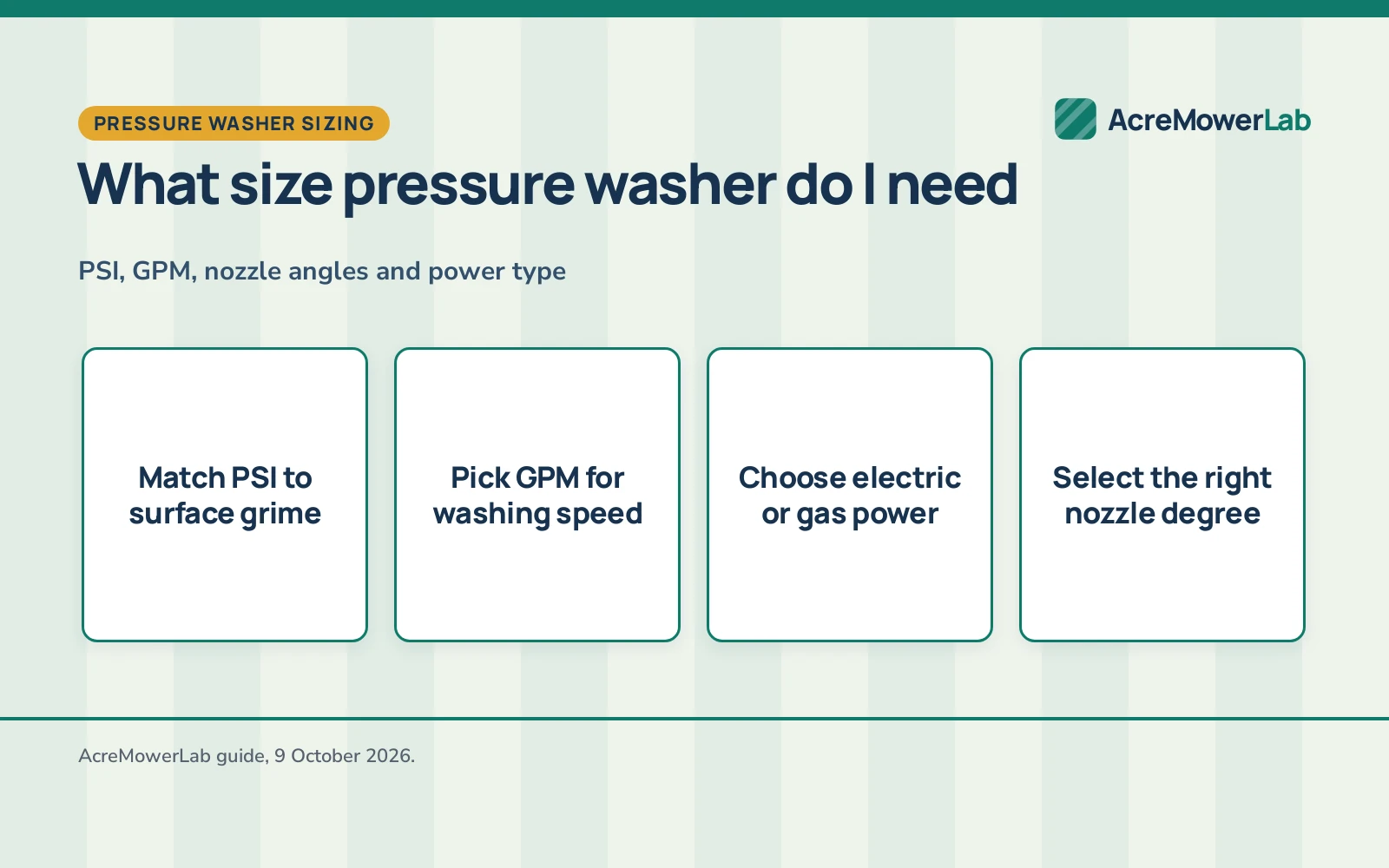
A step-by-step guide to choosing the right pressure washer size: matching PSI, GPM, nozzle angles, and power type to your outdoor cleaning jobs.

On this page
Top picks at a glance
As an Amazon Associate I earn from qualifying purchases.
- 1
 JANZ 24 in Stainless Steel Pressure Washer Surface Cleaner9.8/10View on Amazon
- 2
 JANZ 30 in Stainless Steel Pressure Washer Surface Cleaner9.7/10View on Amazon
- 3
 PowerSmart Gas Pressure Washer9.6/10View on Amazon
- 4
 Sun Joe Pressure WasherView on Amazon
- 5
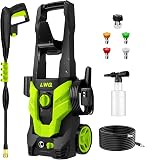 Pressure WasherView on Amazon
- 6
 Greenworks 1600 PSIView on Amazon
- 7
 CRAFTSMAN Electric Pressure WasherView on Amazon
- 8
 McKillans Foam Cannon for Pressure WasherView on Amazon
- 9
 Greenworks 2000 PSIView on Amazon
To answer what size pressure washer do I need, match pressure and water flow to your cleaning jobs: electric models like the Westinghouse WPX3000e (3000 max PSI and 1.76 max GPM) handle vehicles, fences, and patio furniture, mid-size gas units like the SIMPSON Clean Machine (3400 PSI and 2.5 GPM) tackle driveways, siding, and walks, while heavy gas powerhouses like the SIMPSON PowerShot (4000 PSI and 3.5 GPM) or TechSweepPro (4400 PSI and 4.5 GPM) strip large concrete slabs and farm outbuildings. Pressure loosens grime, while water flow rinses debris away. This guide explains how to size each specification for your property.
Other machines to compare
 Sun Joe Pressure WasherCheck price on Amazon
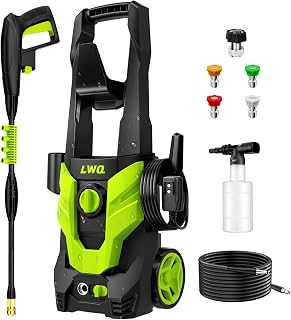 Pressure WasherCheck price on Amazon
 Greenworks 1600 PSICheck price on Amazon
 CRAFTSMAN Electric Pressure WasherCheck price on Amazon
 McKillans Foam Cannon for Pressure WasherCheck price on Amazon
 Greenworks 2000 PSICheck price on Amazon
AcreMowerLab earns a commission when you shop through links here. It never changes your price. Affiliate disclosure.
What size pressure washer do I need: pick the right PSI and GPM
| Machine size | Best for | Limit |
|---|---|---|
| Electric power (Westinghouse lists 3000 max PSI, 1.76 max GPM) | Vehicles, patio furniture, siding, garage floors, fencing | Lower flow rate takes more time on large surfaces |
| Residential gas (SIMPSON lists 3400 PSI, 2.5 GPM) | Driveways, concrete walks, siding, fencing, house exterior | Gas engine upkeep and outdoor-only operation |
| Heavy-duty gas (SIMPSON lists 4000 PSI, 3.5 GPM) | Concrete prep, paint preparation, wood restoration, farm equipment | Requires wide nozzles and distance on wood; 120 pounds to transport |
| Commercial gas (TechSweepPro lists 4400 PSI, 4.5 GPM) | Grease, oil stains, large barn floors, industrial buildup | Aggressive pressure strips paint; demands high water supply flow |
Most property owners choose between electric and gas models based on acreage and stain severity. See our best gas pressure washer guide for acreage cleanup options.
Step 2: choose your power source
Electric pressure washers run quietly with zero exhaust fumes, making them convenient near windows and patio doors. Westinghouse lists an AC 120V electric motor on the WPX3000e, equipped with a 35′ GFCI cord and an auto-stop pump that halts when the trigger is released. Electric units require no engine oil, spark plugs, or fuel cans, though cord reach limits travel distance.
Gas pressure washers deliver cord-free mobility across pastures, barnyards, and long driveways. SIMPSON equips a 208 cc CRX engine on the Clean Machine, IvyBess lists a 212cc 7HP engine on its 4200 PSI washer, and TechSweepPro lists a 420cc 15HP engine on its 4400 PSI model. Gas power delivers higher pressure and greater flow to blast heavy mud. However, gas engines require oil checks (IvyBess lists 10W-30 engine oil), fuel stabilizer, and outdoor-only operation due to exhaust emissions.
Step 3: select the nozzle degree
Nozzle tips shape the water stream and determine effective cleaning force. Narrow nozzles concentrate pressure for stubborn spots, while wide nozzles spread water into a gentle rinsing fan. IvyBess lists quick-connect nozzles in 0°, 15°, 25°, 40°, and 60° angles:
- 0° nozzle (red): Pinpoint stream with maximum force. IvyBess lists 0° for high reach and sidewalk crevices. Never use 0° on wood, vehicles, or siding because it can cut surfaces.
- 15° nozzle (yellow): Narrow fan for heavy cleaning. IvyBess lists 15° for concrete, brick, and stubborn stains.
- 25° nozzle (green): Medium fan for general washing. IvyBess lists 25° for painted surfaces, wood siding, fences, and lawn mowers.
- 40° nozzle (white): Wide, gentle spray. IvyBess lists 40° for windows and screens.
- 60° nozzle: Broad spray for gentle washing. IvyBess lists 60° for cars, patios, garden items, and furniture.
- Soap nozzle (black): Low-pressure spray for detergent application. Westinghouse lists a 0.45 gallon soap tank, and IvyBess lists a 1L soap tank for soaping furniture, patios, and siding.
Step 4: verify water supply and flow
A pressure washer pump requires an uninterrupted water supply to prevent pump cavitation and seal damage. If incoming water flow from your spigot falls below the machine output rating, the pump draws in air pockets that harm internal components.
Westinghouse lists 1.76 max GPM on the WPX3000e, an intake volume that typical residential outdoor spigots can accommodate. Gas washers demand more water: SIMPSON lists 2.5 GPM for the 3400 PSI Clean Machine, SIMPSON lists 3.5 GPM on the 4000 PSI PowerShot, and TechSweepPro lists 4.5 GPM for its commercial unit. Check spigot flow into a bucket before connecting a high-flow machine, and inspect supply hoses for kinks that restrict flow.
Step 5: check hose length and mobility
Hose length and machine weight determine how easily you navigate around a property. Westinghouse, SIMPSON, and IvyBess include 25 feet high-pressure hoses on several models, providing enough reach for localized patio and vehicle cleaning. Larger grounds benefit from longer lines: SIMPSON lists a 35′ Morflex hose on the ALH3425, while SIMPSON equips a 50-foot Monster hose on the 4000 PSI PowerShot, and TechSweepPro lists a 50FT hose on a reel. A 50-foot hose lets you wash wide driveway areas while the machine stays put.
Weight reflects build materials. Westinghouse lists 36.8 pounds for its electric washer with 10″ never-flat wheels. Gas washers add engine and frame weight: SIMPSON lists 61 pounds for the Clean Machine (64 lb in bullets) on 10″ pneumatic tires, IvyBess lists 66 pounds, SIMPSON lists 78 lb on the aluminum ALH3425, TechSweepPro lists 100 pounds, SIMPSON lists 120 pounds on the PowerShot with 13-inch pneumatic tires, and VEVOR lists 137 pounds with 10-inch wheels. Pneumatic tires cushion travel over gravel and uneven turf.
Evaluate pump design: axial versus triplex
The pump drives pressurized water through the wand nozzle. Axial cam pumps suit residential chores and select high-output machines. Westinghouse lists an axial 3 piston auto-stop pump on the WPX3000e, SIMPSON lists an OEM Technologies axial cam pump on the Clean Machine, and IvyBess pairs an axial cam pump with its 4200 PSI engine. Axial pumps are maintenance-free, factory-sealed units. SIMPSON includes a thermal relief valve to dump hot water during idling. They provide dependable service without pump oil changes.
Triplex plunger pumps cater to demanding commercial workloads and extensive acreage upkeep. A triplex pump uses a crankshaft and connecting rods to drive ceramic-coated plungers inside a serviceable manifold. SIMPSON equips industrial AAA triplex plunger pumps on the 3600 PSI ALH3425 and 4000 PSI PowerShot. Triplex pumps run cooler, dissipate heat efficiently, and feature rebuildable valves and seals for prolonged daily operation.
Match pressure ratings to surface materials
Matching pressure washer force to surface hardness protects outdoor property from permanent damage. Soft surfaces like wood decking, painted siding, and vehicle panels require cautious pressure to avoid gouging timber or stripping paint. Westinghouse lists 2600 rated PSI and 1.1 rated GPM on the WPX3000e, which cleans painted walls and patio furniture safely when paired with a wide 25° or 40° nozzle.
Poured concrete, brick pavers, and stone walkways tolerate substantial force. SIMPSON lists 3400 PSI and 2.5 GPM for homeowner driveways, while SIMPSON lists 4000 PSI and 3.5 GPM for restoration projects. Using a rotary surface cleaner on concrete speeds work and eliminates zebra striping. See our pressure washer surface cleaner guide for compatible attachments.
Removing industrial grease, dried tar, and peeling paint requires heavy power. TechSweepPro lists 4400 PSI and 4.5 GPM, while IvyBess lists 4200 PSI for commercial stripping. SIMPSON incorporates PowerBoost Technology to maintain high pressure at the nozzle tip.
Plan property washing in zones
Dividing property cleaning into structured zones keeps work efficient and prevents dirty runoff from crossing clean surfaces. Begin with flat hardscapes like concrete driveways and walkways, sweeping away loose twigs before washing. Work downhill toward natural drainage points so wash water drains away from work areas.
For house siding and perimeter fencing, apply detergent from the bottom up to avoid streaks, then rinse thoroughly from the top down. Direct nozzles downward so pressurized water does not push under horizontal siding laps. Our best 3000 PSI pressure washer guide reviews versatile options for multi-zone property maintenance.
Clean mowers, tractors, and farm implements on grass or gravel where runoff can filter into soil. Avoid aiming concentrated high-pressure streams directly into electrical wiring harnesses, carburetor intakes, or wheel bearing seals.
Mind surface drainage and cold weather
Operating a pressure washer requires managing runoff water and protecting equipment from freezing weather. High-flow washers discharge substantial water volume: TechSweepPro lists 4.5 GPM, and SIMPSON lists 3.5 GPM on the PowerShot. Verify that runoff drains toward turf, ditches, or swales rather than pooling against building foundations. Avoid routing detergent runoff into garden beds or ornamental plantings.
Wet concrete and mossy wood become slick during washing. Wear footwear with slip-resistant soles and maintain stable footing. Never climb onto a ladder while holding an active spray wand; wand recoil from a 3400 PSI or 4000 PSI machine can compromise balance. Keep both feet on level ground, and use extension wands for elevated reach.
Safety
Pressure washers operate under high mechanical force and require strict safety precautions. The high-velocity water stream can cause physical injury, while gas engines and electrical connections introduce specific operating hazards.
Never point a spray gun or nozzle tip at people, pets, or livestock. High-pressure water can pierce skin, causing deep injection injuries that require immediate surgical care. Never place hands or feet in front of the spray tip. Engage the spray gun trigger safety lock whenever you pause work; SIMPSON includes an ergonomic spray gun with a safety lock-out to prevent accidental discharge.
Gas pressure washers produce toxic carbon monoxide exhaust and must operate outdoors only in well-ventilated areas, away from open windows and doors. Never refuel a gas engine while it is running or hot; allow the engine to cool down before adding fuel to prevent gasoline vapor ignition on hot engine blocks.
Electric pressure washers must connect to grounded outlets with ground-fault circuit interrupter protection. Westinghouse lists a 35′ GFCI cord to protect operators against electrical shock in wet surroundings.
Wear personal protective equipment during operation: impact-rated eye protection shields against flying gravel, hearing protection muffles gas engine noise, and sturdy closed-toe footwear protects feet from high-pressure water contact.
FAQ: mowing large lots
Is 3000 PSI enough for washing a driveway?
Yes, 3000 PSI cleans concrete driveways effectively, though cleaning speed depends on flow rate. Westinghouse lists 3000 max PSI at 1.76 max GPM, which cleans dirt and mildew on residential concrete surfaces. Gas models like the SIMPSON Clean Machine deliver 3400 PSI at 2.5 GPM, providing faster rinsing on larger driveways.
What is more important: PSI or GPM?
Both ratings determine cleaning performance, but they perform different roles. PSI measures the stripping pressure that breaks grime loose from surfaces, while GPM measures the water flow volume that washes loosened dirt away. Higher GPM allows wider cleaning passes and speeds work across large acreage surfaces.
Can a 4000 PSI pressure washer damage wood decks?
Yes, if used improperly. Excessive pressure held too close or paired with a narrow nozzle can gouge soft wood, raise wood grain, and splinter deck boards. When cleaning wood with a powerful machine, maintain a safe working distance and use a wide fan such as a 25° or 40° nozzle. SIMPSON notes its 4000 PSI PowerShot for wood restoration, where stripping deteriorated surface fibers or preparing old coatings for refinishing is the goal.
Can I run a pressure washer from a garden hose?
Yes, provided your outdoor water spigot delivers more water flow than the pressure washer pump consumes. Electric washers like the Westinghouse WPX3000e draw 1.76 max GPM, which standard outdoor spigots easily supply. High-flow gas units drawing 3.5 GPM (SIMPSON PowerShot) or 4.5 GPM (TechSweepPro) require checking spigot flow before connecting.
What size pressure washer do I need for washing cars?
Vehicles require gentle washing to protect automotive clearcoats, window seals, and trim. Electric washers like the Westinghouse WPX3000e operate at 2600 rated PSI and 1.1 rated GPM for safe exterior washing when paired with wide fans or soap tanks. IvyBess specifically designates its 60° nozzle for car and patio cleaning. Avoid narrow nozzles like 0° or 15° on vehicle paint.
More mowing guides
- Best Gas Pressure Washer: 3 Picks for Farm and Acreage Cleanup
- Best 3000 PSI Pressure Washer: 5 Electric and Gas Picks (2026)
- Best 4000 PSI Pressure Washer: 5 Gas and Electric Picks (2026)
- Cheap Pressure Washer Surface Cleaner: 5 Budget Picks Compared (2026)
Explore our pressure washers hub to compare categories, ratings, and equipment specs for your property.