Anti Seize vs Thread Locker: Which One Should You Buy?
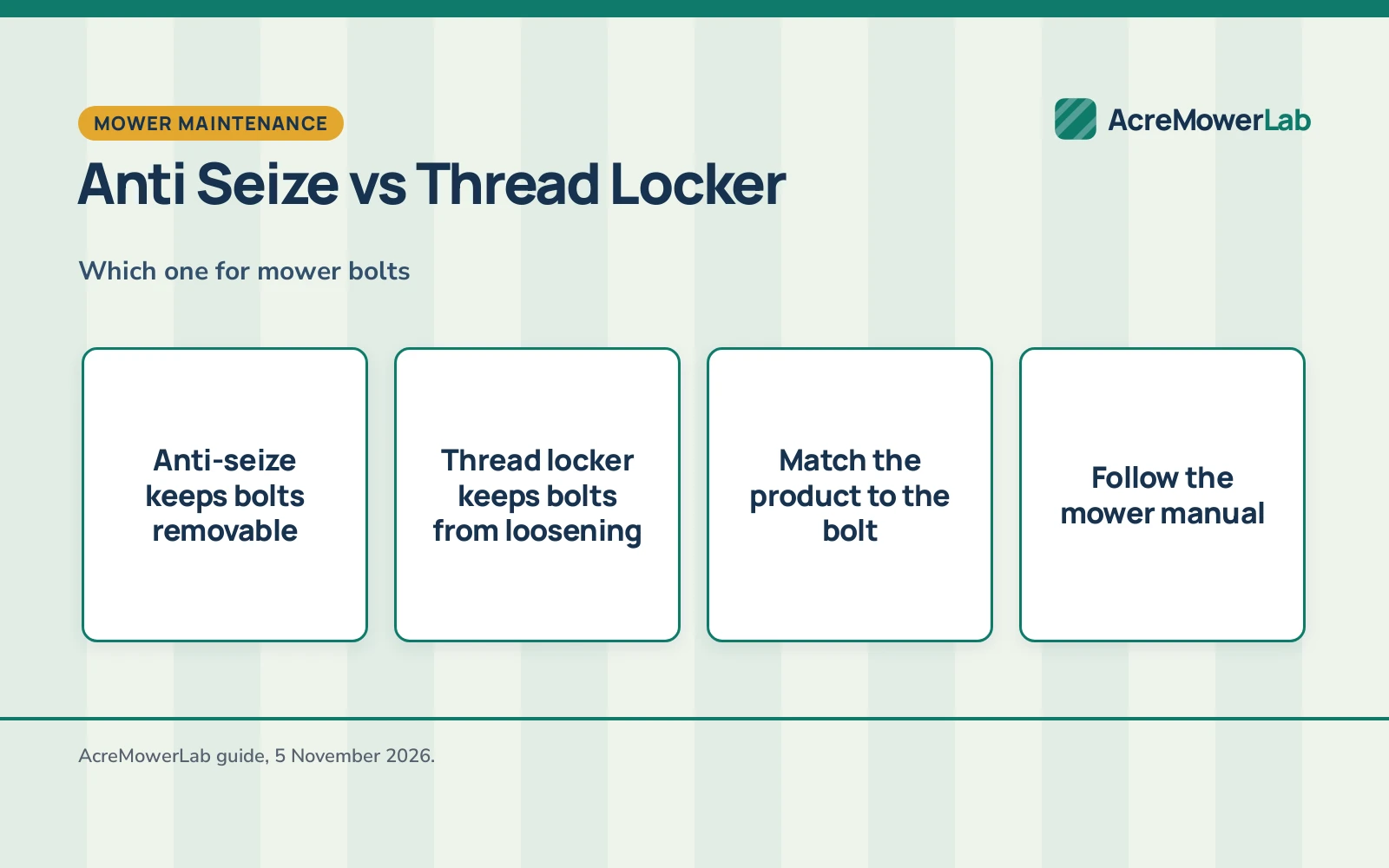
Anti-seize keeps mower bolts removable and thread locker keeps them from loosening, and the right choice depends on whether the bolt must come out again.

On this page
Top picks at a glance
As an Amazon Associate I earn from qualifying purchases.
- 1
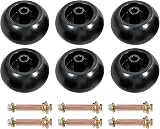 DICMIC Anti Scalp Deck Wheels9.6/10View on Amazon
- 2
 55" L Aluminum Shed Ramps for Lawn Mowers9.5/10View on Amazon
- 3
 VNN Shed Ramps for Lawn Mower9.5/10View on Amazon
- 4
 Loctite 34395 Marine Grade Anti-Seize Compound 1 EachView on Amazon
- 5
 Loctite-41205 Anti-Seize CompoundView on Amazon
- 6
 ESKONKE Thread Locker Blue 243View on Amazon
- 7
 ESKONKE Thread Locker Red 271View on Amazon
- 8
 ESKONKE Red Thread Locker 271 Nuts & Bolts Locker HighView on Amazon
- 9
 ESKONKE 3 Pack Thread Locker Blue 243 + Red 271 Removable &View on Amazon
Anti seize vs thread locker comes down to one question: must this bolt come out again, or must it stay put? Anti-seize is a grease that coats threads so a bolt does not bond to the hole, and it lets you remove that bolt later. Thread locker is a compound that holds a fastener in place against vibration, so it suits bolts that must not move. On a mower, use anti-seize on blade bolts, spark plugs and exhaust bolts, and thread locker on fasteners the manual says must stay tight.
Other machines to compare
 Loctite 34395 Marine Grade Anti-Seize Compound 1 EachCheck price on Amazon
 Loctite-41205 Anti-Seize CompoundCheck price on Amazon
 ESKONKE Thread Locker Blue 243Check price on Amazon
 ESKONKE Thread Locker Red 271Check price on Amazon
 ESKONKE Red Thread Locker 271 Nuts & Bolts Locker HighCheck price on Amazon
 ESKONKE 3 Pack Thread Locker Blue 243 + Red 271 Removable &Check price on Amazon
AcreMowerLab earns a commission when you shop through links here. It never changes your price. Affiliate disclosure.
Anti seize vs thread locker: the short answer
| Product | Best for | Limit |
|---|---|---|
| Anti-seize | Bolts you will remove again: blade bolts, spark plugs, exhaust bolts | Does not lock a fastener against vibration |
| Thread locker | Fasteners that must stay tight under vibration | Makes later removal harder |
The four picks below are all anti-seize, because this guide covers the anti-seize side of the comparison. For the rest of the fluids on your mower, see our motor oil vs lawn mower oil guide.
When to use anti-seize on a mower
Use anti-seize where steel threads sit in heat, damp or a long stretch between services, and the manual does not call for thread locker on that bolt. Blade bolts are the clearest case: the bolt comes out each time the blade comes off for sharpening, and a seized blade bolt turns a short job into a long one. See our mower blade sharpener picks for the other half of that job.
Spark plug threads are the second case. The BTAS listing names spark plug threads among its applications, and the Keze listing names spark plug and brake systems, bolts and nuts. A plug that has sat through a season of heat can bond to the head, and anti-seize keeps the threads free so the plug turns out cleanly at change time.
Exhaust hardware is the third case. The BTAS listing names exhaust manifold bolts among its applications and gives a temperature range of -30°F to 1800°F, so the grease is made for the hot end of the engine. Wheel hub nuts and brake pad bolts appear on the same applications list, which covers the running gear as well as the engine.
When to use thread locker on a mower
Use thread locker where a fastener must not move at all. Vibration loosens bolts over a season of mowing, and some fasteners on a mower are meant to stay exactly where the manual put them. If the manual calls for thread locker on a bolt, use thread locker and not anti-seize: anti-seize does the opposite job, it keeps a bolt removable. The two products are not interchangeable, and swapping them is how a bolt ends up either seized in place or working loose.
When the manual is silent, ask which failure costs more. A blade bolt that seizes costs time and a broken bolt. A fastener that works loose costs a part, or worse. Choose the product that guards against the failure you cannot afford.
The four anti-seize picks in this guide
Permatex 80078, 8 oz brush-top bottle
The Permatex 80078 is the standard pick: an 8 oz brush-top bottle of silver anti-seize lubricant with a grease base in paste form, listed at 0.7 pounds. The brush top puts the paste on the threads, and the 8 oz bottle covers repeated mower jobs across a season rather than a single bolt. It is the one to buy first if you service your own mower.
BTAS copper antiseize, 8 oz
The BTAS copper antiseize grease is a semi-synthetic grease with micro copper flakes, in an 8 oz size listed at 0.5 pounds. The listing states it prevents bonding and corrosion of metal contact surfaces caused by high temperatures or prolonged operation, and it states excellent electrical conductivity. It also states anti-rust and corrosion resistance, protection for threads during disassembly, and that it eliminates metal squeaks. Its stated applications run from spark plug threads and exhaust manifold bolts to wheel hub nuts, brake pad bolts, engine bolts, oxygen sensors, knock sensors, thermostat housing bolts and battery cable connections. One contradiction to note: the title calls it a copper grease while the spec table lists the color as red.
Permatex 81343, 1 oz tube
The Permatex 81343 is a 1 oz tube of white anti-seize lubricant, listed at 0.09 pounds. It is the small-format version of the same idea: a tube for a single small job, such as one spark plug change or a single blade bolt, where an 8 oz bottle would sit on the shelf for years.
Keze copper anti-seize, 1 oz
The Keze copper anti-seize is a 1 oz pack of copper thread lubricant grease, listed for automotive spark plug and brake systems, bolts and nuts, to prevent rust and corrosion, with high temp resistance. It states the least of the four listings, with no weight or dimensions given, so it suits a reader who wants a small amount of copper anti-seize for spark plugs and bolts and nothing more.
For the grease side of mower care more broadly, our lithium vs synthetic chassis grease guide covers the greases that go into fittings rather than onto threads.
How to apply anti-seize
Follow the instructions on the listing you buy. The BTAS listing states the method plainly: remove excess dirt or grease from the surfaces to be coated, apply the product to the surface, wipe away any excess, and use only a neat, thin film for the best results. A thin film on the threads is enough. A thick coat does not add protection, it adds mess, and it can work its way onto surfaces that should stay clean.
Coat the threads, not the head of the bolt and not the mating surface around the hole. Keep the grease off the electrode of a spark plug and off brake friction surfaces. Put the cap back on and store the bottle or tube where it will not tip over in the shop.
Safety
Wear eye protection when you work under the deck or around the engine, and keep children and pets away from the work area. Let the engine cool before you touch exhaust bolts or pull a spark plug. Refuel only with the engine off and cool, and follow the safety guidance in your mower manual.
FAQ: mowing large lots
Can I use anti-seize on mower blade bolts?
Yes, where the manual allows it: the grease keeps the bolt removable after a season of mowing, and the 8 oz brush-top bottle suits the job. Anti-seize changes thread friction, so follow the torque instructions in your mower manual for the thread condition it specifies.
Can I use thread locker on a spark plug?
No. Spark plug threads are an anti-seize application on the BTAS and Keze listings, and thread locker is made to hold a fastener in place, which is the opposite of what a spark plug needs at change time.
Does anti-seize handle exhaust heat?
The BTAS listing gives a temperature range of -30°F to 1800°F and names exhaust manifold bolts among its applications, so that grease is made for the hot end of the engine. The range differs by product: the Permatex 80078 listing gives -80°F to 1600°F, so check the range on the listing of the product you buy.
Which size should I buy first?
The 8 oz bottles, Permatex 80078 and BTAS, cover repeated mower jobs, while the 1 oz tube, Permatex 81343, and the 1 oz Keze pack suit a single small job.
Can I use anti-seize instead of thread locker?
Only where the manual allows it. If the manual calls for thread locker, use thread locker: anti-seize does not lock a fastener against vibration.