Are Push Reel Mowers Any Good?
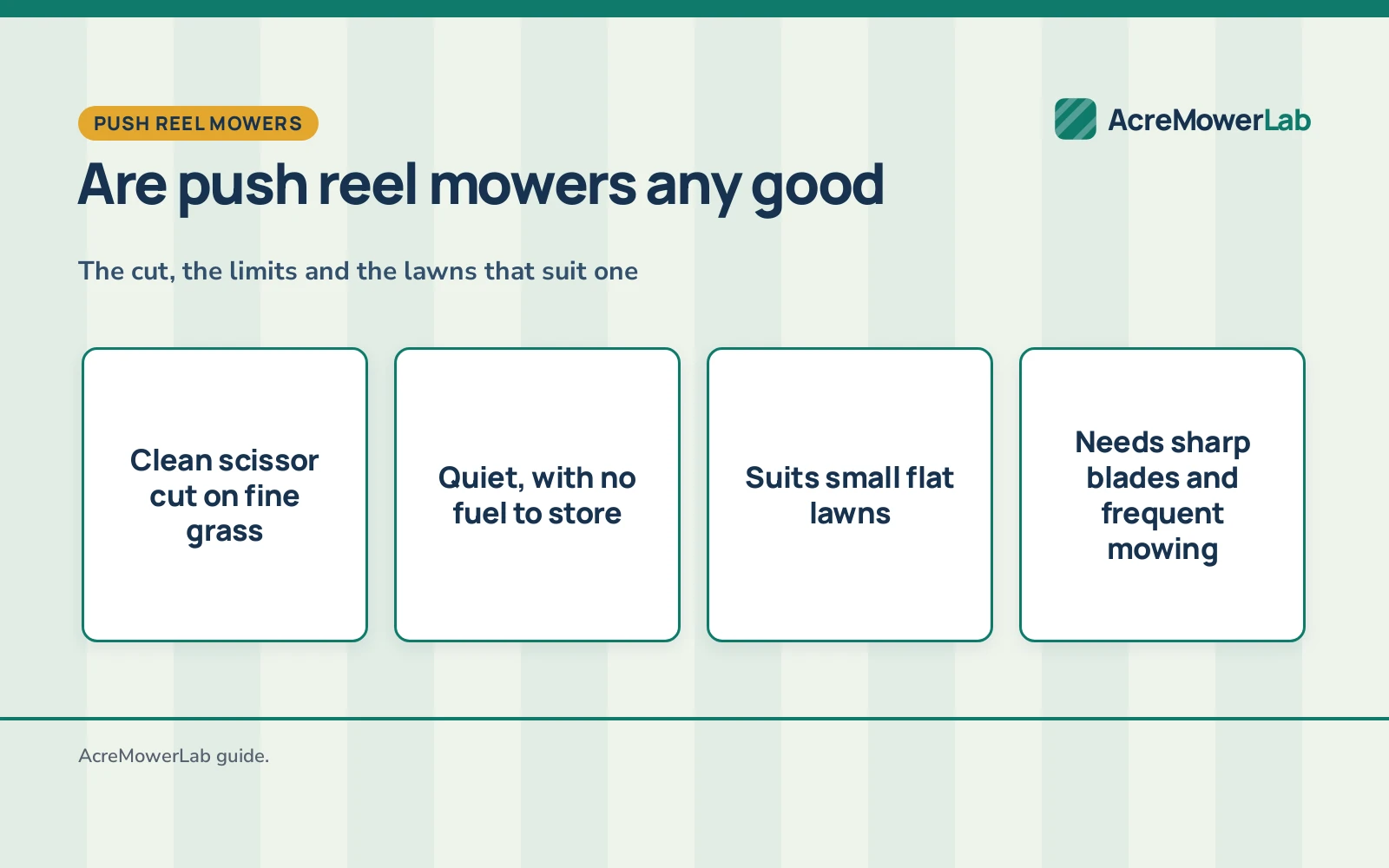
A push reel mower cuts cleanly on a small, flat lawn of fine grass mowed often, and turns into hard work on tall, wet or rough ground.

On this page
Top picks at a glance
As an Amazon Associate I earn from qualifying purchases.
- 1
 LawnMaster 20” 5-Blade Push Reel Lawn Mower9.3/10View on Amazon
- 2
 Scotts 304-14S 14-Inch 5-Blade Push Reel Lawn Mower9.2/10View on Amazon
- 3
 Greenworks 48V 17in Push Mower9.6/10View on Amazon
Are push reel mowers any good? For a small, fairly flat lawn of fine grass that gets mowed on a regular rhythm, yes. A push reel mower gives a clean scissor cut, stays quiet, needs no fuel, and has no engine to maintain. For a large or rough lawn, tall or wet grass, or ground scattered with sticks and bumps, the same mower turns into hard work and leaves a patchy cut. This guide explains how the cut works, where a reel mower shines, where it struggles, and how to judge whether a reel mower fits a particular property.
AcreMowerLab earns a commission when you shop through links here. It never changes your price. Affiliate disclosure.
Are push reel mowers any good: how the cut works
A push reel mower carries curved blades on a cylinder that spins as the wheels turn. Each blade passes a fixed bed knife and snips grass the way scissors snip paper, instead of tearing it the way a spinning rotary blade does. That scissor action leaves a tidy tip on each grass blade, which helps the lawn look neat and recover after mowing. The cut depends on the blades meeting the bed knife closely, so a sharp reel that is set right cuts well, while a dull or loose reel folds grass over and leaves it standing.
Pushing the mower turns the reel, so the pace of the cut follows the pace of the walk. A steady, even walking speed gives the most even result, and overlapping the edge of the last pass keeps uncut strips from showing. When grass bends under the reel instead of standing up to meet the blades, the cut goes ragged, which is why mowing before grass grows tall matters more with a reel than with a rotary mower.
| Mower | Suits | Limit |
|---|---|---|
| Push reel mower | Small flat lawns of fine grass, mowed often | Struggles in tall, wet or rough grass |
| Rotary push mower | Mixed grass and uneven ground | Needs fuel or a charge, louder and heavier |
| Robotic mower | Steady upkeep on a defined lawn | Needs setup and a clear boundary |
For a closer look at manual models, see the manual walk behind reel lawn mower guide, and compare the cutting styles in reel mower vs rotary.
Where a reel mower works well
A reel mower earns its keep on a modest lawn that is flat, smooth and free of debris. Fine grasses suit it best, because thin blades stand up to meet the reel and snip cleanly. Lawns mowed on a steady rhythm stay within the height a reel handles with ease, and the mower stays light enough to push without strain. Quiet running suits early mornings and close neighbors, and the absence of fuel or a battery means nothing to charge, nothing to spill, and little to store over winter. Storage is simple too, since a reel mower hangs on a wall or stands in a shed corner. The best reel mower for Kentucky bluegrass roundup covers picks for fine turf.
Where a reel mower struggles
Tall grass is the main limit. When grass grows past the height the reel can gather, blades bend forward instead of standing to be cut, and the mower leaves stragglers behind. Wet grass clings to the reel and bed knife, which drags the cut and leaves clumps. Thick weeds with tough stems resist the snip, and sticks, pine cones and stones can nick the blades or jam the reel.
Rough or bumpy ground adds strain. The reel needs even contact with the bed knife across its width, so ruts and bumps make the cut uneven and force the walker to push harder. Size sets the other limit: on a large property the same walk takes far longer than with a powered mower. For larger lawns, see types of push mowers.
Mowing with a reel mower
Mow often, and mow when the grass is dry. A dry lawn cuts cleanly and leaves little residue on the reel, while a damp lawn clings and clumps. Walk at a steady pace, overlap each pass a little, and clear sticks and stones before starting.
Set the cutting height to suit the grass and the season: raise it when grass grows fast in spring, lower it when growth slows. If the cut looks ragged, check the blade setting before blaming the grass, since a reel that has drifted away from the bed knife folds blades over instead of cutting them. The best reel mower with height adjustment roundup covers models with easy height changes, and a catcher keeps clippings off paths and beds, as shown in manual reel mower with grass catcher.
Keeping the blades sharp
Sharp blades are the whole game with a reel mower. Dull blades tear and fold grass, leaving pale tips and a lawn that looks tired soon after mowing, so blade care belongs in the regular routine, not as an afterthought.
The usual routine is to hone the edge, set the reel against the bed knife so the edges meet along the full width, and check the cut on a sheet of paper fed between reel and bed knife. A sharp, well-set reel snips the paper cleanly, while a dull reel folds it. See manual lawn mower blade sharpener, best way to sharpen lawn mower blades, and reel mower repair when the cut stays ragged after sharpening.
Safety
A reel mower has no engine, but its blades are sharp and the reel spins fast when the mower rolls. Keep hands and feet clear of the reel, wear sturdy shoes and eye protection, and clear sticks, stones and other debris before mowing. Keep children and pets out of the yard while mowing, and store the mower where the blades cannot catch a passing leg.
FAQ: mowing large lots
Are push reel mowers any good for a large lawn?
Not as a rule. The effort grows with the size of the lawn, and a large property takes far longer on foot than with a powered mower. A reel mower suits a modest lawn. For larger ground, see choosing the right mower size.
Do reel mowers work on thick or tall grass?
Poorly. Thick stems resist the snip, and tall grass bends under the reel instead of standing to be cut. Mow before the grass grows tall, and use a rotary mower or a string trimmer for overgrown patches.
How often should the lawn be mowed with a reel mower?
On a steady rhythm through the growing season, before the grass grows tall enough to bend under the reel. Short, frequent passes keep the cut clean and the pushing easy, while letting the lawn grow long between mows makes the work hard and the cut ragged.
Are reel mowers hard to push?
On flat, short grass, no. The mower is light, and the reel turns freely when the blades are sharp and set right. On a slope, in tall grass, or over rough ground, pushing takes real effort, and a powered mower may suit the property better.
Can a reel mower replace a rotary mower?
On a small, flat lawn of fine grass, yes, and many owners find the reel mower becomes the main mower. On mixed ground with rough patches, thick weeds or leaves to clear, a rotary mower still earns its place, and some owners keep a rotary mower as well. See the comparison in reel mower vs rotary.