Types of Push Mowers
Gas, battery, corded-electric and reel push mowers compared by deck, drive and ground, so you can match a push mower to your yard.

On this page
Top picks at a glance
As an Amazon Associate I earn from qualifying purchases.
- 1
 Greenworks 40V 4.0Ah Lithium-Ion Battery9.6/10View on Amazon
- 2
 EGO Power+ 56V 2.5Ah Lithium-Ion Battery BA1400T9.6/10View on Amazon
- 3
 Mighty Max YTX4L-BS 12V 3AH Sealed Lead Acid Battery9.4/10View on Amazon
- 4
 BLACK+DECKER Electric Lawn MowerView on Amazon
- 5
 SENIX Gas Lawn MowerView on Amazon
- 6
 PowerSmart 21" Push Lawn MowerView on Amazon
- 7
 SENIX 21" 144cc Gas Push Lawn MowerView on Amazon
- 8
 SENIX 144 cc Gas Lawn MowerView on Amazon
- 9
 SENIX 20" Gas Lawn MowerView on Amazon
A yard with slopes, beds and trees to mow around asks for a mower you can steer by hand. Types of push mowers cover that whole walk-behind range, from a gas mower that powers through thick grass to a quiet reel mower for a small flat lawn. This guide walks through each kind, what it handles well, and how to match one to your yard.
Other machines to compare
 BLACK+DECKER Electric Lawn MowerCheck price on Amazon
 SENIX Gas Lawn MowerCheck price on Amazon
 PowerSmart 21" Push Lawn MowerCheck price on Amazon
 SENIX 21" 144cc Gas Push Lawn MowerCheck price on Amazon
 SENIX 144 cc Gas Lawn MowerCheck price on Amazon
 SENIX 20" Gas Lawn MowerCheck price on Amazon
AcreMowerLab earns a commission when you shop through links here. It never changes your price. Affiliate disclosure.
Types of push mowers: the main kinds
A push mower is a walk-behind mower that you guide across the lawn, with the blade turning as you walk behind it. The main kinds split by power: gas, battery, corded-electric and manual reel. Each kind suits a different yard, so the choice starts with your grass, your ground and how much upkeep you want to do.
| Type | Best for | Limit |
|---|---|---|
| Gas push | Thick grass, rough ground and larger lawns | Fuel, noise and regular upkeep |
| Battery push | Quiet mowing with no fuel to store | Run time ends when the charge ends |
| Corded-electric push | Light, quiet mowing near an outlet | The cord limits how far you can go |
| Manual reel push | Small flat lawns and quiet early mowing | Needs short grass and a level lawn |
Most yards suit more than one kind. See our best walk-behind push mower roundup for push mowers we scored, and the manual walk-behind reel lawn mower guide for reel mowers in detail.
Gas push mowers
A gas push mower runs on a small petrol engine, and it is the kind to reach for when grass grows thick or the ground turns rough. The listing for one gas push mower states a 144cc 4-cycle engine, a 20-inch steel deck and a 2-in-1 mulch and discharge setup, with 5 cutting heights from 1.25 to 3.75 inches and 7-inch wheels front and rear. That combination suits yards where the grass gets tall between cuts and where the ground is uneven, since the engine keeps the blade turning through thick patches and the wheels roll over rough ground. A gas mower needs fuel, oil and air filter care, and it is louder than the electric kinds, so store fuel safely and follow the manual for upkeep. For how gas mowers compare with robotic mowers, see our gas lawn mower vs robotic mower comparison.
Battery push mowers
A battery push mower runs on a rechargeable pack, so there is no fuel to mix or store and no cord to drag behind you. It starts without a pull cord, runs quieter than a gas mower, and suits yards where you can finish the cut on a charge. The trade-off is run time: when the charge ends, the mowing stops until the pack charges again, so a yard that takes longer than a charge needs a spare pack or a different kind. Keep the pack dry and charged through the off-season, and follow the manual for storage. For battery options, see our best cordless lawn mower roundup, and for a smaller yard, see our best lawn mower for a quarter acre roundup.
Corded-electric push mowers
A corded-electric push mower plugs into an outlet and runs as long as it stays plugged in, so there is no charge to run down and no fuel to buy. It is light, quiet and simple, which suits a small yard close to the house where the cord can reach every corner. The cord is also the limit: you mow in a pattern that keeps the cord behind you, and a yard with beds, trees and paths to work around can turn cord handling into the main chore. Use an outdoor-rated extension cord and keep connections dry.
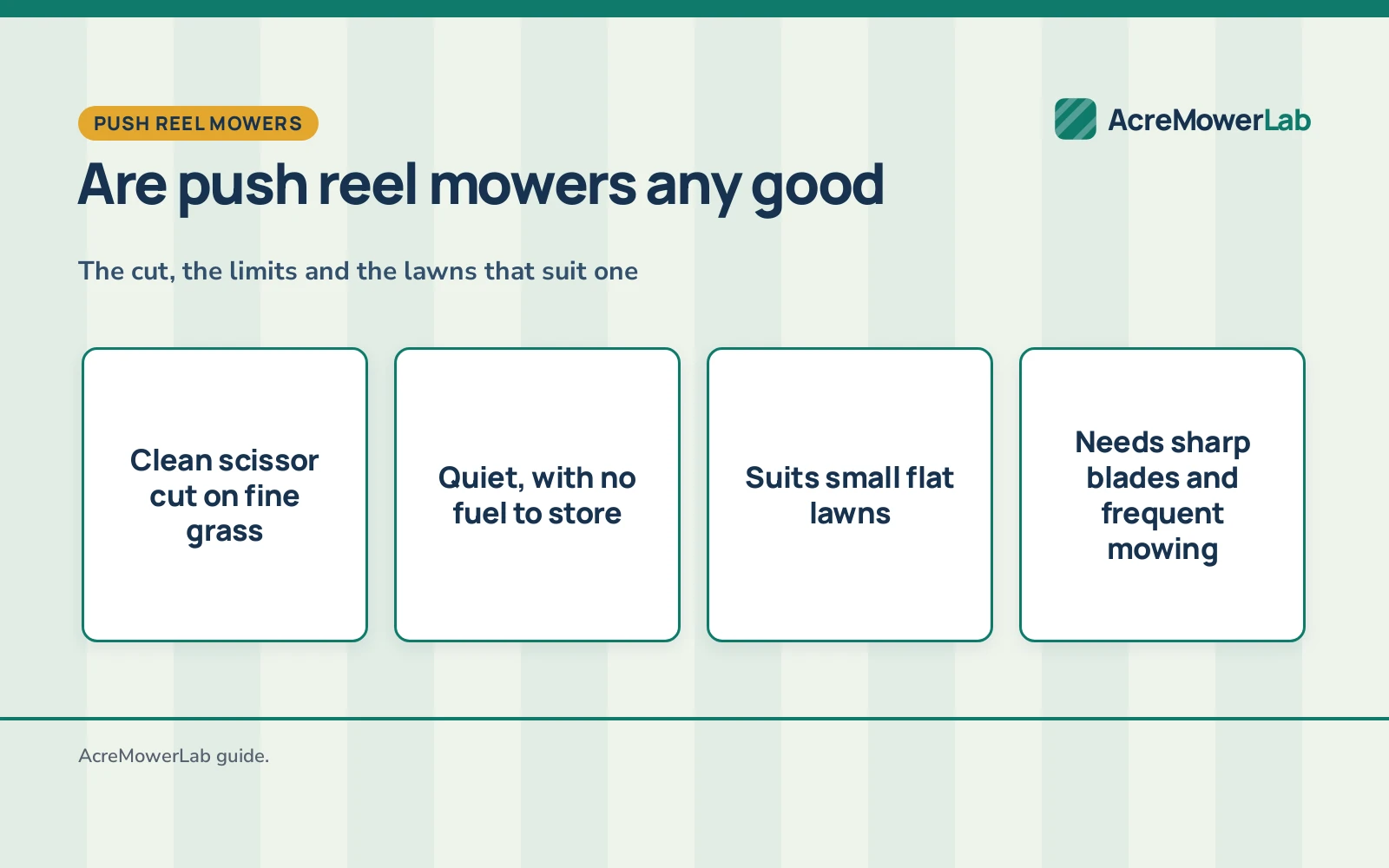
Manual reel mowers
A manual reel mower has no engine at all: your push turns a reel of blades that cuts the grass like scissors. It is quiet, light and simple, with nothing to fuel or charge, and it suits a small flat lawn that gets cut often. A reel mower needs short grass to cut cleanly, so it is a poor fit for a lawn left to grow tall, and it struggles on rough or bumpy ground where the reel cannot stay level. Keep the blades sharp and the reel adjusted to the manual, and see our manual walk-behind reel lawn mower guide for the details.
Deck width, drive and cutting height
Deck width sets how much grass each pass cuts. The gas listing cited above states a 20-inch deck, and its maker notes that a wider deck takes fewer passes than a narrower one. Drive matters too: a self-propelled model pulls itself along, while a mower you push by hand relies on you, so think about slopes and the weight you are willing to push. The same listing states a weight of 43.4 pounds and dimensions of 27.2 inches by 22.2 inches by 14.2 inches, which helps when you plan storage space. Cutting height shapes the finish: the listing states 5 height settings from 1.25 to 3.75 inches, so you can raise the deck for tall grass and lower it for a shorter cut. For mowers with wheels that adjust to uneven ground, see our push lawn mower adjustable wheels picks.
Slopes and rough ground
Slopes decide a lot about which push mower fits. The gas listing cited above rates its mower for gentle slopes up to 15 degrees, and that rating belongs to that mower alone, so check the manual of any mower you buy for its own limit. On rough ground, larger wheels roll over bumps and ruts more easily. The listing states 7-inch wheels front and rear and notes they help on rugged terrain and gentle slopes. Mow across a slope rather than up and down it when the manual allows, and never mow a slope that feels unsafe underfoot. For help judging your ground, see our lawn mower tire for traction picks.
Safety
Wear eye and hearing protection and sturdy shoes. Clear sticks, stones and other debris before you mow, and keep children, pets and bystanders away from the work area. Refuel only with the engine off and cool, and never reach under the deck while the blade can still turn. On slopes, follow your mower’s maximum slope rating, and do not mow wet grass on a hill.
FAQ: mowing large lots
What is the best type of push mower for a small yard?
A small flat yard suits a battery mower, a corded-electric mower or a reel mower, since none of them needs fuel and all of them are quiet enough for close neighbours. A reel mower needs short grass and regular cuts, while a battery or corded mower handles taller grass more easily. Pick the kind whose limits match your yard, not the one with the longest feature list.
Are gas push mowers better than battery push mowers?
Gas mowers suit thick grass and rough ground, since the engine keeps cutting through thick patches. Battery mowers suit quieter mowing with no fuel to store and less upkeep. Neither kind is better in every yard, so match the power to your grass and ground.
Can a push mower handle a slope?
It depends on the mower and the slope. The gas listing cited in this guide rates its mower for gentle slopes up to 15 degrees, and that rating belongs to that mower alone. Check the manual for the limit on any mower you buy, and never mow a slope that feels unsafe underfoot.
What deck size should a push mower have?
A wider deck cuts more grass per pass, so it finishes a lawn in fewer passes. The gas listing in this guide states a 20-inch deck and a 144cc engine. Match the deck to your yard: a wide deck saves passes on open ground, while a narrower deck turns more easily around beds and trees.
Do reel mowers work on tall grass?
No, not well. A reel mower cuts cleanly when the grass is short and the lawn is cut often, and it struggles when the grass grows tall or the ground turns rough. If your lawn goes uncut for long stretches, a gas or battery mower handles the taller grass better.