Best Brand for Pressure Washer (2026)
A practical guide to choosing the best brand for pressure washer on acreage, comparing pump durability, engine pairings, flow ratings and heavy-duty carts.

On this page
Top picks at a glance
As an Amazon Associate I earn from qualifying purchases.
- 1
 JANZ 24 in Stainless Steel Pressure Washer Surface Cleaner9.8/10View on Amazon
- 2
 JANZ 30 in Stainless Steel Pressure Washer Surface Cleaner9.7/10View on Amazon
- 3
 PowerSmart Gas Pressure Washer9.6/10View on Amazon
Maintaining a rural property with gravel driveways, outbuildings, and farm implements requires machinery that handles continuous mud and grit. On acreage, identifying the best brand for pressure washer comes down to commercial pump and engine engineering rather than exterior styling. Manufacturers like SIMPSON pair a Honda GX270 engine with an industrial triplex plunger pump to deliver 4000 PSI at 3.5 GPM for tractors and barns, while residential lines use maintenance-free axial cam pumps for washing vehicles and siding. This guide walks through pump mechanics, engines, flow ratings, and frame builds for your land.
AcreMowerLab earns a commission when you shop through links here. It never changes your price. Affiliate disclosure.
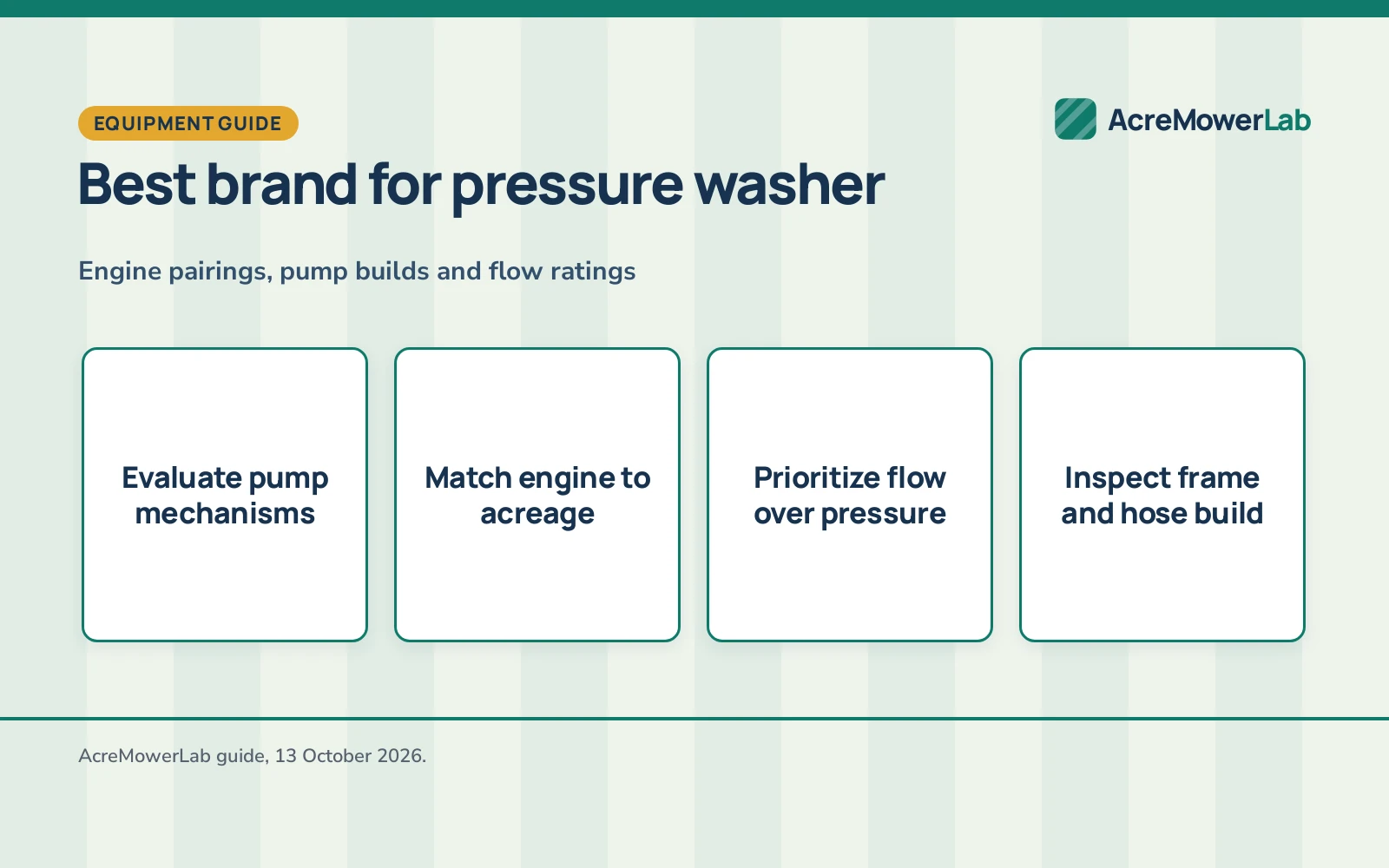
Best brand for pressure washer: evaluate pump design
| Equipment Class | Target Workload | Pump and Drive Configuration |
|---|---|---|
| Residential Gas | Vehicles, decking, siding, light property washdowns | Axial cam pump, sealed maintenance-free design |
| Commercial Gas | Barns, farm implements, heavy mud, livestock stalls | Triplex plunger pump with rebuildable valves |
| Corded Electric | Indoor workshops, garage detailing, light outdoor rinsing | Sealed electric motor eliminating exhaust fumes and oil changes |
The pump separates consumer machines from commercial equipment. Residential models feature an axial cam pump where a swash plate pushes pistons. These factory-sealed units require no oil changes, though worn assemblies must be replaced entirely. For homeowner tasks like rinsing a mower deck, an axial pump provides dependable service. For example, SIMPSON builds the CM61083 with an axial cam pump delivering 3400 PSI and 2.5 GPM powered by a 208 cc CRX engine, backed by a 2 year engine warranty and a 1 year pump warranty.
For properties where cleaning involves mud and multi-hour jobs on livestock trailers or tractors, a triplex plunger pump is essential. Triplex pumps use a crankshaft to drive three plungers, running cooler with rebuildable brass manifolds and serviceable seals. SIMPSON packages an industrial triplex plunger pump on the PS60869, generating 4000 PSI at 3.5 GPM. To see how pump designs fit different tasks, read our guide to pressure washer types.
Step 2: match engine reliability to your acreage
A commercial pump requires an engine that sustains steady torque under load. On acreage, gas engines dominate because cleaning tasks occur far from outlets. Commercial overhead-valve engines feature cast-iron sleeves and dual air filters to protect assemblies in dusty rural conditions.
Commercial Honda GX engines set the benchmark for durability. On the PS60869, SIMPSON pairs its triplex pump with a Honda GX270 engine featuring low-oil shutdown. Other brands configure heavy displacement engines: TechSweepPro equips a 420cc 4-cycle engine generating 15 hp with electric and recoil start, IvyBess utilizes a 212cc 4-stroke engine delivering 7 hp on its 4200 PSI model, and VEVOR builds a unit with a 15 hp rating. To select a dedicated rig for outbuildings, consult our guide to the best commercial grade pressure washer models.
Step 3: balance water flow against pressure ratings
While pressure ratings in pounds per square inch (PSI) measure stripping force, water flow in gallons per minute (GPM) determines wash speed by flushing loosened dirt away.
On rural properties, high flow is critical. Rinsing a muddy tractor with low flow swirls dirt without clearing it. A machine delivering 4000 PSI and 3.5 GPM, like the SIMPSON PS60869, cleans faster than a 3400 PSI model flowing 2.5 GPM like the SIMPSON CM61083. Higher-output units move more volume: IvyBess lists 4200 PSI at 4.0 GPM, and TechSweepPro offers 4400 PSI at 4.5 GPM. To pick the right pressure without gouging wood or siding, review what PSI pressure washer do I need.
Step 4: inspect chassis and cart mobility
Hauling a pressure washer across acreage demands a welded steel cart with powder coating to withstand mud, moisture, and detergents. Small plastic wheels sink into soft turf or gravel.
Pneumatic and flat-free tires handle uneven ground. SIMPSON outfits the CM61083 with 10″ premium pneumatic tires on a 64 lb frame measuring 37″ L x 30″ W x 21″ H. The commercial SIMPSON PS60869 weighs 120 pounds on 13-inch premium pneumatic tires with a 38″ L x 23.5″ W x 29″ H frame. Other carts use flat-free tires: TechSweepPro lists 10″ never-flat tires on a 100-pound cart measuring 28″ L x 23″ W x 24″ H, VEVOR mounts two 10-inch wheels on a 137-pound chassis, and IvyBess uses 10-inch wheels on a 66-pound frame. For tidy hose management around outbuildings, explore our best pressure washer hose reel reviews.
Step 5: select spray nozzles and wand connections
Commercial brands use standard 1/4″ quick-connect couplers at the wand tip with threaded M22 or 3/8-inch fittings at the pump and gun.
Quick-connect nozzles tailor the spray pattern to specific tasks:
- 0° red tip: Pinpoint jet for reaching high spots and blasting hard-caked mud from tractor treads.
- 15° yellow tip: Narrow chisel spray for stripping paint, peeling moss, and cleaning concrete.
- 25° green tip: Medium fan for washing equipment decks, utility trailers, and fencing.
- 40° white tip: Wide fan for siding, glass, screens, and vehicle bodywork.
- 60° tip: Broad spray for gentle rinsing on painted surfaces and patio furniture.
- Soap nozzle: Low-pressure tip that siphons detergent from tanks to apply foam.
Hoses and wands also vary: SIMPSON includes a 25′ MorFlex hose on the CM61083 and a 3/8-inch x 50-Foot Monster hose on the PS60869, paired with a 16″ wand or 31-inch steel lance. For broad driveways and barn pads, connect a best pressure washer surface cleaner.
Set up dedicated property wash stations
Verify your water supply volume before running high-flow equipment. Spigots must deliver enough flow to meet or exceed pump displacement, whether 2.5 GPM on residential units or 3.5 GPM and 4.5 GPM on commercial rigs, preventing cavitation that damages valves and plungers.
Set up a dedicated wash area on concrete or packed gravel sloping toward drainage. Avoid washing heavy equipment on bare turf where runoff causes deep ruts.
Electric versus gas commercial equipment
Corded electric washers provide quiet, fume-free operation with zero oil changes, making them useful inside barns or workshops. However, outlet cords and household circuit limits restrict their flow rates.
Gas machines deliver mobility across remote pastures and machinery sheds. When selecting gas equipment, check standards: IvyBess models list CARB, EPA, and ETL compliance for emissions and safety, while SIMPSON models offer 49-State compliance. For work beyond electrical outlets, explore our best gas pressure washer guide.
Plan seasonal cleanup across property zones
Zoning property chores prevents dirty wash runoff from contaminating clean surfaces:
- Field machinery zone: Clean tractors, rotary cutters, and mower decks before debris dries.
- Outbuilding zone: Wash livestock pens and workshop aprons from high points down to drains.
- Driveway and entry zone: Clear moss, oil, and grime from concrete and approach gates.
Pump maintenance and freeze protection
Pump failure on acreage typically stems from bypass overheating or freeze damage. Leaving the engine idling with the spray trigger released traps water in a closed loop where friction creates heat. SIMPSON equips pumps with a thermal relief valve to vent hot water and draw cool replacement water.
Before winter, purge all moisture from the pump, hose, and lance to prevent expanding ice from cracking brass manifolds. Circulate pump protector antifreeze through the inlet before storage to lubricate seals, following our pressure washer maintenance guide.
Safety
High-pressure equipment requires strict adherence to safety procedures:
- Never point the wand or nozzle at people or animals; high-velocity jets cause severe puncture injuries.
- Operate gas pressure washers strictly outdoors in open air; never run engines in enclosed barns or garages due to carbon monoxide fumes.
- Turn off the engine and let it cool completely before refueling.
- Wear eye protection, hearing protection, and sturdy work footwear.
- Relieve residual line pressure by squeezing the trigger after shutting off the engine and spigot before disconnecting hoses.
- Keep children and pets well away from the work area.
FAQ: mowing large lots
What is the best pressure washer?
The best pressure washer for acreage depends on your workload: commercial gas models with triplex plunger pumps handle tractors and barns, while residential axial cam units manage deck and vehicle washing.
What is a commercial grade pressure washer?
A commercial grade pressure washer features a crankshaft-driven triplex pump with rebuildable valves, a commercial engine like the Honda GX series, a welded steel cart, and steel-braided hoses built for daily chores.
What is a commercial pressure washer?
A commercial pressure washer is a heavy-duty machine engineered for sustained agricultural, contractor, and facility cleaning, unlike consumer units built for occasional light washdowns.
What is the difference between axial cam and triplex plunger pumps?
Axial cam pumps use a swash plate in a sealed, maintenance-free layout for residential tasks. Triplex plunger pumps use a crankshaft driving three plungers, running cooler with rebuildable valves for commercial duty.
Why is water flow rating more critical than pressure?
Pressure breaks grime loose, but water flow flushes debris away. High flow stops dirt from settling back onto surfaces, saving time on driveways and muddy implements.
More mowing guides
- Best Commercial Grade Pressure Washer (2026)
- Pressure Washer Types: Complete Guide for Acreage Owners
- Best Gas Pressure Washer: 3 Picks for Farm and Acreage Cleanup
- Pressure Washer Maintenance: Step-by-Step Care Guide
Explore our complete pressure washer guides to compare equipment by pump mechanism, engine platform, and cleaning capabilities.