Bow Saw Uses: Tasks for Pruning and Cutting
A bow saw handles pruning, trail clearing and firewood cutting on acreage, and a folding model packs down for storage between jobs.

On this page
Top picks at a glance
As an Amazon Associate I earn from qualifying purchases.
- 1
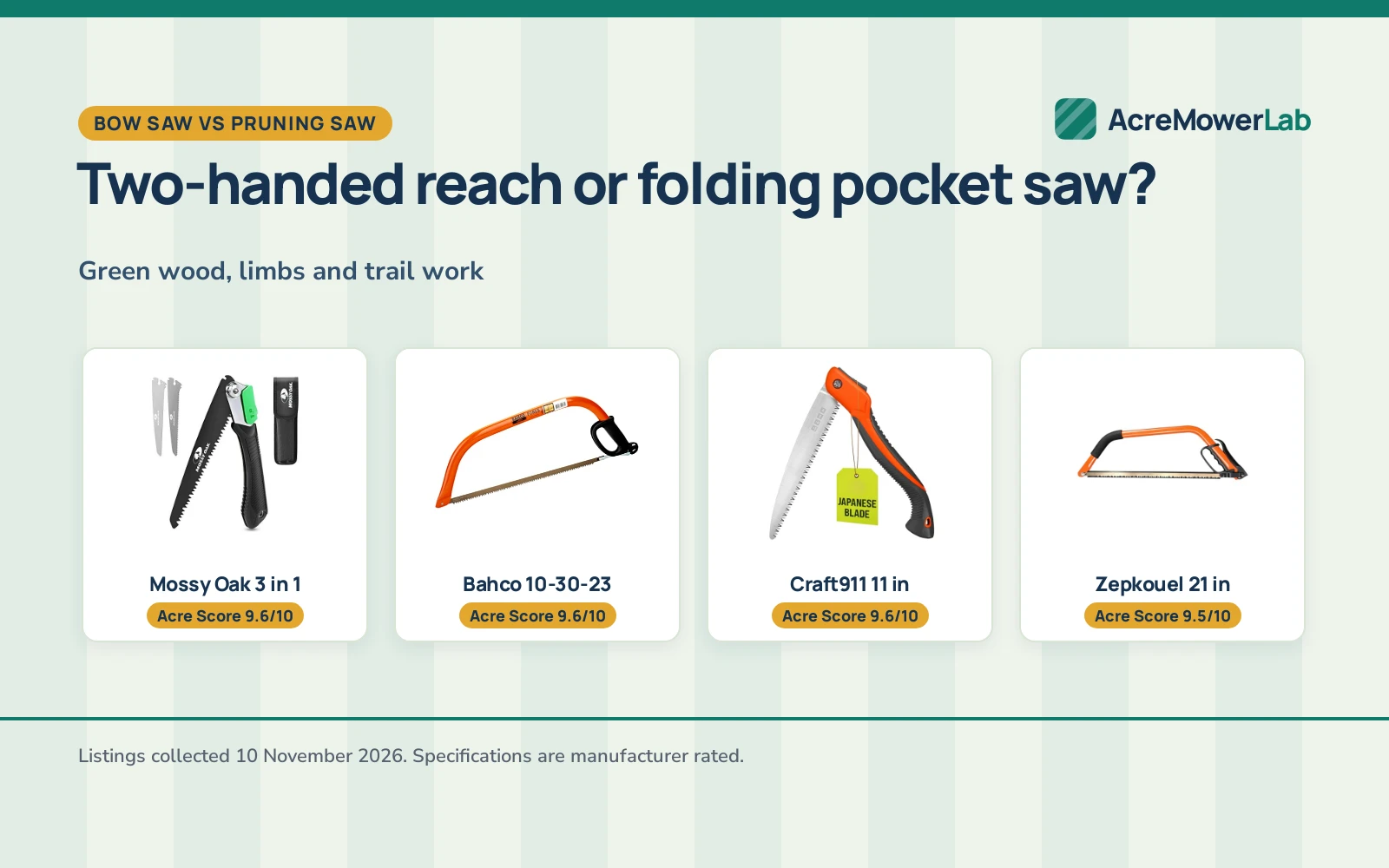
 Bahco 10-30-23 30-Inch Ergo Bow Saw for Green Wood9.6/10View on Amazon
- 2
 Zepkouel 21 Inch Heavy Duty Bow Saw for Green Wood9.5/10View on Amazon
- 3
 Mossy Oak 3 in 1 Folding Saw9.6/10View on Amazon
On acreage, the cutting jobs pile up between the lawn and the tree line: a dead limb over the drive, saplings closing in on a trail, a fallen branch that needs cutting to length. A bow saw fits the middle ground where shears stop short and a chainsaw is more tool than the job needs. Bow saw uses center on pruning limbs, clearing trails and brush, and cutting firewood and camp wood, and a folding bow saw folds flat for storage and carry. This guide walks through each use, how to use a bow saw with steady strokes, and how to pick a blade length that fits the limbs on your property.
AcreMowerLab earns a commission when you shop through links here. It never changes your price. Affiliate disclosure.
Bow saw uses: pruning, clearing and cutting
A bow saw is a hand saw with a toothed blade held in a frame, and a folding bow saw adds hinges that let the blade fold into the frame for carry. The frame holds the blade in tension, so the work is steady arm work rather than engine work. The table below sets out the main uses and what each one asks of the saw.
| Use | What it covers | Limit |
|---|---|---|
| Pruning limbs | Dead, damaged and crossing limbs on yard and orchard trees | Limbs overhead or near power lines call for a pole saw or a pro |
| Clearing trails | Saplings, low limbs and brush along paths and fence lines | Thick stands take many passes and a lot of arm work |
| Cutting firewood | Limbs and small logs cut to length for the stove or the fire pit | Large rounds and whole trunks need a chainsaw |
| Camp wood | Poles, kindling and small logs at the campsite | A fixed bow saw packs poorly; a folding model fits the kit |
Pruning is the use most acreage owners reach for first. The best hand pruning saw roundup covers fixed-blade options, and bow saw vs pruning saw explains where each one earns its keep.
How to use a bow saw
Set the limb so it stays still while you cut. Brace it against the ground or a stump where you can, or hold it with a gloved hand well clear of the blade path. Start the cut with short, light strokes to open a groove, then settle into long, steady strokes and let the teeth do the cutting. Forcing the saw binds the cut, so keep the pressure light and the stroke even.
Keep the blade straight in the cut and the frame square to the limb. A blade that twists binds fast, and forcing it only makes the bind worse, so back the blade out and start again. When the limb is heavy, cut from below first with a shallow undercut, then finish from above so the limb drops cleanly instead of tearing bark. Work at a comfortable height, keep your footing solid, and fold and lock the blade before you carry the saw or put it away.
Pick a blade length that fits the job
Blade length sets the stroke length and the size of limb the saw handles with ease. A longer blade covers more wood with each pull, while a shorter blade packs smaller and weighs less. The figures below come from the makers’ listings.
Agawa lists the BOREAL21 folding saw with a 21-inch blade and a weight of 18oz, and the BOREAL24 with a 24-inch blade and a weight of 21oz. Both fold into their frames, and the maker lists automatic blade tensioning with no loose parts. The 24-inch blade gives a longer stroke for bigger limbs, while the 21-inch blade suits pruning and trail work where the saw rides in a pack.
For tight spots where a bow frame would catch on branches, folding pruning saws cover the small end. Gerber lists the Freescape camp saw, a folding hand saw with a 12-inch blade and a weight of 1.0 pounds that folds flat while staying assembled. Bahco lists the Laplander folding saw with a 7-1/2 inch blade, 7 TPI, a 9-inch handle and a weight of 0.47 pounds. The short blades suit tight spots and light pruning.
Pruning with a bow saw
Prune dead wood first, then limbs that cross or rub, then limbs that block a path, a drive or a roofline. Cut just outside the branch collar, the raised ring where the limb meets the trunk, and leave the collar in place so the tree can seal the cut. A clean cut seals better than a torn one, so keep the blade sharp and the stroke steady.
Shears and loppers handle small limbs with less effort, so reach for the bow saw when the limb is past what they cut cleanly. The types of pruning shears guide covers the small end, and the best tree loppers picks cover the middle ground. For limbs over a roof or a drive, or near a power line, leave the work to a pole saw or a professional.
Clearing trails and brush
A folding bow saw earns its keep on trails because it rides in a pack and opens in seconds. Agawa lists the BOREAL frame with a 3-hinged design that unfolds and snaps into position, and the teeth fold into the frame when the saw is closed. That matters on a narrow trail, where an open blade snags clothing and pack straps.
Walk the trail first and mark the limbs and saplings that block the path. Cut saplings low, near the ground, so no stub trips the next walker, and cut low limbs just outside the branch collar so the trail stays open at head height. Haul the cut brush off the path as you go. For limbs above reach, a pole saw beats a bow saw; see the best rated pole saw picks for high branches.
Cutting firewood and camp wood
A bow saw cuts limbs and small logs to length without fuel, noise or a pull cord. Set the log on a sawbuck or across two stumps so the cut end hangs free, and cut just past the support so the piece drops clear. Keep the blade out of soil and stones, which dull the teeth fast.
Agawa ships its Tripper Kit with two blades: an All-Purpose blade for dry, hard and soft woods, and an Aggressive blade for fast, aggressive cutting. Swap to the Aggressive blade when you want faster, more aggressive cutting, and keep the All-Purpose blade for dry, hard and soft woods and mixed work. At camp, the same saw cuts poles for a shelter, kindling for the fire, and small logs for the evening burn.
Care and storage
Wipe the blade clean after use and let it dry before folding it away. The makers list rust-protective coatings on their blades, but a dry blade still lasts longer than a damp one. Store the saw folded and locked, with the teeth inside the frame, in a dry shed or garage. Agawa lists its BOREAL blades as simple to replace with no special tools required, so keep a spare blade with the saw if the model takes one.
Safety
Wear eye protection and work gloves, and wear sturdy shoes with a good grip. Keep the free hand clear of the blade path, and never cut toward your body or toward anyone standing nearby. Keep children and pets out of the work area while you cut. Check the limb above you before you cut, stand clear of the drop zone when a limb falls, and fold and lock the blade before you carry the saw or hand it to someone else. For limbs near power lines, or limbs you cannot reach with both feet on the ground, use a pole saw or call a professional.
FAQ: mowing large lots
What can you cut with a bow saw?
Pruning limbs, trail brush, saplings, firewood and camp wood. The makers list green and dry wood as the main work, and Agawa lists its All-Purpose blade for dry, hard and soft woods.
How do you use a bow saw?
Hold the work steady, open a groove with short strokes, then cut with long, steady strokes and light pressure. Keep the blade straight, and undercut heavy limbs before finishing the cut from above.
What size bow saw do I need for pruning?
A 21-inch folding saw covers most pruning on acreage, and Agawa lists the BOREAL21 at 18oz for carry. A 24-inch blade gives a longer stroke for bigger limbs, while a 12-inch or 7-1/2 inch blade suits tight spots and a pack.
Can a bow saw cut green wood?
Yes. Agawa lists its All-Purpose blade for dry, hard and soft woods, and folding pruning saws such as the Bahco Laplander (on Amazon) are listed for green and dry wood. Green limbs cut cleanly with a sharp blade, so keep the teeth clear of sap and sawdust as you work.
Should I use a bow saw or loppers for a limb?
Use loppers for small limbs they cut cleanly, and a bow saw for limbs past that size. The pruning saw vs loppers guide compares the two, and bow saw vs pruning saw covers the saw side in more depth.
More mowing guides
- Bow Saw vs Pruning Saw: Which One Should You Buy?
- Best Hand Pruning Saw (2026): 5 Picks for Tree Care
- Best Pruning Saw for Tree Limbs (2026): 5 Picks by Blade
- Best Tree Loppers (2026): 5 Picks Compared
Browse the trimmer and blower reviews for the rest of the cutting tools that keep acreage in shape.