Box Blade Uses for Tractors and Lawns
Box blade uses for tractors and lawns: grading, leveling, back-filling and digging, plus how to set scarifier shanks and clear the ground first.

On this page
Top picks at a glance
As an Amazon Associate I earn from qualifying purchases.
- 1
 Vlaeng 18 in Box Blade Shank Set, 5 Shanks with 7 Ripper Teeth9.6/10View on Amazon
- 2
 Tolpassa 18 in Box Blade Shank Set, 5 Shanks with 7 Ripper Teeth9.6/10View on Amazon
A box blade turns a tractor into a grading tool, and box blade uses cover the ground work a property needs after the mowing is done: leveling a rutted drive, smoothing a lawn area, back-filling a low spot and breaking up packed soil before seed. A scarifier shank set does the digging part, with teeth that bite into the ground while the blade carries the loosened soil. This guide walks through the jobs a box blade handles, how to set the shanks, and what to clear before the first pass.
AcreMowerLab earns a commission when you shop through links here. It never changes your price. Affiliate disclosure.
Vlaeng 18 in Box Blade Shank Set, 5 Shanks with 7 Ripper Teeth
Five 18-inch alloy steel box blade shanks with 7 ripper teeth and 4-position adjustment holes for grading and digging in soil.
Who it's for: landscapers, farmers and homeowners who want to replace worn shanks for grading, leveling and back-filling in soil.
Who should skip it: anyone working ground with roots or rocks still in it, or anyone who wants a stated warranty before ordering.
The maker lists 5 shanks at 18 inches high and 8 inches wide, with 7 ripper teeth 4 inches long and 2 inches high, and 4-position adjustment holes at a 1.6-inch interval and 0.7-inch diameter. Pins measure 0.62 inches in diameter and 4.13 inches long, and the maker says to verify whether the pin dimensions match your box blade. The shanks are premium alloy steel with black powder coating, and the maker says this set is only intended for soil work, not for cutting tree roots or rocks.
Pros
- 18-inch shanks with 4-position adjustment holes
- 7 replaceable ripper teeth that swap out by removing the bolts
- Pin diameter of 0.62 in and length of 4.13 in stated for fit checks
- Black powder coating for long service life and rust resistance
Cons
- No warranty term is stated
- Soil work only, it cannot cut tree roots or rocks
- Roots and hard rocks must be cleared from soil before use
- No weight is stated
Tolpassa 18 in Box Blade Shank Set, 5 Shanks with 7 Ripper Teeth
Five 18-inch steel box blade shanks with 7 ripper teeth and 4-position adjustment holes for grading, leveling and back-filling.
Who it's for: landscapers, farmers and homeowners who want replacement shanks for digging, plowing and grading.
Who should skip it: anyone who wants pin dimensions or a warranty term stated before ordering.
The maker lists 5 shanks at 18 inches high and 8 inches wide, with 7 replaceable tapered teeth and pins, and 4-position adjustment holes at a 1.57-inch interval and 0.67-inch diameter. The shanks are premium quality steel with a powder coating, and a complete set of mounting fittings is included. The maker gives two widths, 8 inches and 7 inches; check before ordering.
Pros
- 18-inch shanks with four-position adjustment holes
- 7 replaceable tapered teeth with pins
- Powder-coated steel for durability and rust resistance
- Complete set of mounting fittings included
Cons
- No warranty term is stated
- Pin diameter and length are not stated
- No weight is stated
- Mounting uses four-point holes, so it fits only frames with matching holes
Box blade uses: what the tool does
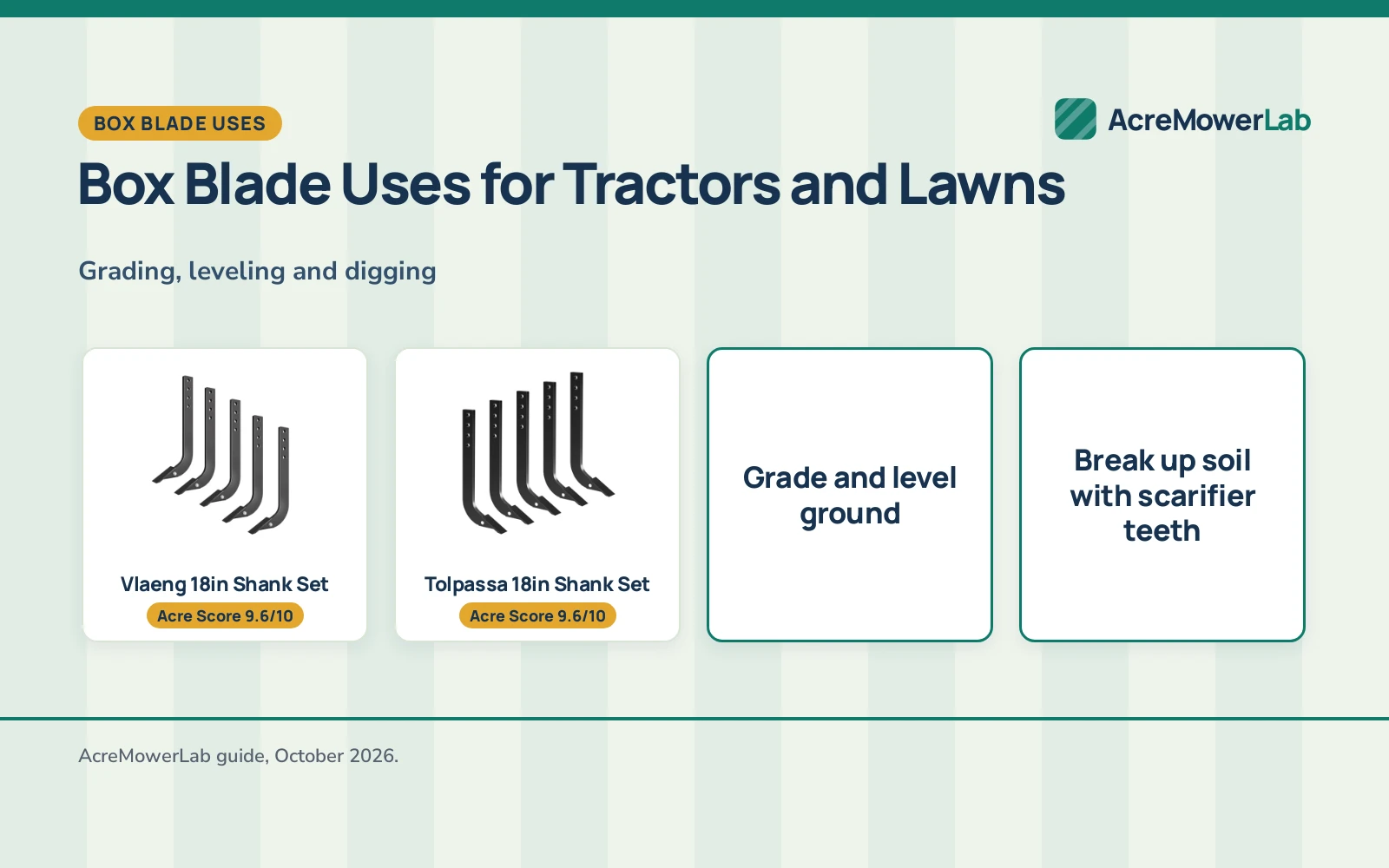
A box blade is a ground-engaging attachment for landscaping, land leveling, back-filling and grading, and the makers of both shank sets here list the same jobs: digging and plowing as well. Leveling means cutting down high spots and filling low ones so water drains off the surface instead of pooling. Back-filling means pushing loose soil into ruts, trenches and low spots left by tires or digging. Grading shapes a drive or a lawn area to a smooth, even surface. Digging and plowing break up packed soil so it can be leveled or seeded. Both sets here are made for landscapers, farmers and homeowners working soil, and both carry replaceable teeth so a worn tooth does not end the job. See our tow-behind attachments for the wider set of tractor tools.
Set the scarifier shanks
Each shank pins to the reinforced frame through four-position adjustment holes, so you set the working depth by choosing which hole the pin goes through. The Tolpassa set lists a hole interval of 1.57 inches and a hole diameter of 0.67 inches, while the Vlaeng set lists a hole interval of 1.6 inches and a hole diameter of 0.7 inches. The Vlaeng set also lists its pins at 0.62 inches in diameter and 4.13 inches long, and the maker says to verify whether the pin dimensions match your box blade. Check the hole spacing and the pin size on your own frame before you order, since a shank that does not pin to the frame cannot be mounted. On the Vlaeng set, teeth swap out by removing the bolts, so keep the pins and fittings that come in the box together.
Clear the ground first
Both shank sets are built for soil work, and the Vlaeng maker states the limit plainly: this replacement box blade is only intended for soil work, and it cannot cut tree roots or rocks. Clear tangled roots and hard rocks from the soil before operation to prevent shank deformation. Walk the ground first and pull out what the teeth cannot cut, then make the first pass shallow and check how the soil breaks. If the teeth hit something solid, stop and clear it rather than forcing the pass. A clean run keeps the teeth and the frame in shape for the next job.
The gear for the job
The shank sets below do the digging part of the jobs above: each set pins to a box blade frame and carries replaceable teeth for soil work.
Safety
Clear tangled roots and hard rocks from the soil before operation, as the maker states, to prevent shank deformation. Check that the pin dimensions match your box blade before mounting, and keep hands clear of the teeth while you fit the shanks. Wear eye protection and sturdy shoes, and keep children, pets and bystanders away from the work area. Follow your tractor manual for hitching and reversing with an attachment on the back.
FAQ: mowing large lots
What is a box blade used for?
Landscaping, land leveling, back-filling, grading, digging and plowing. A box blade levels high spots, fills low spots and ruts, and breaks up packed soil so a drive or lawn area can be smoothed and seeded.
Can a box blade cut through tree roots?
The Vlaeng maker says no for its set: this replacement box blade is only intended for soil work and cannot cut tree roots or rocks. Clear tangled roots and hard rocks from the soil before operation to prevent shank deformation.
How do I fit replacement shanks?
Match the holes and pins to your frame. The Tolpassa set lists a hole interval of 1.57 inches and a hole diameter of 0.67 inches, and the Vlaeng set lists a hole interval of 1.6 inches and a hole diameter of 0.7 inches, with pins 0.62 inches in diameter and 4.13 inches long. Verify the pin dimensions match your box blade before you order.
What size are these shank sets?
Both sets hold 5 shanks at 18 inches high and 8 inches wide, with 7 ripper teeth that measure 4 inches long and 2 inches high. Each shank has four-position adjustment holes that pin to the reinforced frame.
More mowing guides
- Tractor Bucket vs Box Blade: Which One Should You Buy?
- Drag Harrow vs Box Blade: Which One Should You Buy?
- Best Tow Behind Aerator Under $250 (2026): 5 Picks
- Landscape Rake vs Drag Harrow: Which One Should You Buy?
Use the tow-behind attachments hub to compare the other tractor tools for your property.