Edward Tools Hand Tiller Review: Pros, Cons and Who It Is For
A manual carbon steel hand tiller with a solid oak handle, reviewed from its listing: what it states, who it suits and what it leaves out.

On this page
Top picks at a glance
As an Amazon Associate I earn from qualifying purchases.
- 1
 Walensee Twist Tiller with Large Steel Claw9.6/10View on Amazon
- 2
 Garden Weasel Rotary Hand Cultivator Tiller9.6/10View on Amazon
- 3
 Walensee Rotary Cultivator 2-in-1 Hand Tiller and Action Hoe9.4/10View on Amazon
- 4
 Hand Tiller Garden ToolView on Amazon
- 5
 Garden Weasel Double-Sided Garden Cultivator/TillerView on Amazon
- 6
 BARAYSTUS Rotary Cultivator Garden ToolView on Amazon
- 7
 Garden Guru Hand Cultivator Rake Tiller ToolView on Amazon
- 8
 Garden Hand Tiller CultivatorView on Amazon
- 9
 GINMIC Hand Tiller Garden CultivatorView on Amazon
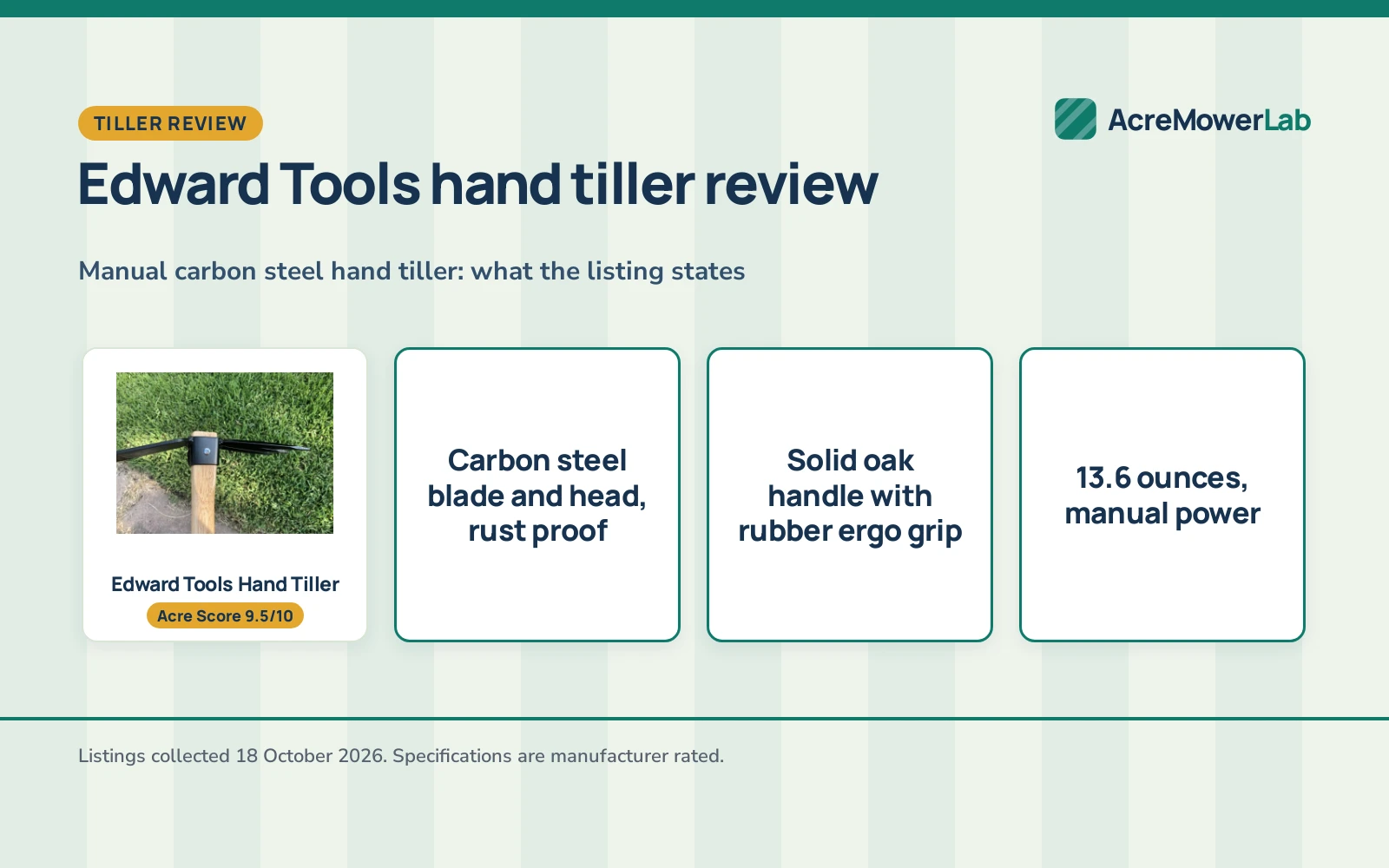
A small kitchen garden behind the house, flat beds of tomatoes and peppers, soil that packs down between plantings: that is the ground this edward tools hand tiller review is written for. In 1 line: a manual hand tool with a carbon steel blade and head, a solid oak handle and a rubber ergo grip, listed at 13.6 ounces for loosening soil, weeding and digging in flower and vegetable gardens. The listing is short on measurements, with no head width, tine count or working depth stated.
Other machines to compare
 Hand Tiller Garden ToolCheck price on Amazon
 Garden Weasel Double-Sided Garden Cultivator/TillerCheck price on Amazon
 BARAYSTUS Rotary Cultivator Garden ToolCheck price on Amazon
 Garden Guru Hand Cultivator Rake Tiller ToolCheck price on Amazon
 Garden Hand Tiller CultivatorCheck price on Amazon
 GINMIC Hand Tiller Garden CultivatorCheck price on Amazon
AcreMowerLab earns a commission when you shop through links here. It never changes your price. Affiliate disclosure.
This is a research-based review. We have not used this hand tiller. Every figure below comes from the Edward Tools Amazon listing, collected 18 October 2026. Where the listing does not state something, or contradicts itself, we say so.
Edward tools hand tiller review: what the listing states
| Spec | Edward Tools hand tiller (B01MTDMUCI) |
|---|---|
| Tool type | Hoe and cultivator hand tiller |
| Head | Carbon steel blade and head, stated for heavy duty use |
| Handle | Solid oak with rubber ergo grip |
| Weight | 13.6 ounces |
| Power | Manual |
| Color | Black |
| Model | 123ABC |
| Warranty | Not stated |
The listing describes a single tool under several names: hoe, cultivator and hand tiller. The bullets add the jobs: loosening soil, weeding and digging, in flower and vegetable gardens. The title adds rust proof. That is the whole of the stated spec; everything else a buyer might want, head width, tine shape, handle length, is absent.
Who the Edward Tools hand tiller is for
- Vegetable and flower gardeners who work established beds and want a hand tool for loosening soil and weeding between plants.
- Gardeners who want no engine: manual power means no fuel, no battery and nothing to charge.
- Anyone who values a light tool: 13.6 ounces is easy to carry to the far bed and hang back up after.
- Buyers who trust simple materials: carbon steel head, solid oak handle and rubber grip are all stated.
The tiller in detail
The head is the working end: carbon steel blade and head, which the listing says suits heavy duty use. The handle is solid oak, which the listing says adds strength and durability, wrapped in a rubber grip the listing calls ergonomic and grippy. The title says rust proof. At 13.6 ounces it is light enough to carry to the far bed and hang back up after. Power source and operation mode are both manual: you supply the force, and there is nothing to refuel or recharge. The model number is 123ABC and the color is black. The listing states 1 count in the box, which reads as a single tool.
What it does well
Stated materials for the job
Carbon steel for the blade and head, solid oak for the handle: the listing names materials that suit digging and prying in garden soil, and the title adds rust proof, which matters for a tool that lives in damp soil.
Grip and handle
The rubber ergo grip is the comfort feature, and solid oak is the strength claim. For repeated weeding passes, a grip that does not slip matters more than it sounds.
Light and simple
At 13.6 ounces with manual power, there is no fuel to buy, no battery to charge and no engine to maintain. It hangs on a shed hook and is ready whenever the weeds are.
Clear intended use
The listing names its ground plainly: flower and vegetable gardens, for loosening soil, weeding and digging. A buyer with that ground knows immediately this is their tool type.
Limitations to know before you buy
No dimensions at all
The listing gives no head width, no tine length, no handle length and no overall size. You cannot tell from the listing whether it suits narrow rows or wide beds; our tiller sizes guide explains what those numbers mean when a listing does state them.
No working depth or tine count
A cultivator’s depth and tine count decide what it can break up. Neither is stated here, so deep or compacted ground is a guess. See how deep a tiller digs for what to ask.
Hoe, cultivator, hand tiller: which is it?
The title uses 3 names without showing the head shapes. A hoe scrapes, a cultivator digs: the listing never says which edge you get, so the exact working action is unclear.
No warranty term
The spec table has no warranty line, so no term can be quoted. With no term stated, it earns no warranty points in our Acre Score.
Buying advice: reading the listing before you commit
Carbon steel blade, rust proof claim
The listing names a carbon steel blade and head for heavy duty use and calls the tool rust proof in its title. Carbon steel takes and holds an edge well, which matters for a weeding and digging blade that meets roots and stones. The rust proof claim is the maker’s word, not an independent measurement; the listing gives no coating or treatment detail beyond it, so the practical move is to knock soil off after use and hang the tool dry rather than leaning it against a damp shed wall. The solid oak handle is there for strength and durability, and the ergonomic rubber grip is the part your hand actually meets.
What 13.6 ounces means in the hand
The spec table lists 13.6 ounces, which is light for a garden tool and a genuine advantage on long weeding sessions. But weight is not the same as leverage: a hand tiller is driven by your arm and shoulder, so the work still lands on you even though the tool is light. That trade is the point of the tool, and it is why the article steers large plots toward a powered machine. For a few raised beds or a flower border, 13.6 ounces is plenty easy to carry out, use for an hour and hang back up.
Manual power: the real cost is your time
The listing states manual power source and manual operation mode, so there is nothing to fuel, charge or plug in. That is a feature, not just a saving: the tool is ready whenever you are, with no battery to find or cord to drag. The cost is pace. If your beds take more than a casual hour of hand work each week, the math shifts toward a powered cultivator; if they take less, this tool’s simplicity wins. Match the tool to the routine you actually keep, not the garden you imagine.
Gaps to accept before buying
The listing states no working depth, no tine count and no head width, so you cannot compare this tiller against powered machines on paper; buy it for the jobs the listing names, loosening soil, weeding and digging in flower and vegetable gardens, and accept the unknowns. The spec table also carries no warranty line, so there is no term to quote. If a stated warranty matters to you, that alone is a reason to pick a different tool.
Who should skip it
- Gardeners breaking new or compacted ground who need a stated working depth first.
- Anyone who wants powered cultivation; this is manual only. Our cordless cultivator picks cover powered options.
- Buyers who need a warranty term in writing before they buy.
- Anyone shopping by measurements: with no dimensions stated, fit is unknowable from this listing.
Matching It to Your Property
- Flat garden beds: the listing names flower and vegetable gardens, which is where a hand tiller belongs.
- Small plots: manual power suits ground you can work on foot, with no fuel or battery to manage.
- Storage: at 13.6 ounces it hangs on a shed hook; nothing to winterize.
- Around established plants: a hand tool works between rows where a powered tiller may not fit.
Lawn size, deck width and speed in; minutes per mow out. Or work backward from the time you want to spend.
Buried utility lines are a real risk: in the US, call 811 a few days before you dig or till new ground. Wear eye protection and sturdy boots, keep feet and hands away from the tines, and start on clear, rock-free soil. Refuel only with the engine off and cool. Read our Safety Disclaimer.
FAQ: mowing large lots
What does the Edward Tools hand tiller weigh?
The spec table lists 13.6 ounces.
Does it need fuel or batteries?
No. The listing states manual power source and manual operation mode, so there is nothing to fuel or charge.
What jobs does the listing name?
Loosening soil, weeding and digging, in flower and vegetable gardens.
Does the listing state a warranty?
No. The spec table carries no warranty line, so no term can be quoted.
How deep does it dig?
Not stated. The listing gives no working depth, tine count or head width. Our guide to tiller digging depth explains the numbers to look for.
Alternatives
If you want powered cultivation instead of manual work, our cordless cultivator picks cover standalone battery options. For bigger breaking jobs see the best small tiller cultivators and the top rated garden tillers and cultivators. To learn the tool types, read tiller types and uses.