How to Operate a Stand On Mower: Step-by-Step Field Guide
A practical step-by-step guide to operating a stand-on zero-turn mower safely, covering platform posture, twin-lever steering, slopes and routine deck upkeep.

On this page
Top picks at a glance
As an Amazon Associate I earn from qualifying purchases.
- 1
 Husqvarna MZ619.7/10View on Amazon
- 2
 EGO Power+ Z6 Zero Turn Electric Riding Lawn Mower9.6/10View on Amazon
- 3
 EGO Power+ Z6 Zero Turn Electric Riding Lawn Mower9.6/10View on Amazon
- 4
 Commercial Lawn Mower Sulky Fits Metro Viking Turf TracerView on Amazon
- 5
 View on Amazon
- 6
 Mammotion LUBA 3 AWD 3000 Robot Lawn Mower with Cleaning StandView on Amazon
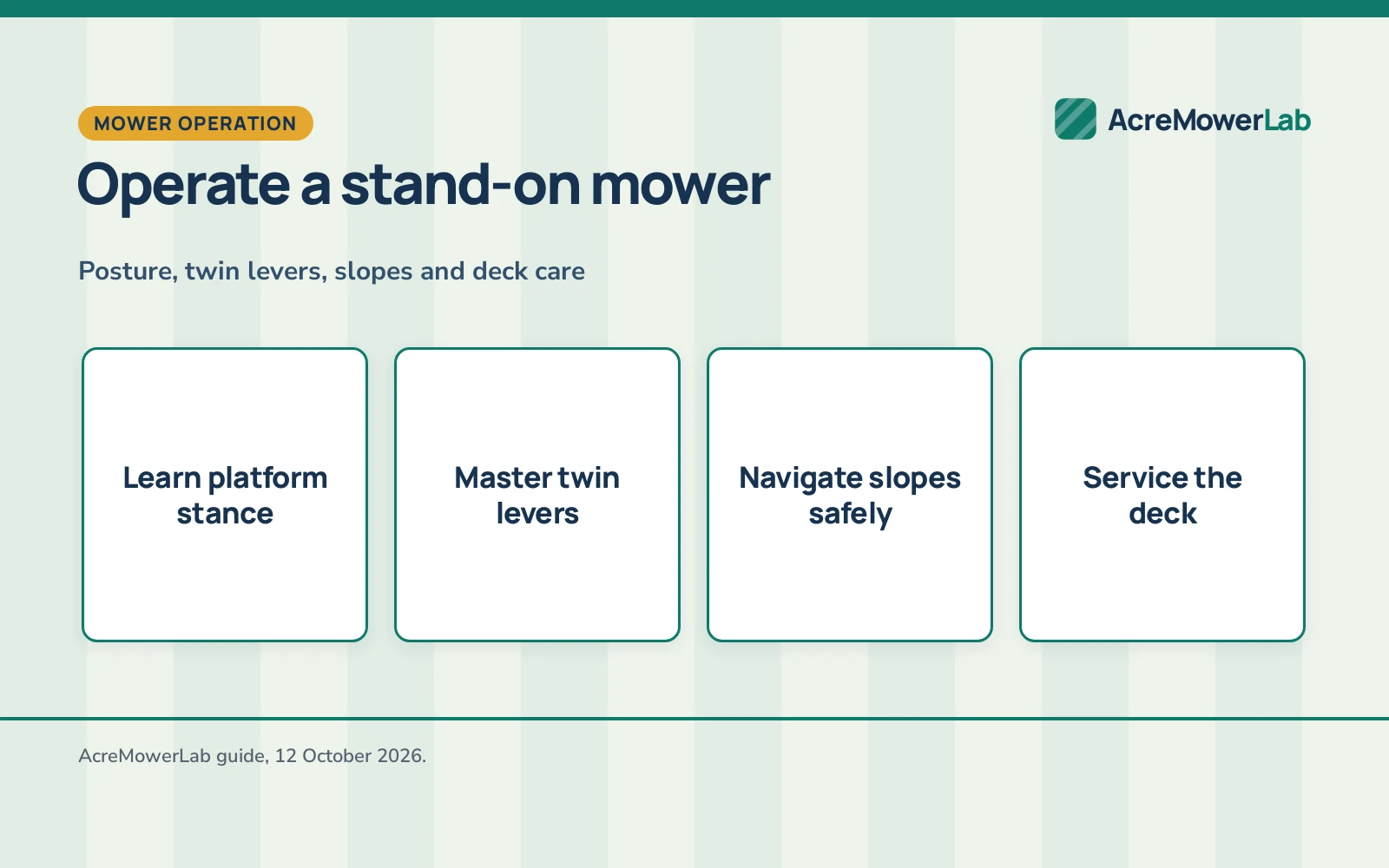
Maintaining expansive acreage with trees, fence lines, and rolling turf demands agility that seated tractors cannot always provide. To learn how to operate a stand on mower, stand centered on the operator platform with knees flexed, release the parking brake, and steer using the twin control levers with light, progressive movements. Pushing both levers forward moves the machine ahead, pulling them back slows or reverses motion, and varying pressure between levers pivots the mower. Operating safely requires keeping your weight balanced, traveling at a controlled pace around obstacles, and respecting slope limits across your property.
Other machines to compare
 Commercial Lawn Mower Sulky Fits Metro Viking Turf TracerCheck price on Amazon
 Mammotion LUBA 3 AWD 3000 Robot Lawn Mower with Cleaning StandCheck price on Amazon
AcreMowerLab earns a commission when you shop through links here. It never changes your price. Affiliate disclosure.
How to operate a stand on mower: core controls and startup
A stand-on commercial mower places the operator on a suspended platform between the drive wheels. This position provides clear visibility over the cutting deck, letting you spot ground hazards and fence posts quickly.
Familiarize yourself with the primary controls on the upper console before starting. Twin steering levers govern speed and direction. A throttle lever regulates engine speed, while an electric PTO knob controls blade engagement. A mechanical parking brake locks the drive wheels during startup and parking.
| Control Component | Location and Function | Operating Rule |
|---|---|---|
| Operator Platform | Suspended footplate between rear wheels | Stand centered with knees flexed; dismount only when stopped or in an emergency |
| Twin Steering Levers | Upper console at chest height | Push forward for travel, center in neutral to stop, and pull past neutral for reverse |
| Throttle Lever | Side console control panel | Set to start position for cranking, low idle for warm-up, and full throttle for mowing |
| PTO Switch | Console push-pull knob | Pull up to engage mower blades at operating speed, push down to stop |
| Parking Brake | Console lever or foot latch | Engage before mounting or dismounting, release before pushing steering levers |
Step 2: pre-operation check and platform stance
Walk your acreage before mowing to clear sticks, stones, wire, and debris that spinning blades can throw. Check engine oil, fuel, and tire pressure on level ground, and clear grass chaff from cooling screens.
Mount the machine and stand centered on the platform with feet shoulder-width apart. Commercial stand-on platforms feature textured, slip-resistant metal footplates to maintain solid footing. Rest your thighs lightly against the padded bolster, hold the stationary reference bar, and ensure your stance activates the platform operator presence switches.
Step 3: engine ignition and throttle management
Starting a stand-on mower requires satisfying internal safety interlocks. Lock the parking brake, place both steering levers outward in their neutral lock notches, and ensure the PTO knob is pushed down. Step onto the platform so your weight engages the presence switch.
Move the throttle to its starting mark, set the choke if the engine is cold, and turn the key clockwise to crank the starter. Once the engine starts, open the choke and let it idle briefly. Before mowing, advance the throttle to full operating speed. Commercial engines typically require full throttle during work to spin hydraulic cooling fans and maintain proper hydrostatic oil temperatures.
Step 4: steering levers and forward motion
Stand-on mowers use independent hydraulic wheel motors to deliver zero-turn agility. Each lever controls its matching drive tire, so steering requires smooth, gradual control pressure rather than sudden jerks.
Release the parking brake and pull both levers inward from their neutral lock slots into the drive gate. Gently push both levers forward together to travel straight ahead. Advancing them farther increases forward speed. Pull both levers smoothly back to neutral to stop, or pull past neutral to reverse. Practice on flat ground until your steering lever pressure is equal. Review our guide on how to use zero turn mower controls for hydrostatic drive basics.
Step 5: turning maneuvers and turf protection
Turning relies on wheel speed differences. To turn right while driving forward, keep forward pressure on the left lever while easing the right lever back toward neutral. The mower curves smoothly rightward as the left wheel outpaces the right wheel.
Pivoting on a completely stationary wheel will tear turf roots, especially on damp ground. Professional operators avoid locked-wheel pivots by using rolling Y-turns at row ends. Slow down near the boundary, swing through a gentle curve, check behind you before backing up with blades disengaged, and drive forward into the new swath. Keeping both wheels rolling protects your lawn from scuff marks.
Engaging the blades and mowing technique
Stop the mower on level turf and adjust the deck to your chosen cutting height using the deck lever or pin selector. With the engine at operating throttle, pull the electric PTO knob upward to engage the blades. Allow the spindles to reach full velocity before driving into uncut grass.
If you encounter tall or dense grass, pull the steering levers slightly back to reduce ground speed while maintaining high blade speed. Forcing the mower through thick growth too quickly can clog the deck and leave ragged streaks. Direct the discharge chute away from flower beds, driveways, and uncut lawn, overlapping each pass slightly to ensure a uniform cut.
Operating on slopes and uneven terrain
Always consult your operator manual for approved slope limits and mowing directions, as many manufacturers recommend cutting up and down slopes rather than across. When operating on approved moderate inclines across a slope face, shift your stance and lean toward the uphill edge of the platform. This places more weight over the uphill drive tire, preserving traction and preventing caster drift.
Never exceed the manufacturer maximum slope rating in your operator manual. Drive tires can slip unexpectedly on dry dust or damp grass. If the machine begins to slide, steer downhill gradually to regain wheel rotation instead of jerking levers or locking the brake. Avoid mowing near drop-offs, retaining walls, canals, and farm ponds. Read our guide on whether zero turn mowers are safe on hills for slope safety advice.
Stopping, parking, and shutdown sequence
Always stop the machine on firm, level ground rather than on an incline. Push the PTO knob down to disengage the cutting blades. Pull both steering levers into neutral and swing them outward into their neutral lock slots.
Move the throttle lever to low idle and let the engine idle briefly to stabilize temperatures. Firmly engage the mechanical parking brake, turn the ignition key off, and remove the key. Step down from the platform only after the engine and blades stop completely. Never leave a running mower unattended; always shut off the blades, set the brake, and stop the engine before walking away.
Deck cleaning and undercarriage inspection
Wet grass and soil buildup under the deck restrict airflow, reduce cut quality, and accelerate corrosion. Because commercial mowers are heavy, dedicated lifts are necessary for safe undercarriage maintenance.
The Jungle Jim’s Jungle Jack V2 provides an 800 lb capacity with a 19 inches lifting height and a 2-inch lifting tooth, backed by a 2-year weld warranty. Other options include the Eastrexon mower lift, which supports up to 800 lbs with a 19 inches lift height and a 2 year warranty, and the Torhang jack, which lifts up to 1400 lbs with a 19 inches height using a 4.3 by 3.5 inch solid hook. Always lock the mechanical safety arm before scraping dried clippings or checking blades. See our guide on what is a mower lift and learn how to clean a mower deck.
Safety
Operating commercial mowers requires following established safety practices:
- Wear eye and hearing protection and sturdy work boots with slip-resistant soles.
- Clear sticks, rocks, wire, and debris from mowing areas before cutting.
- Keep children, pets, and bystanders completely away from the mowing area and discharge chute.
- Never carry passengers on the platform; stand-on mowers are built strictly for a single operator.
- Never exceed the maker maximum slope rating; zero-turn mowers lose traction on slopes and near ponds or ditches. Maintain a safe distance from all water hazards.
- Disengage mower blades before reversing, look behind and down, and verify clear footing before backing up.
- Never bypass operator presence platform switches or neutral interlocks.
- Refuel fuel tanks only outdoors with the engine shut off and cool.
FAQ: mowing large lots
Is a stand-on mower harder to steer than a seated zero-turn?
Both machines use twin hydrostatic levers to direct the drive wheels. A stand-on mower responds directly to body movement, and standing lets you absorb terrain bumps with your knees, which many operators find comfortable across rough acreage.
Can you operate a stand-on mower on slopes?
You can mow moderate slopes approved by your manufacturer by shifting your body weight toward the uphill side of the platform to maintain drive tire traction. Always obey the maker maximum slope limit, avoid damp grass, and stay clear of pond banks and steep ditches.
What should you do if the mower begins to slide on a hill?
Do not jerk the steering levers or lock the parking brake. Steer gently downhill to help the drive wheels regain rolling traction. Because there is no seat belt or cab, you can step off the rear of the platform if a tip-over occurs.
Why does the mower tear grass during turns?
Turf tearing occurs when a single drive wheel locks in place while the opposite wheel pivots around it. Use rolling Y-turns where both wheels keep moving throughout the curve to prevent scuffing grass roots.
How do you safely elevate a stand-on mower to scrape the deck?
Disengage the PTO, pull the steering levers to neutral lock, throttle down to idle, set the parking brake, shut off the engine, and remove the key. Use a dedicated mower jack rated for 800 lb or 1400 lb, elevate the front deck up to 19 inches, and lock the safety arm before scraping clippings or checking blade edges.
More mowing guides
- How to Use Zero Turn Mower: Beginner Operation and Safety Guide
- Are Zero Turn Mowers Safe on Hills?
- What Is a Mower Lift?
- Best Commercial Zero-Turn Mower: 4 Picks for 5 to 10 Acres
Explore our complete zero turn mowers section to compare commercial machines, deck dimensions, and accessories for your acreage.