How to Use a Drag Harrow
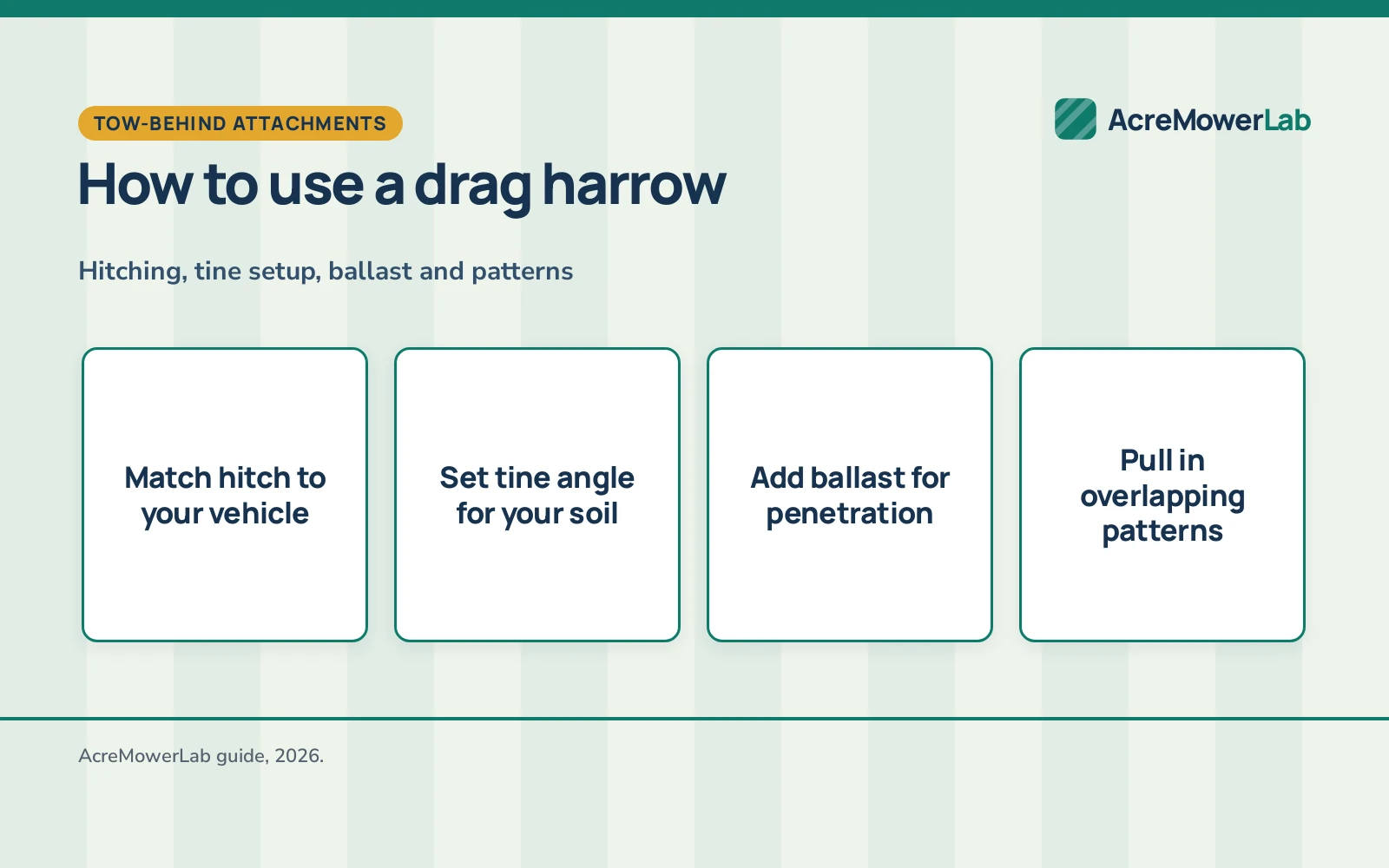
A step-by-step guide to using a drag harrow on acreage: hitching, tine orientation, adding ballast, towing patterns and ground prep.

On this page
Top picks at a glance
As an Amazon Associate I earn from qualifying purchases.
- 1
 Neat Attachments 48x66 Pasture Drag Chain Harrow9.8/10View on Amazon
- 2
 YITAMOTOR 5 ft x 4.5 ft Chain Drag Harrow with 1/2 in Tines9.7/10View on Amazon
- 3
 VEVOR 4 ft x 5.6 ft Tow Behind Chain Drag Harrow9.6/10View on Amazon
- 4
 LANDZIEView on Amazon
- 5
 VEVOR Drag HarrowView on Amazon
- 6
 STIRLINGEAR 4'x5' Pre-Assembled Drag Harrow for ATV/UTVView on Amazon
- 7
 4FT Drag Harrow Driveway GraderView on Amazon
Maintaining a few acres of pasture, a long gravel driveway, or a rough garden plot requires keeping the ground level and free of hard clods. To know how to use a drag harrow, hitch the drawbar or tow chain to your garden tractor, ATV, or utility vehicle, set the mat with the tines angled for your soil, and pull the implement across the ground in steady, overlapping passes. A chain drag harrow breaks up compacted manure and soil lumps, while a rigid grader smooths washboard gravel and high spots. This guide covers how to connect the harrow, adjust aggressiveness, add ballast, and work your acreage efficiently.
Other machines to compare
 LANDZIECheck price on Amazon
 VEVOR Drag HarrowCheck price on Amazon
 STIRLINGEAR 4'x5' Pre-Assembled Drag Harrow for ATV/UTVCheck price on Amazon
 4FT Drag Harrow Driveway GraderCheck price on Amazon
AcreMowerLab earns a commission when you shop through links here. It never changes your price. Affiliate disclosure.
How to use a drag harrow: select the right style for your acreage
| Harrow style | Best for | Key feature |
|---|---|---|
| Flexible chain harrow with tines | Pastures, food plots, seedbeds, and dethatching | Reversible mat with steel teeth for digging or smoothing |
| Rigid frame driveway grader | Gravel lanes, parking areas, arenas, and washboard ruts | Heavy angle iron crossbars with slots for added weight |
| Smooth drag mat | Covering broadcast seed and light surface grooming | Tines inverted or smooth chain mesh for zero digging |
| Heavy drawbar chain harrow | Rough pastures, breaking cattle manure, large fields | Rigid front pull pipe with universal tow ring |
Acreage owners often choose between flexible chain harrows and rigid driveway drags depending on whether they work soil or stone. For general tow-behind options, explore our best drag harrow guide. If you tow behind a compact machine, check our guide on choosing a drag harrow for small tractor use.
Step 2: choose your mat orientation and tine aggressiveness
Flexible chain harrows provide different working actions depending on how you hitch and orient the mat. Before towing, decide which action your ground requires:
Aggressive action: Hitch the drag so the steel teeth point forward and dig downward into the ground. As you pull forward, the angled tines penetrate the soil surface to break compacted clay, pull up dead thatch, aerate pastures, and shatter dried livestock manure. As an example of tine construction, FULUPET specifies 8mm thick reinforced steel tines on its 4×4 ft chain harrow, while VEVOR lists 60 tines, each 5.9 in long, on its 5 ft x 4.5 ft chain harrow.
Moderate action: Reverse the pull direction so the teeth trail backward, angled away from the direction of travel. In this position, the tines skim across the surface without gouging deeply, lightly knocking down rough spots, spreading manure, and smoothing loose dirt. Neat Attachments notes that on its 6′ 4″ x 4′ chain harrow, changing actions from aggressive to less aggressive is accomplished by switching the pull drawbar to the opposite end.
Smoothing action: Flip the entire harrow upside down so the tines face upward toward the sky. The smooth back of the chain links glides flat against the soil. This position levels topsoil, breaks small crusts, and presses broadcast seed into a prepared seedbed without burying the seed too deeply.
Step 3: add ballast for deeper ground penetration
On hard-packed clay or rutted gravel, a light drag harrow can skip across high spots. Adding weight keeps the implement planted into the ground so the cutting edges and teeth penetrate evenly.
Many rigid driveway drags include built-in trays or crossbars designed to hold concrete blocks or bricks. For instance, Vlaeng provides 2 adjustable bars and safety straps on its 4 Ft frame to secure ballast. Garvee includes concrete block slots supporting up to 50 LBS on its tow-behind grader frame. Similarly, VEVOR builds a tray into its 66-inch tow behind drag harrow that supports up to 50 lbs of firebricks, complementing the unit’s 30.58 lbs weight, with the spec table listing 30.5 pounds. On chain harrows, VEVOR includes a heavy-duty tray that holds bricks on its 4 x 5 ft model weighing 30.2 pounds. By contrast, heavier commercial mats such as the 120 Lbs chain harrow from Neat Attachments rely on the mass of 1045 Carbon steel and do not require supplemental weights.
Always secure cinder blocks or firebricks firmly with heavy straps so they cannot shift, bounce loose, or slide off during operation. Never overload a light frame beyond the maker’s stated limit.
Step 4: set your travel speed and towing pattern
Towing speed and travel patterns determine how smoothly your ground finishes:
Maintain a steady walking pace: Towing too fast causes a chain harrow or drag grader to bounce, fish-tail, and skip across high spots, leaving gouges and uneven windrows. Slow, steady momentum lets the tines penetrate and the leveling bars distribute loose material evenly across the swath.
Pattern on pastures and seedbeds: Pull in straight, overlapping passes across the property. On subsequent passes, change direction and drag diagonally or perpendicular to the initial rows. A crisscross pattern breaks up stubborn clods, distributes manure evenly, and prevents grooving the soil in one direction.
Pattern on gravel driveways: For crowned driveways, drag along the outer edges first to pull displaced gravel back toward the middle. Make a final pass down the center line to blend the ridge and re-establish a gentle crown that sheds rainwater into side ditches.
Step 5: clear accumulated debris and store the harrow
During field work, chain harrows collect roots, dead thatch, sticks, sod clumps, and weeds. Clearing and storing the implement properly preserves the steel for the next season:
- Stop and clear: Shift your tow vehicle into park, turn off the engine, and remove packed roots and vegetation before the mat clogs.
- Wash down the frame: Rinse away mud and corrosive manure residues with a hose, and allow the steel to dry to prevent surface oxidation. Vlaeng recommends rinsing and drying the drag rake after each use to protect the powder-coated carbon steel.
- Inspect hardware: Check hitch pins, linchpins, pull chains, and shackles for wear, bending, or loose fasteners.
- Fold or uncouple: Roll or fold flexible chain mats, or disassemble two-piece frames for flat storage inside a shed or barn. Landzie notes that its 6 FT driveway grader separates into two parts for compact shed storage, while VEVOR notes that its chain harrows fold for storage.
Hitching and matching your tow vehicle
Connecting a drag harrow requires matching the hitch hardware and tow vehicle to the size of the implement:
Tow vehicles: Lawn tractors and garden tractors handle light to medium dragging on turf or loose garden soil. ATVs and UTVs provide extra traction and ground clearance for rough pastures and long gravel lanes. Sub-compact and utility tractors provide the tractive effort needed for wide, heavy chain harrows. Neat Attachments specifies 6 HP required to pull its 120 Lbs chain harrow.
Hitch connections: Tow connections vary between pin hitches and trailer ball couplers. For instance, VEVOR provides a 37-inch pull rod with a 1.77-inch hitch width on its 66-inch grader for pin hitch connections, while other VEVOR chain harrows connect using a tow ring compatible with a 2″ trailer ball. Vlaeng includes two 5 Ft chains with an adjustable hitch connection, and Garvee uses a 6 ft adjustable chain.
Zero-turn mowers: Towing attachments behind a zero-turn requires caution. Most zero-turn hydrostatic transmissions are engineered for mowing rather than continuous heavy pulling, and tight spin turns can jackknife a trailing chain. Read our guide on whether a zero-turn can pull attachments before hitching a heavy drag.
Match the harrow width to your acreage and terrain
Working width dictates coverage and vehicle requirements. Narrower units, such as the 4 ft width models listed by VEVOR and Vlaeng, suit garden plots, tight riding rings, and garden tractors. Wider implements, like the 66-inch model from VEVOR, the 6 FT grader from Landzie, or the 8 ft drag harrow from VEVOR, cover wide pastures and long driveways in fewer passes but require more tractive effort and storage room.
On uneven or rolling ground, a flexible chain harrow contours to dips and swales better than a rigid frame grader. A rigid driveway drag bridges dips to shave off high crests, making it the preferred choice for leveling road base and compacted stone. To understand the mechanical action behind these tools, see our explainer on how a drag harrow works.
Plan your property passes in zones
Divide large acreage into distinct working zones, such as the driveway, house grounds, horse paddocks, and open pasture. Finish one zone before moving to the next so you do not track gravel across grass or drag soil onto clean stone paths.
Work perimeter fence lines and field borders first before completing the open center. Avoid dragging near newly landscaped beds or wet drainage swales where loose gravel or dirt could spill into unwanted areas. For comprehensive implement research, browse our tow-behind attachment reviews.
Mind ground moisture and working conditions
Soil moisture determines whether a drag harrow leaves a clean finish or a damaged field. Never harrow saturated, muddy ground. Pulling through wet soil packs clay into slick ruts, tears turf out by the roots, and causes heavy clods to ball up inside the chain mesh.
Avoid bone-dry, baked soil when attempting aggressive tilling, as tines may skate across the crust without cutting. The ideal window is moist soil that crumbles cleanly when squeezed in your palm. For gravel driveways, dragging after a gentle soaking rain softens the hard-pack surface just enough for the cutting bars to level ruts without kicking up clouds of dust.
Safety
Wear heavy work gloves, eye protection, and sturdy steel-toe footwear when handling steel harrows, chains, and ballast blocks. Inspect the work area and clear large rocks, branches, wire, and hidden debris before pulling the implement. Never carry passengers on the tow vehicle, and keep children, pets, and bystanders away from the work area. On hills and rolling terrain, never exceed your vehicle’s maximum slope rating, and avoid dragging across steep banks where an unbraked tow attachment can cause jackknifing or rollover. Stay well back from ponds, ditches, and steep drop-offs. If using a mower as a tow rig, keep the mower blades disengaged, and always shut off the engine and set the parking brake before hooking or unhooking the hitch. Refuel gas engines only when turned off and completely cool. See our Safety Disclaimer.
FAQ: mowing large lots
Can you pull a drag harrow with a riding mower or zero-turn?
Yes, provided your machine has a rear hitch pin hole and adequate traction. However, check your operator manual for towing capacity, as heavy drag harrows put sustained load on hydrostatic transmissions. Keep turns wide to avoid binding the chain against the rear drive tires.
Which way should the tines face on a chain drag harrow?
Point tines forward and downward for aggressive pasture renovation, dethatching, and breaking hard dirt clods. Point tines backward for light smoothing and manure spreading. Flip the mat upside down with tines facing the sky for smooth leveling and covering broadcast seed.
How fast should you pull a drag harrow?
Maintain a steady walking speed. Pulling too fast causes the harrow to bounce and skip across the surface, which leaves uneven ridges and reduces leveling efficiency.
When is ground too wet to drag harrow?
If tires sink into the soil or mud sticks in thick clumps to the chain mesh, the ground is too wet. Working saturated soil causes compaction and ruts. Wait until soil is damp enough to crumble when handled.
Do you need to add extra weight to a drag harrow?
Not always. Heavy chain harrows often have sufficient mass on their own. On lighter frames or hard-packed gravel, adding ballast helps tines penetrate. For example, VEVOR lists a tray capacity of up to 50 lbs of firebricks on its driveway grader, and Garvee specifies concrete block slots supporting up to 50 LBS. Always strap weights down securely.
More mowing guides
- Best Drag Harrow (2026): 5 Tow-Behind Picks Compared
- Drag Harrow for Small Tractor: 5 Picks Compared (2026)
- How Does a Drag Harrow Work?
- Can a Zero Turn Pull Attachments?
Use the Mower Matcher to narrow down choices by acreage, terrain, budget, and power type.