How to Use a Flail Mower
A practical field guide to operating a tractor flail mower safely: hitch setup, PTO speed, cutting height, terrain handling, and routine maintenance on acreage.

On this page
Top picks at a glance
As an Amazon Associate I earn from qualifying purchases.
- 1
 Earthquake Walk-Behind String Mower9.6/10View on Amazon
- 2
 YARDMAX YL2250 22 in. 170cc Gas Walk Behind String Trimmer9.6/10View on Amazon
- 3
 Earthquake 60V Walk Behind String Mower9.5/10View on Amazon
- 4
 MechMaxx 48'' PTO Powered 3 Point Light-Duty Flail Mower forView on Amazon
- 5
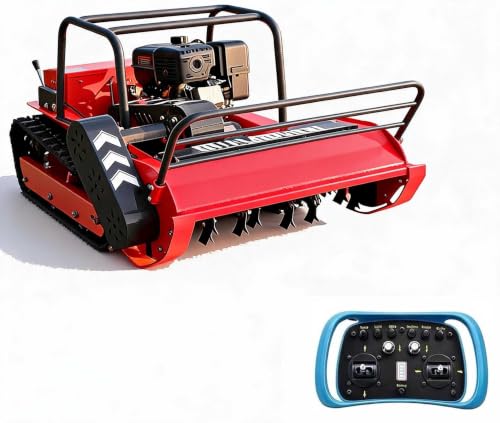 Tyzar 459cc Remote Control Flail MowerView on Amazon
- 6
 MechMaxx 48 inch Working Width Tow-Behind ATV Offset FlailView on Amazon
- 7
 MechMaxx 78" Heavy Duty PTO Drive Offset Ditch Bank VergeView on Amazon
- 8
 MechMaxx 27" Walk Behind Flail MowerView on Amazon
- 9
 Remote Control Flail Mower with 459cc High-Power EngineView on Amazon
On rural acreage with overgrown pastures, fence lines, and drainage ditches, keeping brush under control requires heavy-duty equipment that mulches without throwing dangerous debris. Learning how to use a flail mower gives property owners a clean, safe way to cut tall grass and woody brush. To use a tractor flail mower, attach the implement to your tractor three-point hitch, couple the PTO drive shaft, set cutting height with the rear roller, engage the PTO at low engine idle, advance the throttle to 540 RPM PTO speed, and drive forward at a steady low speed while rotating hammers shred vegetation into fine mulch. This guide covers setup, operating technique, terrain handling, and maintenance.
Other machines to compare
 MechMaxx 48'' PTO Powered 3 Point Light-Duty Flail Mower forCheck price on Amazon
 Tyzar 459cc Remote Control Flail MowerCheck price on Amazon
 MechMaxx 48 inch Working Width Tow-Behind ATV Offset FlailCheck price on Amazon
 MechMaxx 78" Heavy Duty PTO Drive Offset Ditch Bank VergeCheck price on Amazon
 MechMaxx 27" Walk Behind Flail MowerCheck price on Amazon
 Remote Control Flail Mower with 459cc High-Power EngineCheck price on Amazon
AcreMowerLab earns a commission when you shop through links here. It never changes your price. Affiliate disclosure.
How to use a flail mower: pick the right setup
Flail mowers differ from rotary cutters by spinning a horizontal drum armed with swinging knives or forged hammers. Before operating, match the mower style, cutting width, and weight to your tractor hitch category and available horsepower. Standard three-point models suit open fields and pastures, offset ditch bank models handle pond edges and steep grades, while self-propelled walk-behind and remote-control crawler units manage tight spaces and steep slopes where tractors cannot safely travel.
| Tool | Best for | Limit |
|---|---|---|
| Standard 3-point flail mower | Pastures, fields, and orchard rows | Cannot reach across ditch banks or fence lines |
| Offset ditch bank flail mower | Pond banks, road ditches, and embankments | Requires tractor hydraulic remotes and sufficient tractor weight |
| Walk-behind tracked flail mower | Trails and rough acreage without a tractor | Slower ground coverage across large open pastures |
| Remote-control crawler flail mower | Steep slopes, wet retention basins, and hazardous hills | Higher mechanical complexity than tractor implements |
Acreage owners using compact tractors generally choose standard or offset three-point units. MechMaxx lists standard models with cutting widths of 48 inches and 60 inches for 15 to 35 horsepower tractors, weighing 673 pounds, while BILT HARD lists a 53-inch Category 1 model for 15 to 35 horsepower tractors. For ditch banks, MechMaxx lists offset models in 48-inch, 60-inch, and 65-inch widths for 25 to 60 horsepower tractors. See our best sub compact tractor guide for tractor pairing advice.
Step 2: connect the hitch and PTO shaft
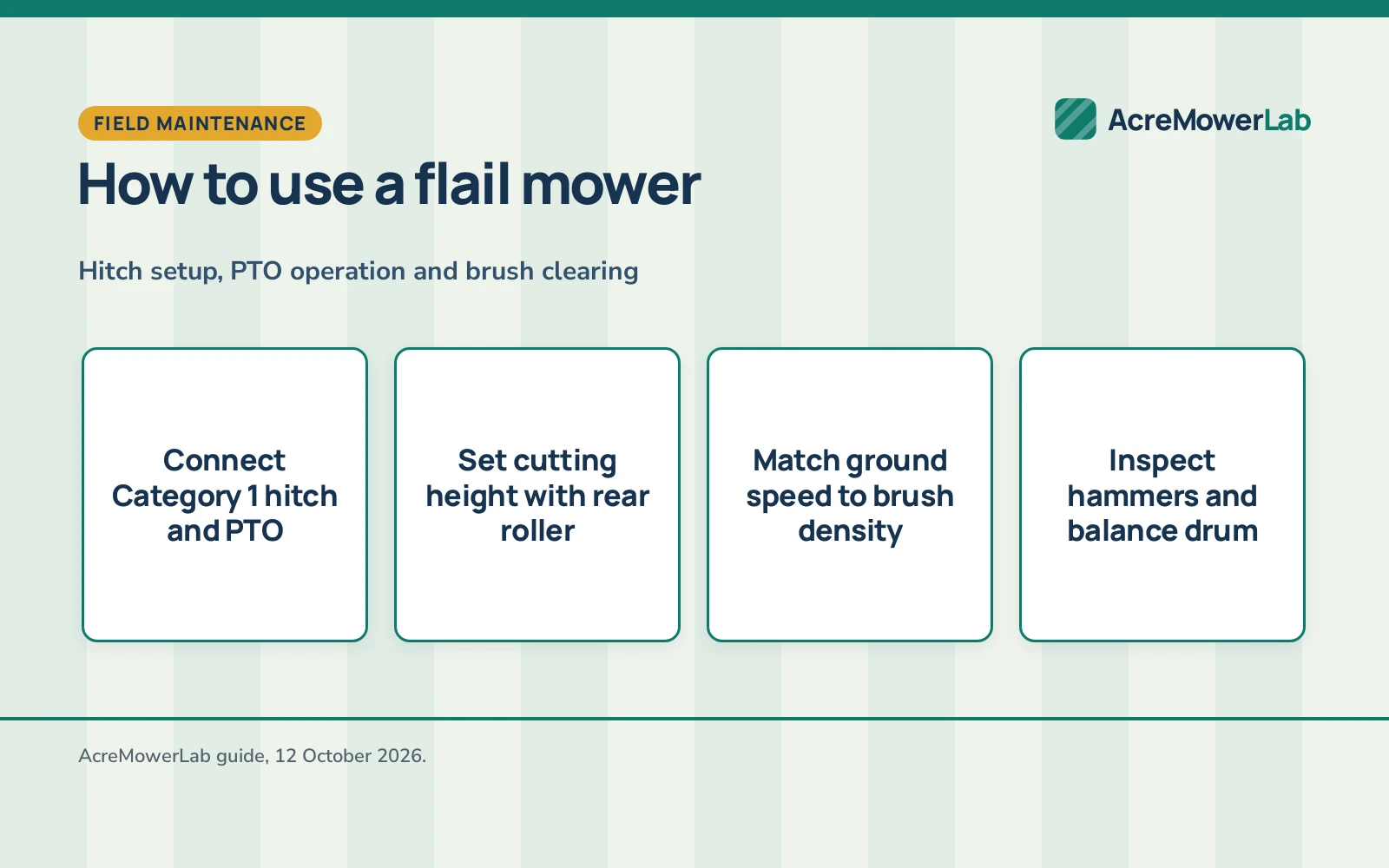
Back your tractor up to the mower on level ground. Lower the three-point draft links and connect them to the lower hitch pins, securing them with linchpins. Attach the tractor top link to the mower mast.
Slide the PTO drive shaft onto the tractor splined output shaft until the locking collar clicks into place. Pull back firmly to verify the lock. Fasten the safety chains on the PTO shield to the tractor and mower housing so the shield stays stationary while the shaft spins at 540 RPM. If your mower has a kickstand, raise or stow it before moving the tractor. Adjust the top link until the mower housing sits level from front to rear.
Step 3: set your cutting height and roller
A tractor flail mower floats on its rear steel roller and side skids rather than hanging on the three-point hydraulics. Carrying the implement on the hydraulics strains lift seals and cuts unevenly.
Set cutting height by adjusting the rear roller brackets and side skids. MechMaxx lists adjustable cutting heights between 0.6 inches and 1.8 inches on standard models, with ditch bank models reaching up to 2 inches. Keep cutting height higher on unfamiliar terrain to avoid scalping rocks or soil mounds.
Ensure the mower stays level from front to rear after adjusting the roller. If you change the roller height, readjust the tractor top link so the side skids sit parallel to the ground. A level housing keeps the front safety chains hanging close to the turf to block thrown debris while letting the rotor mulch cleanly.
Step 4: engage the PTO and match ground speed
Never engage the PTO at full throttle or while the rotor is buried in heavy brush. Keep the mower raised slightly above thick vegetation, set engine idle low, and engage the PTO smoothly. Once the rotor spins freely, advance the throttle until the tractor tachometer reaches 540 RPM PTO speed, lower the mower onto its rear roller, and begin mowing.
Select low gear or crawl range on hydrostatic drives. Ground speed must stay slow so the drum can shred growth before you advance. MechMaxx specifies a rotor shaft speed of 2356 rpm on its ditch bank models when the PTO runs at 540 rpm, producing the speed needed to mulch dense material. If the engine lugs down, slow your travel speed or narrow your cut pass. For heavy brush, see our guide on how to clear an overgrown field.
Step 5: clean the rotor and inspect the blades
Shut down the tractor, set the brake, remove the key, and verify the rotor has stopped before dismounting.
- Hammer wear: check cutting edges for dullness, chips, or damaged mounting bolts.
- Rotor balance: replace missing hammers across the drum to avoid damaging vibration.
- Bearings: clear wrapped wire, twine, and weed fibers from roller bearings.
- Drive belts: check belt tension and tighten adjustment bolts if belts slip under load.
For initial assembly and gearbox oil checks, see our tutorial on how to set up a flail mower.
Walk the field and scout obstacles
Before mowing overgrown acreage, walk the ground on foot. Tall brush hides obstacles that can shatter flail hammers, bend rotor shafts, or puncture tires. Look for stumps, surface rocks, steel t-posts, wire fencing, and washout ruts.
Mark immovable hazards with tall stakes so they remain visible from the tractor seat. While flail hammers swing back when striking hard objects, hitting solid steel or granite at full rotor speed will bend mounting ears and throw the drum out of balance. Route your pattern around steep washouts where tractor stability is compromised.
Match the blade hammer to the vegetation
Flail mowers use either Y-blades or forged hammer blades. Y-blades suit pasture grass and light weeds. MechMaxx lists a 27-inch walk-behind mower equipped with 38 Y-shaped flail blades designed to deflect off obstacles and protect the spindle.
For heavy brush and saplings, forged hammer blades provide the mass needed to pulverize woody growth. BILT HARD equips its 53-inch model with 18 heat-treated 40Cr alloy steel hammer blades rated for material up to 0.75 inches in diameter. MechMaxx lists models with 20 to 24 hammers mulching 0.75-inch brush, while its ditch bank models handle material up to 1.5 inches in diameter with 20 to 28 hammer blades.
Plan the property in mowing zones
Divide acreage into zones to work efficiently. Start by mowing a clean perimeter swath around field edges, fences, and tree lines. Clearing headlands first provides turning room at each pass without dragging the mower roller sideways through tall growth.
Raise the three-point hitch slightly at the end of each pass before turning on the headland, then lower the mower once lined up for the next pass. Turning sharply with the roller on the ground puts side strain on hitch components. For ditch banks and pond borders, an offset mower reaches outside the tractor tire track. MechMaxx lists offset models providing 69 inches, 77 inches, or 85 inches of lateral reach, with a 60-degree downward tilt and a 90-degree upward tilt, keeping tractor tires safely on flat ground.
Mind the ground and slope limits
Wet soil causes tractor tires to spin, rut pastures, and lose traction on slopes. Damp vegetation also cakes inside the cutting chamber, packing the roller and dragging down PTO speed.
Mow only when ground is firm and dry. Avoid steep hills where tractor roll-over is a hazard. Check how to measure the slope of your yard before tackling grades. On slopes too steep for a tractor, AIWEIYA lists a 39.4-inch hybrid crawler mower with a 459cc gas engine operated by remote control from a safe distance.
Safety
Always wear safety glasses, hearing protection, sturdy boots, and work gloves. Keep the tractor Roll-Over Protective Structure upright and latch your seat belt.
Check all safety shielding before engaging the PTO. The driveline guard must rotate freely with safety chains tethered. Front safety chains or reinforced flaps must hang intact to deflect thrown debris. Keep children, pets, and bystanders away from the work area. Disengage the PTO, lower the mower, shut off the engine, and remove the key before clearing clogs. See our brush and field mower guides for more equipment advice.
FAQ: mowing large lots
When should you use a flail mower instead of a rotary cutter?
Use a flail mower when you want fine mulch, clean pasture clipping, and low debris throw near buildings, fences, or roads. Flail hammers shred vegetation into small pieces that rot quickly, whereas rotary cutters leave windrows.
What PTO RPM is needed to run a tractor flail mower?
Tractor flail mowers operate at 540 RPM PTO speed. The tractor PTO drives a gearbox and belt pulleys that spin the internal rotor shaft at high speed. For example, MechMaxx lists a rotor shaft speed of 2356 rpm at 540 PTO rpm on its offset ditch bank models to achieve the blade tip speed needed for brush mulching.
Can a 25 horsepower tractor run a 60-inch flail mower?
Yes. MechMaxx specifies that its 60-inch standard-duty flail mower pairs with 15 to 35 horsepower tractors, while its 60-inch offset model operates with 25 to 60 horsepower tractors. Confirm tractor lift capacity matches implement weight.
How does a flail mower handle rocks and hidden obstacles?
Flail hammers and Y-blades mount on loose shackles. When a blade strikes a rock, it pivots back instead of transferring the impact shock into the rotor shaft and tractor driveline.
Where can you buy a flail mower and replacement parts?
Acreage owners can buy flail mowers through farm equipment dealers and online machinery sellers. Replacement hammer blades, belts, and PTO shafts are sold through agricultural suppliers.
More mowing guides
- How to Set Up a Flail Mower
- How to Clear an Overgrown Field
- Best Walk-Behind Brush Mower: 4 Picks for Rough Ground
Use the Mower Matcher to narrow down choices by acreage, terrain, budget, and power type.