How to Use Belt Tension Gauge on a Mower
A plain plan for reading belt deflection with a gauge, setting the tension, and rechecking the belt after the mower runs again.

On this page
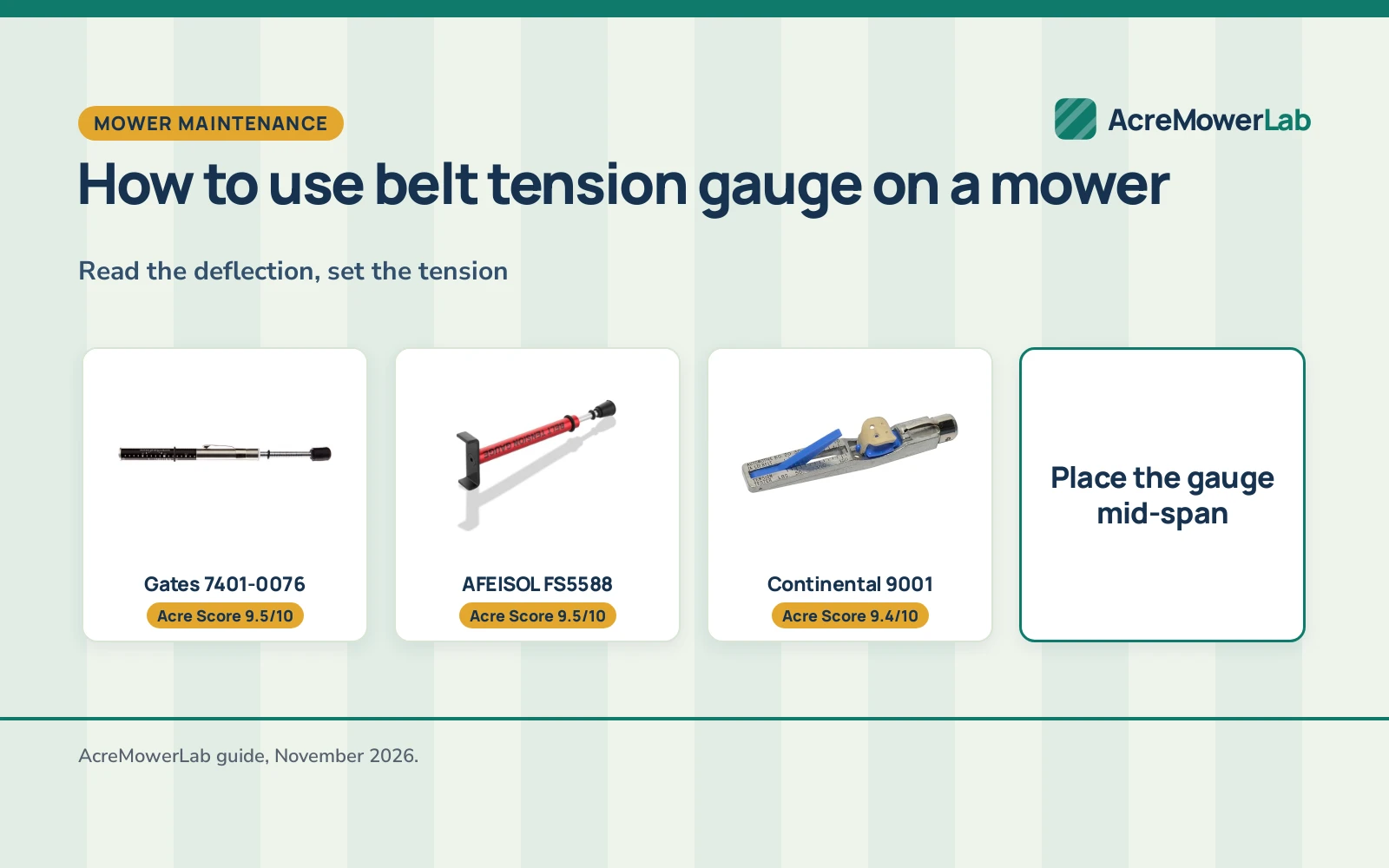
Top picks at a glance
As an Amazon Associate I earn from qualifying purchases.
- 1
 Gates 7401-0076 Pencil Type Tension Gauge9.5/10View on Amazon
- 2
 AFEISOL FS5588 10 Lb Belt Tension Gauge9.5/10View on Amazon
- 3
 Continental 9001 Krikit Tension Gauge9.4/10View on Amazon
A mower belt that slips will squeal and leave the blades short of power, while a belt pulled too tight strains bearings and wears fast. The fix is a reading, not a guess: a belt tension gauge shows how far the belt gives under a set push, and that reading tells you whether to loosen or tighten. This guide explains how to use belt tension gauge on a mower belt, from finding the span to reading the scale.
AcreMowerLab earns a commission when you shop through links here. It never changes your price. Affiliate disclosure.
| # | Product | Acre Score | Buy |
|---|---|---|---|
| 1 | Gates 7401-0076 Pencil Type Tension Gauge | 9.5/10 | Buy on Amazon |
| 2 | AFEISOL FS5588 10 Lb Belt Tension Gauge | 9.5/10 | Buy on Amazon |
| 3 | Continental 9001 Krikit Tension Gauge | 9.4/10 | Buy on Amazon |
Gates 7401-0076 Pencil Type Tension Gauge
Pencil type gauge with a 30 lb deflection force for small V-belts and synchronous belts.
Who it's for: owners who need a plain pencil gauge for small V-belts and synchronous belts at a stated 30 lb force.
Who should skip it: anyone whose belts need more than 30 lb of force, or anyone who wants a bracket that holds the gauge on the belt.
The Gates 7401-0076 is a pencil type gauge with a stated maximum deflection force of 30 lb. The maker lists it for small V-belts and synchronous belts, and states the country of origin as the United States. The body is black, and the part number is 7401-0076. The maker states dimensions of 8.0 inches by 8.0 inches by 11.0 inches.
Pros
- 30 lb deflection force, the highest stated force in this group
- Pencil type body is simple to press against the belt span
- Stated as made in the United States
- Part number 7401-0076 is stated, so matching a replacement is simple
Cons
- Suited to small V-belts and synchronous belts, so larger drive belts need a different gauge
- Pencil type body must be held square to the belt through the whole reading
- 30 lb is the maximum deflection force, so belts that need more force need a different gauge
- Warranty term is not stated on the listing
AFEISOL FS5588 10 Lb Belt Tension Gauge
Drive belt tension gauge with a 10 lb mark, O-ring stopper and U-shaped bracket for motorcycles, bicycles and mowers.
Who it's for: owners who want a marked 10 lb reading with a bracket that holds the belt still.
Who should skip it: anyone whose belt needs a force above 10 lb, or anyone who wants a gauge built for mower belts alone.
The AFEISOL FS5588 sets a rubber O-ring stopper at the 10 pound mark, then reads the belt at the inspection window. The maker states a universal U-shaped bracket that holds the belt in place while you adjust the tension, and clear markings for reading the result. The gauge is red, weighs 0.0625 pounds, and carries part number FS5588. The maker states it for motorcycles, bicycles and mowers with a secondary drive belt.
Pros
- 10 lb mark with a rubber O-ring stopper that sits on the mark before you press
- Universal U-shaped bracket holds the belt in place while you adjust the tension
- Clear markings help you read the belt tension at a glance
- Stated for use on mowers as well as motorcycles and bicycles
Cons
- 10 lb marked force covers only belts set to that mark; belts needing a higher reading need a different gauge
- Warranty term is not stated on the listing
- No case is stated with the gauge, so it rides loose in a toolbox
- The O-ring stopper must sit on the 10 pound mark before each reading, which adds a step to every use
Continental 9001 Krikit Tension Gauge
Compact electromechanical tension gauge with a 5.1 inch body and a 0.08 pound weight.
Who it's for: owners who want a small, light gauge for a deflection reading during routine mower care.
Who should skip it: anyone who needs a stated force figure such as 10 lb or 30 lb, or anyone who wants a bracket that holds the gauge on the belt.
The Continental 9001 Krikit is an electromechanical gauge in a compact body. The maker lists item dimensions of 5.1 inches by 1.4 inches by 0.9 inches and an item weight of 0.08 pounds, with part number 9001. One item is in the box.
Pros
- Compact body at 5.1 inches long, easy to carry in a pocket or toolbox
- Light at 0.08 pounds, so it adds little weight to the hand while you press
- Part number 9001 is stated, so matching a replacement is simple
- Reads belt tension by deflection, which suits a quick check during routine mower care
Cons
- Suits belts where the manual gives a deflection reading; a belt that needs a stated force figure needs a different gauge
- At 5.1 inches long and 0.08 pounds, the small body can be easy to misplace in a shop
- No bracket is stated to hold it on the belt while you read
- No stated use for mower belts in particular, so mower owners should confirm the fit with their manual
How to use belt tension gauge: read the deflection
The table below shows the stated force and bracket for the gauges in this guide, so you can match the gauge to the reading step before you start.
| Gauge | Stated force | Bracket |
|---|---|---|
| Gates 7401-0076 | 30 lb max | None stated |
| AFEISOL FS5588 | 10 lb | U-shaped bracket |
| Continental 9001 | Not stated | None stated |
Find the belt span
Park the mower on flat ground with the engine off and cool. Lift or remove the belt cover the way the mower manual shows, and clear grass and debris from the belt run. Find the longest free run of belt between pulleys: that open span is where the gauge reads.
Place the gauge at the middle of the span
Seat the gauge flat on the belt, square to its run, at the middle of the span. For the AFEISOL gauge (on Amazon), set the rubber O-ring stopper at the 10 pound mark before you press, and use the U-shaped bracket to hold the belt in place. For the Gates gauge, hold the pencil body square to the belt through the reading.
Press to the marked force and read the deflection
Press steadily to the force your mower manual calls for: the 10 pound mark on the AFEISOL gauge, and no more than the 30 lb maximum on the Gates gauge. Read where the belt sits against the scale while you hold the pressure, and compare the reading with the figure in your mower manual. Do not press past the marked force.
Adjust the belt and read again
Loosen or tighten the belt the way the mower manual shows, then refit the gauge and read the deflection again. A reading that matches the manual means the belt is set. A reading that stays off means the belt needs another pass, so adjust and read again until the reading matches.
Belt tension gauges for mower belts
The reading step needs a gauge that matches the force your manual calls for: a marked 10 lb reading, a 30 lb pencil gauge, or a compact deflection gauge.
Safety
Work with the engine off and cool, and keep the key out of the ignition while the belt cover is off. Keep hands clear of pulleys and blades, and refit the belt cover before starting the mower. Wear eye protection when you clear debris, and keep children and pets out of the work area.
FAQ: mowing large lots
What does a belt tension gauge measure?
It measures how far a belt deflects under a set push. The gauge presses the belt at the middle of the span and shows the deflection on its scale.
Where does the gauge go on the belt?
Place it at the middle of the longest free run between pulleys, square to the belt. The AFEISOL gauge reads at the inspection window with the O-ring stopper set at the 10 pound mark.
How can you tell if the belt is too loose or too tight?
Compare the gauge reading with the figure in your mower manual. A loose belt slips and leaves the blades short of power, while a tight belt strains bearings and wears fast. Adjust the belt, then read again until the reading matches the manual.
Can a motorcycle belt tension gauge work on a mower?
Yes, when the marked force matches what your manual calls for. The AFEISOL gauge is stated for mowers as well as motorcycles and bicycles, with a 10 lb mark and a U-shaped bracket that holds the belt in place.
What if the belt needs more force than the gauge marks?
Pick a gauge whose stated force covers the figure in your manual: the Gates gauge states a maximum deflection force of 30 lb, while the AFEISOL gauge marks 10 lb.
More mowing guides
- How to Measure a Drive Belt for Replacement
- Best Deck Belt for Riding Mower (2026): 5 Compared
- Deck Belt vs Drive Belt: Which One Should You Buy?
- Best Mower Maintenance Kit for Beginners (2026): 5 Kits Compared
For more upkeep, see the mower maintenance hub.