How to Measure a Drive Belt for Replacement
Measure the old belt before ordering a replacement, so the new belt fits the pulleys and runs at the right tension.

On this page
Top picks at a glance
As an Amazon Associate I earn from qualifying purchases.
- 1
 UDC Parts 532130969 Drive Belt for Husqvarna9.7/10View on Amazon
- 2
 BlueStars 954-04260 Aramid Cord Drive Belt9.6/10View on Amazon
- 3
 UDC Parts GX20006 Drive Belt for John Deere9.6/10View on Amazon
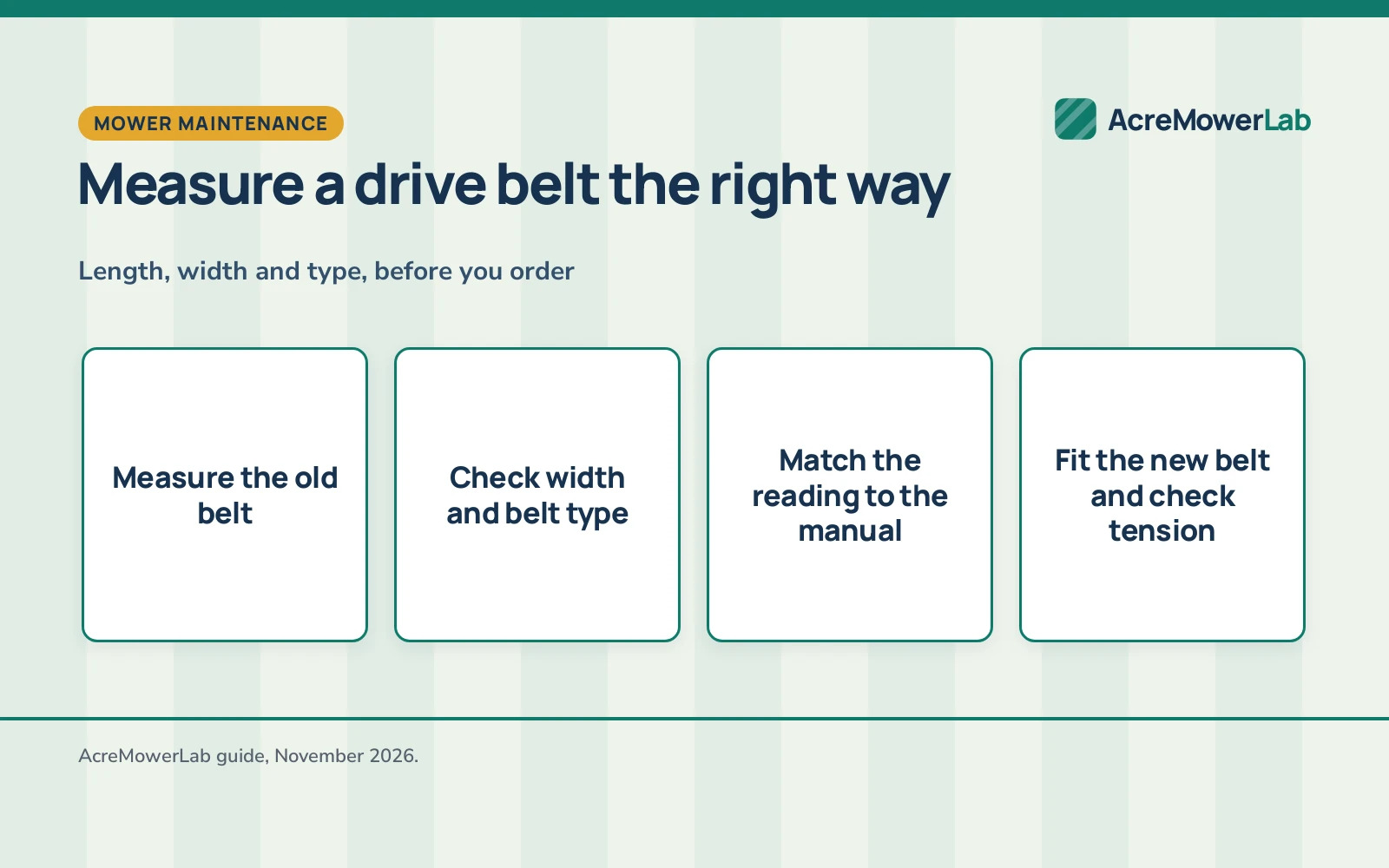
A riding mower earns its keep across open lawn, slopes and rough ground around sheds and fences, and the drive belt carries power from the engine to the wheels. When the belt slips, squeals or stops driving the mower, the belt may be worn, stretched or the wrong size. To learn how to measure a drive belt, start with the belt that came off the mower, measure the outside, check the width and the type, and match those readings to the replacement the manual calls for.
AcreMowerLab earns a commission when you shop through links here. It never changes your price. Affiliate disclosure.
How to measure a drive belt: start with the old belt
Remove the belt from the mower with the engine off and cool, following the manual for the routing and the guards. Lay the belt flat on a clean bench, and look for cracks, fraying, glazing or a section that has stretched out of shape. A belt that has stretched gives a reading that runs long, so note the wear before measuring.
Keep the old belt for comparison until the new belt is fitted. Write down the width, the type and the outside length in the same place, so the order matches the belt that was measured.
| Method | What it measures | Limit |
|---|---|---|
| Tape around the outside | Outside length of the old belt | A stretched belt reads long |
| Belt measurer | Outside length in small steps | Needs the belt off the mower |
| Manual and part number | The size the maker calls for | The manual may be missing |
For the size ranges that fit common mowers, see lawn mower belt sizes, and for the difference between the belts on a mower, see deck belt vs drive belt.
Measure the outside circumference with a tape
Wrap a flexible tape around the outside of the belt, along the back of the belt, and keep the tape snug without pulling the belt out of shape. Mark the point where the tape meets its start, then lay the tape flat and read the length at the mark. Take the reading, then repeat it, and keep the reading that repeats.
Measure the belt as it lies, not stretched tight, because a belt under tension reads longer than the belt at rest. A cloth tape follows the curve of the belt, while a steel tape can kink, so a cloth tape gives a steadier reading. Record the outside length exactly as read.
Check the width and the belt type
Measure the width across the top of the belt with a ruler or calipers, at a clean section away from wear. The width sets how the belt sits in the pulley groove, and a belt that is too narrow sits low and slips, while a belt that is too wide rides high and wears at the edges.
Look at the shape of the belt in cross section. A drive belt for a mower is often a V shape, and the angle of the V and the depth of the belt set how it grips the pulleys. Note whether the belt is a plain V belt or a belt with cogs on the inside face. Read any markings printed on the outside of the belt, and copy them exactly as printed.
Use a belt measurer for a worn belt
A belt measurer reads the outside circumference of a belt that is off the mower, and the Stens belt measurer measures FHP, power rated, A and B belts up to 100 inches. Set the belt on the measurer, follow the maker instructions for the scale, and read the length where the belt meets the mark. The Stens measurer (on Amazon) reads in 1/2-inch increments, and the nearest mark is the reading to compare with the manual figure.
A measurer helps when a tape reading is hard to repeat, because the belt sits in a fixed path and the scale stays still. Compare the measurer reading with the tape reading and with the manual figure before ordering.
Match the reading to the manual and the replacement
Open the manual for the mower and find the belt size and the belt type that the maker lists for the drive. Compare the manual figure with the outside length, the width and the type that were measured, and order the belt that matches the manual on all of those points. A belt that matches on length alone can still slip or wear fast when the width or the type is wrong.
For help with the wider maintenance routine, see riding mower maintenance, and for the category hub, see mower maintenance. A drive belt and a deck belt are not the same part, so check that the replacement is made for the drive, not for the deck.
Fit the new belt and check the tension
Fit the new belt along the routing the manual shows, with the belt seated in the pulley grooves and the guards back in place before the engine runs. Turn the pulleys by hand and watch the belt track in the grooves. If the belt rides high or sits low, stop and check the width and the routing before running the mower.
Check the tension with a belt tension gauge where the manual calls for a gauge reading. The MTRPS belt tension gauge (on Amazon) uses a standard pressure of 10 pounds to measure the tension of the belt. The Gugxiom belt tension gauge (on Amazon) rests its U shaped bracket at a 90-degree angle against the bottom of the belt, and the difference in the reading gives the belt deflection.
For the full change procedure, see how to change a drive belt on a Craftsman riding mower. After fitting, run the mower at low speed on open ground, then stop, let the engine cool, and check the belt seating and the tension again.
Safety
Work on the belt with the engine off and cool, the blades off, and the mower parked on flat ground with the parking brake set. Wear eye protection and sturdy shoes, and keep hands clear of the pulleys while the belt is being fitted. Keep children, pets and bystanders away from the work area, and follow the manual for the guards and the routing.
FAQ: mowing large lots
How is a drive belt measured without the old belt?
Use the manual figure for the drive belt, and confirm it with the mower model and the deck layout at the parts counter. Without the old belt to measure, the manual figure is the guide.
What if the belt has stretched?
A stretched belt reads long on a tape and on a measurer, so compare the reading with the manual figure and order by the manual figure. Check the width and the type as well, because a stretched belt can also be worn thin at the sides.
Is the inside or the outside of the belt measured?
Measure the outside of the belt, along the back of the belt, because the Stens belt measurer measures the outside circumference of the belt. The outside reading is the length to match, and the inside reading is shorter.
How is the right width checked?
Measure the width across the top of the old belt at a clean section, and compare it with the manual figure and with the pulley groove. A belt that sits at the right depth in the groove has a width that matches the pulleys.
Can a tape measure replace a belt measurer?
A flexible tape can give a useful outside length when the belt is off the mower and laid flat, and a belt measurer gives a steadier reading when the tape reading is hard to repeat. Use the reading that repeats, and compare it with the manual figure before ordering.