Lawn Leveling Rake vs Landscape Rake: Which One Should You Buy?
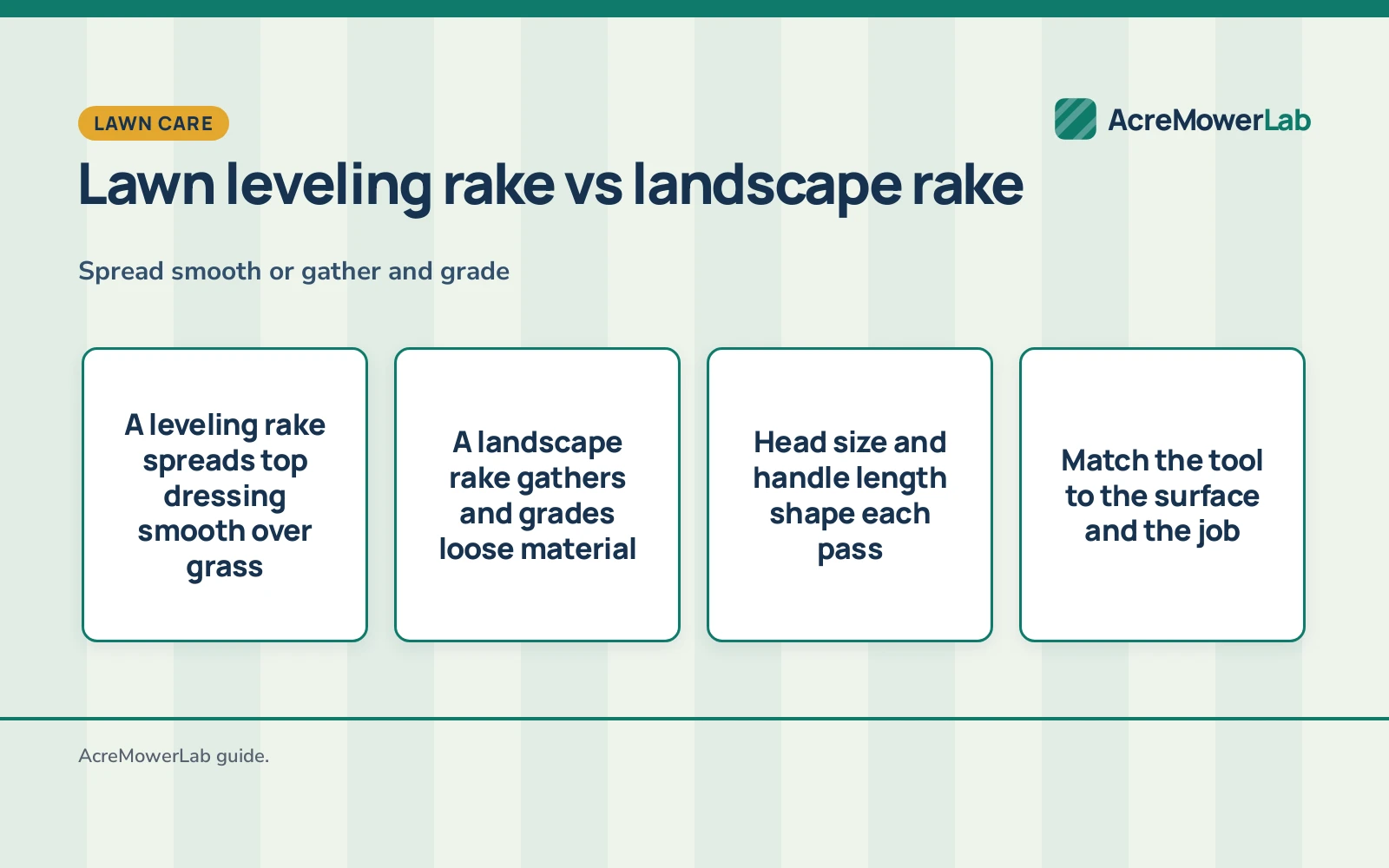
A leveling rake smooths top dressing over grass, while a landscape rake gathers and grades loose ground, so the right tool depends on the job at hand.

On this page
Top picks at a glance
As an Amazon Associate I earn from qualifying purchases.
- 1
 Rocklin 30 in Lawn Leveling Rake9.7/10View on Amazon
- 2
 Standard Golf Garden Landscape Rake Combo9.5/10View on Amazon
- 3
 HIDALIFE 30 in Stainless Steel Lawn Leveling Rake9.6/10View on Amazon
- 4
 Levelawn ProView on Amazon
- 5
 VIVOSUN 48" Lawn Leveling RakeView on Amazon
- 6
 Lawn Leveling RakeView on Amazon
- 7
 30"x10" Lawn Leveling RakeView on Amazon
- 8
 Lawn Leveling Rake 30x10View on Amazon
- 9
 Professional Lawn Leveling RakeView on Amazon
For a lawn leveling rake vs landscape rake decision, start with the material being moved. A leveling rake spreads top dressing and loose fill into a smooth, even layer across grass. A landscape rake gathers, grades and moves loose material such as soil, gravel and debris across bare ground and beds. Pick the leveling rake when the goal is a flat lawn surface, and pick the landscape rake when the goal is gathering and grading loose ground.
Other machines to compare
 Levelawn ProCheck price on Amazon
 VIVOSUN 48" Lawn Leveling RakeCheck price on Amazon
 Lawn Leveling RakeCheck price on Amazon
 30"x10" Lawn Leveling RakeCheck price on Amazon
 Lawn Leveling Rake 30x10Check price on Amazon
 Professional Lawn Leveling RakeCheck price on Amazon
AcreMowerLab earns a commission when you shop through links here. It never changes your price. Affiliate disclosure.
Lawn leveling rake vs landscape rake: the core difference
The two tools look similar from a distance, but the head does a different job. A leveling rake carries a flat plate or tray that pushes material ahead of it and leaves a thin, even layer behind. A landscape rake uses teeth or a toothed bar that catch, drag and gather loose material into rows or piles.
| Tool | Best for | Limit |
|---|---|---|
| Lawn leveling rake | Spreading top dressing, sand and fill smooth over grass | Not for gathering debris or grading rough ground |
| Landscape rake | Gathering and grading loose soil, gravel and debris | Less suited to fine smoothing over established grass |
When the surface is mostly bare ground that needs shaping, the toothed tool has the edge. When grass is already growing and the surface needs smoothing, the flat plate has the edge. See the companion comparison of a bow rake vs landscape rake for how a toothed rake compares with another gathering tool.
How a leveling rake works
A leveling rake works by dragging a wide, flat head across the surface while material sits in front of the plate. As the head moves forward, high spots lose material and low spots gain it, until the layer looks even. Short, steady passes with a light touch give more control than long, forceful pushes, because a heavy push can pile material up and leave ridges behind the head.
Top dressing, sand, soil and compost all behave differently under the plate. Dry, loose material spreads easily and fills low spots without clumping. Wet or heavy material drags, sticks and needs thinner layers and more passes.
The gear in this guide
The four leveling rakes below are ranked by the strength of their listings: head size, handle, build description and stated warranty term, with contradictions counted against a listing. A listing that disagrees with itself on size or material is harder to trust than one that states its facts cleanly.
GARDEASE Lawn Leveling Rake, 48 inch x 10 inch. The listing states a 48 inch x 10 inch ground plate, a 78 inch handle, and a frame of 2mm thick steel with reinforced welds and a powder-coated finish. The maker describes the steel as twice the standard 1mm found in other rakes, and lists an assembled weight of 14.5 lbs with a 3-piece handle that disassembles for storage. The listing also states a lifetime replacement term. The wide plate suits large, open lawns, while the stated weight and rigid frame suit repeated work over soil, sand and gravel.
Standard Golf Levelawn Pro, 30 inch head. The listing states a 30 inch head, a 72-inch handle in two pieces of wood, and a stainless steel tray for holding and spreading top dressing material. The maker says the tool is used by golf course superintendents and that each tool is made in Cedar Falls, Iowa. The listing gives no warranty term and no folded size, so storage and long-term cover are unstated rather than promised.
Lilyvane Folding Lawn Leveling Rake. The listing states a folding head that packs to 13.5 inch by 10 inch for transport and storage, with a maker claim of saving 50% of garage space, plus a smooth edge meant to avoid catching on lawn and tufts of grass. The listing also states a 70 inch adjustable steel handle with a 28mm diameter, and notes the tool works best on large areas especially when grass is cut to 1.5 inch or less. The listing contradicts itself on size: the title gives a 30 inch by 10 inch head, while the spec table lists a head size of 26.7×10, and the spec table lists overall dimensions of 30 inch by 84 inch against the 70 inch handle in the title and bullets. Trust the title and bullets over the spec table, so this guide uses the 30 inch by 10 inch head.
EUIJOIP Professional Lawn Leveling Rake. The listing states an adjustable handle of 80 inch and a wide work surface for filling dirt and removing depressions, with stated uses across gardens, lawns, soccer fields and golf courses for leveling soil, topsoil, dirt and sand. The maker claims the poles withstand over 300 pounds of pressure, plus a 999 days return and exchange service. The listing contradicts itself on the two facts that matter most: the title gives a 30×10 inch size while the bullets and spec table give a 27 inch by 10 inch work surface, and the title describes a stainless steel handle while the spec table lists handle material as plastic and head material as plastic. The title and the bullets disagree on size (30×10 against 27×10), and the title and the spec table disagree on material (stainless steel handle against plastic handle and head), so both facts stay disputed and this listing ranks last despite the long handle.
Choosing between the two rakes
Choose a leveling rake when the lawn already exists and the work is smoothing: top dressing after overseeding, sanding low spots, or preparing a bare lawn for seeding with an even layer of soil. Choose a landscape rake when the ground is bare or rough and the work is gathering: clearing debris from a bed, grading a gravel drive, or pulling loose soil into shape before planting. The surface decides, not the size of the property.
Once the type is settled, head width and handle length decide ease of use: a wide head is harder to steer around beds and trees, and a folding or multi-piece handle suits small storage. For soil work specifically, compare the lawn leveling rake for dirt picks with the landscape rake for dirt picks before settling on one type.
Working method
Start with a clear surface. Remove sticks, stones and other debris that could catch under the plate or teeth, and mow before leveling so the head meets the ground. Spread material in thin layers rather than dumping it in heaps: a thin layer levels faster and leaves fewer ridges than a thick one that the head must push around.
Work in overlapping passes, pulling or pushing the head in steady lines across the area, then cross over the same ground from another direction to catch ridges left by the first direction. Check the surface by eye and by foot as the work goes on, and add material only to the low spots that still show. A second thin layer beats a single heavy layer that buries the grass.
Finish by watering lightly if the material is dry and dusty, and keep traffic off freshly leveled ground until the layer has settled.
Safety
Wear sturdy shoes and eye protection, clear sticks, stones and other debris before starting, and keep children, pets and bystanders away from the work area. Watch for hidden obstacles under leaves and loose material, and stop if the head catches on roots, rocks or buried edging rather than forcing it free. Work on firm, dry ground where possible
FAQ: mowing large lots
How do you use a lawn leveling rake?
Spread top dressing or fill in a thin layer, then drag the flat head across the surface in steady, overlapping passes. High spots lose material and low spots gain it until the layer looks even
How does a lawn leveling rake work?
The flat plate pushes material ahead of it and leaves a thin, even layer behind. As the head moves, it shaves down high spots and fills low spots, which is why it suits smoothing over grass rather than gathering debris from bare ground.
How is a landscape rake different from a lawn leveling rake?
A landscape rake gathers and grades loose material with teeth, while a leveling rake smooths with a flat plate. Pick the toothed rake for gathering and shaping bare ground, and pick the flat plate for smoothing top dressing over an existing lawn.
Which rake suits a lawn that needs top dressing?
A lawn leveling rake suits top dressing work, because the flat plate spreads the layer thin and even over grass. A landscape rake can move the material, but its teeth leave grooves rather than the smooth finish a lawn needs.
Can a lawn leveling rake also move gravel or sand?
Yes, within limits. The listings in this guide describe spreading sand, soil, gravel and compost, so a leveling rake handles loose, granular material well. For gathering gravel from a drive or grading rough, bare ground, a landscape rake is the better match.
More mowing guides
- Bow Rake vs Landscape Rake: Which One Should You Buy?
- Best Lawn Leveling Rake for Dirt (2026): 5 Picks for Level Ground
- Best Landscape Rake for Dirt (2026): 5 Picks for Soil Work
- Tiller Types and Uses: Guide for Acreage and Gardens
Browse the tillers and cultivators section for more ground-preparation guides.