Lawn Tractor vs Riding Mower: What Is the Difference?
Learn the key differences between a lawn tractor and a riding mower, including deck sizes, steering controls, towing power, and yard fit.

On this page
Top picks at a glance
As an Amazon Associate I earn from qualifying purchases.
- 1
 EGO Power+ Electric Riding Lawn Mower9.5/10View on Amazon
- 2
 Eparts Riding Mower Garden Tractor Seat9.4/10View on Amazon
- 3
 Greenworks 80V 42" CrossoverT Cordless Riding Lawn Tractor9.5/10View on Amazon
- 4
 KEMIMOTO Magnetic Tractor Mirrors Compatible with John DeereView on Amazon
- 5
 Orbit Traveling Tractor Water SprinklerView on Amazon
- 6
 John Deere Lawn Tractor 1/32 ScaleView on Amazon
- 7
 COSTWAY Lawn Roller Push/Tow Behind a Tractor Sod Drum RollerView on Amazon
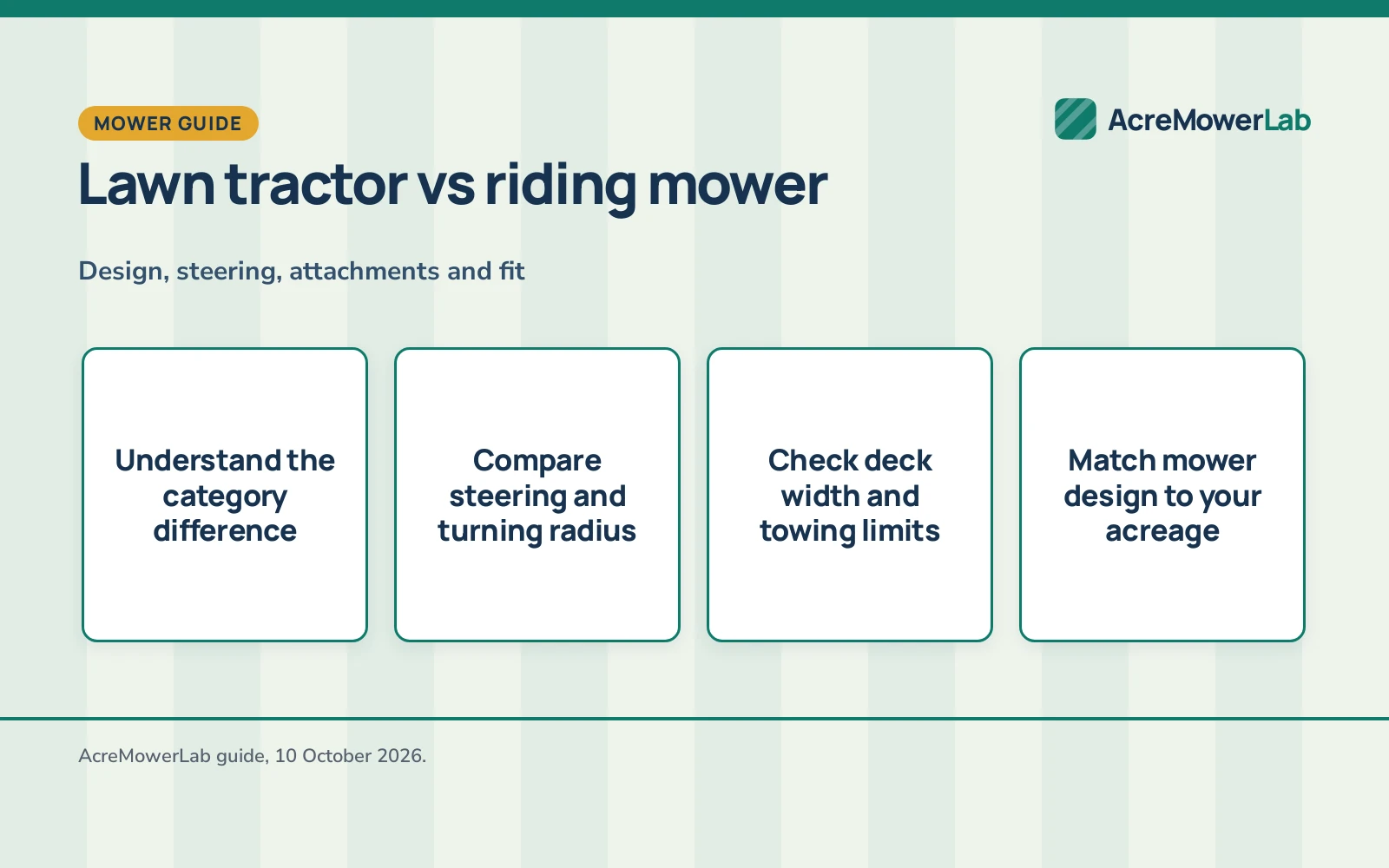
When exploring lawn tractor vs riding mower what is the difference, the core distinction is that a lawn tractor is a specific subcategory within the broader riding mower family. Riding mower is the umbrella term for every machine designed for an operator to sit on while mowing turf, including rear-engine riders, zero-turn machines, garden tractors, and lawn tractors. A lawn tractor features a front-mounted engine, a traditional steering wheel, a mid-mount cutting deck, and a rear hitch for light yard chores. Every lawn tractor is a riding mower, but not every riding mower is a lawn tractor.
Other machines to compare
 KEMIMOTO Magnetic Tractor Mirrors Compatible with John DeereCheck price on Amazon
 Orbit Traveling Tractor Water SprinklerCheck price on Amazon
 John Deere Lawn Tractor 1/32 ScaleCheck price on Amazon
 COSTWAY Lawn Roller Push/Tow Behind a Tractor Sod Drum RollerCheck price on Amazon
AcreMowerLab earns a commission when you shop through links here. It never changes your price. Affiliate disclosure.
Lawn tractor vs riding mower what is the difference: core design
| Machine Type | Steering and Drive | Best Property Role | Key Limitation |
|---|---|---|---|
| Lawn tractor | Steering wheel, front engine, foot pedal drive | Mowing open turf and pulling light yard attachments | Wider turning radius around tight obstacles |
| Zero-turn mower | Steering levers, rear engine, independent wheel motors | Fast mowing around trees, beds, and complex obstacles | Reduced traction on steep slopes and wet ground |
| Rear-engine rider | Steering wheel, compact frame, under-seat engine | Small lawns with narrow gates and flat turf | Narrow cutting deck and minimal towing power |
| Garden tractor | Heavy-duty frame, high-output engine, reinforced transmission | Ground-engaging equipment, soil tillers, and heavy hauling | Heavier weight and larger storage footprint |
Choosing between these formats depends on lawn size, terrain complexity, and attachment needs. If you maintain a modest yard, our guide to the best riding mower for 1 acre compares top options across these categories.
Step 2: compare steering controls and maneuverability
Steering design represents the most noticeable operational contrast between machine styles. A lawn tractor relies on a standard steering wheel connected to front steering spindles. This layout provides intuitive control that feels familiar to drivers accustomed to operating an automobile. The operator turns the wheel to guide the front tires along gentle curves or broad mowing stripes. Because the front wheels pivot on mechanical linkages, lawn tractors maintain an uncut circle of grass when circling tight obstacles, requiring back-and-forth multi-point turns to trim around trees or garden beds.
A zero-turn riding mower replaces the steering wheel with independent steering levers that govern separate hydraulic wheel motors. Pushing a steering lever forward drives that side of the machine ahead, while pulling the opposite lever back reverses the opposite tire. This configuration allows the mower to spin in place on its own footprint. On acreage with extensive landscaping, our zero-turn mower guide explains how lever steering eliminates trimming passes around fence posts, flower borders, and outbuildings.
Step 3: check cutting deck sizes and mowing speed
Cutting width directly influences how quickly an operator finishes mowing acreage. In reference listings, Craftsman lawn tractor platforms feature 42-inch and 46-inch decks. Lawn tractors commonly carry stamped steel decks in these widths, which balance cut quality with airflow for bagging and mulching grass clippings across residential acreage.
Commercial and heavy-duty zero-turn mowers frequently carry wider fabricated decks constructed from welded steel plate. Forward mowing speed also separates the categories. A lawn tractor operates at moderate forward velocities suited for smooth, controlled cutting and stable accessory towing. Zero-turn mowers travel at higher speeds across open turf, shortening total mowing hours on expansive lawns. To calculate appropriate cutting width for your property, read our guide on what size riding mower do I need.
Step 4: evaluate towing and rear attachments
Towing utility marks a major functional difference between lawn tractors and zero-turn riding mowers. A lawn tractor comes built with a rear hitch pin hole stamped into its steel frame. This rear hitch point enables the machine to pull non-powered turf accessories, transforming the mower into a multi-season yard tug. Property owners regularly attach poly dump carts for firewood, broadcast spreaders for seed and fertilizer, spike dethatchers, and lawn sweepers.
While aftermarket hitch kits exist for certain zero-turn mowers, their lightweight front ends and high-speed wheel drives are not optimized for heavy pulling. Pulling weighted implements behind a zero-turn can stress hydrostatic pumps, cause the front casters to lift, or cause the drive tires to spin and tear turf. For dedicated chore hauling, review our picks for the riding mower with attachments category.
Step 5: inspect maintenance and storage space
Equipment maintenance and storage requirements differ based on chassis layout. A lawn tractor uses an elongated front hood that houses the engine. Tilting this hood forward gives open access to the air cleaner, oil drain, spark plug, and 12-volt battery. Cleaning the stamped underside of the deck and servicing the drive belt follows straightforward access paths beneath the running boards.
Zero-turn riding mowers position the engine behind the operator seat, resulting in a wider, squarer footprint that demands greater floor space in a garage or storage barn. Both equipment formats require periodic blade sharpening, oil changes, deck leveling, and belt inspection. To budget for ownership upkeep, review our breakdown on how much does it cost to maintain a riding mower.
Match the mower to your acreage
Property acreage provides a helpful guide when selecting between equipment styles. For properties around 1 acre, a lawn tractor offers a balanced combination of cutting capacity, storage economy, and towing practicality. Its moderate footprint parks easily inside a standard garage stall, and its turning radius is well suited for typical suburban and rural yards.
When managing broader acreage, mowing duration becomes a primary consideration. A wide-deck zero-turn mower covers open acreage rapidly, reducing hours spent in the seat during the peak summer growing season. However, acreage owners who also need to haul garden soil, clear fall leaves, and move firewood often prefer keeping a lawn tractor as a dependable utility machine.
Consider yard terrain and slopes
Yard topography is a critical safety consideration when evaluating riding equipment. Front-engine lawn tractors place machine weight evenly between the front steering tires and rear drive wheels. This balanced weight distribution helps the front tires hold a line across gentle hills and sloping turf without slipping downhill.
Zero-turn mowers concentrate most of their machine weight over the rear drive tires, while the front caster wheels pivot freely. On steep slopes or damp turf, caster wheels can lose direction, causing the machine to slide downhill toward obstacles. For properties with rolling hills, review our safety analysis on the maximum slope for a riding mower before operating on sloped ground.
Transmission types and durability
The transmission system governs how engine power turns the wheels and regulates ground speed. Modern lawn tractors predominantly use hydrostatic transaxles controlled by a foot pedal. Pressing the pedal forward smoothly accelerates the machine without manual shifting, while releasing the pedal slows the vehicle to a stop.
Zero-turn riding mowers use independent hydrostatic pumps and wheel motors for each rear tire. This system provides agile zero-turn steering and precise ground speed regulation. Because the hydraulic circuit contains dedicated wheel motors, proper maintenance of cooling fans, drive belts, and hydraulic fluid levels is vital for longevity. For detailed comparisons across drive platforms, visit our comprehensive riding mowers section.
Long-term maintenance and lifting
Regular maintenance underneath the cutting deck keeps blades sharp and preserves airflow for a clean lawn cut. Wet grass clippings pack against the deck shell, promoting rust and causing ragged grass tips. Cleaning under the deck, changing worn mower belts, and swapping dull blades requires elevating the machine safely.
Reference data listings show dedicated maintenance lift jacks with load ratings of 300 pounds, 550 pounds, and up to 1400 pounds. These jacks cradle the front wheels and raise the front chassis with mechanical safety locks, allowing homeowners to inspect blades and scrape out debris without removing the entire cutting deck.
Safety
Operating riding equipment requires strict adherence to safety practices. Never exceed the maker’s maximum slope rating for your machine. Zero-turn mowers can lose traction on slopes and near ponds or ditches, creating rollover hazards. Always deploy rollover protective structures (ROPS) and fasten your seat belt where equipped. Never carry passengers, and keep children and pets completely out of the yard during operation. Disengage cutting blades before shifting into reverse. Wear eye and hearing protection, clear sticks and rocks from the lawn before mowing, and refuel only when the engine is turned off and cool.
FAQ: mowing large lots
Can a lawn tractor pull more than a zero-turn riding mower?
Yes. Lawn tractors feature a rigid steel frame and rear hitch specifically engineered for pulling dump carts, spreaders, and dethatchers. While some zero-turn mowers accept an optional hitch bracket, heavy towing places excessive stress on hydrostatic wheel drives.
Is a zero-turn mower considered a riding mower?
Yes. A zero-turn mower is a specialized style of riding mower. Riding mower is the broad category for all sit-on turf equipment, while zero-turn refers to machines that steer via independent drive wheels and lap bars rather than a front steering wheel.
Which machine cuts grass faster, a lawn tractor or a zero-turn?
A zero-turn riding mower cuts grass significantly faster. Zero-turn machines offer higher forward travel speeds and eliminate uncut grass circles by spinning in place at the end of each pass, avoiding the multi-point turns required by a lawn tractor.
What deck sizes are standard on residential lawn tractors?
Residential lawn tractors commonly use mid-size cutting decks. Replacement listings from makers like Craftsman highlight 42-inch and 46-inch deck dimensions as widely used homeowner platforms for acreage maintenance.
Are lawn tractors safer on hills than zero-turn mowers?
Lawn tractors generally offer more predictable steering on slopes because front wheels steer mechanically and the front-engine layout balances vehicle weight across the front and rear axles. Zero-turn mowers rely on rear wheel traction for both drive and steering, which can slip on damp hillsides.
More mowing guides
- Best Riding Mower for 1 Acre: 4 Picks by Deck Size
- What Size Riding Mower Do I Need?
- What Is Zero Turn Mower?
- What Is the MAX Slope for a Riding Mower?
Compare your acreage and yard layout before picking a mower.