Pick Axe vs Mattock: Which One Should You Buy?
Pick axe vs mattock compared on head design, handle length, weight and dual heads, with examples of each side from the listings we reviewed.

On this page
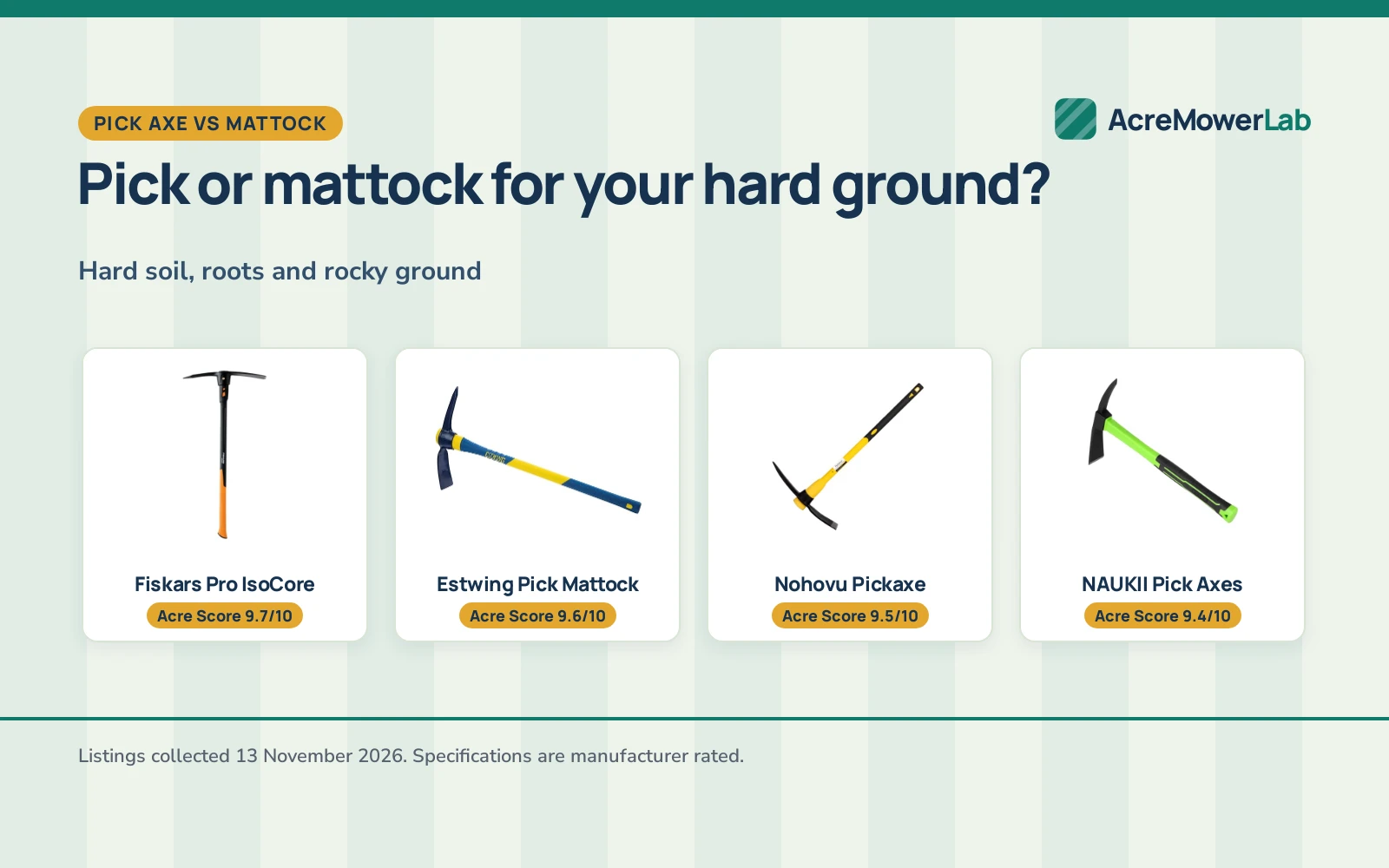
Top picks at a glance
As an Amazon Associate I earn from qualifying purchases.
- 1
 Fiskars Pro IsoCore 36" 2-in-1 Pickaxe & Hoe, 5 lb9.7/10View on Amazon
- 2
 Estwing 5-Pound Pick Mattock with 36-Inch Fiberglass Handle9.6/10View on Amazon
- 3
 Nohovu Pickaxe with Shock Absorbing Fiberglass Handle, 36 Inches9.5/10View on Amazon
- 4
 NAUKII Pick Axes for Digging, 14.7 Inch9.4/10View on Amazon
Verdict: Choose a pick axe if your work is breaking hard, rocky ground with a pointed end and precise work in narrow spaces. Choose a mattock if you also need a wide blade for hoeing, digging and moving soil in one long-handled tool.
A patch of ground baked hard over summer, or a bed full of roots that a shovel will not shift, is where the pick axe vs mattock question starts. Both swing a steel head on a long handle to break ground a spade cannot touch. A pick axe drives a pointed end into hard surfaces, while a mattock pairs that point with a wide blade that hoes and digs. This comparison covers the differences, then one example of each side.
AcreMowerLab earns a commission when you shop through links here. It never changes your price. Affiliate disclosure.
The examples
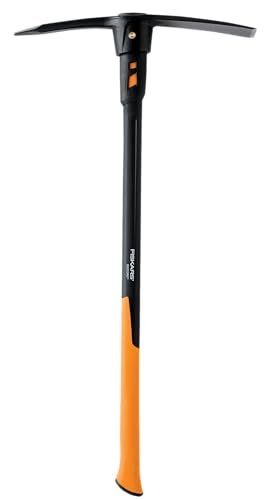
Fiskars Pro IsoCore 36" 2-in-1 Pickaxe & Hoe, 5 lb
A 36-inch 2-in-1 pickaxe and hoe with a forged steel head, an insulated ergonomic handle and IsoCore shock control, backed by a lifetime warranty.
Who it's for: owners working tough soil, rocky ground and roots who want one long-handled tool with a pick end and a hoe end.
Who should skip it: anyone who wants a short tool for tight spaces.
The Fiskars Pro IsoCore is a 36-inch 2-in-1 tool with a forged steel head: a pickaxe end for tough soil, rocky surfaces and roots, and a hoe end for cultivating, digging and weeding. The maker states its IsoCore shock control system reduces shock and vibration, and the insulated ergonomic handle reduces blisters and dampens vibration.
Pros
- Dual-ended head: pick end breaks tough soil and roots, hoe end digs
- IsoCore shock control reduces shock and vibration, per the maker
- Forged steel head with a riveted connection
- Lifetime warranty stated on the listing
Cons
- No head weight is stated beyond the 5 lb total
- No replacement head is listed
- No storage detail is stated
- The hoe end width is not stated
Estwing 5-Pound Pick Mattock with 36-Inch Fiberglass Handle
A 5-pound pick mattock with a drop-forged, heat-treated head and a 36-inch fiberglass handle, for breaking hard ground and hoeing rocky soil.
Who it's for: owners breaking hard ground and hoeing rocky soil who want a full-length mattock with a replaceable head.
Who should skip it: anyone who wants a short, light tool for tight spaces.
The Estwing is a 5-pound pick mattock with a drop-forged head that the maker states is heat treated and tempered, on a double-injected 36-inch fiberglass handle. The pick end drives through hard surfaces and the mattock end works as a hoe in tough soil, and the maker lists it for digging, chopping and hoeing in confined areas and rocky soil.
Pros
- Drop-forged head, heat treated and tempered for strength
- Pick end and mattock end in one tool
- 36-inch fiberglass handle, double injected
- Replacement heads available separately
Cons
- No warranty term is stated
- No head width is stated
- No weight beyond the 5-pound total
- No grip or shock-absorbing detail stated
Nohovu Pickaxe with Shock Absorbing Fiberglass Handle, 36 Inches
A 36-inch pickaxe with a forged high-carbon steel dual head, a 4.3-inch flat blade and a pointed blade, on a shock-absorbing fiberglass handle.
Who it's for: owners digging and loosening soil in gardens, yards and vegetable plots who want a wide flat blade beside a pointed pick.
Who should skip it: anyone who wants a lighter tool, since the listing states 7.8 pounds.
The Nohovu is a 36-inch pickaxe with a forged high-carbon steel head and a dual-head design: a 4.3-inch flat blade for wide digging and breaking hard clods, and a pointed blade for precise work in narrow spaces. The fiberglass handle has a shock-absorbing structure and a textured, anti-slip surface, and the maker lists it for soil, gravel and frozen ground.
Pros
- Dual head: 4.3-inch flat blade for wide digging and a pointed blade for narrow spaces
- Forged high-carbon steel head, per the maker
- Fiberglass handle with shock-absorbing structure
- 36-inch length for leverage with less bending, per the maker
Cons
- Bullets and spec table disagree on blade width: 4.3 inches vs 3.7 inches
- No warranty term is stated
- No grip length is stated
- Heaviest of the examples at 7.8 pounds
NAUKII Pick Axes for Digging, 14.7 Inch
A 14.7-inch pick axe with a high-density carbon steel dual head and a fiberglass handle with rubber overmolding, listed at 1 lb for tight spaces.
Who it's for: owners working in tight spaces who want a short, light pick axe for roots and hardened ground.
Who should skip it: anyone who wants full-length leverage.
The NAUKII is a short pick axe at 14.7 inches, with a high-density carbon steel head in a dual-head layout: a pick end for rocky soil and roots and a hoe end for digging trenches and breaking dirt. The fiberglass handle has elastic rubber overmolding, and the maker lists it for breaking hardened ground and removing tree roots in tight spaces.
Pros
- Short 14.7-inch length suits tight spaces
- Dual head: pick end for rocky soil and roots, hoe end for trenches
- Fiberglass handle with elastic rubber overmolding
- Integrated head and handle, with no separate head to loosen, per the maker
Cons
- No warranty term is stated
- No blade width is stated
- The 14.7-inch length gives less reach than the 36-inch examples
- The spec table weight disagrees with the bullets
Other machines to compare
 Estwing 2.5-Pound Pick Mattock with 36-Inch Fiberglass HandleCheck price on Amazon
 KINJOEK 15 Inch Pick Mattock HoeCheck price on Amazon
 glorousamc Forged Adze PickCheck price on Amazon
 Forged Adze PickCheck price on Amazon
 TAICHEUT 2 Pack 30oz Weeding Mattock HoeCheck price on Amazon
Pick axe vs mattock side by side
| Factor | Fiskars Pro IsoCore | Estwing Pick Mattock | Nohovu Pickaxe | NAUKII Pick Axes |
|---|---|---|---|---|
| Head | Dual head: pickaxe end and hoe end | Dual head: pick end and mattock end | Dual head: flat blade and pointed pick | Dual head: pick end and hoe end |
| Head material | Forged steel | Drop-forged steel, heat treated and tempered | Forged high-carbon steel | High-density carbon steel |
| Handle | Insulated ergonomic handle, 36 inches | Fiberglass, double injected, 36 inches | Fiberglass, shock absorbing, 36 inches | Fiberglass, rubber overmold, 14.7 inches |
| Weight (stated) | 5 lb | 5 pounds | 7.8 pounds | 1 lb |
| Best at | Tough soil, rocky surfaces and roots | Breaking hard ground and hoeing rocky soil | Hard clods, soil, gravel and frozen ground | Clay soil and tight spaces |
| Warranty (stated) | Lifetime warranty | Not stated | Not stated | Not stated |
Figures are manufacturer stated for the example models, collected 13 November 2026.
Head design: pick or mattock blade
A pick axe leads with a point. The point concentrates each swing on a small spot, which is why it breaks hard surfaces, rocky soil and frozen ground, and works in narrow spaces between roots and stones. The pick-axe examples here are dual-headed: the Nohovu example pairs its point with a 4.3-inch flat blade, so one head covers wide digging and precise work, and the NAUKII example pairs its pick end with a hoe end for digging trenches.
A mattock keeps a pick end and adds a wide blade that works as a hoe. The Fiskars example uses its hoe end to cultivate, dig and weed, while the Estwing example uses its mattock end as a hoe in tough soil. The wide blade moves soil the point only loosens.
Length and leverage
Length sets how much leverage each swing carries and how far you bend to use it. The Nohovu, Fiskars and Estwing examples each state a 36-inch handle, which gives a full swing and keeps the work at a standing height. The NAUKII example states a 14.7-inch length, which trades leverage for control in tight spaces where a long handle will not fit. Short tools suit close work around roots, beds and foundations; long tools suit open ground, where each swing covers more soil.
What each one can break up
A pick axe suits hard, rocky ground, gravel and frozen ground. The NAUKII example lists clay soil and tree roots, and the Nohovu example lists soil excavation, turning and loosening soil, surface leveling and gravel clearing.
A mattock suits the same hard ground, then adds hoeing. The Fiskars example lists tough soil, rocky surfaces and roots for its pick end and cultivating, digging and weeding for its hoe end. The Estwing example lists breaking hard ground, hoeing rocky soil and digging in tight spaces.
Handling and weight
Weight changes how long each swing stays comfortable. The NAUKII example lists 1 lb, easy to carry and control in tight spots. The Fiskars and Estwing examples each list 5 lb, a middle weight for a full-length tool. The Nohovu example lists 7.8 pounds, which adds breaking force at the cost of a heavier swing.
Handles matter as much as weight. The Nohovu and NAUKII examples use fiberglass handles with shock-absorbing structure or rubber overmolding, the Fiskars example uses an insulated ergonomic handle that the maker states dampens vibration, and the Estwing example uses a double-injected fiberglass handle. The listings state the materials but not the feel.
Upkeep
Hand tools ask for little upkeep, and the listings state little about it. Keep heads clean and dry, and check that the head stays tight on the handle. The Estwing example lists replacement heads available separately, so a worn head need not mean a new tool.
Acreage and terrain fit
Fiskars Pro IsoCore
Estwing Pick Mattock
Nohovu Pickaxe
NAUKII Pick Axes
Matching It to Your Property
- Rough, rocky ground with roots suits the full-length examples, which pair a pick end with a wide blade or a hoe end.
- Tight spaces between beds, roots and foundations suit the short NAUKII example, which the maker lists for work a shovel cannot handle.
- Gardens, yards and vegetable plots suit the Nohovu example, which the maker lists for tilling, loosening soil and rock drilling.
The Acre Score explained
The Acre Score weighs performance (heads and what each tool can break up), build quality (head, handle and grip), value (what comes in the box), safety (features or operator controls the listing states) and warranty (term and coverage). A factor the listing does not state scores zero, which is why examples without a stated warranty score zero there.
| Product | Acre Score | Perf. /35 | Build /25 | Value /25 | Safety /10 | Warranty /5 |
|---|---|---|---|---|---|---|
| Fiskars Pro IsoCore | 9.7 | 30 | 21 | 20 | n/a | 4 |
| Estwing Pick Mattock | 9.6 | 29 | 21 | 20 | n/a | 0 |
| Nohovu Pickaxe | 9.5 | 28 | 20 | 19 | n/a | 0 |
| NAUKII Pick Axes | 9.4 | 24 | 18 | 18 | n/a | 0 |
Each score is a linear conversion of the weighted total onto the 9.2 and 9.8 bounds; more points move a pick up the scale. Manual gear with no listed safety feature is not scored on safety, and the other 90 points decide its total.
Many owners on acreage keep a full-length tool for open ground and a short one for tight spots. If your ground needs a mattock beside a digging bar, see our garden mattock vs digging bar comparison.
Read the manual, keep children and pets out of the yard while you work, wear eye and hearing protection and sturdy footwear, and never exceed the slope rating of your machine. Refuel only with the engine off and cool. See CPSC lawn mower safety. Read our Safety Disclaimer.
FAQ: mowing large lots
Can a pick axe break up rocky soil?
Yes, that is its main job. The pointed end concentrates each swing on a small spot, and the listings here state rocky soil, gravel and frozen ground.
Which is better for removing tree roots?
Either head can work roots, and the choice turns on space. The NAUKII example lists removing tree roots among its jobs, and the Fiskars example lists roots for its pick end.
What handle length should I choose?
Choose a 36-inch handle for open ground, where length adds leverage. Choose the 14.7-inch NAUKII example for tight spaces, where a long handle will not swing.
Do I need a pick axe and a mattock?
Not always. A mattock already pairs a pick end with a wide blade, so one tool covers breaking and hoeing. A pick axe suits owners who mainly break hard ground and want a pointed end with a flat blade beside it.
More mowing guides
- Garden Mattock vs Digging Bar: Which One Should You Buy?
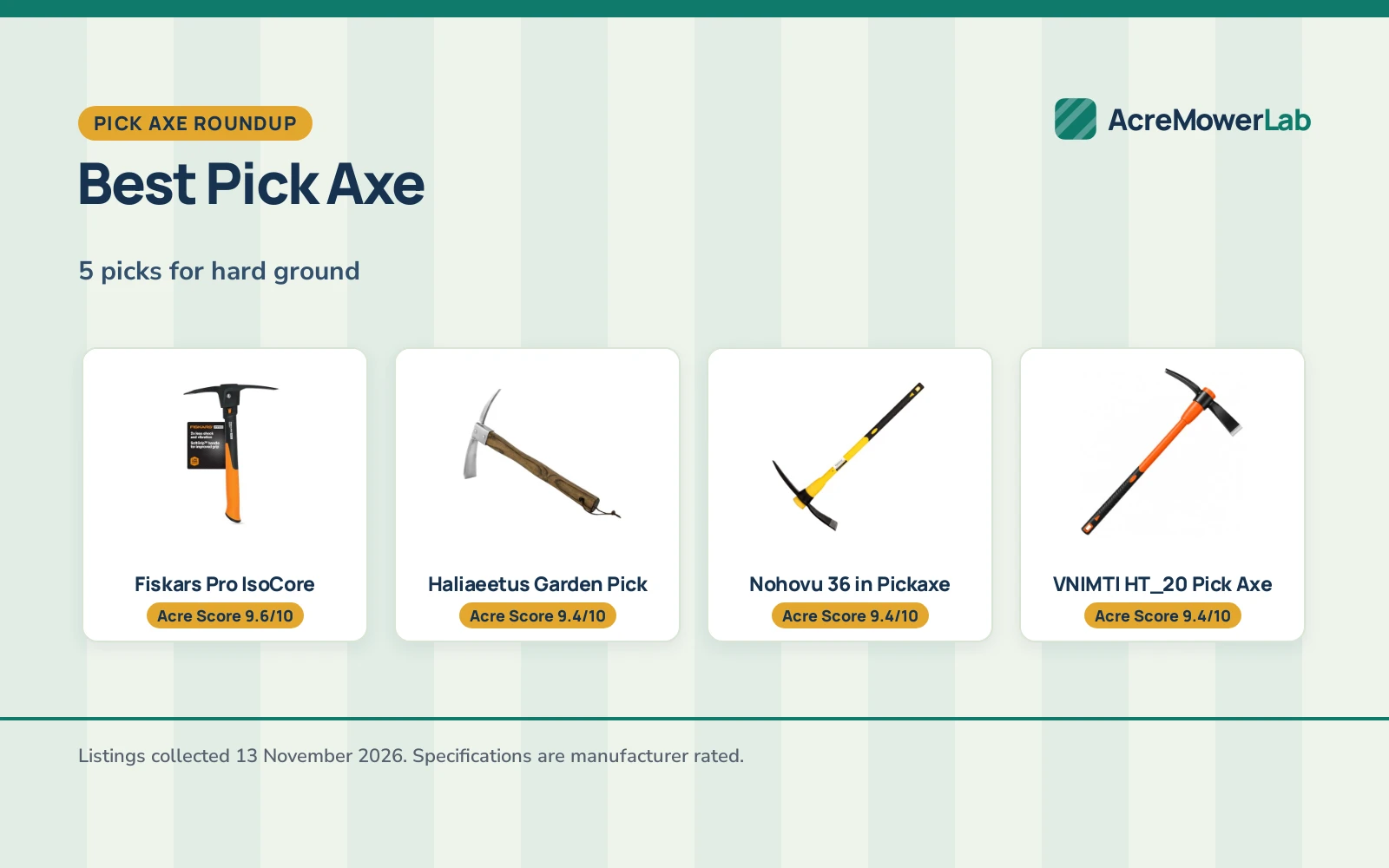
- Best Pick Axe (2026): 5 Picks for Hard Ground
- Hand Tiller vs Cultivator: Which One Should You Buy?
- Post Hole Digger vs Auger: Which One Should You Buy?
If you want a single pick axe rather than a comparison, see our best pick axe roundup.