Pole Pruner vs Pole Saw: Which One Should You Buy?
A plain comparison of reach tools for high branches: what each tool cuts, where each one fits, and how to choose between them.

On this page
Top picks at a glance
As an Amazon Associate I earn from qualifying purchases.
- 1
 Fiskars XtendControl Extendable Pole Saw and Tree Pruner9.8/10View on Amazon
- 2
 ECHO PPT-2620 Gas Pole Saw9.7/10View on Amazon
- 3
 Fiskars 8-12 Ft Extendable Tree Pruner and Pole Saw9.6/10View on Amazon
- 4
 GARTOL 32 Inch Cut and Hold Pole PrunerView on Amazon
- 5
 Fiskars 3-14 Ft XtendControl Extendable Pole Saw & TreeView on Amazon
- 6
 Supstable Cordless Pole Saw & Hedge Trimmer 6-in-1View on Amazon
- 7
 4.6-10 Ft Tree Trimmers Long Handle Pruner with Long ReachView on Amazon
- 8
 SENIX 8A Corded Electric Pole SawView on Amazon
- 9
 EGO PSA1020 10-Inch Carbon Fiber Pole Saw Attachment for EGOView on Amazon
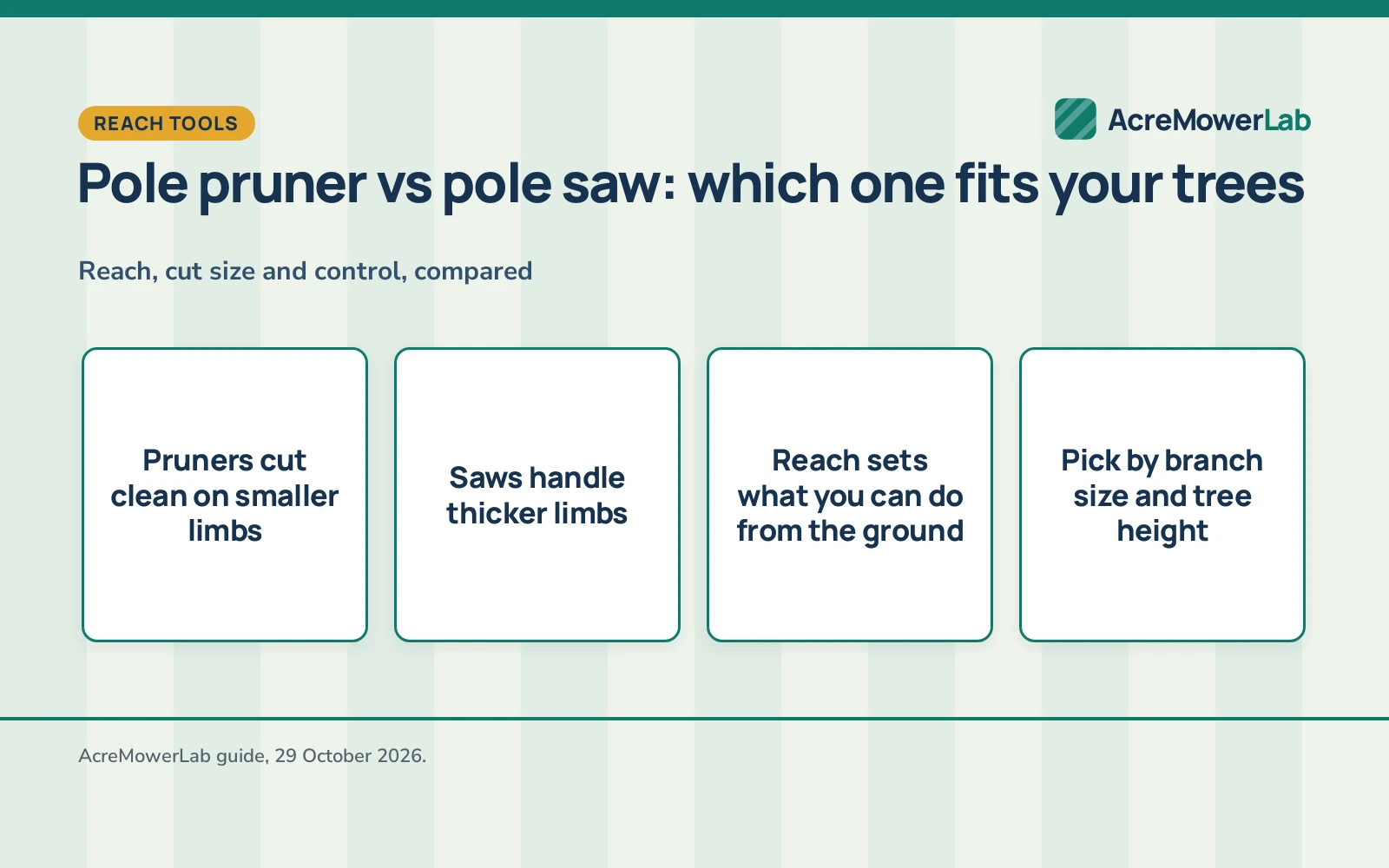
A branch hangs too high to reach from the ground, and the choice comes down to how it should be cut. That is the whole question behind pole pruner vs pole saw: a pole pruner closes a scissor head around a limb for a clean, controlled cut, while a pole saw draws a toothed blade back and forth through wood that is too thick for a scissor head. Pick the pruner when the limb fits the head and you want a neat cut, and pick the saw when the limb is thicker and needs sawing.
Other machines to compare
 GARTOL 32 Inch Cut and Hold Pole PrunerCheck price on Amazon
 Fiskars 3-14 Ft XtendControl Extendable Pole Saw & TreeCheck price on Amazon
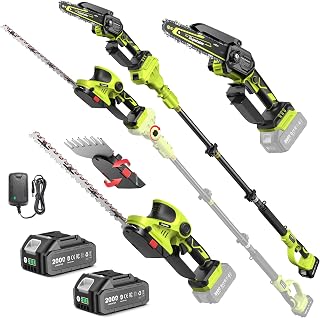 Supstable Cordless Pole Saw & Hedge Trimmer 6-in-1Check price on Amazon
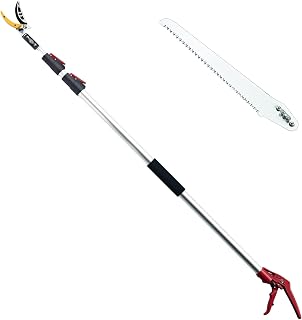 4.6-10 Ft Tree Trimmers Long Handle Pruner with Long ReachCheck price on Amazon
 SENIX 8A Corded Electric Pole SawCheck price on Amazon
 EGO PSA1020 10-Inch Carbon Fiber Pole Saw Attachment for EGOCheck price on Amazon
AcreMowerLab earns a commission when you shop through links here. It never changes your price. Affiliate disclosure.
pole pruner vs pole saw: what each tool does
A pole pruner is a long pole with a cutting head worked from the ground. A cord or lever closes the head around the limb, so the cut is made in one closing motion and the piece can be lowered with care. A pole saw is a long pole with a saw blade at the end, worked with a push and pull motion, so it can work through limbs that are too thick for a scissor head to close around. Both tools keep the operator on the ground instead of on a ladder, and both are aimed at high branches.
| Tool | Best for | Limit |
|---|---|---|
| Pole pruner | Smaller limbs where a clean, controlled cut matters | The head only closes around limbs that fit it |
| Pole saw | Thicker limbs that need sawing through | Slower, repeated strokes and more effort overhead |
| Combination kit | Yards with both small and thick high branches | More parts to carry and assemble |
See our best pole pruner roundup for more pruner options, and our pole saw vs loppers guide if the branch is low enough to reach without a pole.
How the cut differs
The pruner head decides what it can cut. The Fiskars set lists a fixed pruner head that slices through branches up to 1.25 inches thick, with an automatic cord reel that keeps the line taut and tangle-free. The Jameson kit lists a Big Mouth double-pulley pruner with a 1-3/4 inch cut capacity, and the maker states that the double-pulley design increases leverage and reduces the pulling effort required overhead. A pruner cut is neat because the blades close around the limb in one motion.
A saw blade has no closing limit. It cuts as far as the stroke and the blade length allow, so it suits limbs that have grown past pruner size. The Fiskars set pairs its pruner with a 15 inch X2 Hook Bill Saw with a triple-grind profile, and the hooked tip helps prevent the blade from slipping out of the cut. The Jameson kit pairs its pruner with a 16 inch Barracuda Tri-Cut blade with impulse-hardened teeth designed to reduce cutting effort. The VEVOR set takes a different route, with two dual-hook blades and a small saw alongside pruning scissors for detailed cuts, and the hook blade pulls back branches while the blade holes clear wood chips.
Reach: how high each kit goes
Reach is set by the poles, and each kit takes a different approach. The VEVOR set uses 8 adjustable sections and extends up to 27 ft, and the maker lists a recommended length for trimming of 20 ft, about 6 poles. The Jameson kit uses one 6-foot base pole and two 6-foot extension poles for up to 18 feet of assembled pole length, and sections can be added or removed to match the height of each job. The Fiskars set reaches 14 ft with two extension poles, and its modular design lets the user fit only the poles the job needs, which reduces the weight lifted compared with a fixed-length pole.
Longer is not always better overhead. A longer pole is harder to control, and the VEVOR listing itself suggests wearing back support for extended use. The Fiskars aluminum poles are described as lightweight to minimize arm fatigue at the full 14 ft reach, and the Jameson hollow-core fiberglass poles are described as combining low weight with strength and rigidity.
The gear, ranked
Three kits cover the choice, ranked here from the most complete setup to the longest reach.
The Jameson BL-6PKG-5 kit ranks at the top. It is a complete tree-trimming kit: a Big Mouth double-pulley pruner, a 16 inch Barracuda saw blade, three 6-foot fiberglass poles, a 20-foot pruner rope, a wooden pull handle, a Rope Ratchet, a rope storage bag and a three-pole grip. The pruner cuts up to 1-3/4 inches, the assembled poles reach 18 feet, and both the saw and the pruner include pole adapters, so switching tools does not mean replacing the complete pole assembly. The enamel surface on the poles helps prevent fiber blooming, and the Cut-Safe feature helps prevent unintended cuts.
The Fiskars XtendControl set comes next. It pairs a fixed pruner head with a 15 inch X2 Hook Bill Saw, reaches 14 ft, and uses lightweight aluminum poles with a snap-fit double-locking system and secondary security locks. The pruner slices branches up to 1.25 inches thick, the saw uses a triple-grind profile for thicker limbs, and the automatic cord reel keeps the line taut and tangle-free. Its modular design is the selling point: use only the poles the job needs and leave the rest behind.
The VEVOR manual pole saw offers the longest reach of the three. It extends from 3.87 ft to 27 ft across 8 adjustable sections, with a fiberglass pole of 1.26 inch diameter, dual-hook blades of 65Mn steel, which the maker lists with an electroplated rust-proof coating, a small saw and pruning scissors. Metal-threaded connections hold the sections together, and a sturdy carrying bag covers storage and transport. The tradeoff is weight: the listing states 15.7 pounds, so this is the kit to pick when the tallest branches matter more than the lowest weight.
Choosing between them
Start from the branch, not the tool. If most of the work is smaller live limbs where a clean cut matters, a pruner head does the job with less effort. If the work is thicker dead wood or limbs past pruner size, a saw blade is the right call. If the yard has both, a combination kit that swaps heads on the same poles covers both jobs without buying two full poles.
Then check reach and weight together. Stand on the ground and sight the tallest branch that needs cutting, then pick the kit whose reach covers it without going far past it. A pole that reaches well past the branch is harder to control than a shorter pole that just reaches it, and weight matters more the longer the pole stays overhead.
Storage matters too. The VEVOR set packs into a carrying bag, the Fiskars set breaks down for storage and transport, and the Jameson kit includes a rope bag and a three-pole grip.
Safety
Wear eye protection and sturdy shoes. Keep children, pets and bystanders away from the work area. These tools are made for work from the ground, so keep feet on stable ground and stay clear of falling limbs. For extended overhead work, the VEVOR listing suggests wearing back support.
FAQ: mowing large lots
Can a pole pruner cut a thick limb?
Only up to the head’s closing limit. The Fiskars pruner head slices branches up to 1.25 inches thick, and the Jameson pruner offers a 1-3/4 inch cut capacity. Past that size, switch to a saw; on the Fiskars and Jameson kits the saw head fits the same poles.
Do I need both a pole pruner and a pole saw?
It depends on the trees. Yards with only smaller live limbs can get by with a pruner, while yards with dead wood or thicker limbs need a saw. The Fiskars and Jameson kits pair both heads on the same poles, so one of those kits covers both jobs; the VEVOR set pairs blades and a small saw with pruning scissors for detailed cuts.
How much reach do I need?
Match the tallest branch that needs cutting. The kits here reach 14 ft, 18 feet and 27 ft, and a longer pole is harder to control overhead, so pick the reach that covers the job without going far past it.
Are manual pole tools heavy overhead?
Weight varies by kit. The VEVOR listing states 15.7 pounds, the Fiskars aluminum poles are described as lightweight to minimize arm fatigue, and the Jameson hollow-core fiberglass poles are described as combining low weight with strength. Modular kits help because only the poles the job needs have to be lifted.
Can these tools handle palms and shrubs?
The VEVOR listing describes its set for high branch trimming and for pruning palms and shrubs, and its pruning scissors suit detailed cuts on smaller growth. The Fiskars and Jameson listings describe high-branch work without naming palms or shrubs.
More mowing guides
- Best Pole Pruner (2026): 4 Picks for Trees and Hedges
- Best Pole Saw for Pine Trees (2026)
- Pole Saw vs Loppers: Which One Should You Buy?
- Best String Trimmer for Acreage: 4 Gas and Battery Picks
Use the Mower Matcher to narrow down choices by acreage, terrain, budget, and power type.