Pros and Cons of Riding Mowers (2026)
Compare the main benefits of riding lawn mowers, including rapid mowing and towing versatility, against higher purchase costs and storage requirements.

On this page
Top picks at a glance
As an Amazon Associate I earn from qualifying purchases.
- 1
 Eparts Riding Mower Garden Tractor Seat9.4/10View on Amazon
- 2
 Greenworks 80V 42" CrossoverT Cordless Riding Lawn Tractor9.5/10View on Amazon
- 3
 Electric Riding Lawn Mower9.5/10View on Amazon
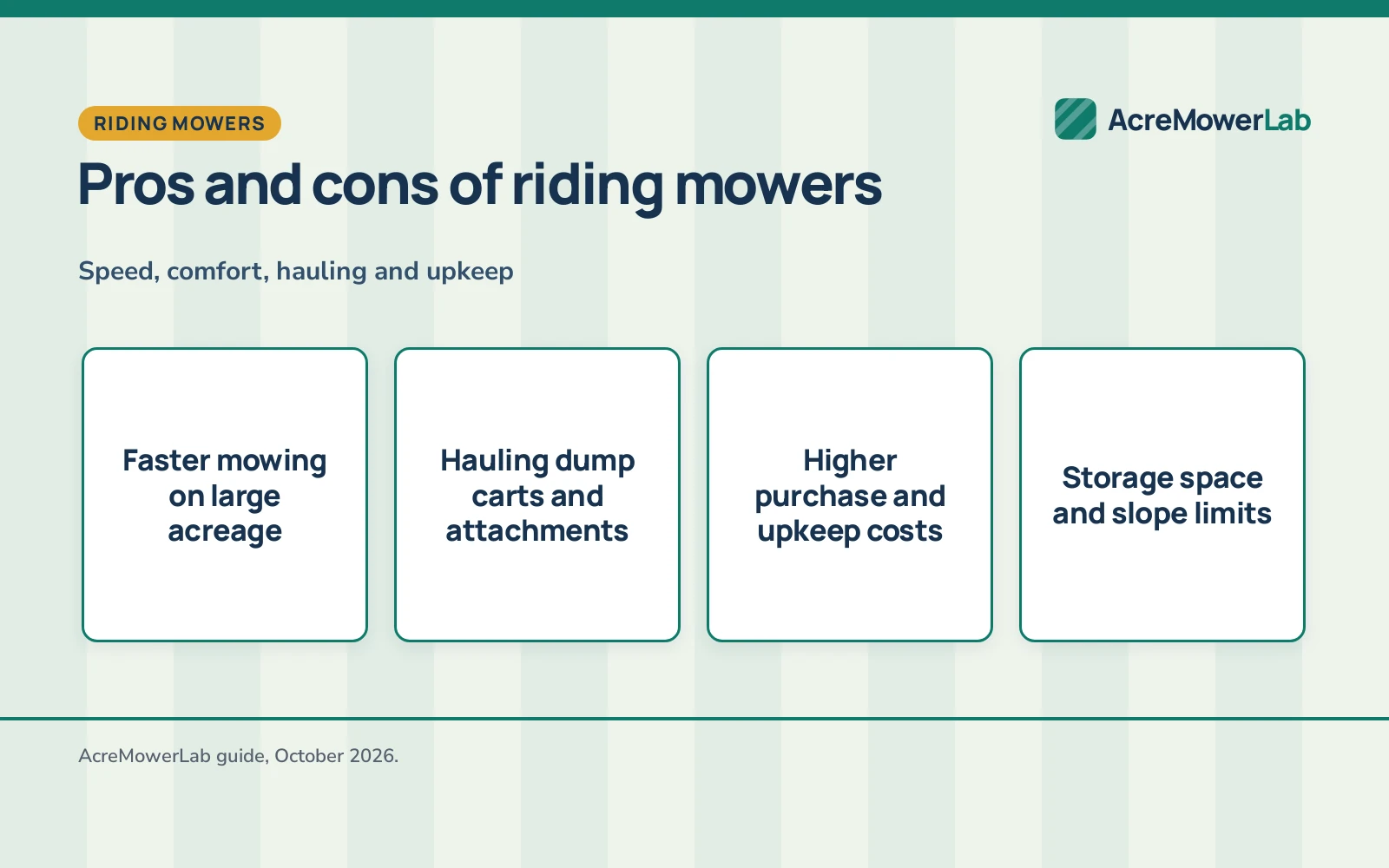
The main pros and cons of riding mowers center on cutting speed and comfort balanced against purchase price, storage space, and routine upkeep. On large properties, a riding mower cuts turf faster than a walk-behind unit, eliminates walking fatigue, and provides towing capability for dump carts and attachments. In exchange, owners face higher purchase costs, larger storage footprints, ongoing maintenance, and strict slope limits to prevent rollovers.
AcreMowerLab earns a commission when you shop through links here. It never changes your price. Affiliate disclosure.
Pros and cons of riding mowers: core tradeoffs at a glance
| Equipment | Primary advantages | Main drawbacks |
|---|---|---|
| Riding lawn mower | Seated comfort, wide cutting deck, towing for dump carts and attachments | Large storage footprint, higher purchase price, regular maintenance |
| Walk-behind mower | Compact storage, lower purchase cost, simple upkeep, agile in tight spots | Operator fatigue, narrow cutting path, no towing, slow on acreage |
| Zero-turn mower | Rapid mowing on flat turf, agile around obstacles, dual-lever steering | Premium price, steep learning curve, poor traction on damp hills, minimal towing |
Homeowners evaluating riding mowers often compare them directly against walk-behind mowers and zero-turn models. While zero-turn mowers focus on mowing speed around obstacles, a lawn tractor offers a balanced platform for mowing and yard chores. Read our guide on the lawn tractor vs riding mower difference.
Cutting speed and efficiency on large acreage
Mowing expansive acreage on foot demands substantial time and stamina. A walk-behind mower cuts a narrow swath, forcing an operator to walk miles back and forth across the property. During peak growing weeks, keeping up with mowing becomes difficult without dedicating entire afternoons to lawn care.
A riding mower increases efficiency by pairing a wider cutting deck with faster ground speeds. The broader deck covers more turf per pass, reducing mowing duration and letting the operator maintain a steady forward pace across open ground without tiring.
Operator comfort and reduced physical strain
Pushing a heavy lawn mower across uneven ground strains the back, legs, and joints, while summer heat compounds fatigue. For property owners managing large lawns, physical exertion turns routine mowing into an exhausting task.
Riding mowers eliminate this burden by placing the operator in a contoured seat with automotive-style steering and foot-pedal drive controls. Operators with joint discomfort, back stiffness, or mobility limits can finish mowing sessions comfortably without physical exhaustion.
Hauling utility carts and pull-behind attachments
Unlike walk-behind mowers, a riding lawn tractor features a rear hitch hole to pull aerators, spreaders, and utility dump carts across your property.
For moving firewood, mulch, soil, and branches, owners frequently hitch a metal dump trailer for riding lawn mower tasks. Specifications for aftermarket utility carts show available capacities, though owners must check their mower transmission towing limits. For example, VEVOR lists a heavy-duty steel dump trailer offering 17 cubic feet of space and a 600-pound load capacity, featuring 1mm thick side panels, 8 reinforcement ribs, 16-inch pneumatic tires, and a 0.47-inch hitch pin. Clyrava also lists a steel dump cart with 17 cubic feet of volume and a 600-pound capacity, reinforced by 1mm thick steel walls and 8 structural ribs.
For lighter tasks, YINTATECH specifies a steel dump cart rated for 350 pounds of payload that weighs 74 pounds. ExploreHorizon lists an 11.4 cubic feet steel dump cart rated for 500 pounds that tilts at a 45-degree angle, while TricaLktdp lists an 8 cubic feet utility trailer rated for 750 pounds with 16-inch pneumatic tires. Exceeding transmission limits causes transaxle wear. See our guide to the pull-behind dump cart category.
Purchase costs and ongoing maintenance expenses
The primary drawback of a riding mower is high purchase cost and recurring upkeep. A riding mower contains complex systems: an engine or battery pack, hydrostatic transaxles, cutting decks, belts, and safety switches.
Routine maintenance includes seasonal oil changes, filter and spark plug replacements, fuel stabilizer, and periodic blade sharpening. Belts stretch, starter batteries degrade, and spindles wear over time, requiring mechanical skills or professional service. Review our guide on how much does it cost to maintain a riding mower.
Storage space requirements and shed access
While a push mower folds neatly against a wall, a riding mower demands substantial floor space in a garage or shed. Measure doorways, gates, and ramp widths before purchasing to confirm the cutting deck and discharge chute can pass through.
Leaving equipment outdoors exposes the deck, belts, and wiring to moisture, sunlight, and rust. Providing sheltered, dry storage is essential for preserving the engine, paint, and battery life.
Maneuvering around landscaping and tight obstacles
Lawn tractors rely on front-wheel steering with a wide turning radius. While predictable on open straight passes, this creates challenges in yards with dense trees, garden beds, and narrow gates.
A riding tractor cannot pivot in place around circular beds. Operators must disengage the deck, back up, and realign for forward passes. Owners with complex landscaping typically need a secondary string trimmer or walk-behind mower to finish tight borders.
Slope stability and rollover prevention
Riding mowers carry a higher center of gravity than walk-behind mowers, introducing tip-over hazards on inclines and ditch banks. Mowing across a hillside can cause the machine to slide sideways or roll over, while wet turf degrades tire grip.
Operators must adhere strictly to manufacturer slope ratings, avoid damp hillsides, and mow up and down slopes rather than across them. Read our guide on the maximum slope for a riding mower.
Transporting equipment on a utility trailer
Transporting a riding mower for off-site service or multi-property upkeep requires a sturdy trailer with adequate width and weight capacity.
Loading ramps must support the mower’s wet weight. For low thresholds and trailer decks, Vlaeng lists aluminum ramps measuring 4FT in length supporting an 880-pound capacity across a set of 2 ramps, with a stated maximum rise of 13.5 inches for 4-to-12-inch steps. The maker highlights a punched non-slip surface and explicitly instructs users never to ride equipment when using the ramp. Guiding the mower from ground level prevents backward tip-overs. See our guides to the trailer for a riding lawn mower and mower ramps.
Safety
Follow manufacturer procedures to prevent accidents. Never exceed the maker’s max slope rating listed in your manual, as steep grades increase rollover risks. Zero-turns lose traction on slopes and near ponds or ditches, causing sudden steering loss on damp turf.
Where ROPS and seat belt are equipped, keep the bar deployed and fasten the belt. Never carry passengers; extra riders face severe falling and blade-contact hazards. Keep children and pets out of the yard entirely while mowing.
Turn blades off when reversing to prevent back-over accidents. Shut down the engine, engage the parking brake, and remove the key before inspecting the deck. Refuel only with engine off and cool to prevent fire. Wear eye protection, hearing protection, and sturdy footwear.
FAQ: mowing large lots
What are the primary pros and cons of riding mowers?
Pros include rapid cutting speed on large lawns, reduced physical fatigue, and towing capability for yard carts. Cons include higher purchase prices, routine maintenance, large storage footprints, and slope tip-over hazards.
How to tie down a riding mower on a trailer?
Position the machine facing forward on the trailer deck. Lower the mower deck fully, engage the parking brake, shut off the engine, and close the fuel valve. Attach ratchet straps to structural frame points rather than steering or deck linkages, ratcheting down until the chassis settles firmly.
Will a riding mower run without a battery?
No, modern riding mowers will not run without a battery. Modern engines use an electric carburetor fuel solenoid that requires battery current to stay open; without a battery, fuel is cut off. Running without a battery can also damage the charging system and voltage regulator. See our review of the battery maintainer for riding mowers.
Is a riding mower or a zero-turn better for rolling terrain?
A traditional lawn tractor provides better stability on moderate slopes when mowing up and down the grade. Conventional linked front wheels maintain steering control, whereas zero-turn front caster wheels pivot freely and can slide downhill on wet turf.
What property size justifies buying a riding mower?
A riding mower is practical once mowing on foot consumes excessive time and physical energy. Large lawns, gentle slopes, and hauling chores benefit most from the speed, seating comfort, and towing capability of a riding machine.
More mowing guides
- Lawn Tractor vs Riding Mower: What Is the Difference?
- What Size Riding Mower Do I Need?
- How Much Does It Cost to Maintain a Riding Mower?
- Best Trailer for Riding Lawn Mower (2026): 5 Top Picks Compared
Use the Mower Matcher to narrow down choices by acreage, terrain, budget, and power type.