Rotary Hoe vs Tiller: Which One Should You Buy?
Rotary hoe vs tiller compared on blades, tines, handles, depth and weight, with two examples of each from the listings reviewed for this article.

On this page
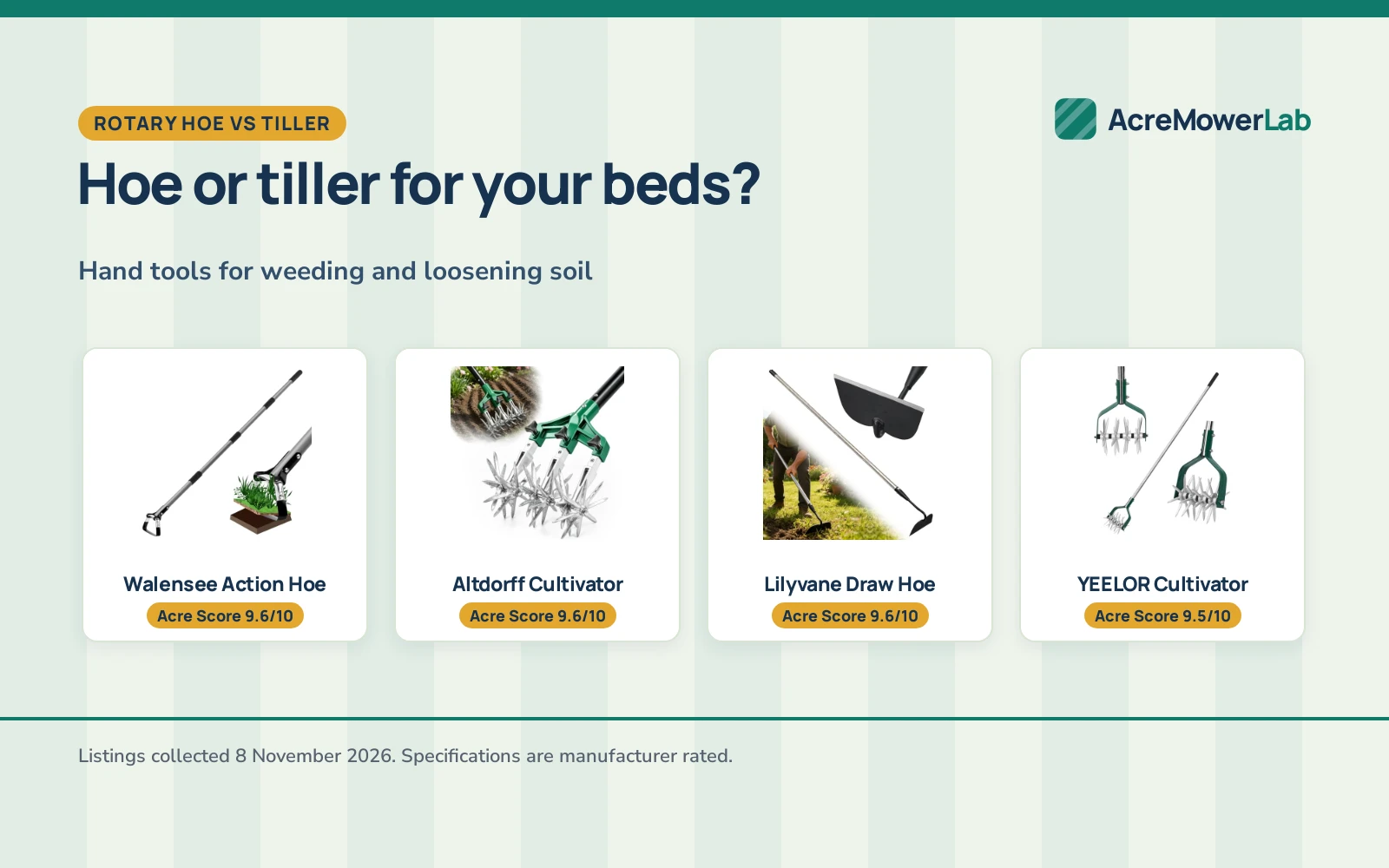
Top picks at a glance
As an Amazon Associate I earn from qualifying purchases.
- 1
 Walensee Action Hoe with Adjustable 36-66 Inch Handle9.6/10View on Amazon
- 2
 Altdorff Rotary Cultivator with Detachable Tines9.6/10View on Amazon
- 3
 Lilyvane Garden Hoe for Weeding with 60 Inch Handle9.6/10View on Amazon
- 4
 YEELOR Rotary Cultivator with 57 Inch Handle9.5/10View on Amazon
Verdict: Choose a rotary hoe if your work is weeding, furrowing and loosening soil in beds and rows by hand. Choose a tiller if you want star-shaped tines that roll through the soil to break clods and mix in fertilizer for seedbeds and small plots.
The rotary hoe vs tiller question comes down to how the tool meets the soil. A rotary hoe is a hand hoe you push and pull through weeds and soil: the Lilyvane draw hoe carries a blade, the Walensee a triangular loop. A manual tiller rolls star-shaped tines across the ground to crush clods and loosen the surface. This comparison covers the differences, then four examples from the listings reviewed for this article.
AcreMowerLab earns a commission when you shop through links here. It never changes your price. Affiliate disclosure.
The four examples
Walensee Action Hoe with Adjustable 36-66 Inch Handle
A stirrup hoe with a triangular loop head and an adjustable 36-66 inch handle that screws together from 4 pieces, built from hand-forged and welded steel with a cushioned grip.
Who it's for: gardeners who weed beds, rows and borders standing up and want the handle length to fit their height.
Who should skip it: anyone who needs to break hard, compacted ground; the loop cuts weeds and shallow roots. The listing states a satisfaction offer with no term or length attached, so it scores zero for warranty. Note the listing disagrees with its own spec table on length: the text states a 66 inch handle while the spec table gives a different figure, so trust the text.
The Walensee is a stirrup hoe, also called an action hoe, with a triangular loop head that cuts weeds and shallow roots on the push and the pull. The handle adjusts from 36 to 66 inches and screws together from 4 pieces with no extra tools, and the grip is cushioned rubber. The maker lists hand-forged and welded steel, heat treated for durability.
Pros
- Adjustable 36-66 inch handle fits gardeners of different heights
- Triangular stirrup head cuts weeds with a push-and-pull motion
- Hand-forged, welded and heat-treated steel blade
- Cushioned rubber grip for long weeding sessions
Cons
- No warranty term is stated; the satisfaction offer has no stated length
- Weight is not stated
- Loop head only cuts weeds and shallow roots, per the listing
Altdorff Rotary Cultivator with Detachable Tines
A manual rotary cultivator with 3 detachable star-shaped steel tines that reach 1.5 in into the soil, on a 61 in 3-section steel handle, for aerating, reseeding grass and loosening shallow soil.
Who it's for: owners who aerate lawns, reseed grass and loosen beds and fence lines by hand.
Who should skip it: anyone breaking new ground or working deep soil, which the 1.5 in tines do not reach. The listing states a 61 in handle in the title and 62.7 inches in the spec table; trust the title.
The Altdorff is a hand rotary cultivator built around a polished steel head with 3 detachable tines forged in a star shape. The tines reach 1.5 in deep to crush soil and loosen the shallow layer before planting, and removing the center tine lets the tool work around living plants. The handle is solid steel in 3 sections.
Pros
- 3 detachable tines adjust for narrow rows and around plants
- Star-shaped tines reach 1.5 in to crush soil and loosen the shallow layer
- Solid steel head and handle, no plastic in the head
- Works in flower beds, fence lines and narrow corners
Cons
- Warranty is not stated on the listing
- Weight is not stated
- Manual rolling tines suit shallow work, not deep tilling
Lilyvane Garden Hoe for Weeding with 60 Inch Handle
A heavy-duty draw hoe with a pre-sharpened forged steel blade and a 60 in splicing stainless steel handle, made for weeding, plowing, cultivating, trenching, ridging and loosening soil while standing.
Who it's for: gardeners who weed and shape beds standing up and want one tool for weeding, furrowing and trenching.
Who should skip it: anyone who needs to break clods or mix fertilizer into the soil, which calls for a rotary tiller. The title states a 60 in handle while the spec table lists 66.0 inches; trust the title.
The Lilyvane is a draw hoe with a pre-sharpened forged steel blade on a long splicing stainless steel handle. The blade cuts weeds, loosens compacted soil, trims grass edges and opens furrows, and the push-and-pull motion keeps the work moving with less strain on arms, wrists and shoulders.
Pros
- Pre-sharpened forged steel blade slices roots and surface weeds
- 60 in splicing handle lets you work standing upright
- Push-and-pull motion suits older or less strong users
- Covers tight spots between plants and wide open beds
Cons
- Warranty is not stated on the listing
- Weight is not stated
- Blade work only; no tines for breaking clods or mixing soil
YEELOR Rotary Cultivator with 57 Inch Handle
A compact manual rotary cultivator with 4 eight-tooth aluminum alloy tilling heads on a 57 in adjustable multi-section handle, for loosening soil, mixing fertilizer and preparing seedbeds in small plots.
Who it's for: gardeners with small plots who want a light tool for seedbeds and surface loosening.
Who should skip it: anyone working hard or dry ground; the listing says it works best on loose to moderately compacted soil and slightly moist soil. The bullets state a weight of 1.2 lbs while the spec table lists 2.4 pounds; trust the bullets.
The YEELOR is a compact manual rotary cultivator with star-shaped rollers and 4 eight-tooth aluminum alloy tilling heads. The 57 in multi-section handle adjusts for different heights, and the maker lists a stainless steel pole, aluminum alloy rollers and reinforced manganese steel splints. It suits seedbed preparation, soil loosening, aeration and fertilizer mixing in vegetable gardens, raised beds and flower beds.
Pros
- 4 eight-tooth aluminum alloy heads break clods and make fine, loose soil
- 57 in adjustable handle fits different heights and reduces bending
- Stainless steel pole with aluminum alloy rollers and manganese steel splints
- Lightweight build suits raised beds, flower beds and small plots
Cons
- Warranty is not stated on the listing
- Suits loose to moderately compacted soil, not hard ground
- Best on slightly moist soil, per the listing
Other machines to compare
 Tomerry Japanese Hoe and Cultivator Hand TillerCheck price on Amazon
 14-Inch Electric Tiller Cultivator with 8.7-Inch TilllingCheck price on Amazon
 Garden Weasel Rotary Cultivator 72" Hand TillerCheck price on Amazon
 Farmer-Helper 37" Adjustable Offset 3pt Rotary Tiller FH-TL95Check price on Amazon
 BARAYSTUS Rotary Cultivator Garden Rotary Tiller AdjustableCheck price on Amazon
 Walensee Rotary CultivatorCheck price on Amazon
Rotary hoe vs tiller side by side
| Factor | Walensee Action Hoe | Altdorff Cultivator | Lilyvane Draw Hoe | YEELOR Cultivator |
|---|---|---|---|---|
| Tool type | Stirrup hoe | Manual rotary cultivator | Draw hoe | Manual rotary cultivator |
| Head | Triangular stirrup loop | 3 detachable star-shaped tines | Pre-sharpened forged steel blade | 4 eight-tooth aluminum alloy heads |
| Handle | Adjustable 36-66 in, 4 pieces | 61 in, 3-section steel | 60 in splicing stainless steel | 57 in multi-section, adjustable |
| Tilling depth | Not stated | Tines reach 1.5 in | Not stated | Not stated |
| Weight | Not stated | Not stated | Not stated | 1.2 lbs (bullets); 2.4 pounds (spec table) |
| Best at | Weeding, ditching, seeding, loosening soil | Aerating, reseeding grass, loosening shallow soil | Weeding, furrows, trenching, ridging | Seedbeds, raised beds, fertilizer mixing |
| Warranty | Satisfaction offer, no term stated | Not stated | Not stated | Not stated |
Figures are manufacturer stated for the four example models, collected 8 November 2026.
Heads: blade or tines
A rotary hoe cuts with a blade or a loop. The Lilyvane draw hoe carries a pre-sharpened forged steel blade that slices roots and surface weeds, while the Walensee stirrup hoe uses a triangular loop that cuts on the push and the pull. The Lilyvane listing also lists trenching, ridging and loosening compacted soil, and neither hoe listing states a working depth.
A tiller rolls tines through the soil. The Altdorff cultivator uses 3 detachable star-shaped tines that reach 1.5 in, and the YEELOR uses 4 eight-tooth aluminum alloy heads. The tines crush clods and open the surface: the Altdorff listing says the loosened layer provides air and nutrition before cultivating, and the YEELOR mixes in fertilizer.
Handles and reach
Handle length decides whether you work standing up. The Lilyvane handle is 60 in per the title, the Walensee adjusts from 36 to 66 inches, the Altdorff is 61 in, and the YEELOR is 57 in. The Lilyvane handle screws together, and the listing says the splicing design allows easy assembly and storage. The Walensee screws together from 4 pieces. The Altdorff handle is 3-section steel, and the YEELOR handle is multi-section and adjustable.
What each one can do
A rotary hoe suits weeding between plants, along borders and near roots, plus furrows, trenching and ridging. A tiller suits seedbed preparation, loosening soil, aeration and mixing fertilizer in vegetable gardens, raised beds and flower beds. Neither side is powered here: all four examples are manual tools, so the work comes from your arms and the leverage of the tool.
Weight and handling
Only the YEELOR listing states a weight, and it states two: 1.2 lbs in the bullets and 2.4 pounds in the spec table. The other three listings state no weight, so compare the tools in hand if weight matters to you. The rotary hoes are hand tools on long handles: the Lilyvane carries a single blade, the Walensee a triangular loop. The tillers roll on their tines: the Altdorff works with a forth-and-back motion, and the YEELOR uses star-shaped rollers.
Upkeep
The listings state materials, not upkeep steps. The Walensee head is hand-forged and welded steel, the Altdorff head is polished steel with no plastic, and the YEELOR uses aluminum alloy rollers with manganese steel splints. No listing states a warranty term; the Walensee states a satisfaction offer with no term attached.
Acreage and terrain fit
Walensee Action Hoe
Altdorff Cultivator
Lilyvane Draw Hoe
YEELOR Cultivator
Matching It to Your Property
- Beds and rows: a rotary hoe works between plants and along borders without disturbing roots.
- Seedbeds and small plots: a manual tiller loosens the surface and mixes fertilizer before planting.
- Narrow corners: the Altdorff tines detach, so it works fence lines and tight rows.
- Storage: the Lilyvane handle screws together, the Walensee from 4 pieces, and the Altdorff and YEELOR handles are built in sections.
The Acre Score explained
The Acre Score weighs performance, build, value, safety and warranty. A factor the listing does not state scores zero, which is why all four examples score zero for safety and warranty.
| Product | Acre Score | Perf. /35 | Build /25 | Value /25 | Safety /10 | Warranty /5 |
|---|---|---|---|---|---|---|
| Walensee Action Hoe | 9.6 | 29 | 21 | 21 | n/a | 0 |
| Altdorff Cultivator | 9.6 | 29 | 21 | 20 | n/a | 0 |
| Lilyvane Draw Hoe | 9.6 | 28 | 20 | 20 | n/a | 0 |
| YEELOR Cultivator | 9.5 | 27 | 20 | 19 | n/a | 0 |
The bottom of our scale is 9.2 and the top is 9.8; weighted totals map onto it in a straight line, keeping their order. If an item uses no power and names no safety feature, safety is dropped and the scale becomes 90 points.
A rotary hoe covers weeding near the house, and a manual tiller covers seedbeds and small plots. If you need powered tilling for larger ground, see the tillers and cultivators for the full range.
Buried utility lines are a real risk: in the US, call 811 a few days before you dig or till new ground. Wear eye protection and sturdy boots, keep feet and hands away from the tines, and start on clear, rock-free soil. Refuel only with the engine off and cool. Read our Safety Disclaimer.
FAQ: mowing large lots
Can a rotary hoe break up hard soil?
None of the four listings claims to break hard ground. The Lilyvane listing says its blade loosens compacted soil and breaks up tough soil, while the YEELOR listing says it works best on loose to moderately compacted soil and slightly moist soil. The Altdorff tines reach 1.5 in, so they loosen the shallow layer.
What is the difference between a rotary hoe and a tiller?
A rotary hoe is a hand hoe for weeding and loosening soil: the Lilyvane carries a blade, the Walensee a triangular loop. A tiller rolls tines through the soil to crush clods and mix fertilizer. The rotary hoe vs tiller choice comes down to weeding or soil preparation.
Which handle length should I pick?
Match it to your height so you can work standing upright. The Walensee adjusts from 36 to 66 inches, the Lilyvane is 60 in, the Altdorff is 61 in, and the YEELOR is 57 in.
Can a manual tiller prepare a seedbed?
Yes, for small plots. The YEELOR suits seedbed preparation, soil loosening, aeration and fertilizer mixing in vegetable gardens, raised beds and flower beds, and works best on slightly moist soil.
Which one is better for weeding between rows?
A rotary hoe. The Walensee stirrup hoe cuts weeds between plants and along borders without damaging them, and the Lilyvane draw hoe handles tight spots and wide areas. A tiller can also work narrow rows: the Altdorff lets you remove the center tine to till around living plants.