String Trimmer Head Types Explained
String trimmer heads come as bump-feed, fixed-line and blade types, and the right choice depends on rotation, adapters and line size.

On this page
Top picks at a glance
As an Amazon Associate I earn from qualifying purchases.
- 1
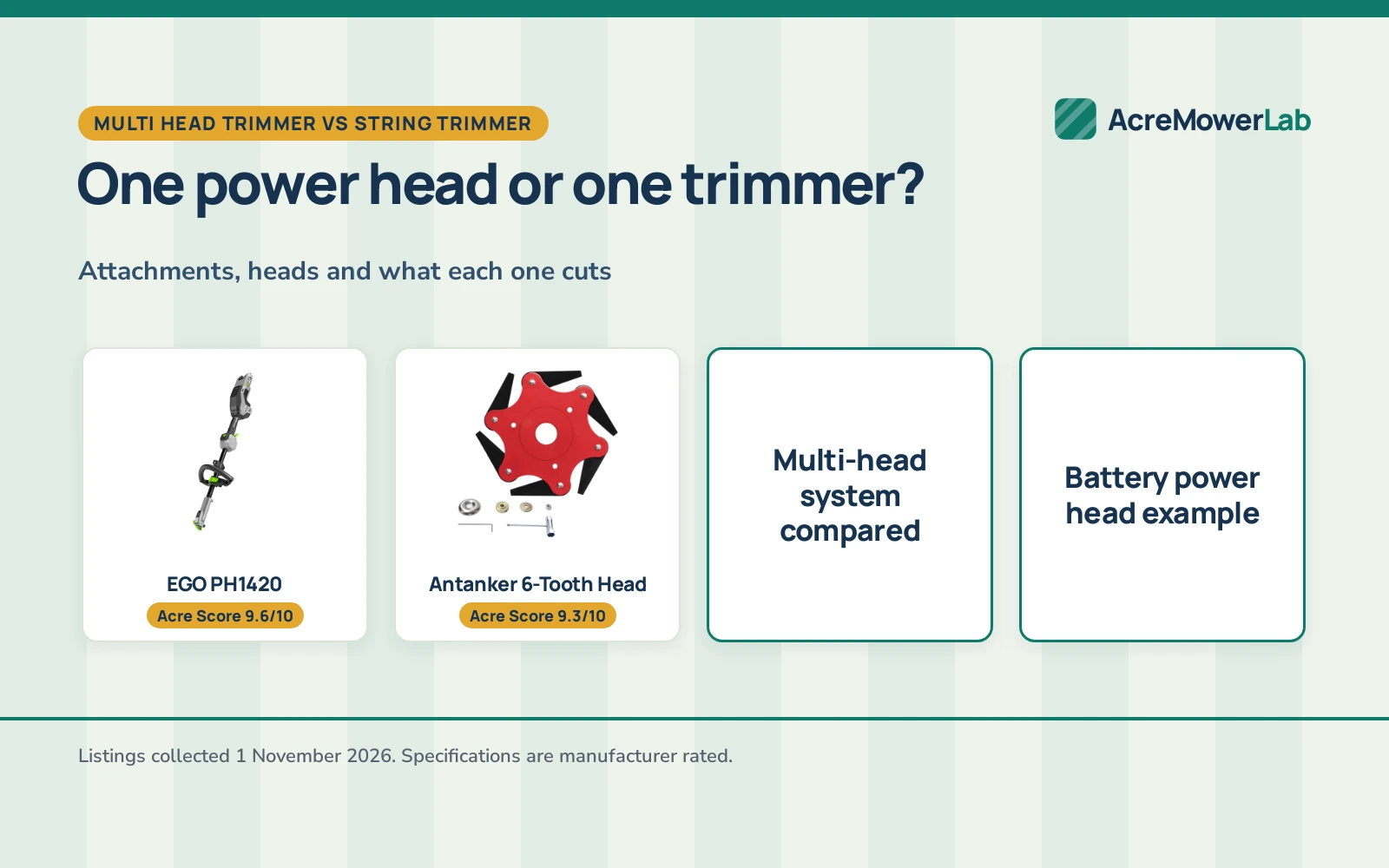
 Antanker 6-Tooth Steel Trimmer Head for String Trimmers9.3/10View on Amazon
- 2
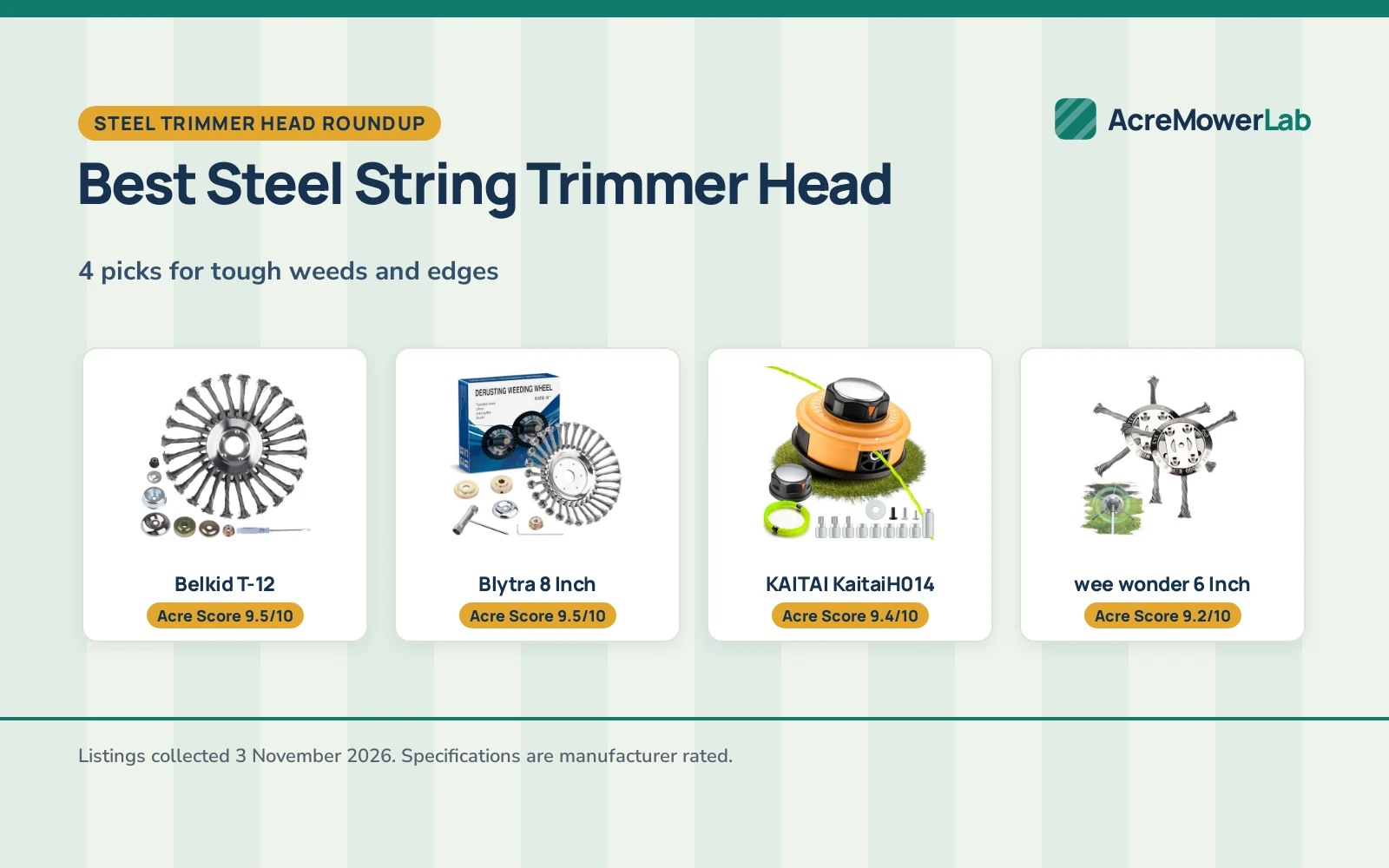
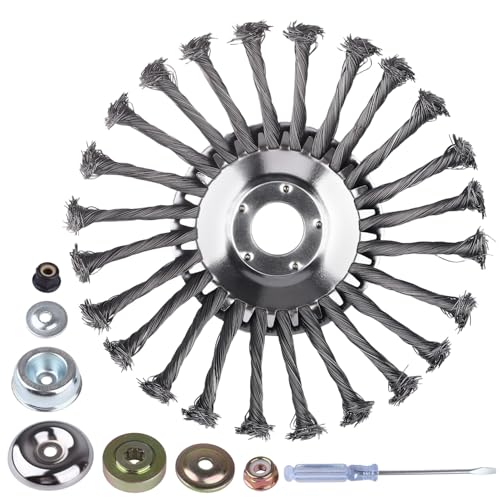 Belkid 8 Inch Steel Wire Grass Trimmer Head with Universal9.5/10View on Amazon
- 3
 Blytra 8 Inch Wire Brush Weed Trimmer Head9.5/10View on Amazon
Along the fence line the grass grows thick where the mower cannot reach, and around the driveway the weeds push through the cracks. A string trimmer handles that edge work, and the head at the end of the shaft decides how the line feeds and what it can cut. String trimmer head types fall into a few groups: bump-feed heads that release line with a tap, fixed-line heads that take pre-cut lengths, and blade heads that swap line for a cutting blade. Some heads are also sold as universal-fit, which means they ship with adapter nuts for many brands instead of fitting a single model. Each type suits a different kind of yard work, and the right choice starts with the trimmer it must fit.
AcreMowerLab earns a commission when you shop through links here. It never changes your price. Affiliate disclosure.
String trimmer head types: the main kinds
Most heads belong to a small set of designs, and each design feeds line in its own way.
| Type | How line feeds | Suits | Watch for |
|---|---|---|---|
| Bump-feed | Tap the head on the ground to release line | Lawns, edges and fence lines | Line can jam if the head is dirty |
| Fixed-line | Pre-cut lengths load through the head | Heavy growth, cracks and tough weeds | Line runs out and must be reloaded |
| Blade head | Metal blade instead of line | Thick stalks and brush | Needs care around hard objects |
A bump-feed head suits the weekly pass around the lawn, where the line wears a little at a time and a tap restores the length. A fixed-line head suits the rougher jobs, where a simple load matters more than feeding on the move. A universal-fit head suits a replacement, since it is built to fit many brands rather than a single model. Universal fit is a fitting, not a feed type: the Rivenox head in this guide is a universal-fit fixed-line head, so it loads pre-cut line and fits many brands. A blade head suits brush and thick stalks that line alone cannot cut. See our best trimmer head roundup for how these types sort across current picks.
How to tell which head fits your trimmer
Fit comes down to rotation, adapters and line size, and the listing for a head states each of them. Start with rotation: trimmers spin clockwise or counterclockwise, and the head must match the spin of the shaft. The Rivenox head in this guide works with both clockwise and counterclockwise rotation trimmer heads, so rotation is not a barrier there, but many heads are built for a single direction, so check the trimmer manual before ordering.
Next come the adapters. A universal-fit head ships with nuts that thread onto the trimmer shaft, and the Rivenox listing states that 3 nuts are included: M10*1.25 LH, M10*1.0 LH and M8*1.25 LH. Double-check that the trimmer shaft matches a nut in the box before buying, since an adapter that does not thread on is a head that cannot be fitted at all.
Finally, check the power type. The Rivenox head fits most gas and electric string trimmers, including Echo, EGO, Stihl, Husqvarna, Ryobi and Redmax, so it covers the common brands on either side of the gas and electric divide. A head that lists only gas trimmers may not suit a battery unit, and the reverse holds too, so read the fit list rather than assuming a head fits every trimmer.
Line size and what it cuts
Line diameter decides what the head can cut and how long the line lasts. The Rivenox head takes trimmer line diameters from .08 to .118 inches, which covers the light line used for lawn edges and the heavier line used for thick weeds. Thinner line cuts cleanly through soft grass and wears faster, while thicker line holds up against tough growth and costs more effort from the trimmer. Match the line to the job: light line for the weekly edge pass, heavier line for the fence line and the driveway cracks.
The listing also states the line that comes in the box: 12 pre-cut 0.095 inch round trimmer lines. Pre-cut line suits a fixed-line head, where each length loads through the head and is swapped out when it wears down, rather than winding a spool. A round profile is the plain choice for general trimming. Our best string trimmer line roundup covers line shapes and sizes in more depth.
Changing line on a fixed-line head
A fixed-line head trades the spool for speed. The Rivenox head uses a twist-on cap that holds trimmer line firmly, and the line can be swapped out on the fly without removing the trimmer head. That matters on a long fence line, where stopping to wind a spool would break the rhythm of the work. Load a fresh pre-cut length, twist the cap shut, and keep trimming. Keep a few spare lengths in a pocket so a worn line does not end the job early. See our how to install trimmer line guide for the steps in detail.
What a head is made of
Heads take a beating, so the material matters as much as the design. The Rivenox head is made from reinforced fiberglass nylon with rust-proof metal hardware, a mix that resists wear, impact and corrosion. A head that cracks or strips its threads will not hold line, so check the cap and the hardware when the line starts feeding poorly. Store the trimmer with the head off the ground and out of the weather.
Safety
Wear eye and hearing protection and sturdy shoes, and clear sticks, stones and other debris before trimming. Keep children, pets and bystanders away from the work area, and never point the head toward people or parked cars. Shut the trimmer off before changing line or clearing a jam, and check that the head is tight before each use. Our metal vs nylon trimmer head comparison covers which head material suits which job.
FAQ: mowing large lots
What string trimmer head type is easiest for a beginner?
A universal-fit fixed-line head with a twist-on cap is the easy start: it fits many brands, loads with pre-cut line, and needs no spool winding. The Rivenox head ships with 12 pre-cut lines and a twist-on cap, so a beginner can change line without taking the head apart.
Can a single head fit different trimmer brands?
Yes, if it is built as a universal-fit head. The Rivenox head fits most gas and electric string trimmers, including Echo, EGO, Stihl, Husqvarna, Ryobi and Redmax. Check the rotation and the adapter nuts before ordering, since fit still depends on the shaft.
What line diameter does a trimmer head take?
It depends on the head. The Rivenox head takes line diameters from .08 to .118 inches, and it ships with 12 pre-cut 0.095 inch round lines. Check the listing for the range the head accepts, and use line inside that range.
How do I know if my trimmer spins clockwise or counterclockwise?
Check the trimmer manual or the marking on the trimmer head. A universal-fit head that works with both clockwise and counterclockwise rotation, such as the Rivenox head, removes the question entirely.
When should a trimmer head be replaced?
Replace the head when line feeds poorly even with fresh line, when the cap no longer holds, or when the hardware is worn or cracked. A head that will not stay tight on the shaft is past its useful life, and a universal-fit head is a straightforward replacement.
More mowing guides
- Best Trimmer Head (2026)
- Best String Trimmer Line (2026)
- How to Install Trimmer Line on a String Trimmer
- Metal vs Nylon Trimmer Head: Which One Should You Buy?
See the trimmer and blower guides for more on heads, line and trimmer care.