Trimmer Head Parts: Spools, Caps and Replacement Heads
A plain guide to trimmer head parts: spools, caps, line, adapters and replacement heads, with fit checks for common string trimmers.

On this page
Top picks at a glance
As an Amazon Associate I earn from qualifying purchases.
- 1
 Envanptaz STH-002 2-Pack Speed Feed 400 Trimmer Head for Echo9.6/10View on Amazon
- 2
 Grass Gator 4600 Heavy Duty Trimmer Head9.6/10View on Amazon
- 3
 CZS 6 Steel Razors Trimmer Head and 36 Teeth Brush Cutter9.6/10View on Amazon
Along fence lines, around trees and beside paths, grass keeps growing where a mower deck cannot reach, and a string trimmer head does the close work. When line stops feeding, a cap cracks or a spool wears smooth, trimmer head parts are the pieces that bring the head back to steady cutting, and this guide names each part, shows how it fits and explains how to choose a replacement that matches the trimmer.
AcreMowerLab earns a commission when you shop through links here. It never changes your price. Affiliate disclosure.
Trimmer head parts: the spool, the cap and the line
| Part | What it does | When it wears |
|---|---|---|
| Spool | Holds wound line and lets it feed out through the eyelets | Wears smooth or cracks with age and use |
| Cap and cover | Holds the spool in the housing and lets line feed through eyelets | Cracks, threads wear, or line slips |
| Trimmer line | Cuts grass and weeds at the edge of the head | Wears short, frays, or snaps on hard stems |
| Adapter nuts | Join the head to the trimmer shaft | Threads that do not match the shaft will not seat |
| Housing and head body | Holds the spool, cap and line together as a unit | Cracks or worn eyelets let line feed unevenly |
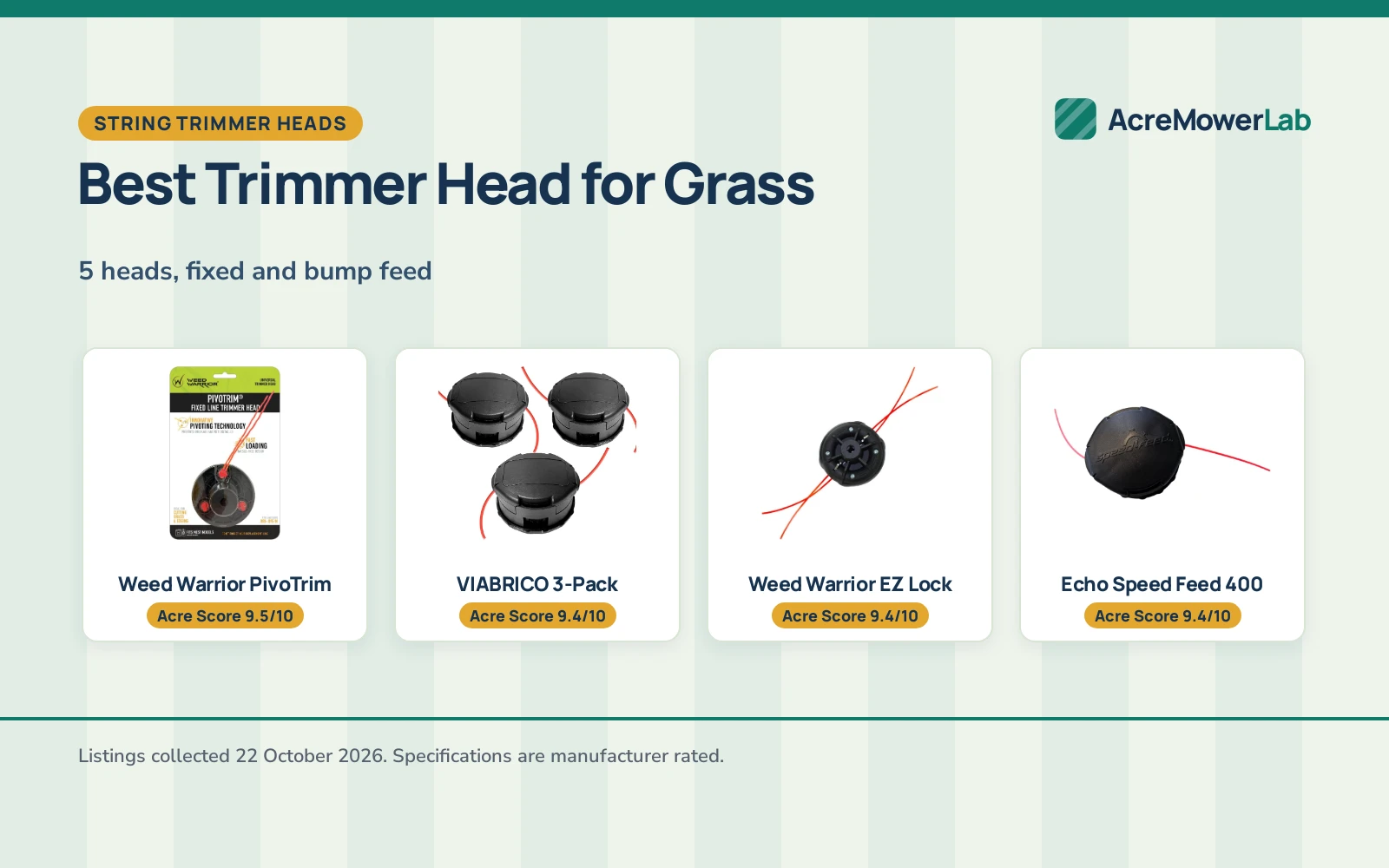
Most trimmer heads use the same set of parts, even when the shape and the feed style differ. A bump-feed head and a fixed-line head both need a body that holds the cutting line, a way to hold that line in place, and a way to join the head to the shaft, while a blade head holds blades instead of line. The string trimmer head types guide covers the feed styles, and the best trimmer head roundup covers complete heads.
Check fit before ordering
Fit comes before brand and line shape. A head that does not match the shaft will not seat, and line that does not match the head will not feed. Start with the trimmer manual and the old head: note the shaft thread, the rotation direction and the line diameter the head accepts. The maker of a universal head lists fit for most gas and electric string trimmers, including Echo, EGO, Stihl, Husqvarna, Ryobi, Redmax, DeWALT, Craftsman, Cub Cadet, Milwaukee, Weed Eater, Poulan and MTD, and lists clockwise and counterclockwise rotation.
The same maker lists 3 nuts in the package: M10*1.25 LH, M10*1.0 LH and M8*1.25 LH. Compare those threads with the shaft thread on the trimmer before ordering, and keep the old head and its nut beside the new parts while checking. If none of the nuts in the package matches, order the adapter that matches the shaft rather than forcing a nut that feels tight. A nut that cross-threads can damage the shaft and leave the head loose in use.
Work through the parts in order
Take the head apart in the order it comes together, and lay the parts out in a row so the order stays clear. Remove the cap, lift out the spool, and set the spring and the eyelets aside where they will not roll away. Look at each part in turn: the spool for cracks and worn grooves, the cap for cracks and worn threads, the eyelets for rough edges that catch line, and the housing for cracks around the rim.
Load line the maker describes
Line size matters as much as line length. The maker lists trimmer line diameters from .08 to .118 for a universal head, so match the line to the head and to the grass being cut. Light line suits light grass along edges and paths, while heavier line suits thick weeds and rough ground. A line that is too thick for the head will not feed through the eyelets, and a line that is too thin can slip and wear fast. The maker also lists 12 pre-cut 0.095 inch round trimmer lines with the head.
Decide when to replace the whole head
A spool, a cap or a set of adapter nuts can be replaced on its own when the housing is sound and the eyelets are smooth. Replace the whole head when the housing is cracked, the eyelets are worn rough, or the threads that hold the cap have worn smooth.
Read the head by its wear
Wear tells a story about the head and the ground it works. A spool that wears smooth in the middle has fed a lot of line, while a cap that cracks at the rim has taken knocks from hard surfaces. Eyelets that feel rough to the touch will fray line, and a housing that wobbles on the shaft has a thread or adapter problem rather than a line problem.
Match line size to the head
Line size, line shape and head type work together. Round line is a plain choice for lawn edges and light weeds, and the maker lists round line with the head described here. Thicker line cuts heavier growth, while thinner line feeds more easily through small eyelets. The head sets the range: line outside the range the maker lists will not feed well, whatever the grass looks like. The best 0.095 trimmer line picks cover line at the size the maker lists with this head.
Keep spares where the work happens
Trimmer work stops when line runs out or a cap cracks, so keep spares with the trimmer rather than in a distant shed. A spare spool, a spare cap, a coil of line and the adapter nuts that fit the shaft cover most stops.
Mind the ground and the weather
Wet grass clings to the head and to the line, and wet ground is slippery underfoot. Dry grass cuts cleanly and feeds more evenly, so wait for dry ground when the work allows. Clear sticks, stones and wire from the path before trimming, because hard debris can crack a cap, snap line and wear eyelets.
Safety
Wear eye and hearing protection and sturdy shoes. Clear sticks, stones and other debris before trimming, and keep children, pets and bystanders away from the work area. Stop the trimmer and let the head stop spinning before changing line, clearing a jam or fitting a part. Refuel only with the engine off and cool. The Safety Disclaimer covers the full rules.
FAQ: mowing large lots
What parts make up a trimmer head?
A trimmer head is made up of a housing, a spool, a cap and cover, eyelets, a spring and adapter nuts that join the head to the shaft. The spool holds the line, the cap holds the spool in place, and the eyelets guide the line out to the cutting edge.
How do I know which trimmer head fits the trimmer?
Check the shaft thread, the rotation direction and the line diameter the head accepts, and compare them with the head and its adapters. The maker of a universal head lists fit for most gas and electric string trimmers and lists clockwise and counterclockwise rotation, with 3 nuts in the package: M10*1.25 LH, M10*1.0 LH and M8*1.25 LH.
What line size does a trimmer head take?
It depends on the head. The maker lists trimmer line diameters from .08 to .118 for the universal head described here, and lists 12 pre-cut 0.095 inch round trimmer lines with the head. Match new line to the diameter the head accepts.
When should a trimmer head be replaced instead of repaired?
Replace a part on its own when the housing is sound and the eyelets are smooth. Replace the whole head when the housing is cracked, the eyelets are worn rough, or the threads that hold the cap have worn smooth.
Can a spool be replaced without replacing the whole head?
Yes, when the housing, cap and eyelets are sound. Remove the cap, lift out the worn spool, fit the new spool with line wound in the direction the spool shows, and seat the cap squarely before the trimmer goes back to work.
More mowing guides
- String Trimmer Head Types Explained
- How to Install Trimmer Line on a String Trimmer
- Best Trimmer Head (2026)
- Best 0.095 Trimmer Line (2026): 5 Picks Compared
Use the Mower Matcher to narrow down choices by acreage, terrain, budget, and power type.