Walensee Twist Tiller Review: Pros, Cons & Who It’s For
A Walensee Twist Tiller review from the listing: a hand-powered twist tiller with four curved steel tines and a 16.5 in T-handle, its height contradiction, and who it suits.

On this page
Top picks at a glance
As an Amazon Associate I earn from qualifying purchases.
- 1
 Walensee Twist Tiller with Large Steel Claw9.6/10View on Amazon
- 2
 Jardineer Manual Twist Garden Tiller9.3/10View on Amazon
- 3
 Walensee Rotary Cultivator 2-in-1 Hand Tiller and Action Hoe9.4/10View on Amazon
- 4
 Walensee Rotary CultivatorView on Amazon
- 5
 Garden Weasel Claw Pro 3-in-1 Hand Cultivator Tiller WeederView on Amazon
Our walensee twist tiller review in one line: the Twist Tiller is a hand-powered claw tool for loosening soil in plant boxes and flower beds, with four curved steel tines and a 16.5 in T-handle you turn with your body weight, but the listing contradicts itself on total height and states no warranty term. We have not used this tiller ourselves; this review is based on Walensee’s Amazon listing for the GT-CT002 and the specs published there.
AcreMowerLab earns a commission when you shop through links here. It never changes your price. Affiliate disclosure.
This is a research-based review. Every figure below comes from Walensee’s Amazon listing for the Twist Tiller, collected 18 October 2026. Where a listing does not state something, we say so.

Walensee Twist Tiller with Large Steel Claw, Manual Hand Tiller Cultivator
A hand-powered twist tiller with four sharp curved steel tines, a 16.5 in T-shaped handle with rubber grips, and a 35 in total height, for loosening soil in plant boxes and flower beds.
Who it's for: gardeners with plant boxes, flower beds and loose soil who want a quiet, fuel-free way to turn and aerate.
Who should skip it: anyone breaking new hard ground or dealing with cement-like soil; the listing is explicit that it cannot loosen cement.
Read the full review
The Walensee Twist Tiller is a manual hand tool for loosening garden soil: four sharp curved tines you press into the soil and turn clockwise, per the listing's three-step instructions. The 16.5 in T-shaped handle has ergonomic rubber grips meant to reduce twisting effort, and the maker says you rotate the claws with your body weight rather than your hands. The listing names plant boxes and flower beds as the intended ground. We have not used this tiller ourselves; this review is based on Walensee's Amazon listing for the GT-CT002 and the specs published there.
Two gaps worth flagging. The bullets give the total height as 35 inches while the spec table gives 39.3 inches; trust the bullets and plan on 35. The care note says to wipe the tool clean and keep it dry, and the steel is powder coated and described as weather and rust resistant, which matters for a tool that lives in a shed. The warranty is a satisfaction promise with no term stated, so it scores nothing for warranty.
Pros
- Four sharp curved tines that dig deeper and wider per the listing
- 16.5 in T-shaped handle with ergonomic rubber grips, twist with body weight
- Hand powered: no fuel, no battery, no cord
- Thickened steel with powder coating, weather and rust resistant per the listing
Cons
- Bullets say 35 in total height, spec table says 39.3 in
- For loose soil; the listing says it cannot loosen cement
- Manual work: only your effort drives the tines
- No warranty term stated
Other machines to compare
 Walensee Rotary CultivatorCheck price on Amazon
 Garden Weasel Claw Pro 3-in-1 Hand Cultivator Tiller WeederCheck price on Amazon
Walensee twist tiller review: the short verdict
| Spec | Walensee Twist Tiller |
|---|---|
| Tines | Four sharp curved steel claws |
| Handle | 16.5 in T-shaped, ergonomic rubber grips |
| Total height | 35 in (bullets), 39.3 in (spec table) |
| Width | 17.5 in |
| Weight | 2.04 kg |
| Material | Alloy steel, powder coating |
| Power | Hand powered |
| Model number | GT-CT002 |
| Warranty | No term stated |
Who the Walensee Twist Tiller is for
- Gardeners with plant boxes and flower beds of loose soil who want to turn, loosen, aerate and weed without fuel or noise.
- People working narrow spaces, which the listing names as a use case.
- Owners who want a quiet tool for early morning or evening work near neighbors.
The pick
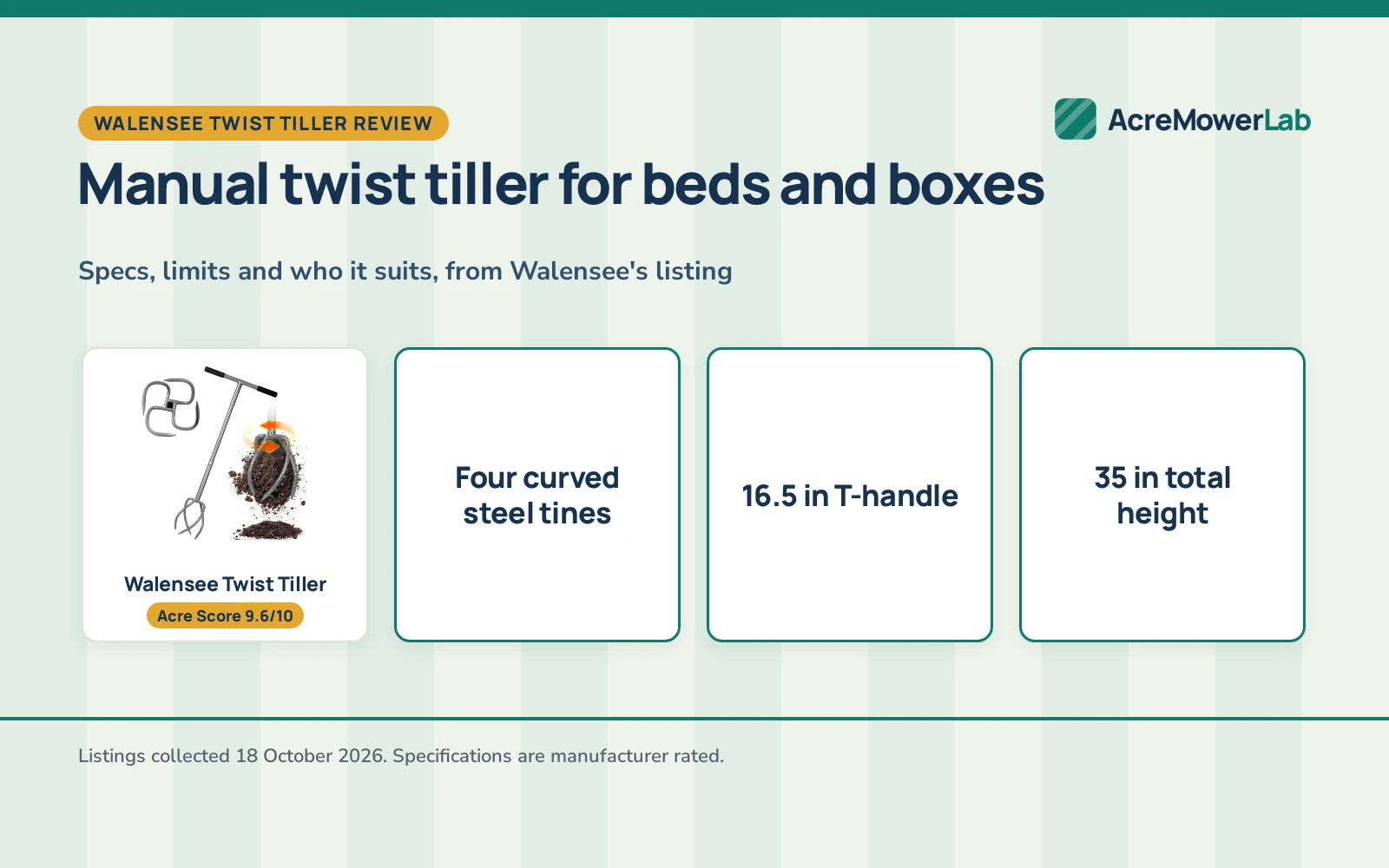
Below is our card for the Twist Tiller, with the Acre Score it earned. It scores on simple, stated construction and hand-powered value; the height contradiction and the missing warranty term hold it back.
What the tiller does well
Four curved tines that dig wide
The listing describes four sharp curved tines that penetrate the soil smoothly and turn and shift the dirt. The tine is wider and longer than a standard hand cultivator’s, so each twist digs deeper and wider, which the maker says saves working time and energy. For a bed you already keep loose, that is the whole job.
A handle built for body weight
The 16.5 in T-shaped handle has ergonomic rubber grips the listing says are easy to hold and reduce the effort of twisting. The instructions call for pressing the claws down and turning clockwise using the force of your body, not your hands, and the maker says the comfortable grip allows long weeding sessions without soreness.
No fuel, no battery, no cord
The power source is hand powered, so there is nothing to charge, fill or plug in. It also comes apart into three parts for storage, which the listing says saves space, and the steel is powder coated and described as weather and rust resistant for shed life.
Simple three-step use
The listing gives the method in three steps: hold the two handles with the tines touching the soil, press the claws down while turning clockwise, then pull up and shake off soil, grass and pebbles. It also says the tool promotes the free flow of water, air and fertilizer for a healthier yard and garden.
Limitations to know before you buy
Height contradicts itself
The bullets give the total height as 35 inches; the spec table gives 39.3 inches. Per our rule we trust the bullets and plan on 35 inches, but if you are tall or short, that gap matters for how the handle meets your hands.
Loose soil only
The listing is explicit: the tiller is suitable for loose soil, and it cannot loosen cement. If your ground is compacted clay or new unbroken earth, this is not the tool to break it.
Your effort is the engine
Hand powered means every twist comes from you. On a few beds that is fine; on a large garden it is a workout. Our tiller sizes guide covers when to step up to a powered machine.
No warranty term stated
The listing carries a satisfaction promise but states no warranty term in years, months or lifetime, so there is nothing concrete to judge. That is why warranty scores zero here.
Who should skip the Walensee Twist Tiller
- Anyone breaking new, hard or cement-like ground; the listing says it cannot loosen cement.
- Gardeners with large plots who need a powered tiller.
- Anyone who wants a stated warranty term on paper.
Alternatives
If your ground is bigger than beds and boxes, our best small tiller cultivator roundup compares five powered picks. The tiller types and uses guide sorts hand tools against front-tine and rear-tine machines, and how deep does a tiller dig covers depth by type.
Buried utility lines are a real risk: in the US, call 811 a few days before you dig or till new ground. Wear eye protection and sturdy boots, keep feet and hands away from the tines, and start on clear, rock-free soil. Refuel only with the engine off and cool. Read our Safety Disclaimer.
Matching It to Your Property
- Ground: best for loose soil in plant boxes, flower beds and narrow spaces; not for cement-hard or new unbroken ground.
- Scale: a hand tool for under an acre of beds; larger plots want a powered tiller.
- Storage: breaks into three parts and the steel is powder coated and described as weather and rust resistant; wipe clean and keep dry per the listing.
- Before you dig: check with the local utility locator for buried lines, even for shallow hand work near the house.
Getting the most out of the Walensee Twist Tiller
Technique matters more than strength with this tool. The listing gives a 3-step method: hold the two handles with the tines touching the soil, press the claws down while turning clockwise, then pull up and shake off soil, grass and pebbles. The 16.5 in T-shaped handle has rubber grips, and the maker says to use your body’s force rather than your hands, which is how you avoid soreness on longer sessions. Work it in loose, maintained soil: the listing says it suits loose soil and promotes the free flow of water, air and fertilizer, and it names plant boxes and flower beds as the intended ground. The four sharp curved tines are described as wider and longer than common garden tools, so each twist turns a wider patch, but the listing is explicit that it cannot loosen cement, so do not start it on compacted new ground. At 2.04 kg with a 35 in assembled height it is light enough to carry between beds, and it breaks into three parts for storage. After use, the care note says to wipe it clean and keep it dry; the powder-coated steel is described as weather and rust resistant, which is what keeps a shed-stored tool working season after season.
FAQ: mowing large lots
How tall is the Walensee Twist Tiller?
The listing contradicts itself: the bullets say 35 inches total height and the spec table says 39.3 inches. We trust the bullets and plan on 35 inches. The T-handle itself is 16.5 inches wide.
Can the Walensee Twist Tiller break hard ground?
No. The listing says it suits loose soil and explicitly states it cannot loosen cement. For compacted or new ground, a powered tiller is the better tool.
How do you use a twist tiller?
Per the listing: hold the two handles with the tines touching the soil, press the claws down and turn clockwise, then pull up and shake off soil, grass and pebbles. The maker says to use your body weight rather than your hands.
What is the warranty on the Walensee Twist Tiller?
The listing states a satisfaction promise but no warranty term in years, months or lifetime. Treat it as having no stated warranty term.
Is the Walensee Twist Tiller good for raised beds?
The listing names plant boxes and flower beds as the intended use, and says it fits narrow spaces. For loose, maintained bed soil, that is exactly its job.