Walk Behind Mower Sizes: Deck Width and Yard Guide
A complete guide to walk behind mower sizes, comparing deck widths, cutting heights, storage footprints and yard capacity.

On this page
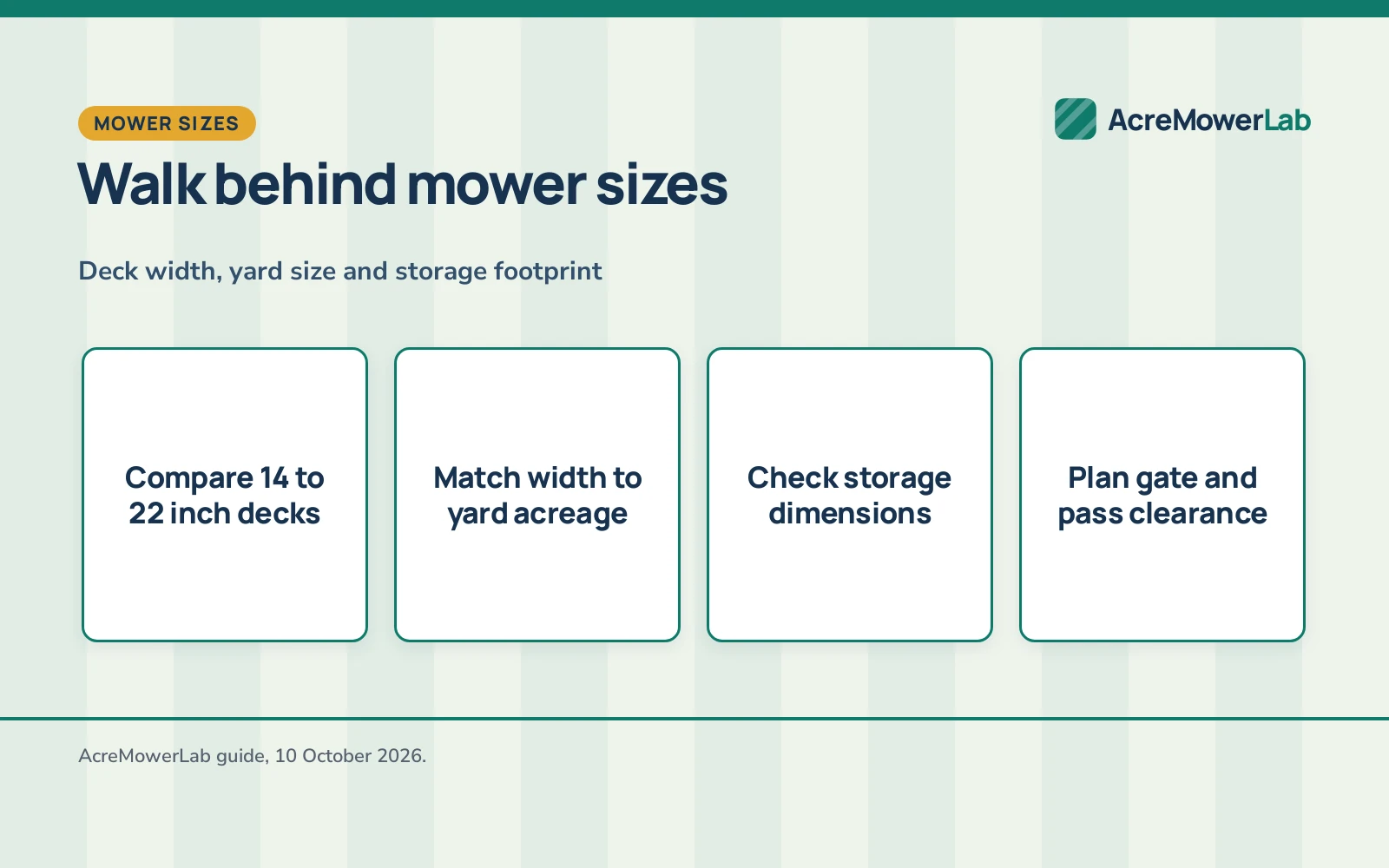
Walk behind mower sizes center on cutting deck widths ranging from 14 inches for compact battery push mowers up to 22 inches for heavy-duty gas and string trimming units, with standard residential models measuring 20 to 21 inches. A smaller 14-inch deck maneuvers easily through narrow garden gates and stores in tight shed corners, while a 21-inch or 22-inch deck cuts a wider swath to finish larger lawns in fewer passes. Choosing the right size depends on your yard acreage, gate clearance, terrain, and storage footprint. This guide breaks down walk behind mower sizes step by step so you can match the right deck and drive system to your property.
As an Amazon Associate I earn from qualifying purchases. AcreMowerLab earns a commission when you shop through links here. It never changes your price. Affiliate disclosure.
Walk behind mower sizes: pick the right deck width
| Deck Width | Best for | Key Specs |
|---|---|---|
| 14-inch deck | Small yards, narrow gates, tight storage | 27.56 lbs weight, 30L bag, 1 to 3 inches cut height |
| 21-inch deck | Suburban lawns, trimming up to 1.5 acres | 0.75-4 inches cut height, variable speed up to 4 mph |
| 22-inch deck | Larger lawns, overgrown weeds, rough ground | 1.25 to 4 inches cut height, 11-inch or 14-inch wheels |
Deck width determines how much grass the mower cuts on every pass. A 14-inch deck suits compact residential lawns where tight spaces make larger machines awkward. A 21-inch deck serves as the standard choice for most suburban yards, balancing cutting speed with maneuverability. For thicker turf or mixed weed growth, a 22-inch gas mower covers ground quickly. See our guide to the best 21 inch lawn mower models for popular mid-size options.
Step 2: measure your gates and storage space
Before picking a deck size, check the narrowest point along your mowing path. A mower deck width refers to the cutting path under the housing, not the total exterior width of the machine. Side discharge chutes, wheel hubs, and adjustment levers add width on both sides.
For example, the SENIX 22-inch mower has a total exterior width of 23.5 inches, requiring clearance beyond its 22-inch blade path. Listing spec tables can also show conflicting measurements: BILT HARD lists an exterior width of 18.6 inches for its 22-inch string trimmer, while PROYAMA lists a width of 57.5 inches for its 22-inch model, reflecting packaging or handle dimensions rather than the true cutting swath. Measure your garden gates, shed doors, and trailer ramps before purchasing. If your gate opening is narrow, a compact machine like the BILT HARD 14-inch cordless mower, which weighs only 27.56 lbs, passes through easily without scraping gate posts.
Step 3: match deck width to yard acreage
Matching mower size to yard acreage keeps mowing time manageable without buying more machine than your space requires. On a small city lot or townhome yard, a 14-inch deck provides plenty of capacity and maneuvers around flower borders without scuffing edges.
For properties ranging up to 1/2 acre, a 21-inch or 22-inch deck saves significant time. PowerSmart rates its 22-inch push string trimmer for a yard size of 1/2 acre, using a wide 22-inch swath to clear tall growth in fewer passes. On lawns approaching 1 acre or more, higher-capacity walk-behind mowers are necessary if you choose not to use a ride-on machine. Manufacturer coverage ratings vary by power platform: Greenworks rates its 21-inch 82V self-propelled mower for up to 1.5 acres per charge with an 8.0Ah battery, delivering up to 90 minutes of run time. Meanwhile, Honda rates its HRX-BE 21-inch battery mower for about 0.37 acre per charge from a single 12 AH battery, with dual battery bays available to double total coverage. To estimate your mowing schedule, read our guide on how long does it take to mow an acre.
Step 4: check cutting height and terrain handling
Mower size also affects how a machine manages uneven ground and varied grass types. Look closely at the stated cutting height range and the number of adjustment positions.
Compact mowers offer focused ranges for maintained turf. The BILT HARD 14-inch mower provides 5 positions from 1 to 3 inches, with settings at 1, 1.38, 1.89, 2.64, and 3 inches. Standard residential mowers expand this span to suit seasonal growth. The Honda 21-inch HRX-BE provides 7 cutting heights from 0.75 to 4 inches, allowing a low cut for spring cleanup and a tall 4-inch cut during dry summer heat. The SENIX 22-inch gas mower uses a single lever to select among 6 positions between 1.25 and 4 inches.
For rough property edges, ditch banks, and overgrown weeds, walk-behind string trimmers feature higher minimum cutting heights to avoid scalping uneven dirt. The BILT HARD 22-inch gas trimmer offers 8 height positions from 1.6 to 3.7 inches. PowerSmart equips its 22-inch trimmer with 2 positions from 1.90 to 3.90 inches, using thick nylon line to clear brush where rotary steel blades might strike rocks.
Step 5: pick push or self-propelled drive
The physical weight of the mower influences whether manual push or self-propelled drive is appropriate for your property.
- Lightweight push: The BILT HARD 14-inch cordless mower weighs 27.56 lbs, making manual pushing effortless on flat ground.
- Mid-weight string push: The PowerSmart 22-inch string trimmer weighs 57 lb (stated as 56 pounds in its spec table), using large 14-inch wheels to roll easily over rough sod.
- Self-propelled gas rotary: The SENIX 22-inch gas mower weighs 79 pounds, where rear-wheel self-propelled drive helps prevent user fatigue on slopes.
- Self-propelled battery rotary: The Honda 21-inch mower features electric drive adjustable from 0 to 4 mph, while the Greenworks 21-inch unit offers ground speeds up to 3.5 MPH.
If your lawn has slopes or thick turf, self-propelled drive saves considerable effort on machines weighing 56 to 79 pounds. For flat suburban lots, a lighter push machine remains simple to steer and maintain. See our comparison of the best gas lawn mower self propelled models for drive options.
Deck width versus total mower width
When planning storage or moving through gates, confusing blade diameter with overall machine width causes clearance problems. The cutting deck width represents the circle of the rotating blade or trimmer line. The outer housing, discharge deflector, and wheel stance extend further out.
On the SENIX 22-inch mower, the 22-inch steel deck sits within a housing measuring 23.5 inches across. Trimmer mowers present a similar difference. The PowerSmart 22-inch trimmer lists a 22-inch cutting swath and an overall width of 22 inches in its dimensions table, but its 14-inch wheels and side clearance require careful navigation near fence posts. Check the maker’s exterior width specifications rather than relying on deck size alone when measuring gates or shed doorways.
Storage dimensions and folding handles
Floor space in a garage or shed often dictates the maximum mower size you can keep comfortably. Review the full length, width, and height specifications before choosing a model.
Full-size walk-behind mowers occupy substantial floor area. The SENIX 22-inch gas mower measures 37 inches deep, 23.5 inches wide, and 15.8 inches high. String trimmers often extend longer because of their forward line head and angled handles. The BILT HARD 22-inch string trimmer measures 52.7 inches deep, 18.6 inches wide, and 42.1 inches high. PowerSmart lists dimensions of 38.9 inches deep, 22 inches wide, and 50 inches high for its 22-inch trimmer.
Foldable handlebars reduce this storage footprint substantially. Listings for BILT HARD, PowerSmart, and PROYAMA all highlight folding handle designs that collapse over the deck for compact parking along a wall or inside a vehicle trunk.
Engine displacement and battery capacity by deck size
As deck size expands, the power required to spin the blade or trimmer head increases. Matching power source to deck width prevents bogging down in dense grass.
Gas walk-behind equipment with 22-inch decks relies on larger displacement engines to maintain cutting momentum. SENIX pairs its 22-inch mower with a 201cc 4-cycle OHV engine to maintain blade speed in thick turf. PROYAMA uses a 170cc 5HP engine running at 3600 rpm with 6.64 foot-pounds of torque on its 22-inch string cutter. BILT HARD uses a 170cc 4-cycle engine on its 22-inch trimmer. PowerSmart lists a 170cc engine in its bullet points and 161cc in its spec table, showing a slight listing contradiction for its 22-inch model.
Battery-powered walk-behind mowers range from compact 40V systems to commercial-grade 82V platforms. The BILT HARD 14-inch mower uses a 40V system powered by two 20V 4.0Ah batteries, spinning a brushless motor up to 3300 RPM. In the 21-inch class, Honda uses a large 12 AH battery for up to 45 minutes of run time, while Greenworks utilizes an 82V platform with an 8.0Ah battery and a 2.5 kW brushless motor that compares to 160cc gas competitors.
Wheel size and slope stability
Mower maneuverability depends heavily on wheel diameter, particularly when moving across rough or sloping lawns.
Standard push mowers often use uniform small wheels, which work well on manicured, level sod. As mower size and weight grow, larger rear wheels roll more easily over rough ground. The SENIX 22-inch self-propelled mower includes 11-inch rear wheels paired with rear-wheel drive to maintain traction across uneven ground. Walk-behind string trimmers take this further to handle fields and ditches. BILT HARD equips its 22-inch trimmer with 10-inch flat-free wheels, while PowerSmart and PROYAMA use 14-inch wheels to roll smoothly through deep weeds and ruts. For dedicated push options, check our guide on push lawn mower sizes.
Safety
Always wear eye and hearing protection and sturdy work footwear when operating any walk-behind mower or string trimmer. Clear rocks, wire, branches, and other debris from the mowing path before engaging the blades, and keep children, pets, and bystanders away from the work area. Never pull a running mower backward toward your feet, and disengage the cutting drive before crossing gravel surfaces or walkways. For gas-powered equipment, refuel only outdoors with the engine turned off and completely cool. On sloping terrain, mow across the face rather than up and down to prevent slipping under the deck. See our Safety Disclaimer.
FAQ: mowing large lots
What is the most common walk behind mower size?
The standard residential size is a 21-inch cutting deck, with 20-inch and 22-inch models also widely used. A 21-inch deck balances trimming speed with easy steering through standard gates.
Can a 21-inch mower maintain 1 acre?
A 21-inch mower can maintain 1 acre, though it requires multiple passes and steady walking. Battery models such as 21-inch units with an 8.0Ah battery rate for up to 1.5 acres per charge, while gas models offer continuous run time as long as fuel is supplied.
How wide of a gate do I need for a 22-inch mower?
A 22-inch cutting deck requires a gate opening wider than the mower’s outer frame. For example, the SENIX 22-inch mower lists an exterior width of 23.5 inches once wheel hubs and housing are included. Always measure gate openings before selecting a mower size.
Is a 14-inch mower big enough for a small yard?
A 14-inch mower works well for compact urban lawns and enclosed townhome yards. At 27.56 lbs, it is lightweight, maneuvers easily around tight borders, and stores in small sheds where larger machines cannot fit.
Do larger walk behind mower decks require self-propelled drive?
While smaller 14-inch mowers push easily at 27.56 lbs, heavier 22-inch steel mowers can weigh 79 pounds. Adding self-propelled drive reduces operator fatigue, especially on uneven turf or gentle slopes.
More mowing guides
- Push Lawn Mower Sizes: Width and Deck Guide
- Best 21 Inch Lawn Mower: 5 Cordless and Gas Picks (2026)
- Best Gas Lawn Mower Self Propelled: 4 Picks Compared (2026)
- How Long Does It Take to Mow an Acre? Times by Mower Type
Use the Mower Matcher to narrow down choices by acreage, terrain, budget, and power type.