Zero Turn Transmission Types Explained
A guide to zero-turn mower drive systems: learn how integrated transaxles, commercial pump systems, fluids and drive belts power your machine.

On this page
Top picks at a glance
As an Amazon Associate I earn from qualifying purchases.
- 1
 Husqvarna MZ619.7/10View on Amazon
- 2
 EGO Power+ Z6 Zero Turn Electric Riding Lawn Mower9.6/10View on Amazon
- 3
 EGO Power+ Z6 Zero Turn Electric Riding Lawn Mower9.6/10View on Amazon
Zero turn transmission types explained: zero-turn mowers use independent drives at each rear wheel, including sealed or serviceable integrated hydrostatic transaxles for residential lawns, separate pumps and wheel motors for commercial use, and electric direct-drive motors on battery models. Controlled by steering levers, each drive wheel operates on an independent circuit. This guide breaks down how integrated transaxles, commercial separate systems, drive belts, and hydraulic filtration work across different property sizes.
AcreMowerLab earns a commission when you shop through links here. It never changes your price. Affiliate disclosure.
Zero turn transmission types explained: comparing drive systems
| Drive system | Configuration | Service requirement | Primary advantage |
|---|---|---|---|
| Sealed integrated transaxle | Combined pump and motor | Sealed; no routine changes | Lower initial cost |
| Serviceable integrated transaxle | Combined pump and motor with ports | Periodic fluid and filter changes | Longer operating life |
| Commercial separate pump and motor | Remote pumps and wheel motors | Routine fluid and filter service | Superior heat dissipation |
| Electric direct-drive | Brushless hub or gear motors | No fluid or belt service | Zero fluid maintenance |
Explore our zero-turn mowers hub for equipment overviews across all categories.
How independent hydraulic drives propel and steer zero-turn mowers
Zero-turn mowers achieve agility through independent wheel control rather than front-wheel steering. In standard lawn tractors, a single transmission powers a differential while front wheels steer. Zero-turn mowers power each rear drive wheel separately.
Dual steering levers connect to pump swashplates. Pushing both levers forward drives straight. Pushing the right lever farther forward increases flow to the right wheel, pivoting left. Moving levers oppositely spins wheels in reverse directions, pivoting the mower within its footprint. Learn more in our guide explaining what is a zero-turn mower and our guide on how to use a zero-turn mower.
Integrated hydrostatic transaxles for residential mowing
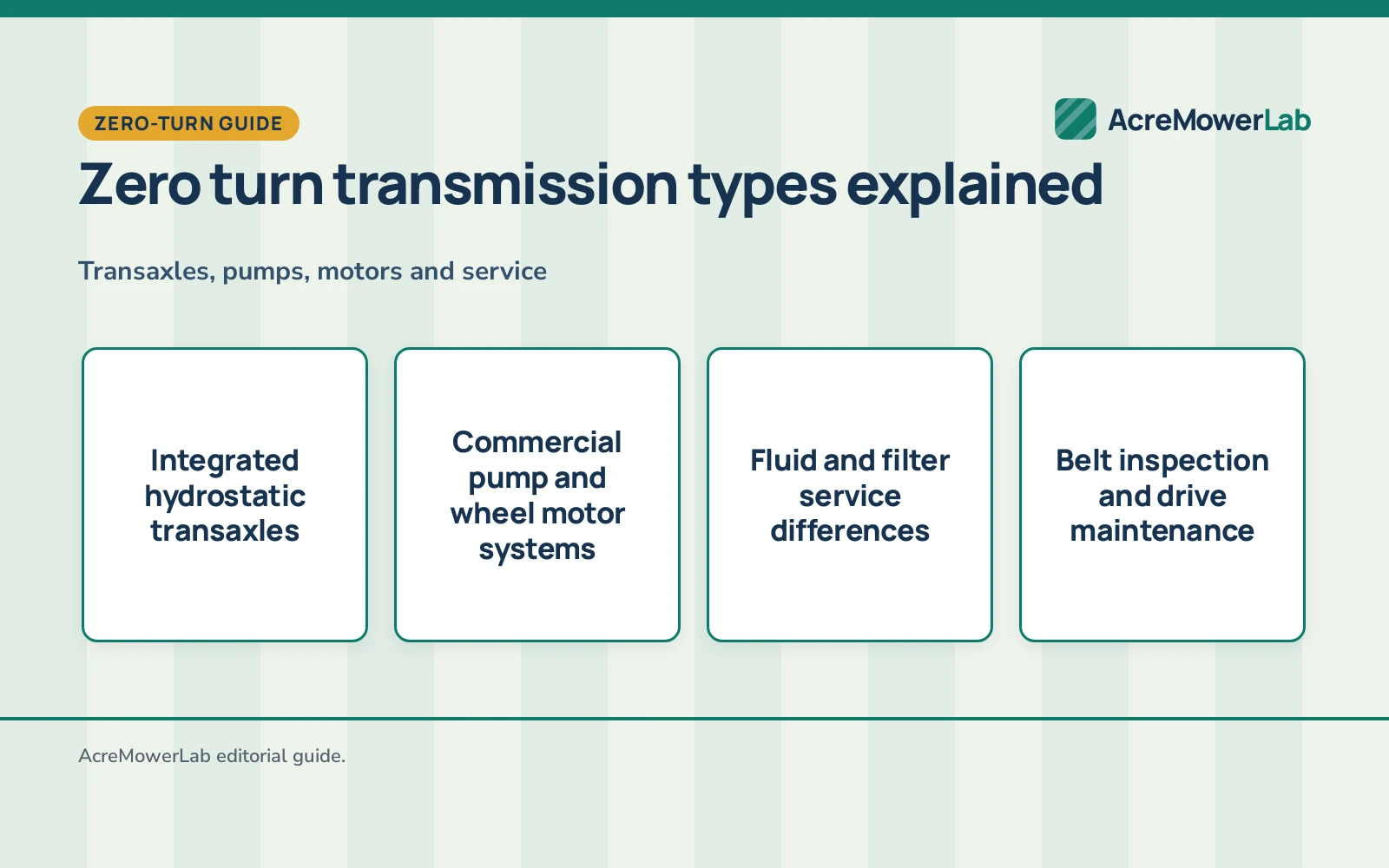
Residential zero-turn mowers predominantly feature integrated hydrostatic transaxles, combining a piston pump, hydraulic motor, reduction gears, and axle shaft inside a single aluminum casing.
Entry-level models use sealed transaxles without external drain plugs or spin-on filters. These require no routine fluid changes, but long-term internal wear eventually requires transaxle replacement. Prosumer mowers feature serviceable transaxles with external expansion tanks, drain plugs, and spin-on filters, allowing fluid changes that extend service life on larger properties. See our guide on how long zero-turn mowers last for longevity expectations.
Commercial separate pump and wheel motor drive systems
While many commercial mowers use heavy-duty integrated transaxles, heavy commercial machines often utilize separate hydraulic pumps and wheel motors. Frame-mounted variable-displacement pumps connect via high-pressure hoses to wheel motors bolted directly to wheel hubs.
This separation allows fluid to circulate through large reservoirs, oil coolers, and spin-on filters, preventing overheating during continuous mowing. Separate systems also allow modular repairs: an individual pump or wheel motor can be rebuilt or replaced without discarding the entire drive assembly. Review our recommendations for commercial zero-turn mowers to compare heavy-duty platforms.
Electric direct-drive systems on battery zero-turn mowers
Battery zero-turn equipment uses electric direct drive instead of hydraulic fluid. Independent brushless electric motors power each rear wheel hub directly or through reduction gearboxes.
Motor controllers read lever position sensors and modulate electric current continuously, providing instant torque without hydraulic delay. Electric drive eliminates hydraulic fluid, filters, hoses, and engine belts, preventing turf leaks and removing transmission maintenance entirely. Check our battery zero-turn mower review for details.
Transmission drive belts and tension pulley assemblies
On gas mowers, a heavy-duty transmission belt transfers power from the engine crankshaft to the hydraulic pumps, operating independently from the cutting deck blade belt.
Autoverve produces a replacement transmission drive belt matching original equipment reference 07200718 for selected Ariens IKON and Gravely ZTX models across 42, 48, 52, and 60-inch cutting deck options, with a specified 0.5-inch top width and 57-inch length. Belt fitment depends on the equipment model and transmission routing rather than deck width alone. Inspect drive belts for cracks, fraying, or glazed sidewalls. Slipping belts cause sluggish acceleration or weak climbing. Explore our directory of zero-turn mower parts for replacement guides.
Hydraulic fluid specifications and filtration requirements
Hydraulic fluid transmits power and lubricates pump pistons and swashplates. Certain systems specify multi-viscosity fluids such as SAE 20W-50. Stens provides SAE 20W-50 hydrostatic transmission fluid (part 770-738) in a 1 gallon container for outdoor power equipment transaxles, protecting components under high summer temperatures. Always follow your manual’s viscosity specifications.
Filtration removes microscopic particles from fluid. For selected Bobcat zero-turn models, Technology Parts supplies a transmission filter (part 2720396) engineered with a 10 micron filtration rating, 3/4-16 thread size, 18-22 PSI pressure relief valve, 3-1/2-inch height, and 3-inch outside diameter. For selected Bad Boy models, Brooks AG Parts provides a replacement hydraulic transmission filter (part 063-1070-00, corresponding to Hydro-Gear HG71943) made of paper and steel with an outside diameter of 2.62 inches. For selected zero-turn mowers, ZAICOLER provides a replacement hydro transmission filter (part 604126) with a heat-resistant metal canister.
Diagnosing transmission symptoms, power loss, and tracking drift
Tracking drift occurs when a mower pulls toward a specific side while levers are pushed forward equally. This usually stems from unequal rear tire pressure, changing the effective rolling diameter, or loose linkage bushings. Machines feature mechanical tracking adjustment bolts near lever stops to equalize forward travel.
Sluggish movement that worsens when warm indicates internal hydraulic leakage past worn pump pistons. For repair steps, see how to fix hydrostatic drive on a riding mower. To roll the mower with the engine off, open the manual bypass valves to relieve hydraulic lock.
Operating on slopes, managing traction, and hydraulic braking
Zero-turn mowers rely on dynamic hydrostatic braking rather than mechanical foot brakes. Returning steering levers to center halts fluid displacement, providing hydraulic resistance that slows the drive wheels.
Because front caster wheels pivot freely, rear drive wheels supply all steering and braking. Pulling levers back abruptly on steep slopes or wet turf can break traction, causing the mower to slide downhill. Once traction is lost, lever steering cannot stop the slide. Review our evaluation on whether are zero-turn mowers safe on hills and our guide on how to measure the slope of your yard before mowing slopes.
Safety
Never exceed the manufacturer’s maximum slope rating, as steep inclines compromise rear-wheel traction and steering. Zero-turn mowers can lose traction abruptly on slopes and near retention ponds, ditches, or embankments; maintain a wide safety buffer from drop-offs.
Deploy the rollover protective structure (ROPS) upright and fasten your seat belt where equipped. Never carry passengers, and keep children, pets, and bystanders clear of the yard. Disengage cutting blades before traveling in reverse, and look behind before backing up. Wear eye and hearing protection and sturdy footwear. Clear debris from the lawn before mowing. Turn off the engine and let it cool completely before refueling or checking hydraulic fluid.
FAQ: mowing large lots
What is the difference between an integrated transaxle and separate hydraulic pumps?
An integrated transaxle houses the pump, motor, and gearing in one casing per wheel for residential mowers. Separate systems mount remote pumps connected by hoses to wheel motors for commercial cooling and modular repairs.
Can you change the oil in a sealed zero-turn transaxle?
Sealed transaxles lack external drain plugs, so routine on-machine changes are not supported. Servicing requires removing the transaxle from the frame and inverting it to drain and refill through the vent port.
Why does my zero-turn mower lose drive power when it gets hot?
Hydraulic fluid thins as temperatures rise. If pump pistons or swashplates are worn, thin hot fluid bypasses pressurized chambers instead of turning wheel motors, causing sluggish drive.
How do bypass valves work on a zero-turn transmission?
Bypass valves open an internal passage between pump ports. Opening the bypass control rods relieves hydraulic resistance, allowing the machine to be rolled by hand without running the engine.
What causes a zero-turn mower to pull toward a specific side?
Tracking drift is typically caused by unequal rear tire pressure, worn linkage bushings, or misaligned lever stops. When one wheel turns slower, the mower pulls toward that side.
More mowing guides
- How to Fix Hydrostatic Drive on Riding Mower
- How Long Do Zero Turn Mowers Last?
- Are Zero Turn Mowers Safe on Hills?
- Zero Turn Mower Parts: Maintenance and Replacement Guide
Use the Mower Matcher to narrow down choices by acreage, terrain, budget, and power type.