What PSI Pressure Washer Do I Need?
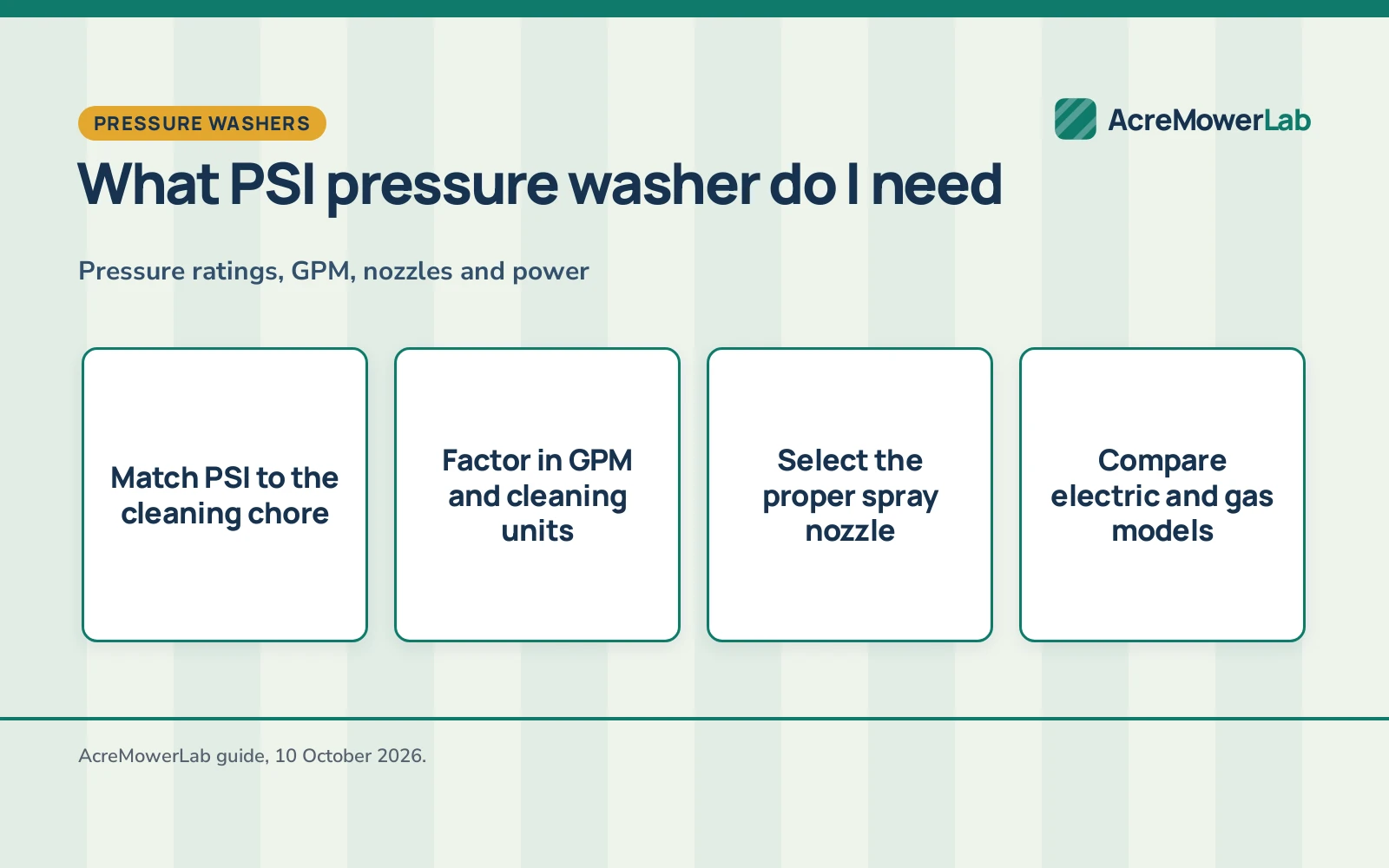
A guide to choosing the right pressure washer: matching PSI and GPM to cleaning tasks, selecting spray nozzles, and comparing electric and gas power.

On this page
Top picks at a glance
As an Amazon Associate I earn from qualifying purchases.
- 1
 PowerSmart Gas Pressure Washer9.6/10View on Amazon
- 2
 Simpson PowerShot 4400 PSI Gas Pressure Washer9.6/10View on Amazon
- 3
 Simpson Aluminum Series 4200 PSI Gas Pressure Washer9.6/10View on Amazon
- 4
 Greenworks 1700 PSIView on Amazon
- 5
 Sun Joe Pressure WasherView on Amazon
- 6
 Greenworks 1600 PSIView on Amazon
- 7
 CRAFTSMAN Electric Pressure WasherView on Amazon
- 8
 Greenworks 2000 PSIView on Amazon
- 9
 Greenworks 1500 PSI 1.2 GPM Pressure WasherView on Amazon
To determine what PSI pressure washer do I need, match your cleaning chores to the pressure rating: light residential cleaning on cars, patio furniture, and soft wood fencing requires 1700 to 2000 PSI, medium chores like composite decks, vinyl siding, and garage floors handle 2100 to 2800 PSI, and heavy concrete cleaning requires 3000 to 4200 PSI. Electric pressure washers cover most home chores, while gas models deliver the power and mobility needed for large property cleanup. This guide breaks down ratings, water flow, and nozzle choices step by step.
Other machines to compare
 Greenworks 1700 PSICheck price on Amazon
 Sun Joe Pressure WasherCheck price on Amazon
 Greenworks 1600 PSICheck price on Amazon
 CRAFTSMAN Electric Pressure WasherCheck price on Amazon
 Greenworks 2000 PSICheck price on Amazon
 Greenworks 1500 PSI 1.2 GPM Pressure WasherCheck price on Amazon
AcreMowerLab earns a commission when you shop through links here. It never changes your price. Affiliate disclosure.
What PSI pressure washer do I need: match pressure to your chores
| Pressure rating | Best for | Limit |
|---|---|---|
| 1700 to 2000 PSI | Cars, patio furniture, screens, soft wood fencing | Slow on large concrete slabs and deep oil stains |
| 2100 to 2800 PSI | Hardwood and composite decks, vinyl siding, garage floors | Takes more time on heavy mud and thick mold |
| 3000 PSI | Driveways, brick, concrete walkways, stubborn grime | Can mark wood or strip paint if nozzle is too close |
| 4200 PSI | Farm machinery, paint removal, commercial acreage jobs | Gas engine required; too intense for cars, wood, and siding |
Most property owners find that 2000 PSI to 3000 PSI handles typical outdoor maintenance without damaging surfaces. See our best pressure washer for beginners roundup for light residential options, or our best commercial grade pressure washer guide for heavy acreage chores.
Step 2: factor in GPM and cleaning units
Pounds per square inch (PSI) measures the stripping force of the water spray, while gallons per minute (GPM) measures water flow volume. PSI breaks the bond holding dirt and grime to a surface. GPM flushes loosened grime away. A machine with higher GPM cleans broader areas faster because water volume carries debris off the surface instead of requiring multiple passes.
Multiplying PSI by GPM is the standard formula for cleaning units, which describe overall cleaning speed. In listings, manufacturers sometimes report cleaning units based on continuous working output rather than peak discharge: Greenworks, for example, lists 3300 cleaning units for its 3000 PSI brushless model with 2.0 GPM max flow. A smaller unit, such as the Greenworks GPW1705, produces 1700 PSI at 1.2 GPM. On properties of 1 to 10 acres with long driveways or broad decks, higher GPM cuts working time significantly.
Step 3: select the right spray nozzle
Pressure washer wands use color-coded quick-connect spray tips with a 1/4 inch fitting. The nozzle angle shapes the water spray and alters impact force.
- 0° red nozzle: Concentrated pinpoint stream with maximum cutting force. Steupoek notes this nozzle is intended for hard-to-reach crevices in sidewalks and driveways. Never spray a 0° tip on wood siding, vehicles, or painted trim.
- 15° yellow nozzle: Narrow spray for stripping stubborn grime, mildew, and paint from concrete, brick, and unpainted masonry.
- 25° green nozzle: Medium fan that serves as the workhorse tip for outdoor chores. It works on wooden decks, fences, vinyl siding, and mower decks without chewing into materials.
- 40° white nozzle: Wide, gentle spray pattern. Use this setting on vehicles, windows, patio furniture, and screens where high impact could cause damage.
- 60° nozzle: Wide fan for vehicles, patios, and outdoor furniture. Steupoek supplies a 60° nozzle alongside a 3 liter dual soap tank for applying detergents.
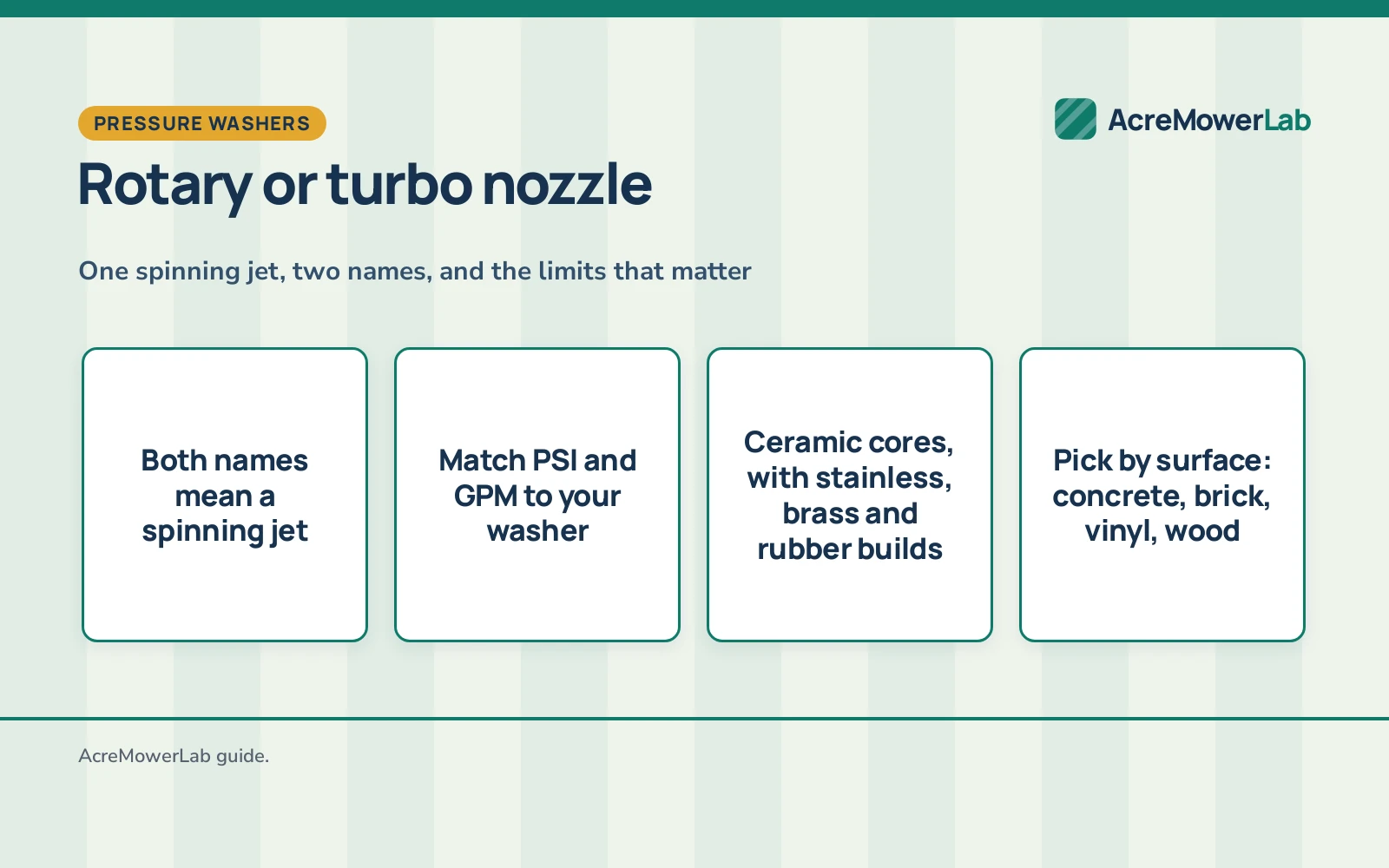
- Turbo nozzle: Combines the cutting force of a 0° jet with the coverage of a 25° fan by rotating the water stream in a circular cone. It strips concrete and stone paths quickly.
Step 4: choose between electric and gas power
Electric pressure washers run quietly, require no fuel storage, and start with a push button. Most residential electric pressure washers operate on 120V power and provide working ratings from 1700 PSI to 3000 PSI. For example, the Westinghouse WPX2300e delivers 2300 max PSI (1900 rated PSI) with 1.76 max GPM, while the Westinghouse ePX3100s provides 2100 max PSI (1800 rated PSI) at 1.76 max GPM. The BILT HARD electric washer delivers up to 2465 PSI at 1.76 max GPM, and A-iPower lists its E2800-FM at 2800 max PSI (2000 rated PSI) with 1.7 max GPM. Electric models excel for chores near the home, garage, and patio.
Gas pressure washers provide higher pressure, greater water volume, and cordless mobility across large acreage. The Steupoek commercial gas pressure washer is powered by a 212cc 4-stroke gasoline engine rated at 7 HP, delivering 4200 PSI at 4.0 GPM. Gas units require regular maintenance, including checking engine oil levels (such as inspecting 0.2 gallons of oil) and refueling. See our best gas pressure washer guide for farm and acreage cleanup.
Step 5: verify hose reach and water supply
Confirm that your garden hose and outdoor spigot provide sufficient water flow before starting a pressure washer. Running a pump without adequate water intake causes cavitation and damages internal seals.
- High-pressure hose: Electric washers commonly supply a 20 foot or 25 foot hose, as seen on the BILT HARD and Westinghouse models. Steupoek provides a 32 foot steel-braided hose on its gas unit.
- Power cord: Most electric washers provide a 35 foot power cord. A-iPower, Westinghouse, Greenworks, and BILT HARD each equip their electric washers with a 35 foot cord.
- GFCI protection: Electric models commonly feature an integrated GFCI plug on the power cord to cut power if electrical leakage occurs.
- Water supply line: Use a sturdy garden hose connected to an outdoor spigot that delivers more gallons per minute than the machine demands.
Pick the right pressure for common surfaces
Matching your machine to the material prevents gouging, paint peeling, and seal damage. Always begin washing from a safe distance and move closer only if dirt resists the spray.
Delicate surfaces require lower pressure and wider spray angles. Wash cars, trucks, and boats with 1700 to 2000 PSI using a 40° nozzle. Soft wood decks and cedar fencing also wash safely at 1700 to 2000 PSI used with a 25° green nozzle, as pressure above 2100 PSI can splinter soft wood grain. Hardwood decks, composite boards, and vinyl siding tolerate 2100 to 2800 PSI when sprayed with a 25° nozzle.
Hard surfaces tolerate higher stripping power. Concrete driveways, brick walkways, and stone patios clean thoroughly under 2800 to 3000 PSI. For commercial flatwork, stubborn oil deposits, or dried mud caked on farm implements, 4200 PSI from a gas washer removes residue that lower-rated machines leave behind.
Match the tool to the surface area
Cleaning large flat expanses with a standard spray wand is slow and frequently results in uneven lines known as zebra striping. A wand concentrates water on a small strip, requiring many back-and-forth passes on a wide driveway.
A rotary surface cleaner attachment solves this problem. It features a circular dome housing rotating spray nozzles that spin rapidly under water pressure. Surface cleaners glide smoothly across concrete, stone, and composite decking, cleaning a broad path in a single pass while preventing spray from splashing onto walls. Check our best pressure washer surface cleaner guide to match attachments with your machine’s PSI and GPM ratings.
Plan the property in zones
On large properties of 1 to 10 acres, organizing cleaning into distinct zones saves time and avoids dragging hoses back and forth across freshly washed areas.
Group chores by location and power requirements. Clean the house perimeter, patios, and outdoor furniture first using an electric pressure washer plugged into an exterior outlet. Wash from top to bottom: clean upper siding, window trim, and railings before washing the underlying deck or patio slab. Dirt washed down from above flushes away on your final ground pass.
Reserve outlying zones for gas equipment. Fences, concrete equipment pads, barns, and machinery situated far from electrical outlets are best cleaned with a gas-powered washer mounted on rolling wheels.
Mind the weather and the ground
Operating a pressure washer generates heavy water runoff that changes ground conditions quickly. Grass and soil around driveways become saturated and slick. Avoid pulling wheeled washers across steep, muddy banks where you could lose traction.
Wind direction affects spraying comfort and efficiency. Spraying against the wind blows fine mist and loose grime directly back onto the operator and onto surfaces you just rinsed. Work with the wind at your back whenever cleaning siding or high walls. During cold weather, store pressure washers indoors in freeze-protected areas, and drain all water from pumps, hoses, and spray guns to prevent frozen water from cracking pump housings.
Safety
Never point a pressure washer spray wand at people or animals. High-pressure water streams can cut skin, puncture tissue, and cause severe internal injuries. Always engage the spray trigger safety lock when pausing between cleaning tasks or setting the wand down.
Wear eye protection at all times to shield your eyes from dislodged gravel, concrete chips, and deflected spray. Wear hearing protection when operating loud gas-powered pressure washers, and wear sturdy boots with slip-resistant soles to maintain firm footing on wet surfaces.
Operate gas pressure washers strictly outdoors in well-ventilated spaces. Gas engines emit poisonous carbon monoxide exhaust that accumulates quickly in garages, sheds, or enclosed breezeways. Refuel gas engines only when the engine is turned off and cool to prevent fuel vapor from igniting. For electric pressure washers, verify that the power cord GFCI is functioning properly before plugging into a grounded electrical outlet. Clear loose stones, sticks, and debris from the work area before starting, and keep children and pets away from the cleaning zone.
FAQ: mowing large lots
What PSI pressure washer do I need for a concrete driveway?
Concrete driveways need 2800 to 3000 PSI to lift embedded tire marks, oil grime, and mildew. Gas models delivering 4200 PSI clean dense concrete even faster when paired with a rotary surface cleaner.
Can a 2000 PSI pressure washer clean concrete?
A 2000 PSI pressure washer can clean concrete walkways, but cleaning takes longer because lower pressure breaks stains slowly. Applying detergent before rinsing helps lift surface grime.
Will a 3000 PSI pressure washer damage car paint?
Yes, 3000 PSI can peel clear coat and damage rubber seals if used close to the vehicle. Cars are best washed using 1700 to 2000 PSI with a wide 40° spray nozzle.
What is more important, PSI or GPM?
Both ratings determine cleaning performance. PSI provides the stripping force to loosen grime, while GPM provides the water volume to flush debris away. Multiplying PSI by GPM gives total cleaning units.
Can I run an electric pressure washer on an extension cord?
Most makers advise against standard extension cords because voltage drop can overheat the motor. Use the 35 foot power cord supplied with the unit and connect a longer garden hose to the spigot instead.
More mowing guides
- What Size Pressure Washer Do I Need?
- Best 3000 PSI Pressure Washer: 5 Electric and Gas Picks (2026)
- Best Gas Pressure Washer: 3 Picks for Farm and Acreage Cleanup
- Best Pressure Washer Surface Cleaner (2026): 5 Picks Compared
Explore our complete library of pressure washer reviews and guides to compare ratings, accessories, and maintenance recommendations for your acreage.